Kafka's beetle, and why it still stings today
Text and illustrations produced by the pipeline
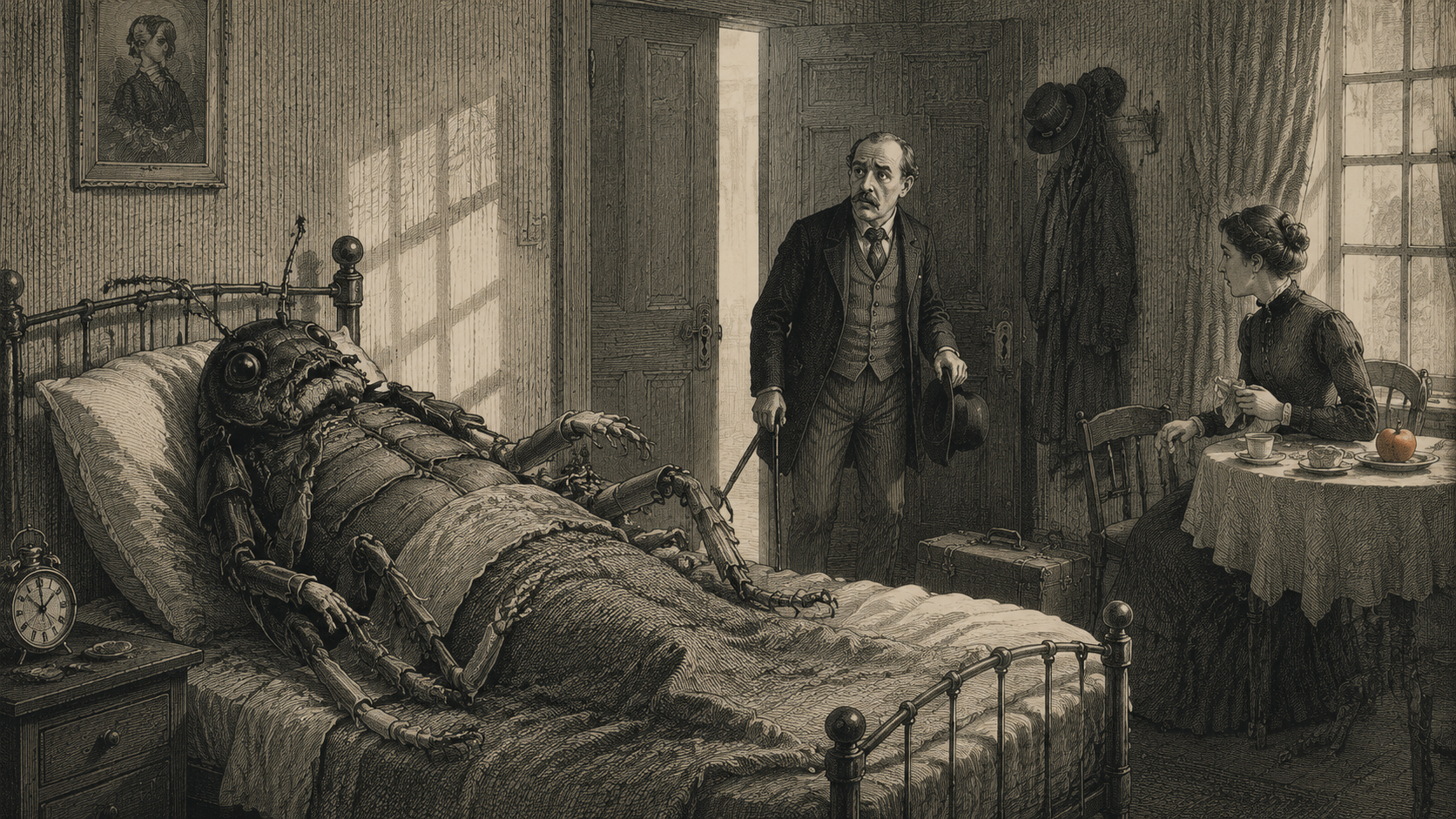
Gregor wakes one morning already transformed. He has become an enormous vermin, some blurred, indescribable shape that makes you want to recoil on instinct. But he can't even turn over, and the first thing on his mind is the train timetable by his bed, his boss's impatient face, and the fact that if he doesn't get out the door soon, he won't get paid this month.
That's exactly what makes the book so uncomfortable: an absolute nightmare, handled by the person living it in the most familiar tone of an office worker. By the third page you'll suddenly realize you've started calculating along with Gregor whether this new body can even squeeze onto the streetcar, without ever asking the one question you'd expect to ask first: why is this happening?
The Metamorphosis is a novella Franz Kafka wrote in the early twentieth century, formally published in 1915. Its place in literary history is a strange one: shorter than a quarter or fifth of an ordinary novel, and yet it single-handedly gave the language an adjective, Kafkaesque, used specifically for situations where the rules go unexplained, the absurdity goes unexplained, and you still have no choice but to keep living through it. It stands as one of the sources behind existentialism, the theater of the absurd, and countless later works about a person who simply doesn't fit the world.
Nearly the entire story is locked inside the cramped apartment of the Samsa family. The text never names the Central European city where it takes place, and the only hint of the world outside is a faint, uneasy tension in the background, the air of the years just before the First World War. One small space, one family, a few months of time, that is all the material Kafka needs to lay bare the thing modern people fear most.
Then there's the door that refuses to explain. From start to finish, the book never says why Gregor became what he became, no curse, no magic, no scientist, no device that lets you slap your knee and say, ah, so that's it. That refusal to explain is itself the answer, for Kafka, the absurd is absurd precisely because it never hands you a decent reason.
Kafka isn't writing about how a man turns into a bug. He's writing about how a family slowly decides that he already is one.
The Metamorphosis was written more than a century ago, but the fear it's really about, the fear of being reduced to your usefulness, is one that almost no one finds foreign, whether they're an office worker, the family member of a patient, or a middle-aged person who's lost their job. That's why reading it still hurts today, you're not frightened by an absurd story, you're quietly caught out by a description that stays far too calm.
The explainer has given you the plot. But there are two things it can never give you. The first is the texture of the prose itself, the sense of being slowly skinned by the author in the calmest possible voice, Gregor, taking the apple's wound, still thinking about how much money he owes his family this month, and that coldness only really cuts into you once you read it, page by page, yourself. The second is the physical sense of it: the effort of Gregor climbing the wall, the clumsiness of forcing the door open, the tremor at the moment he hears the violin, these are things you can only feel by breathing along with his movements. Reading it after already knowing the ending actually hurts more, because you can finally watch, with full attention, exactly how a man who is already doomed manages, bit by bit, to live himself into being vermin.
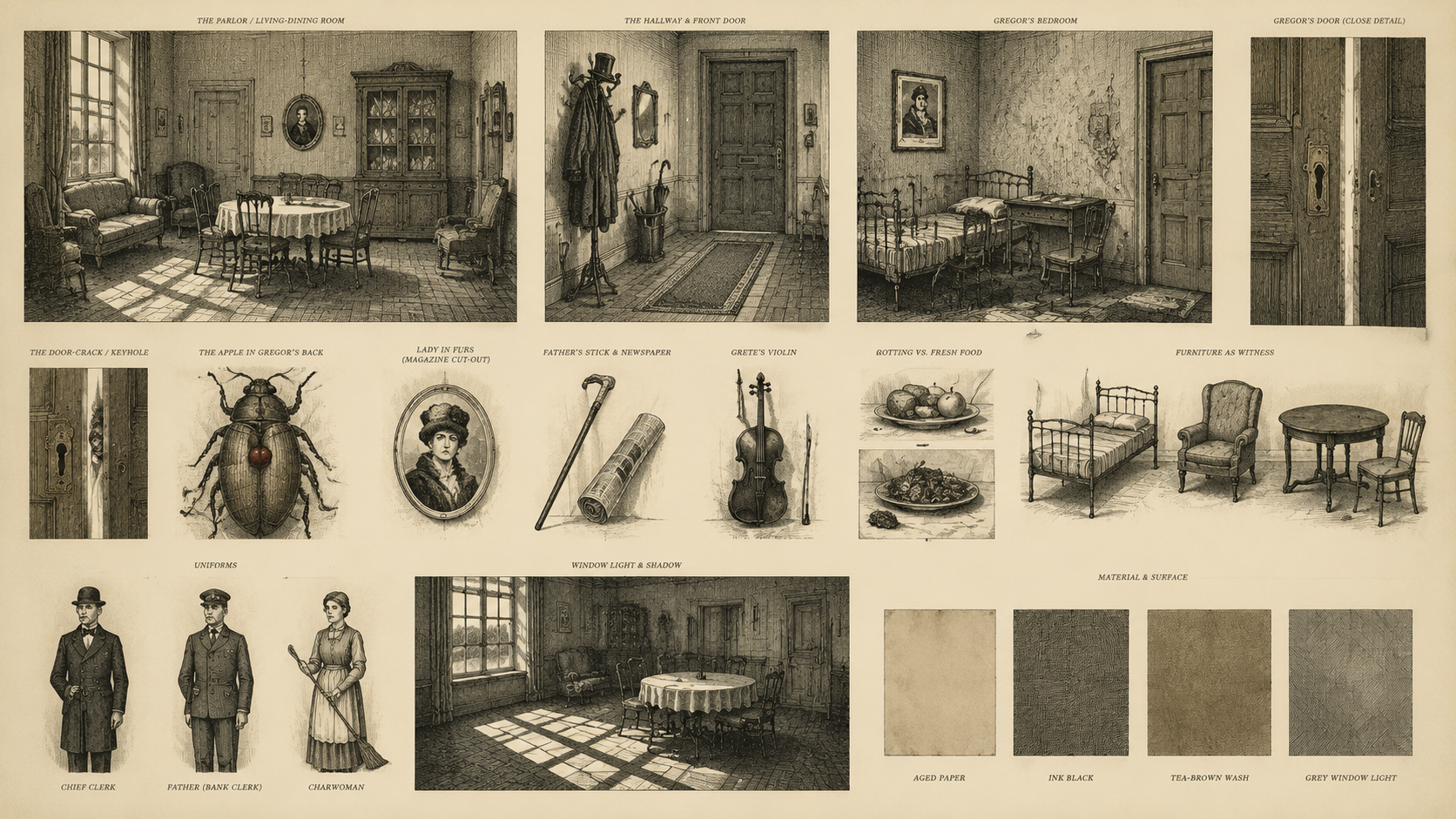
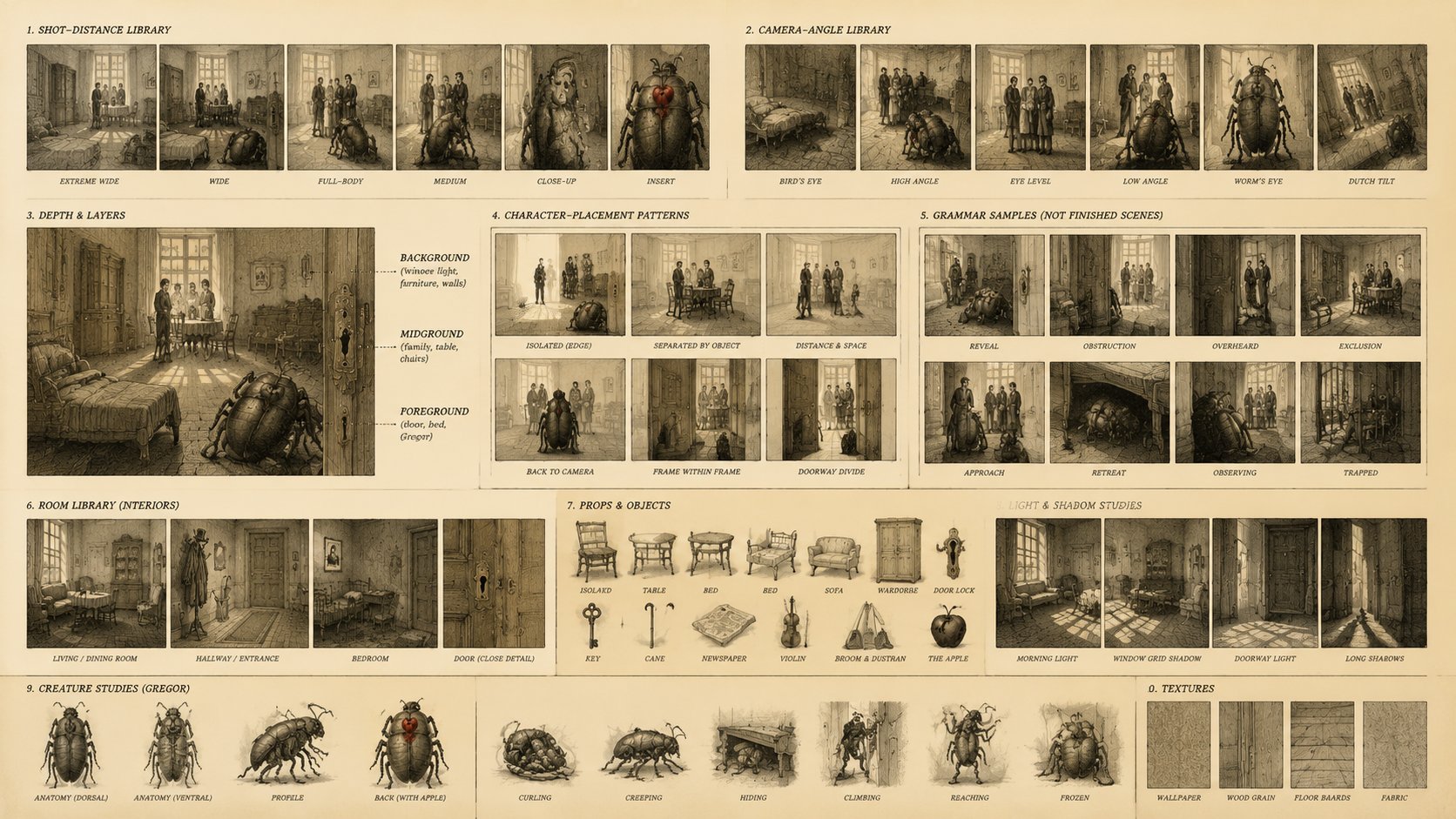
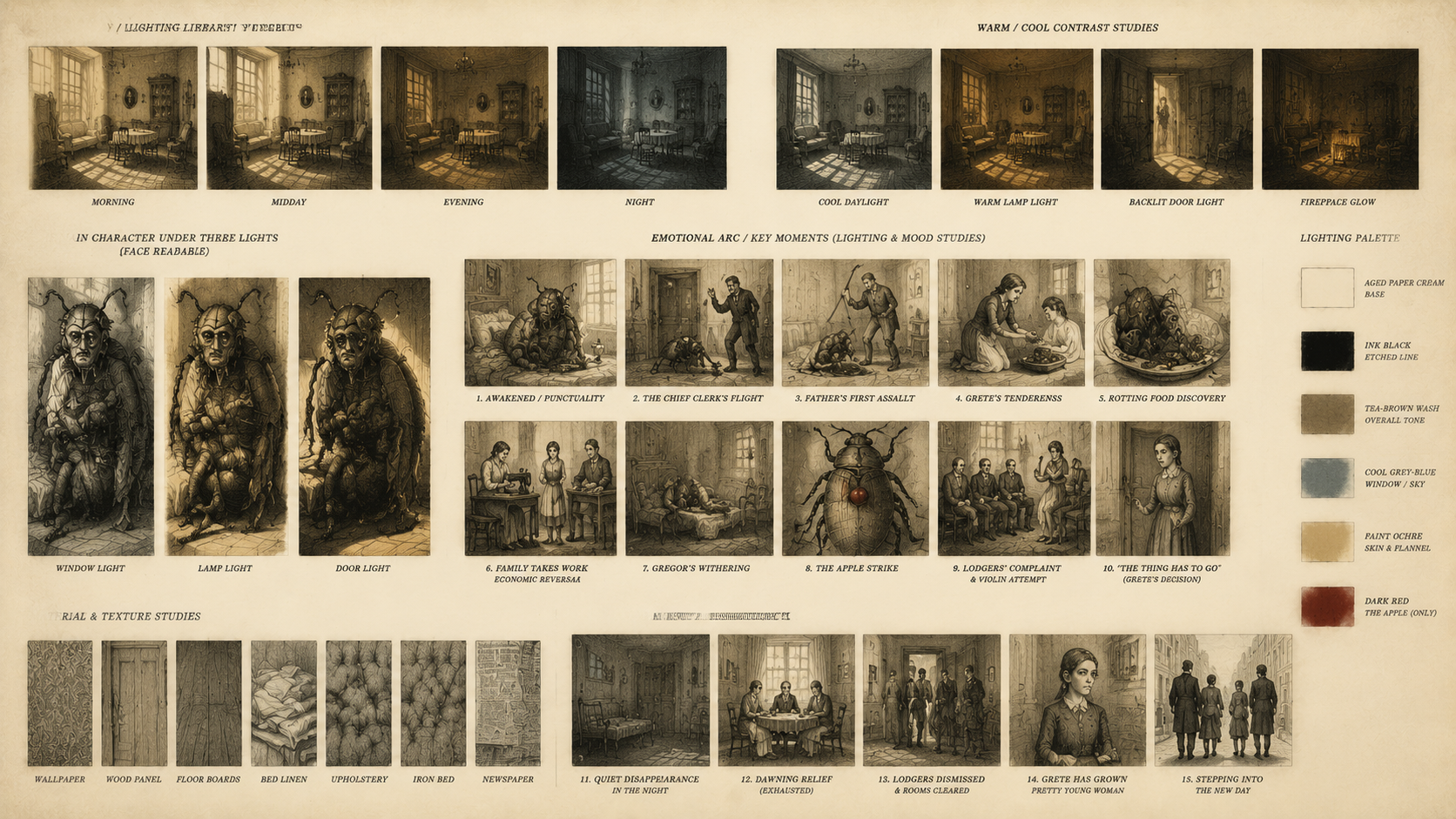
Before the guide was written, this book got a visual foundation — every illustration you just read grew out of it.
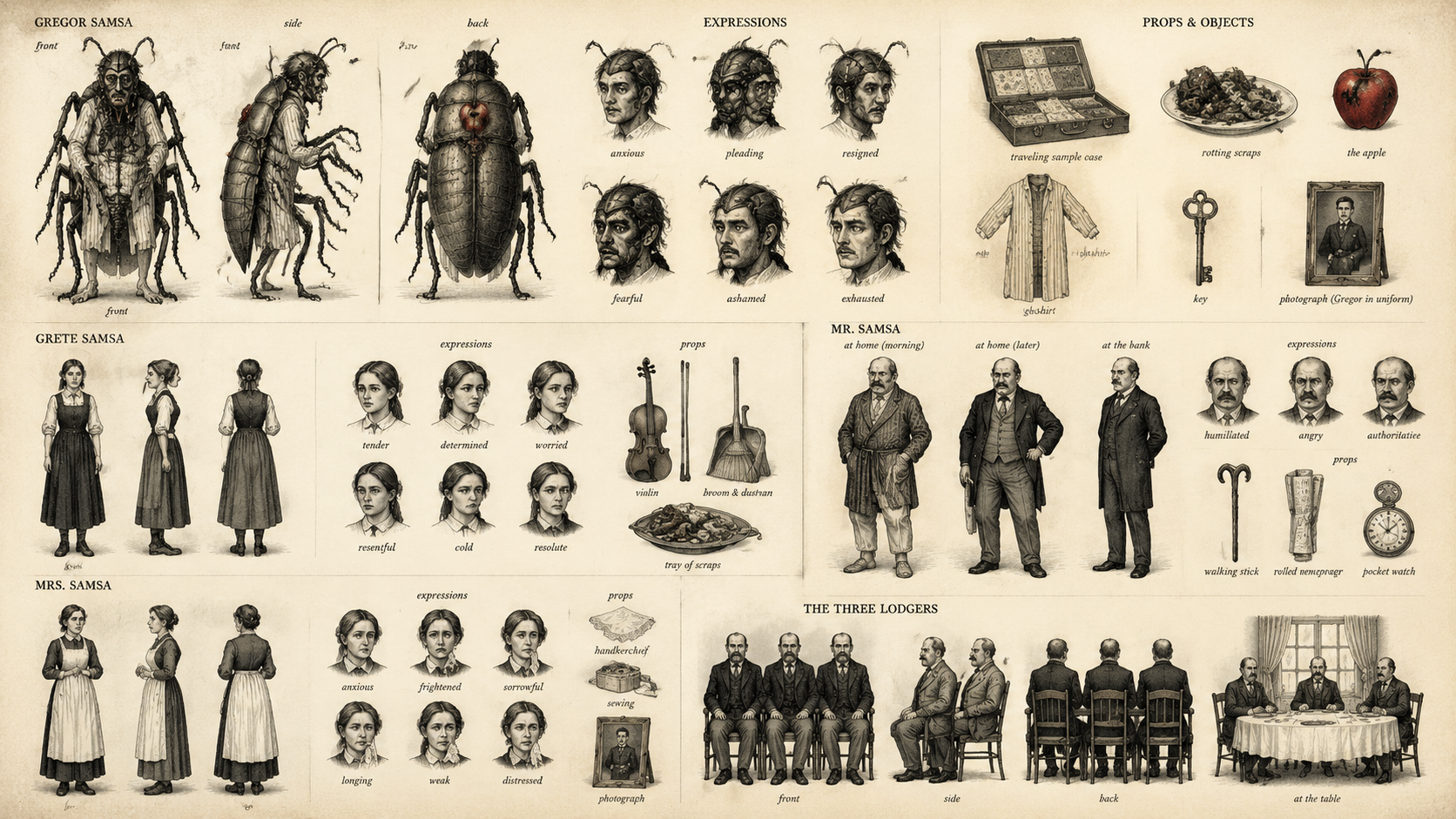
Gregor Samsa is a traveling salesman who makes his living on the road, and the only steady income the family has. Above him is a father broken by an old business failure he never recovered from; below him is a younger sister, Grete, still growing up, while the mother has been pushed to the margins of the household as nothing more than a housewife. Once Gregor transforms, the father pulls himself together and goes back to work, and the mother and sister each take on jobs of their own, the household that used to run on Gregor's salary alone now pulls with five fingers instead of one, and in doing so, it squeezes him entirely out of the family's economy.
Later, to bring in one more income, the family rents out rooms to three lodgers. In the novella they barely register as individuals; their only role is being "the three of them," outsiders whose presence is what finally lets Gregor's secret be discovered by someone outside the family, and it is their reaction that forces Grete's coldest line in the whole book out of her.
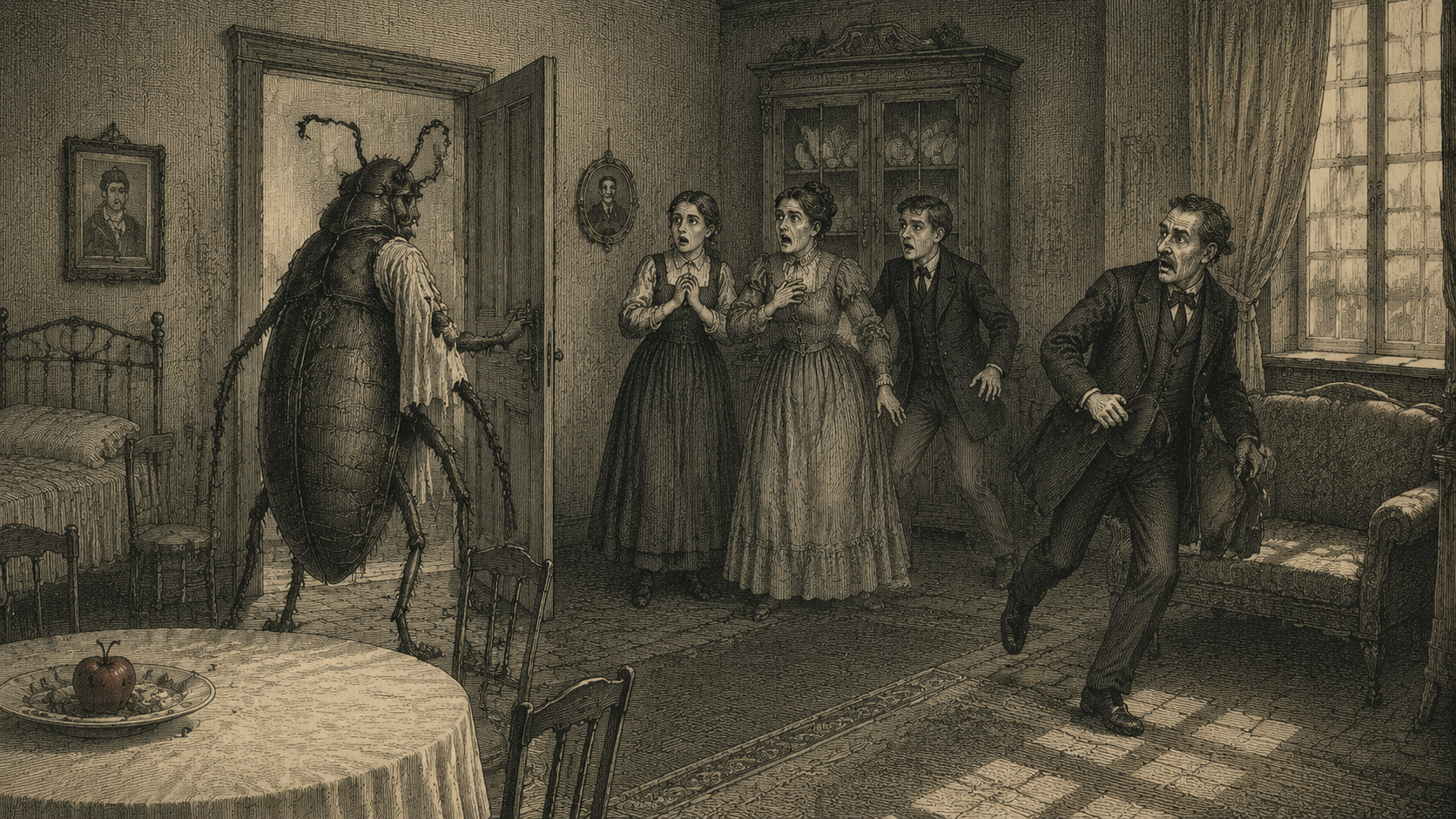
The story begins with Gregor struggling to open his door. He wants to catch his train, and the chief clerk sent by his firm is already outside, pressing him to hurry. His new body simply won't obey him: he works the key with his mouth and forces the door open an inch at a time with his body, and then the man outside sees a huge insect-like creature making strange noises. The chief clerk bolts on the spot, and that is the last time Gregor appears, in any social sense, as a human being.
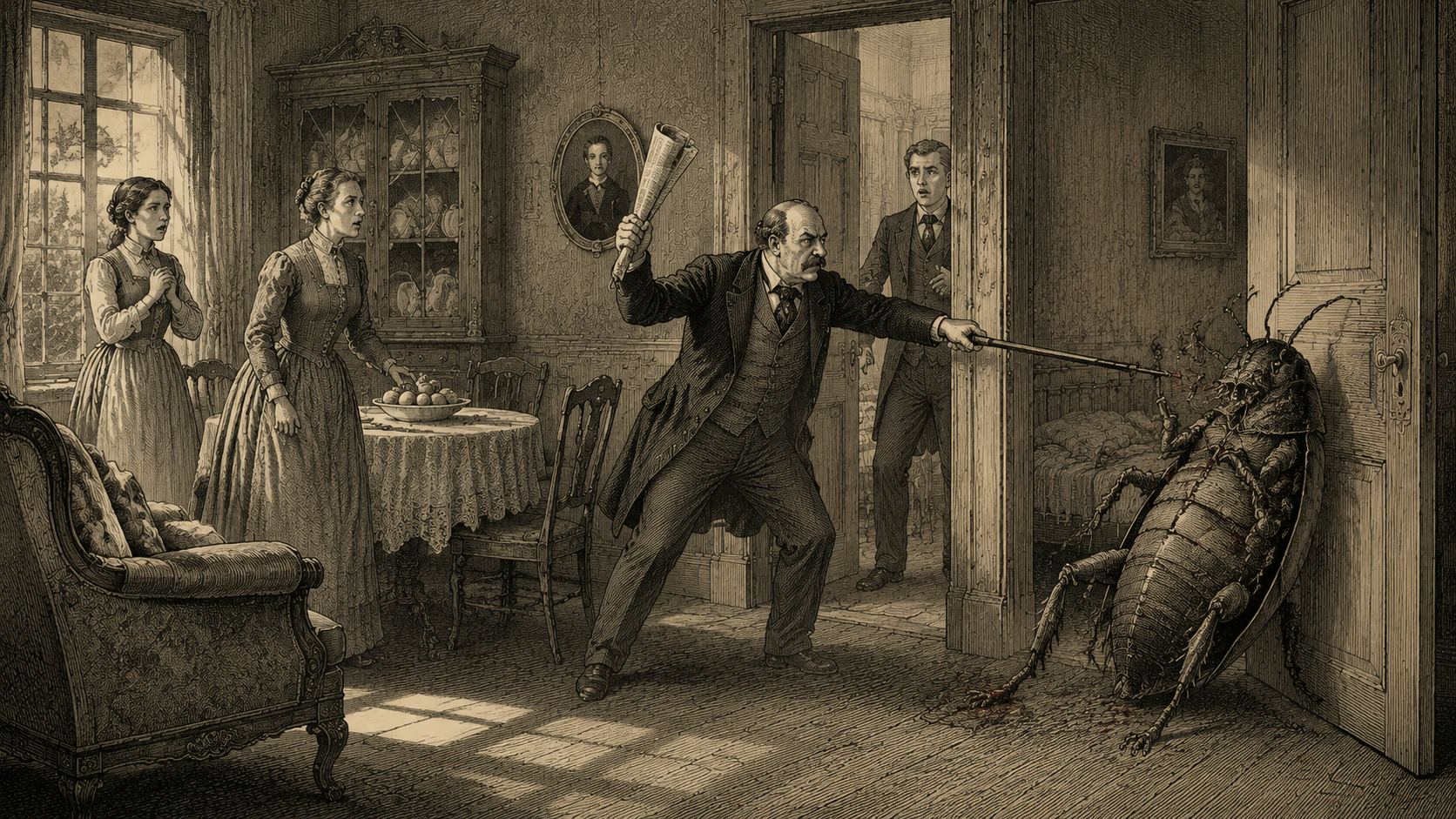
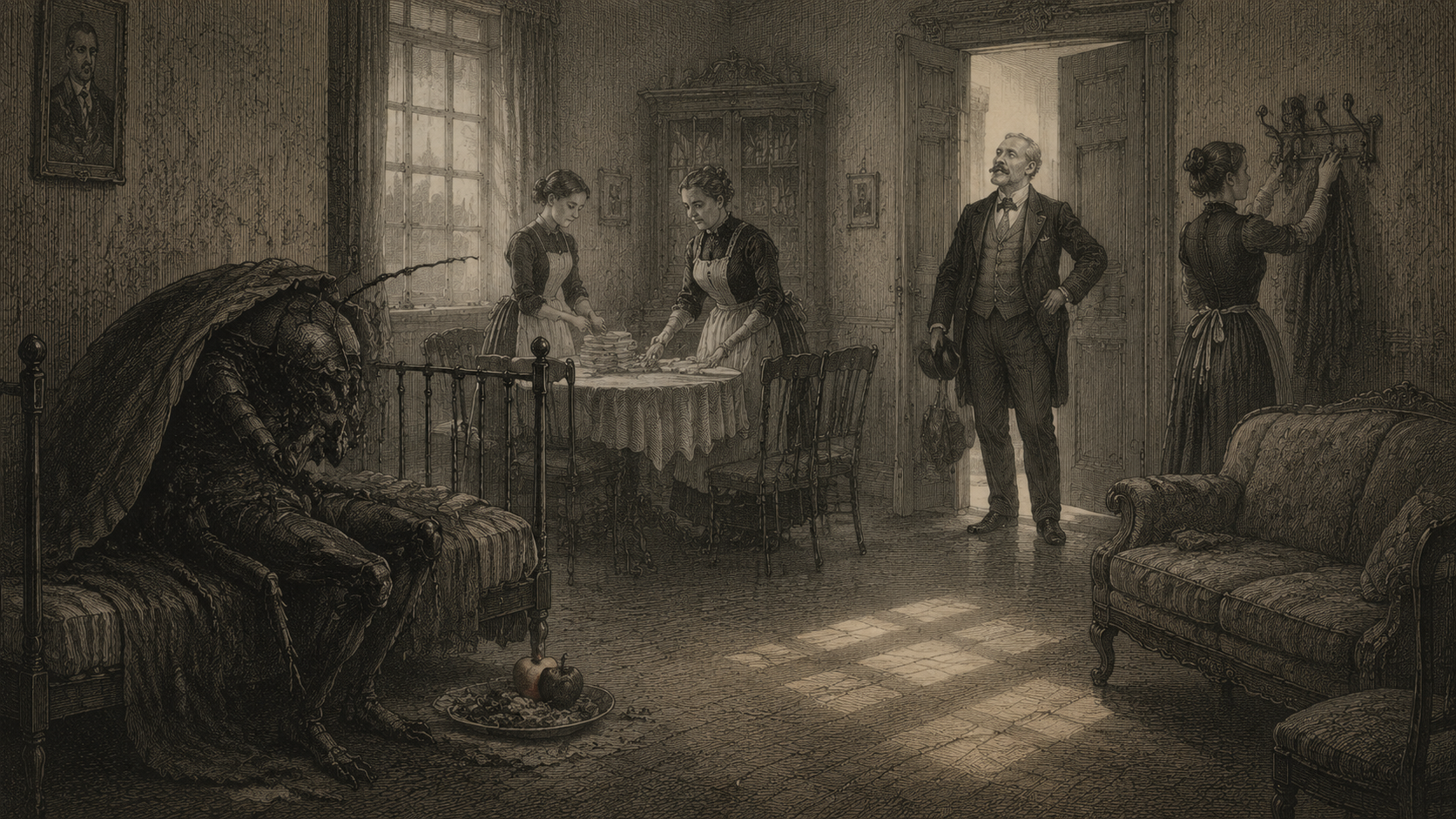
Next comes the first time Gregor's own body turns against him. The father rushes back and sees not his son but a strange thing wedged in the doorframe. He grabs his cane, rolls up a newspaper, and in the manner of someone disciplining a disobedient animal, drives Gregor step by step back into his room. The door is locked from outside, and from then on Gregor loses the run of the whole apartment, all that's left to him is his own bedroom, with its one window.
The first stroke of genius in how this is written shows up right here. The injury Gregor takes as he's driven back into his room isn't fatal, but Kafka sets it down in a tone that's almost like bookkeeping, placing the injury and missing today's pay side by side on the same day. As you keep reading you realize the author never meant for you to pity this bug, he has you, right alongside Gregor, treating the humiliation as just one more piece of business to get through quickly. That coldness is exactly what later came to be called Kafkaesque.
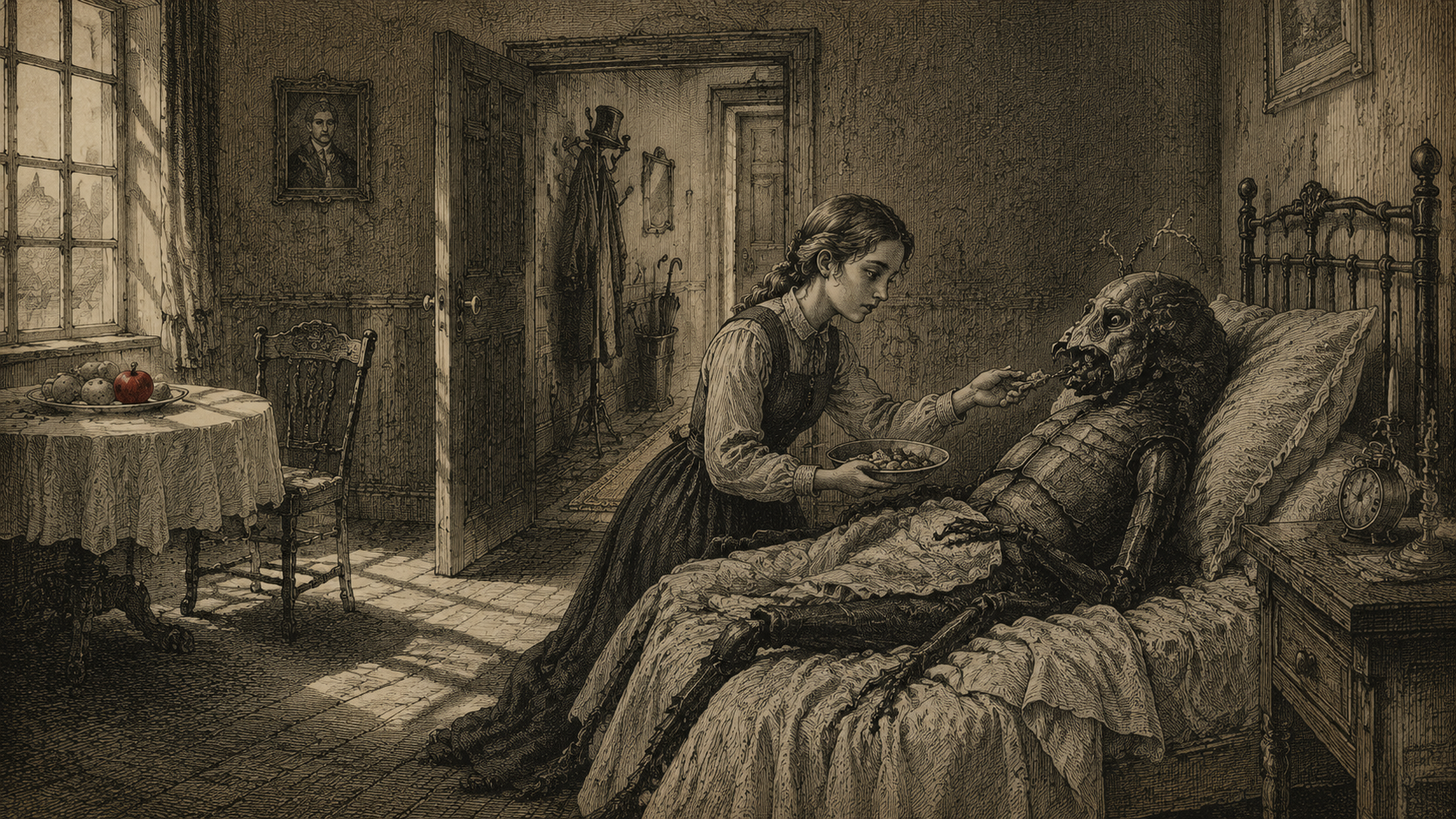
Through the days he's locked away, the only person willing to enter Gregor's room is his sister, Grete. At first she brings him food every day, cleans his room, and works out that Gregor now prefers rotten food to fresh, this passage is one of the rare, almost tender stretches in the whole book. A reader could almost believe that blood ties can hold against anything.
But right around this time, the household's economic structure quietly flips. The father puts on a respectable uniform and goes back out to work, the mother and sister each pick up piecework and sewing jobs. Gregor goes from being the family's pillar to the one who has to be supported by everyone else, and he can't even tell them that he's still conscious in there, that he can still understand every word. The tone the family uses when they speak of him slides, almost without anyone noticing, from how are you feeling to a mutter about a problem that needs handling.
What finally turns that slide into an open wound is the father hurling an apple. One apple lodges in the shell of Gregor's back and stays there, slowly rotting, inflaming, festering. From that point on Gregor moves more and more slowly, and the strength that once let him climb the walls and ceiling drains out of him bit by bit. That apple is the single most concrete symbol in the whole book, it isn't a blow that lands and passes, it's a thing that goes in and is left to rot there.
The decisive night arrives. In the sitting room, the sister plays her violin for the three lodgers, and Gregor, drawn by the music, drags his injured body out of his room an inch at a time, perhaps he only wants to hear, once more, a sound that once belonged to him, a sound with some warmth of ordinary life still in it. The three lodgers catch sight of him and slam their hands on the table on the spot: they will move out immediately unless compensated. A crisis that had only ever been about whether Gregor stays or goes suddenly becomes, because of these outsiders, a financial crisis for the whole family.
It's on this same night that Grete says, for the first time, to her parents the thing she would once never have let herself say: they have to get rid of this creature, and they must stop calling it their brother. The cruelty of that sentence isn't in get rid of, it's in stop calling him our brother. The blood tie is declared, out loud, null and void. Grete, the tenderness of the whole book, turns into the hand that pushes the ending forward.
On the night that follows, Gregor lies alone in his room. He no longer eats the rotting food, not because he doesn't want to, but because the apple wound has left his body less and less his to command. He hears his family retreat to their rooms one by one, hears the whole apartment settle slowly into silence. He thinks of how much he loves them, and then he thinks that he must disappear. In the end he dies quietly in the dark, and Kafka lets no one hear it happen.
The next morning, the charwoman finds Gregor's body already cold and stiff, and sweeps it out of the way as casually as she would an old piece of furniture that's become a nuisance. In that one passage, the novella knocks down every expectation of tragedy the reader might still be carrying: he isn't mourned. He's disposed of.
The ending is the most ironic passage in the whole book. The three remaining Samsas, relieved, decide to take the day off and go out to the countryside. They ride the streetcar through a sunlit country road, and the father and mother look at Grete, who has grown into a full young woman, and start calculating that it's time to find her a good match. It's the first time in months the family has thought about the future together, and in that future, there is no Gregor.
On the surface, The Metamorphosis is about the strange event of a man turning into a bug. Underneath, it's about something far more ordinary: how fast a person, once he loses the label useful, gets treated as a nuisance in the eyes of others, including the eyes of his own family. Gregor's insect shell is only a metaphor; what actually turns him into vermin is the change in how his family treats him. Kafka's genius is in making that metaphor impossible to argue with, Gregor really is a bug, so no one can say otherwise.
Another theme is the split between the body and the self. Gregor's mind stays lucid from beginning to end, he misses home, aches for his parents, is moved by his sister's violin, but his shell can no longer carry any of that feeling out into the world. I and my body become two beings locked in separate rooms. That's why so many readers see themselves in Gregor: trapped by a job, a family role, an identity, unable to make anyone hear him even when he shouts, this is me.