The Odyssey · Companion Guide
The Odyssey
Ten years after Troy falls, the cleverest of the Greeks is still held by the sea on his way home — he turns down a goddess's offer of immortality, just to return to that island, the dog that still knows him, the bed that hides a secret.
A Man Trapped in Paradise
A lonely island. An immortal beauty. Stay, she tells you, and you'll never age, never die. Would you be tempted? Odysseus was tempted. He hesitated. In the end he said no. He spent seven full years on that island — longer than any other stretch of his ten years adrift — and what he actually wanted was never immortality. It was to go home. The Odyssey is that one sentence: going home.
What Kind of Book Is This
The Odyssey is one of the two great epics of ancient Greece, paired with the Iliad as the twin source of Western literature. Tradition credits it to a blind bard named Homer — whether such a man ever existed is the so-called Homeric Question, still unresolved. The poem took shape around the eighth century BC, crystallizing out of oral performance into text, composed in ancient Greek. Its place in Western culture is simple to state: if you want to talk about the long road home, the prodigal's return, a husband testing his wife in disguise, or a story told out of order, you cannot get around this three-thousand-year-old poem. It is not a war epic — that's the Iliad's job. It is a homecoming epic, and it invented an entire toolkit of narrative technique we still use today.
People and World: Who Wants to Go Home, Who Won't Let Him
The hero is Odysseus, king of Ithaca, nicknamed the man of many wiles — it was his wooden horse that cracked open Troy, and no one in the Greek army had a sharper mind. But the war is over, and he cannot get home. His household rests on three people: his wife Penelope, clever enough to stall a forced remarriage for three years with a scheme of her own; his son Telemachus, about twenty now, a boy who has never known his father as a grown man; and his old father, Laertes. Above them, things are more complicated. The goddess Athena watches over Odysseus, but the sea god Poseidon hates him to the bone — because on one of his adventures Odysseus blinded Poseidon's son, the Cyclops. Poseidon's fury is the whole reason for his ten years adrift. The world of the story is the Bronze Age world of Greek myth, where gods and mortals live side by side and magic and miracle are just the weather.
The Opening: Two Young Men, One Decade
The poem's most counterintuitive move: it doesn't start at the beginning. Ten years after the fall of Troy, Odysseus is still stranded on the island of the sea nymph Calypso. Back home, his house has been overrun by more than a hundred young noblemen — the suitors — who are eating through his estate, pressuring his wife to remarry, and plotting to kill his son. This is where Athena steps in. She goes to stir up Telemachus, now about twenty, and sends him sailing to Pylos and Sparta to hunt for news of his father. This is the search-for-the-father thread that runs through the poem's first four books, and it's also a coming-of-age story: a boy nobody takes seriously becomes a man who can stand up straight.
Craft note: Homer runs two lines in parallel — one follows the young man searching for his father across the Greek world, the other follows the father held back by the gods far away — and the two don't converge until several books in. He had, in effect, invented the modern novel's A-plot/B-plot structure three thousand years early.
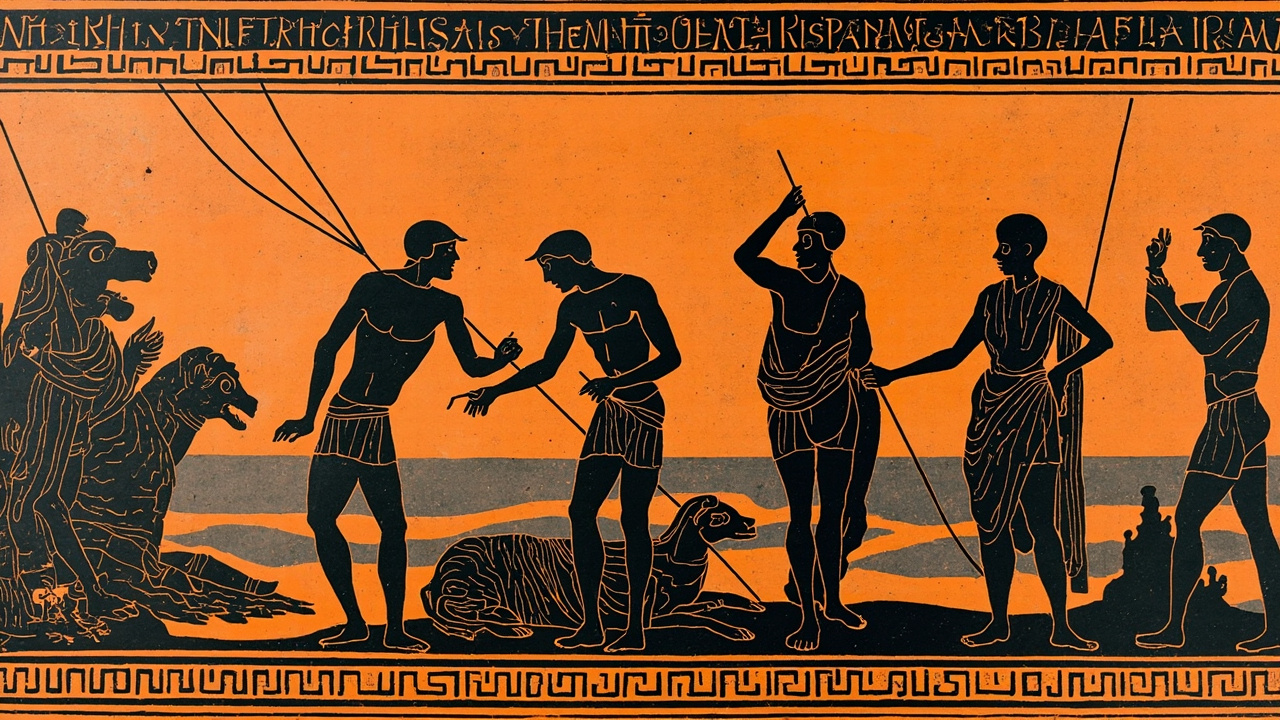
Tell me, O Muse, of that ingenious hero who travelled far and wide after he had sacked the famous town of Troy.
缪斯啊,请为我讲述那位足智多谋的英雄——他攻破特洛伊名城之后,浪迹四海、漂泊天涯。
Original line · The opening lines · the Muse begins the song
Ten Years at Sea: The Hero Tells His Own Story at Court
Zeus sends Hermes down with an order: Calypso must let him go. Odysseus builds a raft and sets out for home, but Poseidon won't have it — one blow of his trident capsizes the raft, and Odysseus nearly drowns before washing up on the island of the Phaeacians. At the Phaeacian king's court, the shipwrecked hero is welcomed to the table — and then he starts talking. In the first person, from the beginning, he tells the whole story of his ten years adrift. That telling is the epic's four most famous books (Odyssey IX through XII), and the source of childhood nightmares for countless readers since.
By the fire at the Phaeacian court, Odysseus tells of the Lotus-Eaters, whose fruit makes you forget home; of sailors strangled by storms; of the Cyclops's cave. He and his men are trapped inside it, and the Cyclops eats two of them alive each day. Odysseus tells how he got the giant drunk on strong wine, gave his name as Outis — Greek for No One, a pun that will matter — and drove a fire-hardened stake into the Cyclops's single eye. He didn't kill him, because only a living Cyclops would roll the boulder away from the cave's mouth. The men escaped clinging to the bellies of the rams.
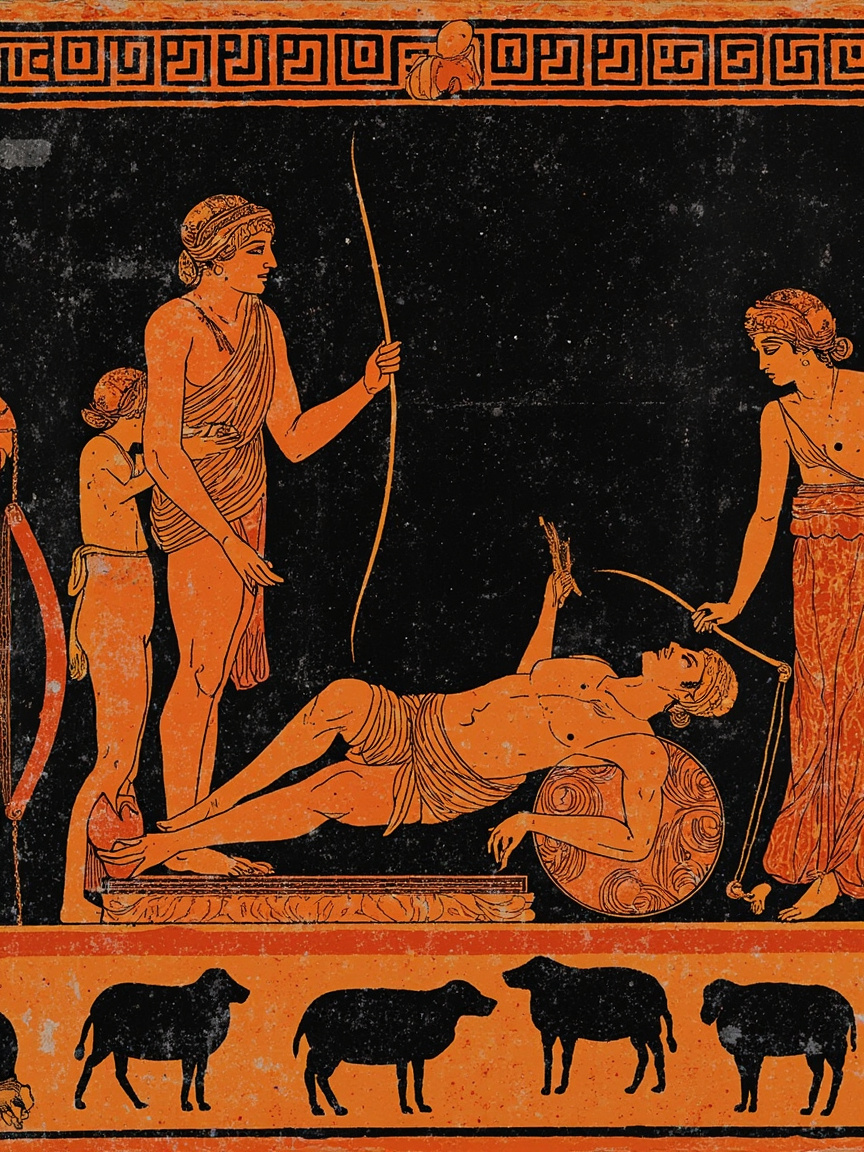
We drove the sharp end of the beam into the monster's eye, and bearing upon it with all my weight I kept turning it round and round
我们把削尖的木桩戳进那怪物的独眼,我用尽全身的重量压上去,一圈一圈地转动它。
Original line · The Cyclops's cave · putting out the giant's eye
The story keeps unspooling: the wind god gives him a bag of contrary winds that nearly gets him home, until his crew, unable to resist, opens it and blows the ship right back where it started. A cliff of cannibals costs him most of his men. The witch Circe turns his crew into pigs, and he forces her to undo it with a magic herb the gods gave him. To find his way home, he descends to the underworld to consult a prophet. Passing the island of the Sirens, he seals his crew's ears with wax and has himself lashed to the mast so he alone can hear the song — and lives to tell it, because he was tied down.
The grimmest episode is the island of the sun god's cattle: starving, the crew slaughters the sacred cattle of Helios. The god's punishment wipes out the entire ship, and Odysseus alone — a captain with no crew left — drifts on to Calypso's island. Craft note: this is the flashback at the heart of the whole poem. The reader gets nearly halfway through the story before hearing its most famous adventures at all, and even then only in the hero's own voice — filtered through memory, shaped by a hero's sense of himself. Homer had invented the embedded first-person flashback three thousand years before anyone had a name for it.
A Mortal Turns Down Immortality
There's a detail most people skip past: Calypso kept Odysseus for seven years, offering him immortality, and he didn't just leave. He chose seven years first. Only then did he choose home. That choice lifts homecoming out of geography and into philosophy: on one side, a deathless world among the gods; on the other, a mortal household that will age and die. He would rather be a mortal man than an undying god. That is the real weight the epic carries.
Home in Disguise: Even the Dog Knows Him
The Phaeacians give him a swift ship, and he is carried home to Ithaca asleep. Athena disguises him as a filthy old beggar. He first takes shelter in the hut of his own swineherd, Eumaeus, who has no idea who this stranger is, yet keeps the rules of hospitality anyway, giving the beggar his best food. This is the poem's moral yardstick: a loyal servant treats people decently whether or not he knows who they are, while the suitors and the disloyal servants abuse him precisely because they think he's nobody.
Telemachus returns from his search for his father, and the two recognize each other. Then Odysseus walks into his own palace as a beggar — the very house that has been eaten and drunk bare in his absence. The suitors insult the old beggar, throw a stool at him, make him fight the dogs for scraps. Only two pairs of eyes see through the disguise: the old dog Argos, too worn out to stand, who hears his long-lost master's voice, twitches his ears, and dies; and the old nurse Eurycleia, who is washing his feet and feels the old scar on his thigh, left there by a boar hunt years before.
Stringing the Bow, Through Twelve Axes
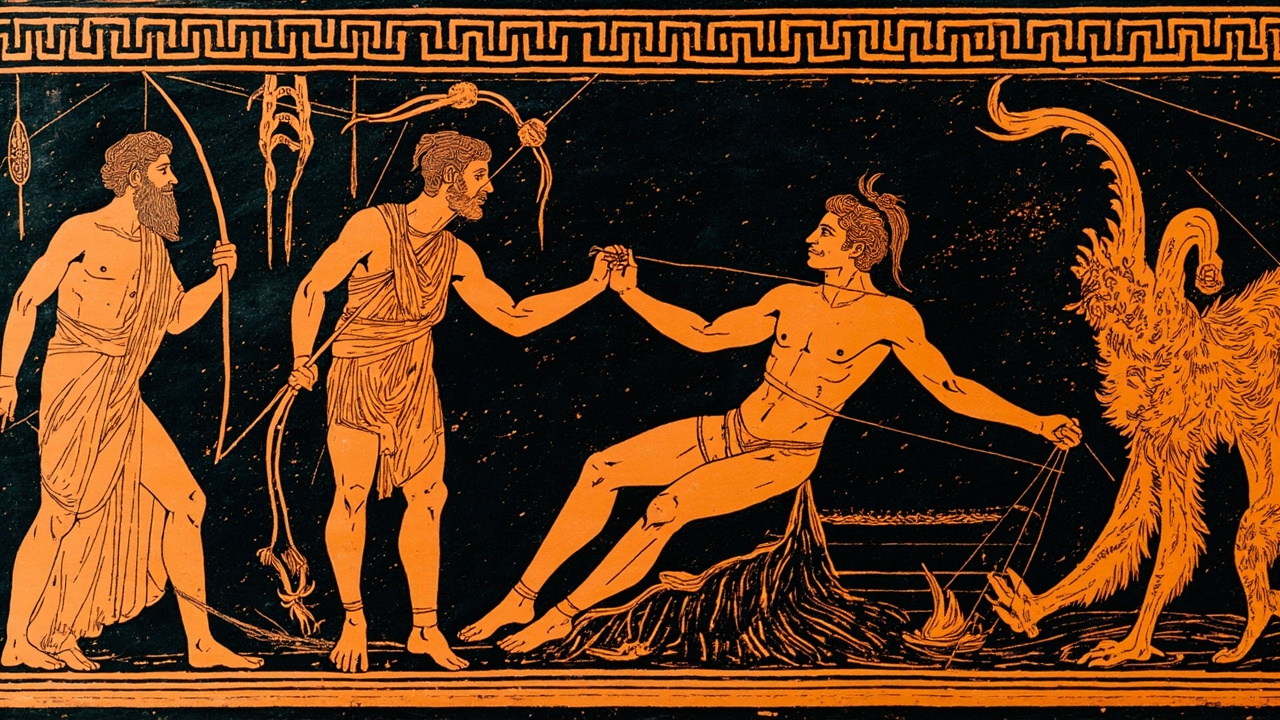
Odysseus, still disguised as the beggar, picks up his own bow, draws it as if it were nothing, and puts an arrow through the sockets of twelve axe heads in a row. Craft note: this scene is the poem's argument — wit over brute strength — pushed to its limit. The hero doesn't win by out-muscling anyone. He wins because this is his bow, and only he can string it. In other words, he proves his identity with his identity. It's a stroke of narrative genius.
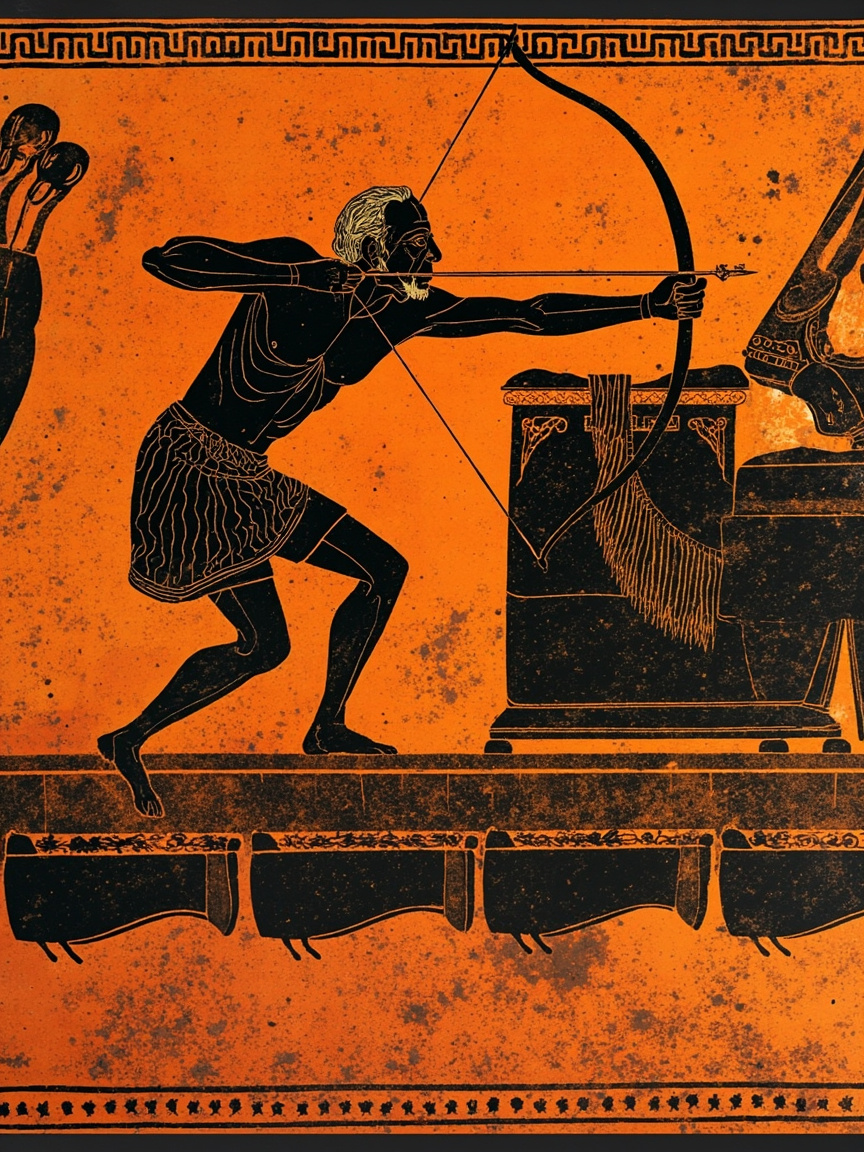
Ulysses, when he had taken it up and examined it all over, strung it as easily as a skilled bard strings a new peg of his lyre and makes the twisted gut fast at both ends.
奥德修斯把弓拿起来、上下打量了一遍,便轻轻一挽将它张开——就像乐手为竖琴换上新弦、把琴弦在两端系牢那般毫不费力。
Original line · Drawing the great bow · one arrow through twelve axes
The Reckoning at Home, and a Husband and Wife Know Each Other Again
Craft note: this is recognition — anagnorisis — done twice over. The hero's identity is proven by the bow; the husband's identity is proven by the bed. One is a private fact about strength, the other a private fact about memory. Homer knew that the most reliable proof of who someone is isn't his armor — it's whether he remembers the wood the bed is made of.
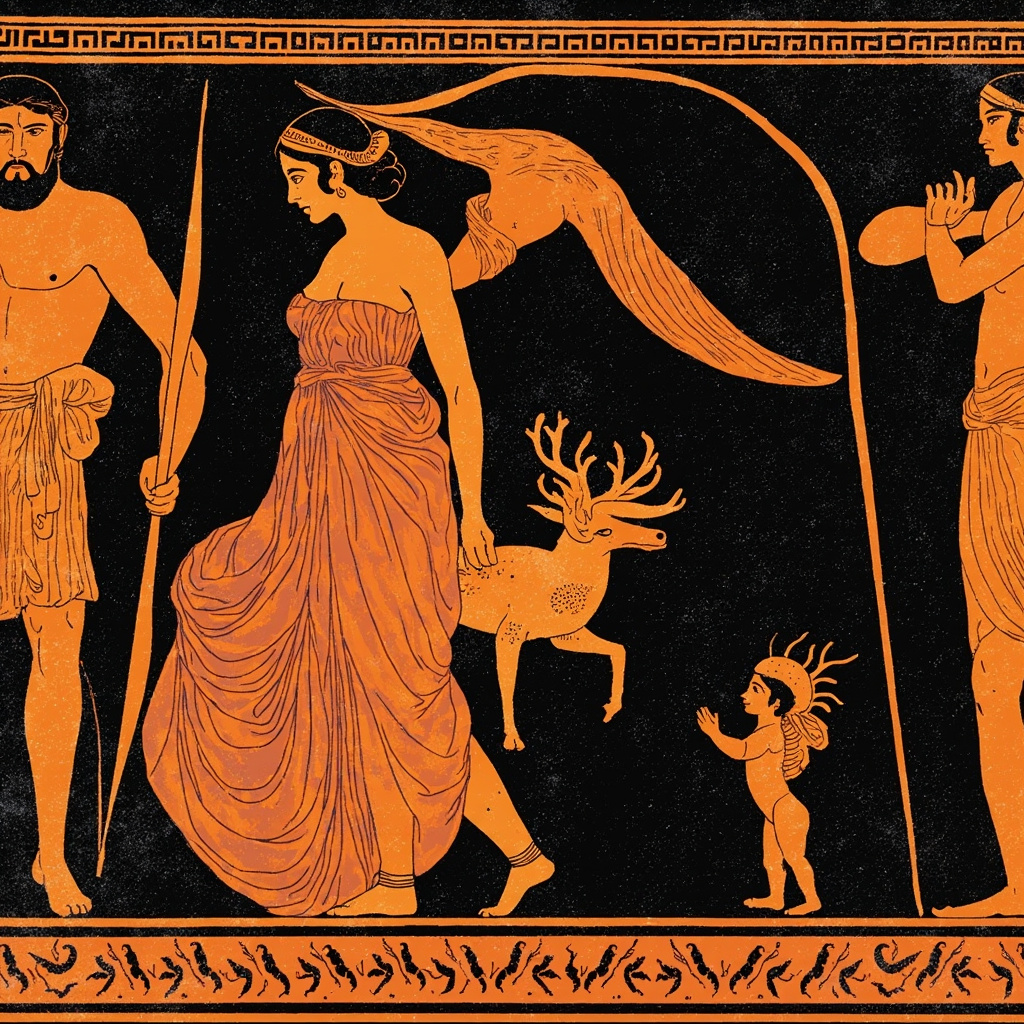
She flew weeping to his side, flung her arms about his neck, and kissed him.
她泪如雨下,扑到他身边,双臂环住他的脖颈,一遍遍地吻他。
Original line · Husband and wife reunited · proven by a bed
What the Book Is Actually About
On the surface it's a sea adventure. Underneath, it's about going home. Homecoming has stayed a Western literary theme for three thousand years because it works on a question that plain: who am I? Odysseus's answer is: I am the mortal man who belongs to this island, this woman, this bed, this dog, this pig, this piece of land, and who will die. He is not a god, and he does not want to be one.
Go one layer deeper and the real subversive story in the Odyssey belongs to Penelope. She is not a woman waiting to be rescued — she weaves a shroud by day and unravels it by night, holding off her suitors alone for three years; she sets the contest that decides her own fate; she tests her returning husband right back, using the secret of the bed against him. She is Odysseus's mirror: the same cunning, the same endurance, just a different sex. That's also why the Odyssey is both a hero's epic and a household epic — its center of gravity is a married couple evenly matched.
Why It's Considered Great
It invented several things we still rely on: — The in medias res opening: skip the beginning, drop into the most dramatic point of the story, then fill in the rest afterward. This is the default structure of the modern movie. — The embedded flashback: let the protagonist tell his own adventures, in his own voice, from another point in the story. — The disguised homecoming: strip the hero of his identity and let him win it back through his mind rather than his muscle. Countless later stories run on this same engine, from wuxia fiction to spy films to The Count of Monte Cristo. — Identity proved by identity: not by a calling card, but by a bow, a scar, the secret of a bed. One more point that gets underrated: in an epic three thousand years old, the hero wins by his wits, his wife wins by her wits, and his patron god is the goddess of wisdom. Putting cleverness above brute strength is, in itself, one of the oldest roots in Western thought.
Why It's Still Worth Reading the Actual Text Once You Know the Plot
A companion guide gives you the map: who fought whom, who turned into what, who killed whom. But the map is not the land. Read the actual text of the Odyssey and you run into the poem's flesh — the way Homer's similes roll in wave after wave; the suspended feeling of those seven years on Calypso's island, unable to go back to the human world and unwilling to stay among the gods; the smell of blood and goat fat in the Cyclops's cave; the way you're pinned down listening to the Sirens right alongside Odysseus, desperate for the next line and unable to stop. None of this happens unless you read it line by line — especially when you reach that flashback by the fire at the Phaeacian court, and it suddenly hits you that this hero is no longer the young man of many wiles. He is a middle-aged man whose crew is entirely dead, whose wife is nearly remarried, whose parents are close to their own deaths, who still cannot get home. What his mouth looks like as he tells these adventures, you can only find in the poem.
The Odyssey's oldest lesson, and its most modern one: the hero is not the strongest man alive. He is the one who remembers the wood of that bed, remembers that dog, remembers what it means to go home.
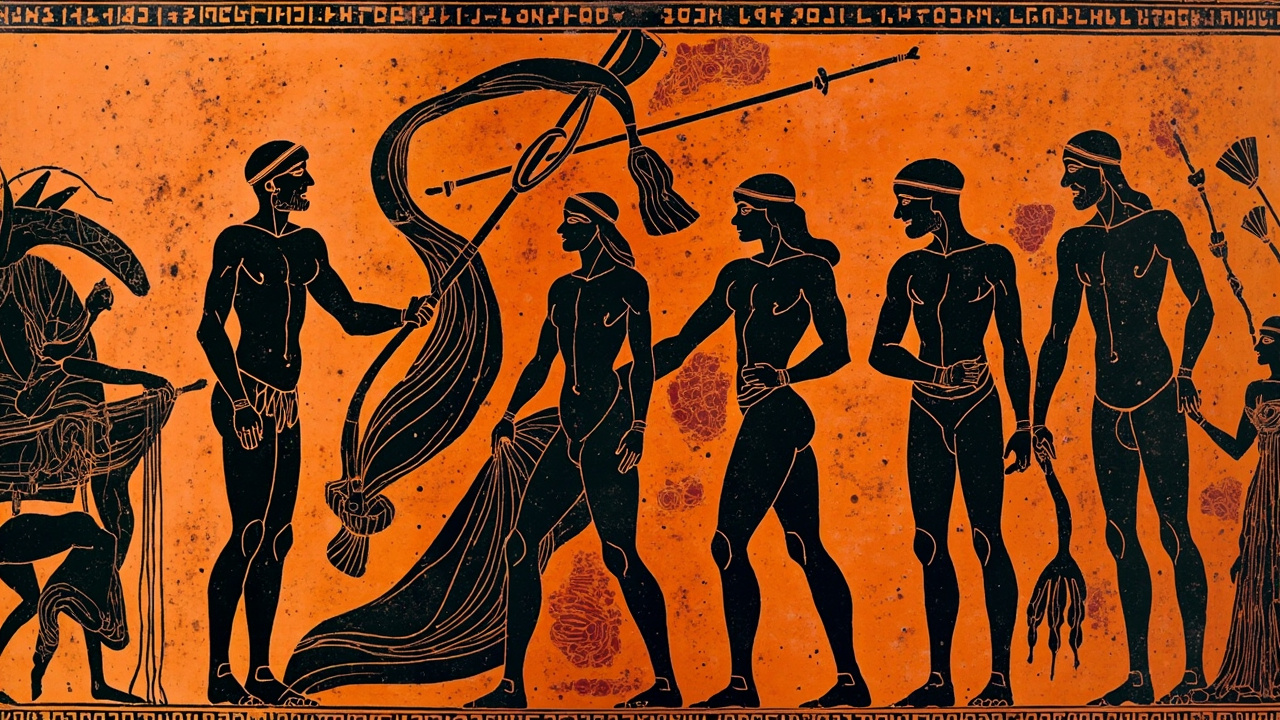
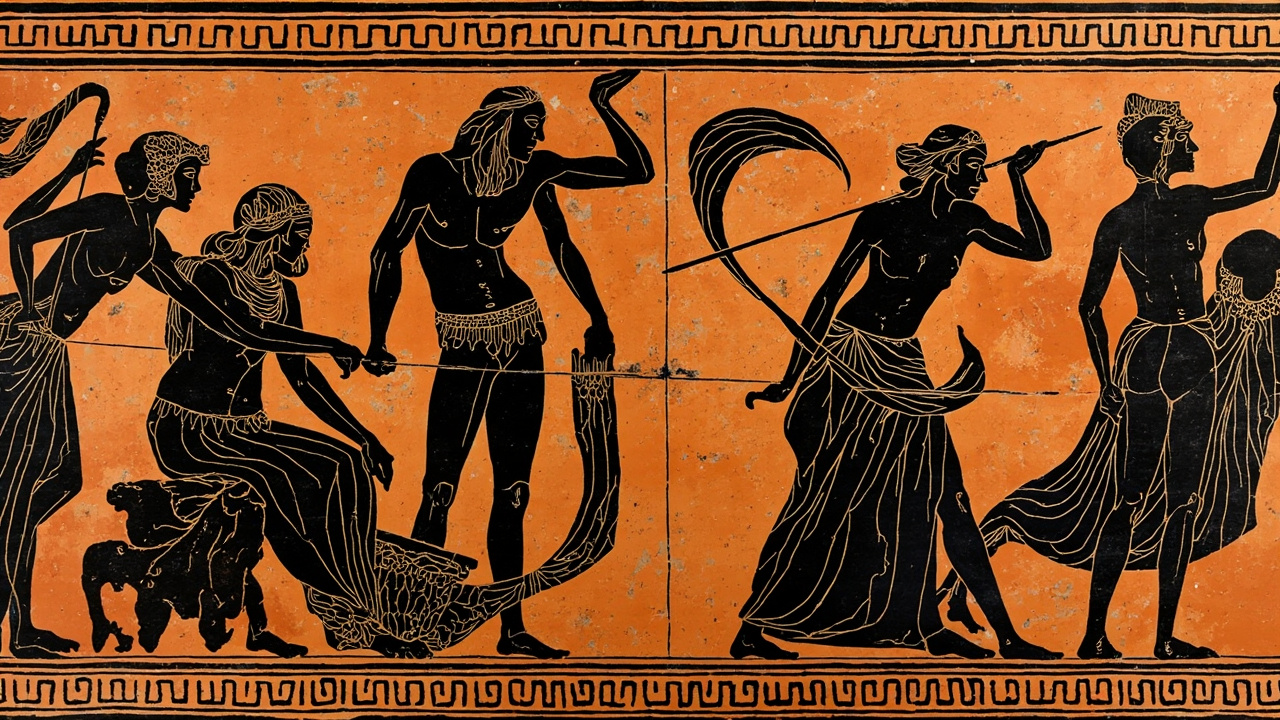
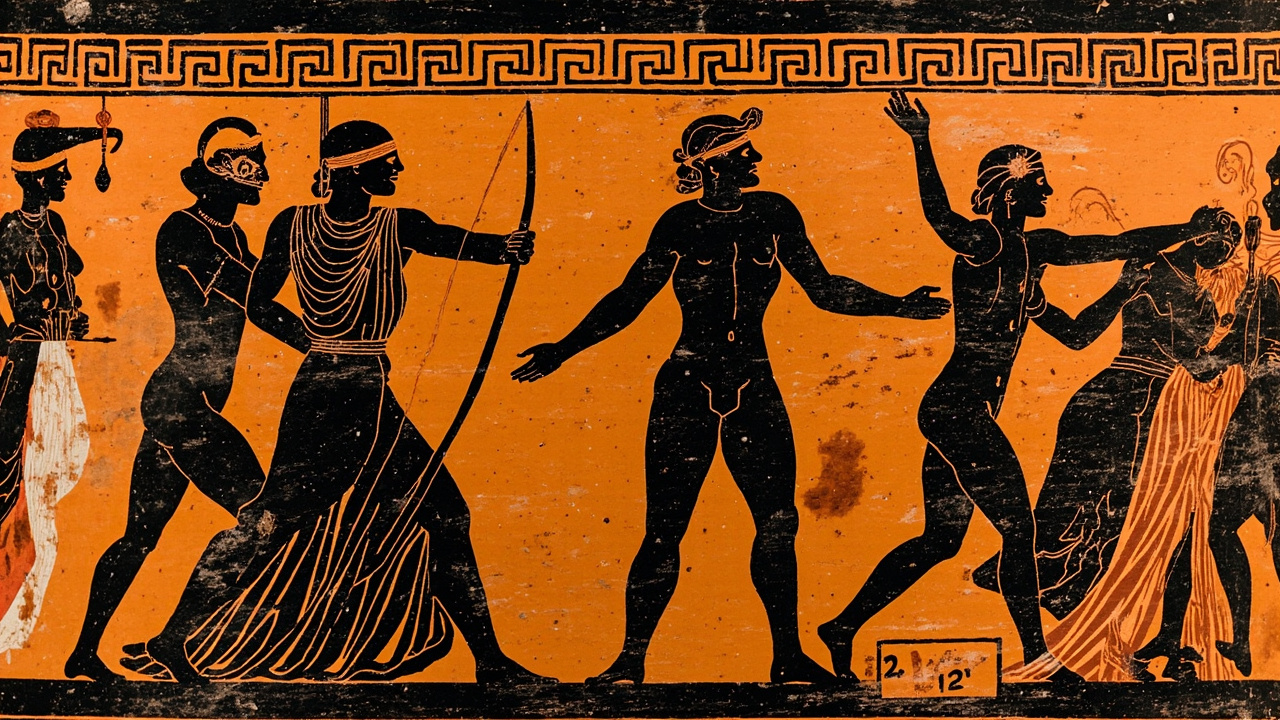
Art Direction4 plates
Before the guide was written, this book got a visual foundation — every illustration you just read grew out of it.