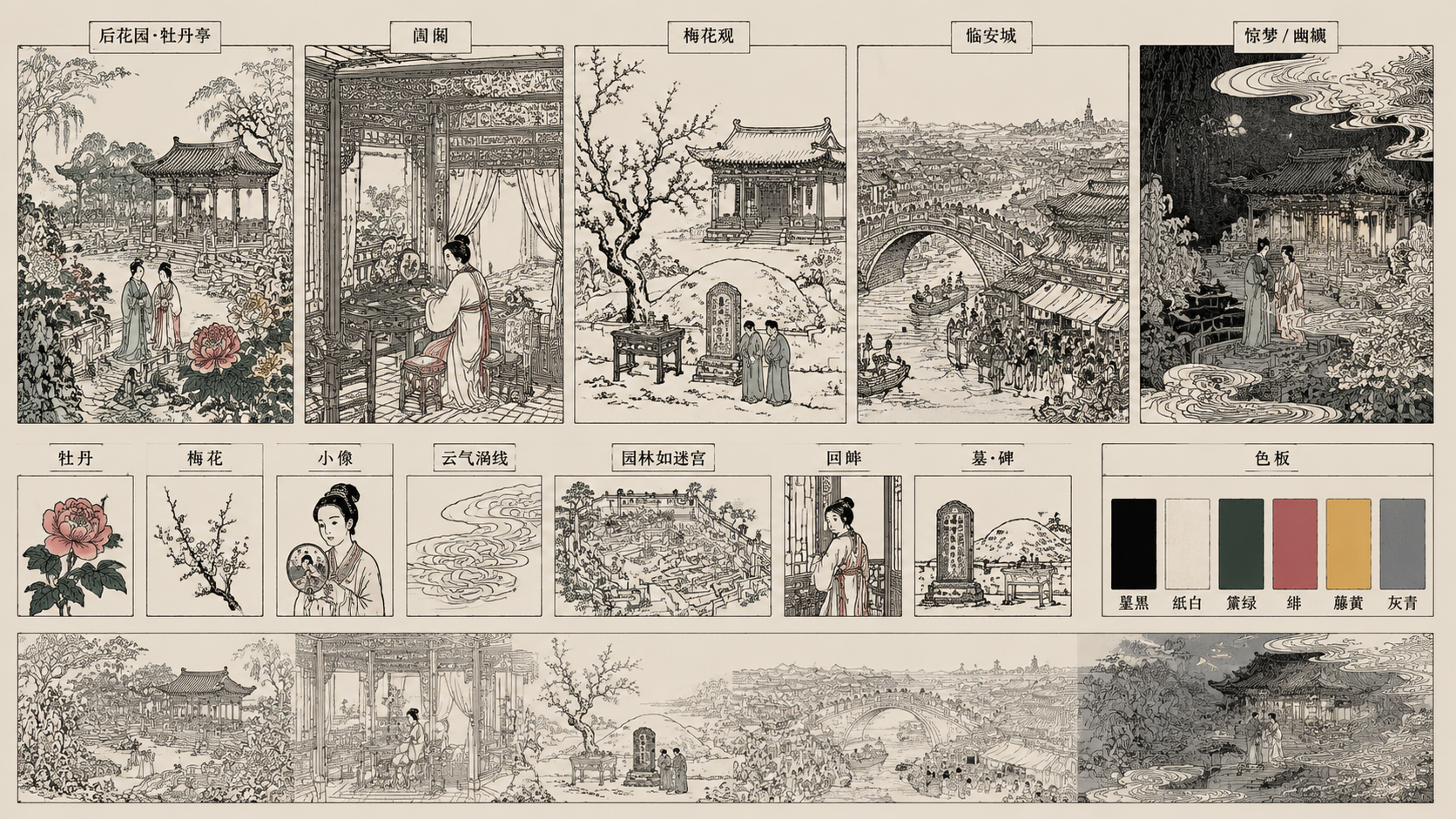
The most delirious, and purest, romanticism Tang Xianzu ever wrote
Text and illustrations produced by the pipeline
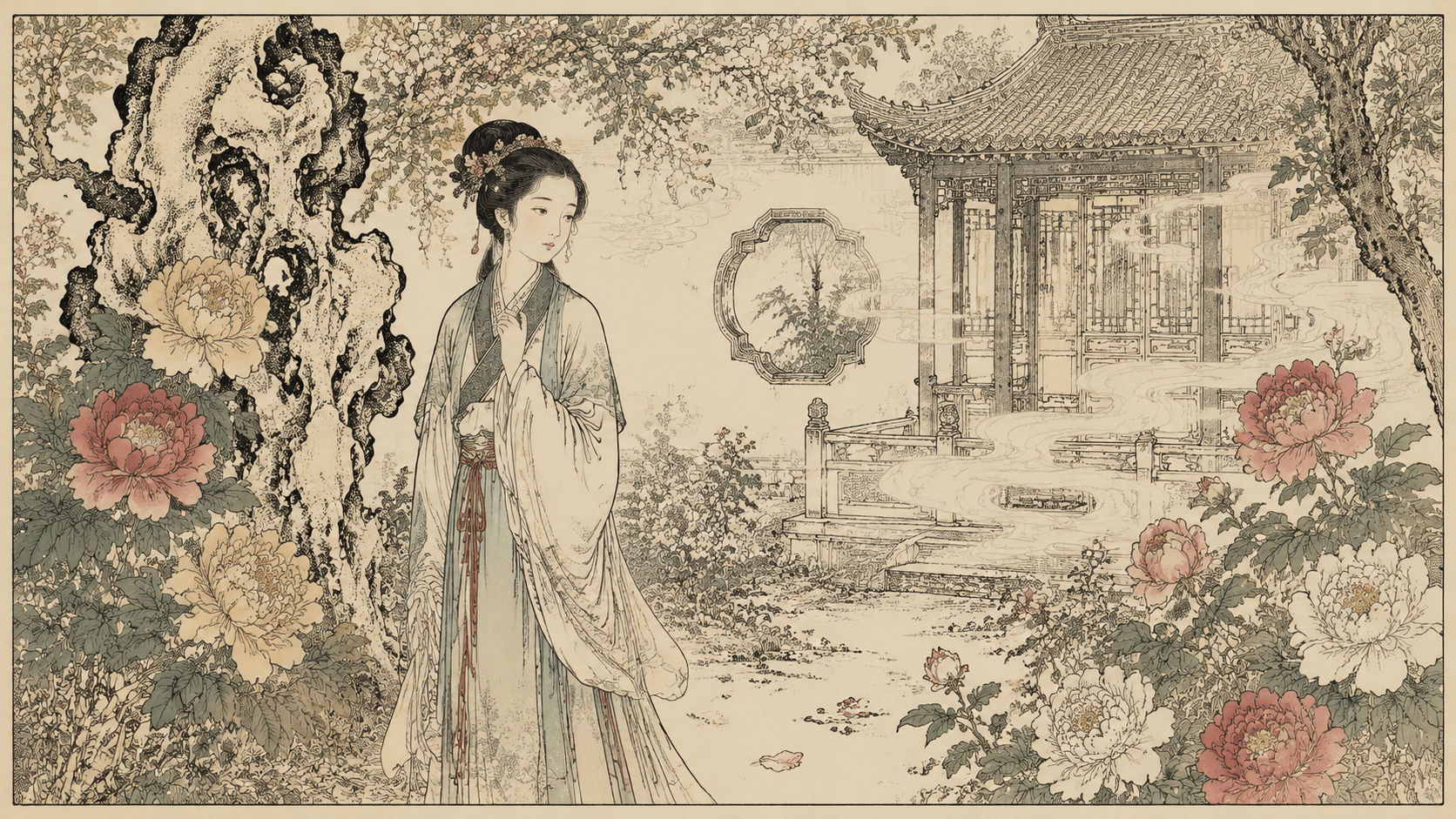
Did you ever have a moment like this as a kid: the backyard, the edge of the school field, some path you'd walked a hundred times — and suddenly the flowers are blooming so hard you just stop and stare, something wordless in you gets struck dead center, and the whole world hits pause. The opening scene of The Peony Pavilion is that moment blown up a thousand times. Du Liniang, the young daughter of the prefect, is half pushed, half coaxed by her maid Chunxiang into the family's back garden for the very first time — the one place her father, Du Bao, has always forbidden her to enter. Peonies, herbaceous peonies, crab apple blossoms, spring piled up so thick it seems about to spill over the walls. She stands there, and something in her stops. She goes back inside and falls ill. It sounds like a stock opening — girl catches spring fever. But Tang Xianzu's real feat is turning that fever into a woman's actual awakening, her actual death, and her actual resurrection.
The Peony Pavilion — in full, The Peony Pavilion, or The Return of the Soul — was written in the late sixteenth century by the Ming dynasty playwright Tang Xianzu. He was about forty-eight, had just resigned his post as magistrate of Suichang, Zhejiang, and gone home to write it in his study, the Yuming Hall, in Linchuan, Jiangxi. It is the crown jewel of what's known as the Four Dreams of Linchuan, Tang Xianzu's four major plays, and the high-water mark of romanticism in the whole history of Chinese theater. It was written within a few years of Shakespeare's own prime, and the two are often paired: Shakespeare's Romeo and Juliet on one side, Tang Xianzu's Du Liniang and Liu Mengmei on the other. For six hundred years the Kunqu opera stage has kept this play alive, and scenes like the Garden Stroll and Interrupted Dream, or Finding the Portrait, still get performed on their own today. One sentence for why it's remembered: it made love outweigh death, outweigh propriety, and outweigh the emperor himself.
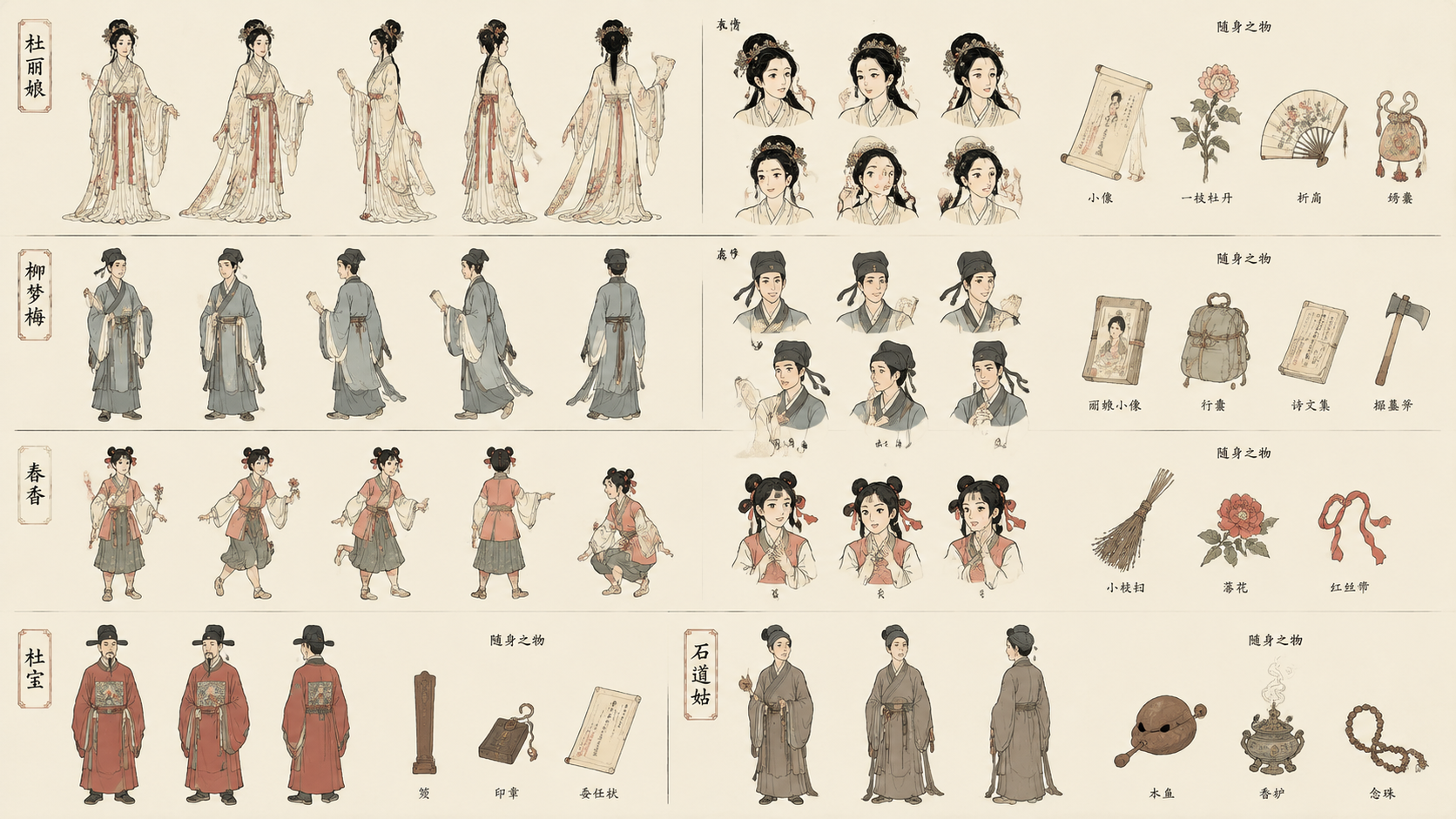
The story is set in the Southern Song, with fighting between north and south never really stopping and the shadow of the invading Jin armies hanging over everyone — that undertone of a world at war runs quietly beneath the second half of the story. There are only a handful of people who matter here. Du Liniang, the treasured only daughter of Du Bao, the prefect of Nan'an. She's been kept shut in her own chambers since childhood, reading the Book of Songs, and has never even seen what her family's back garden looks like. She is the kind of woman propriety has clamped down on hardest, and whose inner fire burns hottest for it. Liu Mengmei, a poor scholar from Lingnan, stops over in Nan'an on his way to sit the imperial examinations in Lin'an. He took the name Mengmei — dreaming of a plum tree — after a strange dream in which a woman stood beneath a plum tree; he changed his name because of it. Chunxiang, Liniang's personal maid, blunt and gutsier than her mistress. She's the one who drags Liniang into the back garden in the first place — without Chunxiang, the story never even starts. Du Bao, Liniang's father and the prefect of Nan'an, a middle-aged man with the word propriety branded into his forehead. He's later promoted to Pacification Commissioner of Huaiyang and put in command of troops fighting the Jin — which is exactly what makes him such a hard case when the story reaches the imperial court.
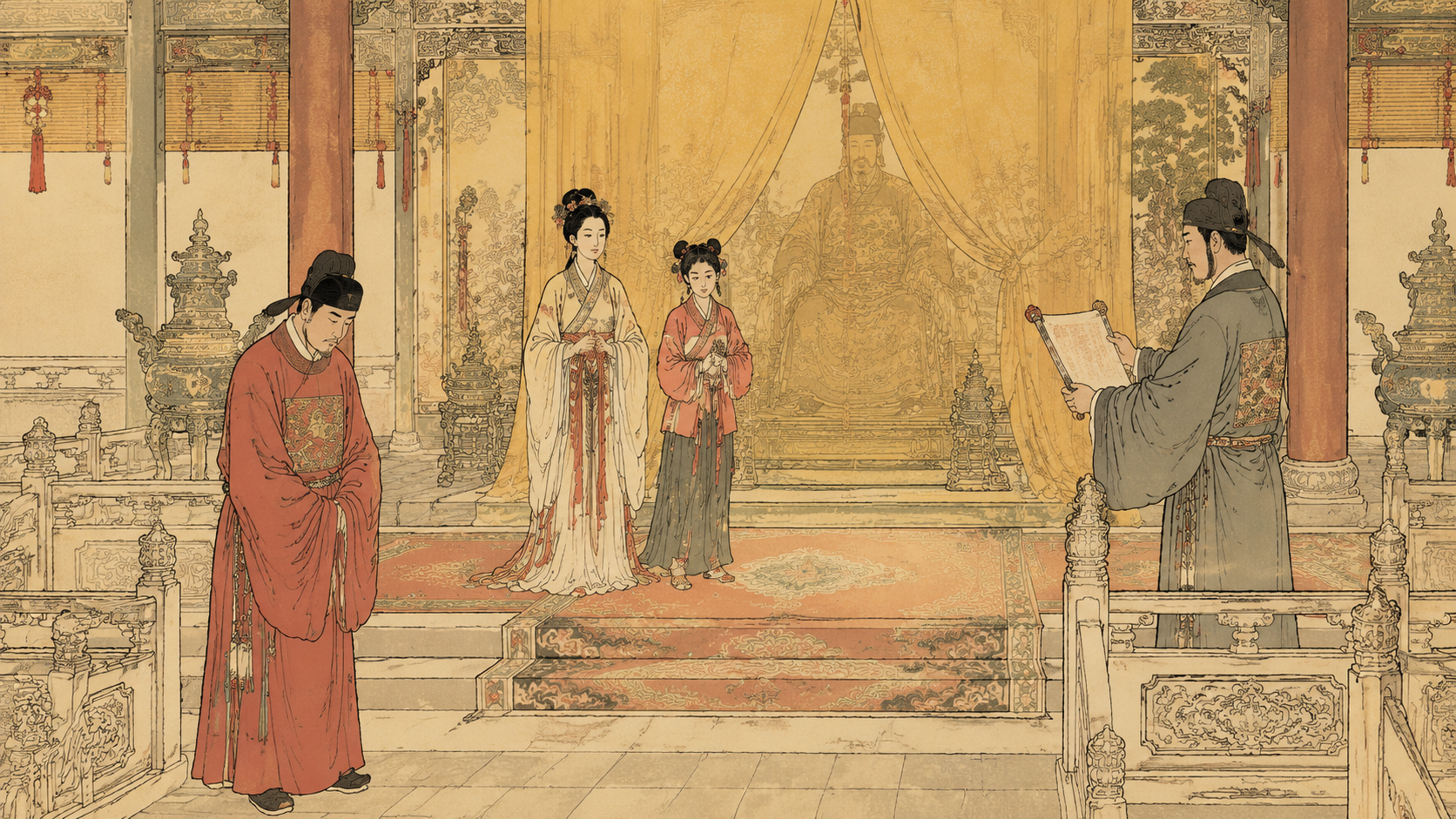
In the end, the highest power in the land steps in. The emperor himself presides over the case of Du Liniang's return from the dead, right there in the imperial court. He hears every piece of evidence — the painting, the poem, the epitaph Du Bao wrote in his own hand, Sister Stone's testimony — and then Liniang herself appears in court to testify. The emperor brings down the gavel: this is real, and this marriage stands. However unwilling Du Bao is, the words imperial decree leave him no choice but to accept his son-in-law. What the writing is doing: Tang Xianzu's sly move here is making imperial authority itself vouch for true love. The emperor isn't cast as an antagonist — he's cast as an authority higher than Du Bao, and that higher authority's ruling comes down on the side of feeling. In effect, Tang Xianzu borrows the emperor's own voice to announce that propriety has bowed to love. Liniang and Liu Mengmei are finally recognized as husband and wife, and the family closes out on a reunion in which true love has overridden propriety.
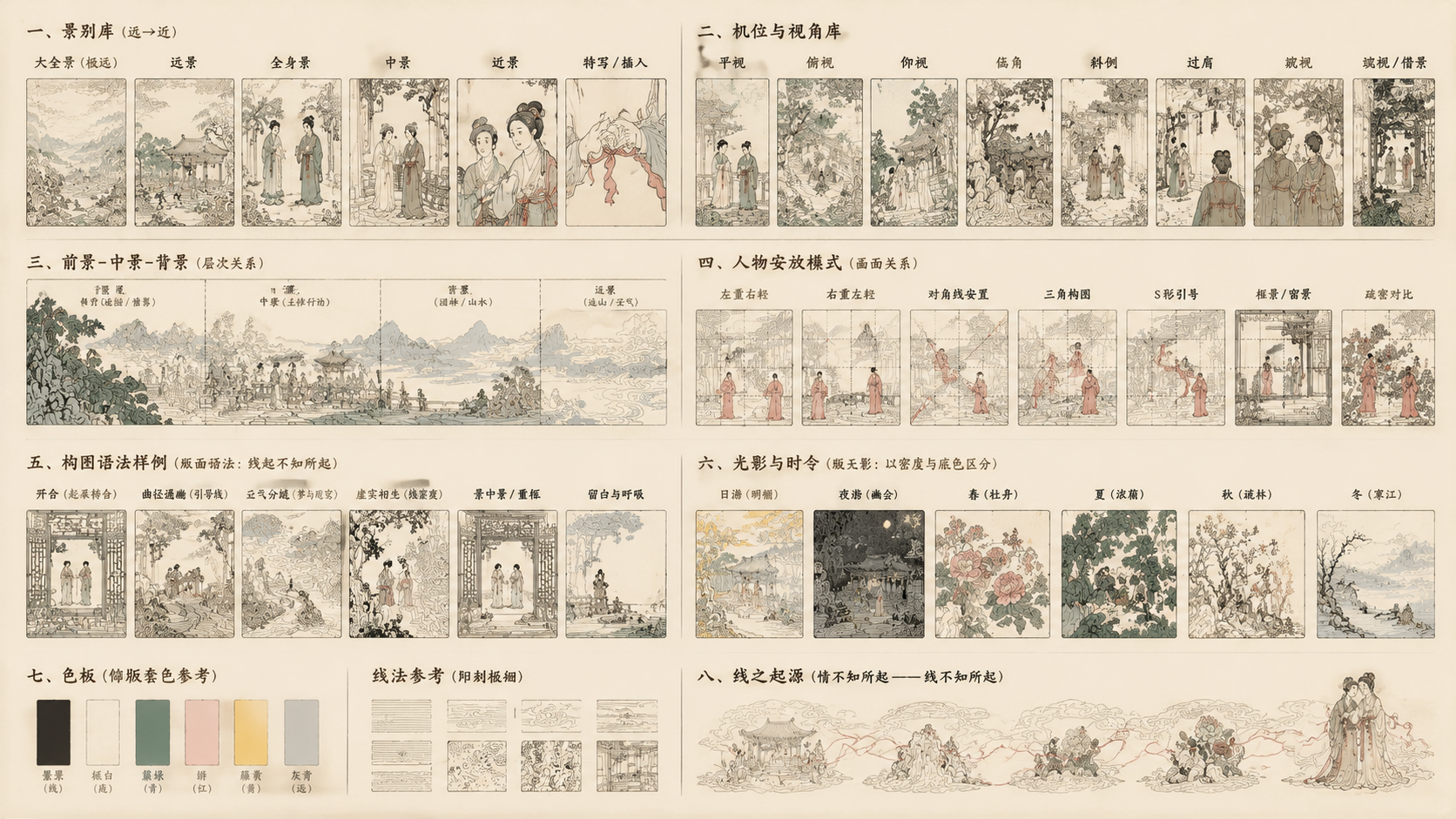
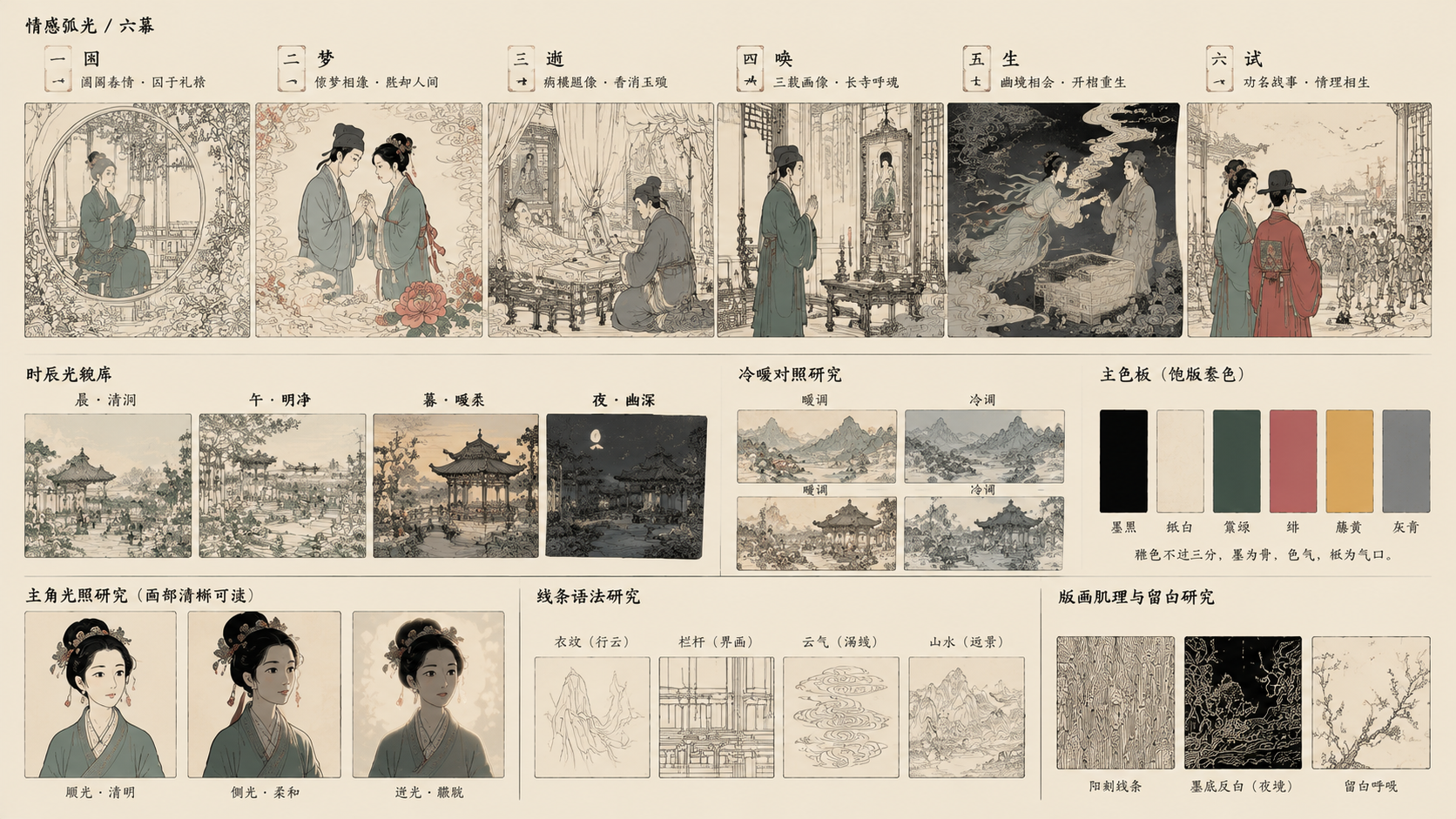
Before the guide was written, this book got a visual foundation — every illustration you just read grew out of it.
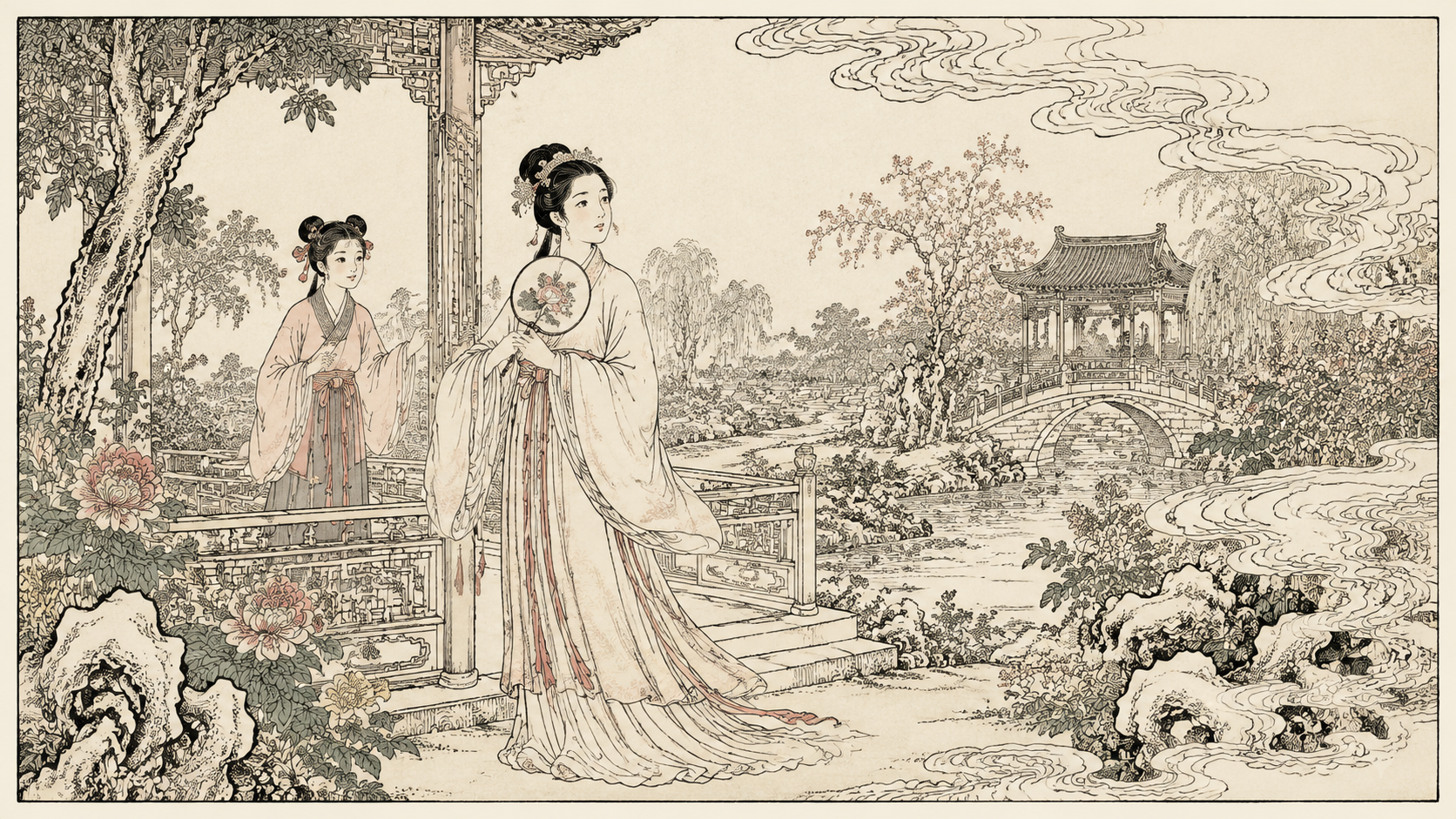
Liniang steps into the back garden for the first time. It's enormous — pavilions and towers, peonies and herbaceous peonies blooming without end. Looking at it all, something in her stirs; she goes back and paints her own portrait, writes a poem on it, and mourns how such fine scenery and lovely weather have gone to waste on no one. What the writing is doing: this scene is one of the most famous passages of externalized feeling in Chinese theater. Tang Xianzu never has Liniang say I wish I were in love. Instead he has her eyes take in the whole garden first, then her feet carry her around the covered walkways, the rockeries, the ponds — and only under that full assault of nature does her sense of self wake up. The whole sequence plays like a slow-motion music video. That night she has the dream that will kill her. In it she falls asleep on a rock beside the Peony Pavilion, and a young scholar she has never met walks up holding the flowers she picked, calls her sister, and under the protection of the flower gods the two of them come together — before anything is fully underway, the lamp goes out, and she wakes.
Waking up leaves Liniang thunderstruck. She starts walking the garden over and over, looking for the pavilion from her dream, looking for the scholar — and never finds either again. What the writing is doing: Tang Xianzu's cruelest touch is staging this search in three layers — Liniang goes looking herself, Liniang paints her own portrait to hold onto what she felt, Liniang sends Chunxiang to see whether the dream can somehow be picked up again. All three fail. Classical drama rarely renders lovesickness this densely or this concretely; what you're watching is a person being peeled back, layer by layer, by longing. In the end Liniang paints her own likeness and writes a poem on it, knowing plainly that she is dying. Grieving through the Mid-Autumn Festival, she dies alone beneath a plum tree. Grief-stricken, Du Bao buries her by that same plum tree in the back garden and builds a convent there, the Convent of the Plum Blossoms, so that someone will always be watching over her grave. A girl as lovely as a flower, dead in the first spring of her life.
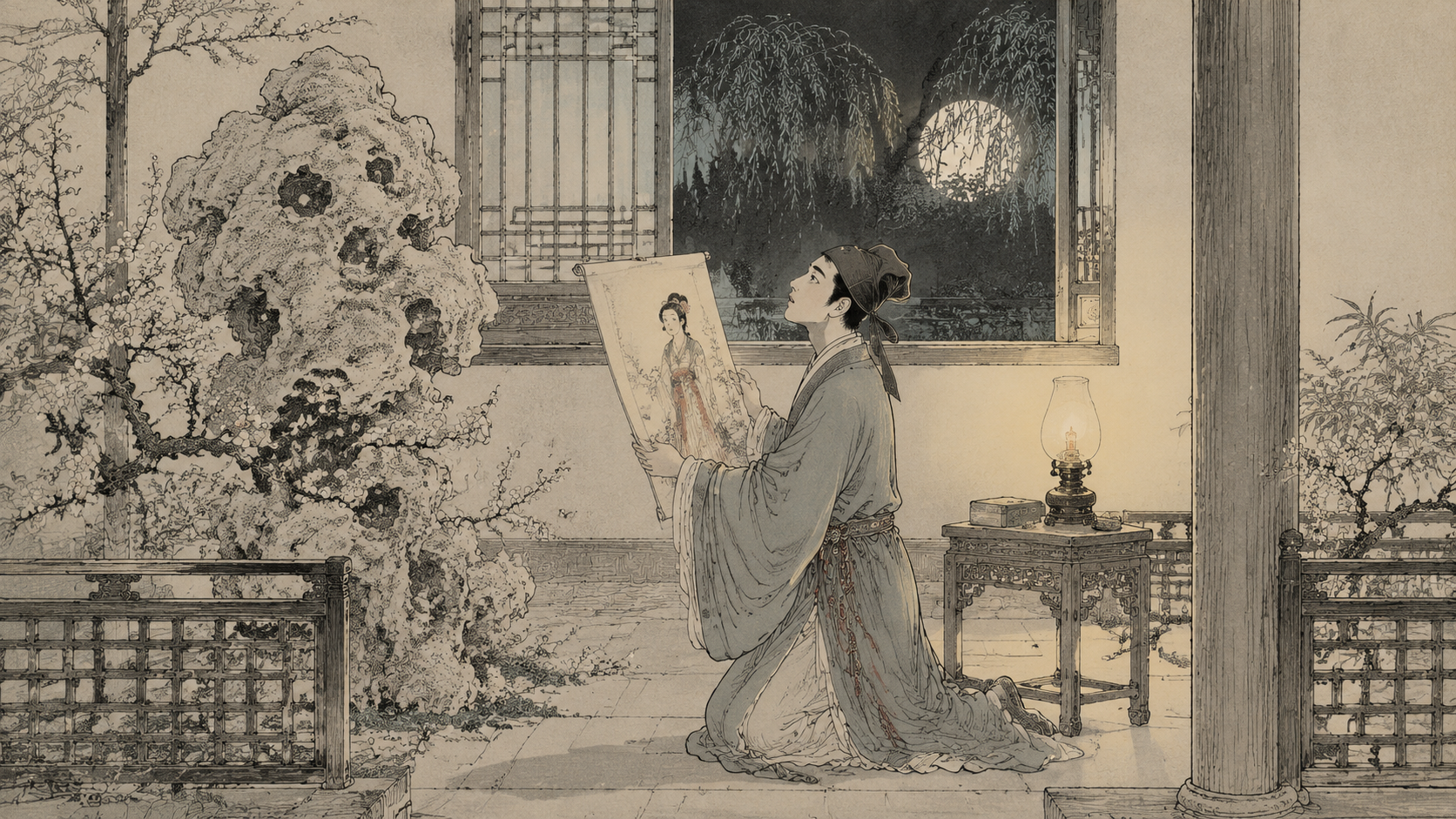
Jump ahead three years. Liu Mengmei, the poor scholar from Lingnan, is on his way to sit the examinations in Lin'an. He passes through Nan'an, runs out of travel money, and takes lodging in the Convent of the Plum Blossoms. One day, beside a garden rock, he finds a painting — a woman so beautiful she barely looks real, with a mournful poem tucked into the scroll. He looks at it again and again, and starts talking to the woman in the painting as if she can hear him: what's your name, sister? Where are you from? Are you even still alive? What the writing is doing: this scene, where the portrait is found and called to, pushes obsession as far as this play ever takes it. Onstage there's just a scholar, a painting, and a few candles. Liu Mengmei is talking to thin air, pouring every feeling he has into a picture — and the audience understands before he does that he's already lost, that he will have to find the woman in that painting. In this same scene Liu has the matching dream, one that takes him to the same garden rock, the same Peony Pavilion, and when he wakes he's even more certain that he and the woman in the painting are bound together.
Then comes the strangest scene in the whole play, and the most moving. Late at night, Liu Mengmei is still talking to himself when Liniang's ghost drifts in over the wall. She stands in front of him and says, timidly: I am the woman in the painting. I have been dead for three years. She hasn't come to frighten him. She has come to ask him for something. She begs Liu Mengmei to dig up her grave, open her coffin, and bring her back to life. What the writing is doing: Tang Xianzu writes this scene as a love scene, not a ghost story. Even though Liniang calls herself a ghost, her tone, her movements, her manner are no different from a girl confessing her feelings to the man she loves. The candlelight flickers, the mood hangs by a thread, and the audience can't quite tell whether this is romance or horror — which is exactly the point, because there's no need to tell them apart. This is the scene where the idea that true love can overcome death first lands on the audience for real: a woman three years dead says the heaviest possible words to a man she has never met — save me.
Liu Mengmei agrees. Sister Stone, the Daoist nun who runs the Convent of the Plum Blossoms and took her vows late in life, helps arrange everything — she has never married, but she is the most generous matchmaker of anyone's happiness in the entire play. They dig up the grave and open the coffin. When the lid comes off, Liniang's body has not decayed at all — Tang Xianzu spares nothing for romance here: the instant sunlight touches her face, she opens her eyes, and her first words ask where she is, her second call out for Liu. Drawing on the vital force that Liu Mengmei's own devotion has stirred up, her body returns fully to life. What the writing is doing: Tang Xianzu draws the resurrection out long and slow, not to convince the audience this could really happen, but so that across the whole long ritual of opening the coffin, they feel exactly how a woman already sentenced to death by her world manages, through one stranger's refusal to let go, to pull herself back out of it. Afterward the two of them pledge themselves to each other in private. Afraid something will go wrong again, Liniang pushes Liu Mengmei to leave at once for Lin'an to sit the examinations — come back with a title to your name, and you'll be a proper son-in-law.
You'd think the story could wrap up here, right? It can't. In these same three years Liniang's father, Du Bao, has risen further, now serving as Pacification Commissioner of Huaiyang and commanding troops against the Jin. Liu Mengmei, freshly credentialed as top graduate of the examinations, goes to Huaiyang to present himself as his son-in-law. Du Bao's reaction: who are you? Are you the grave robber who dug up my daughter? If my daughter is a ghost, then you're a demon — someone arrest this man. What the writing is doing: Tang Xianzu never makes Du Bao, the stand-in for propriety, stupid, or cruel, or a caricature. He genuinely loves his daughter — he simply cannot accept something as impossible, as improper, as a woman returning from the dead. When he asks Liu Mengmei how he could possibly marry a daughter who has been dead for three years, it's a question that holds up in any era, any culture. That pushes the conflict past any easy resolution: on one side, Liniang and Liu Mengmei's camp of true love; on the other, Du Bao's camp of propriety; and layered over both, a nation caught in the chaos of the Jin invasion, private matters and affairs of state tangled into one knot. The case is finally taken all the way to the emperor.
At the core of the whole play is a line Tang Xianzu himself wrote in his preface: love, he said, arises from no one knows where, but runs so deep that the living can die for it, and the dead can be reborn because of it. This play is a monument to that kind of love — love large enough to kill, large enough to raise the dead, large enough to override the authority of an official, large enough to bring the emperor himself out in its defense. But it isn't only a love story. It stages several real conflicts at once. The individual against propriety: Liniang's awakening begins the moment she steps into a garden her father has forbidden her, in the name of proper conduct, to enter. The individual against death: not through myth, not through miracle, but through another person's refusal to give up, pulling someone already dead back out of her coffin. The individual against a nation's crisis: in the second half of the story, the invading Jin armies and the Li Quan rebellion, the wars of the late Southern Song, run as background noise, and what Tang Xianzu seems to be saying is that in a world at war, the one thing an ordinary person may still hold onto is a single, true love. Read today, its theme of awakening still cuts. What does a woman crushed to the very bottom by family and society live on? What gets her out? The answer isn't submission. It's that one spark lit by spring, burning until death and not going out even then.
Its place in literary history hardly needs restating. But even if you never think of it as a classic, there's still plenty here to move you. Its verse is classical Chinese poetry at its very best. A line like such a fine morning, such lovely scenery, wasted on this indifference; such joy for the heart, but whose household ever finds it will stop you on first reading even if you have no idea where it comes from. Nearly every aria, every spoken line, every aside in this play can stand alone as poetry. Its portrait of a woman's situation reaches a startlingly self-aware place for Chinese theater more than four hundred years ago. Liniang is not held up as some model of the virtuous wife and mother. She is a woman whose selfhood is pressed to its absolute limit, and who finally completes her rebellion through death and resurrection.
Four hundred years ago, Du Liniang stepping into that garden for the first time looked exactly like the fire in any of us — held down for so long, finally breaking through.
Knowing the plot only gets you the script. Reading the actual text is watching the play itself — how it sings, how it's staged, how it won't let you sit still.