
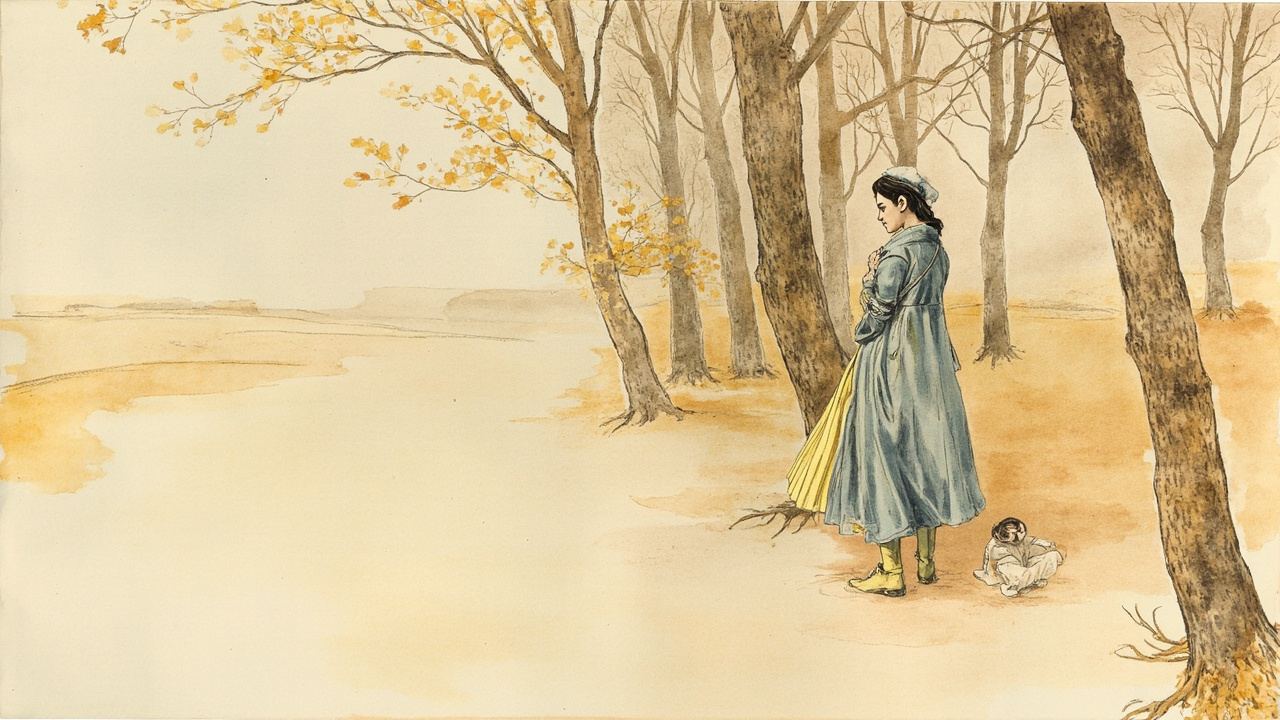
The Sorrows of Young Werther · Companion Guide
The Sorrows of Young Werther
He falls in love with a girl who already belongs to someone else — no one has done wrong, and no one can walk away; in the end he puts on the blue tailcoat and yellow waistcoat and pulls the trigger at his desk, at midnight.
Opening: a man burned alive by his own heart
He walks into the countryside and sees a spring, a linden tree. Children cutting hay at the edge of a field can do just the same — make his face flush and his eyes go wet, right there on the spot. It is not that he has seen too little of the world — it is that the world moves him too easily. Other people feel a thing and move on; he treats every such moment as the whole breath of his life, and ends up choked to death by his own sensitivity. There is no villain in this book, no plot, no one wronging anyone else. He is the one who dies, and he is the one who pulls the trigger.
What kind of book this is: the young Goethe, written in six weeks
The Sorrows of Young Werther was published in 1774, when Goethe himself was not yet thirty — younger than many of the people reading this now. The book set off a sensation across Europe on arrival: it is generally reckoned Europe's first true bestseller phenomenon, and the earliest example of what we would now call a celebrity author. Napoleon is said to have carried a copy in his campaign kit and read it at least seven times. Its form is the epistolary novel: the entire book is made of letters Werther writes to his close friend Wilhelm, with almost no other vantage point. It belongs to the German Sturm und Drang movement of the 1770s — earlier than the Romanticism that would follow in England and France, and the real fuse that lit European Romanticism.
People and world: a deadlock among three
Werther, the protagonist, is a sensitive, gifted young man who paints, writes, and loses himself in nature and Homer. He falls in love with Lotte, a gentle and capable young woman already engaged to the steady Albert, whom she later marries. The cutting edge of the tragedy is that Albert is not a villain — he is decent, respectable, and genuinely deserves Lotte — and Lotte is not toying with anyone's feelings either; she holds to her engagement and to what is proper. A situation in which no one does anything wrong still nails all three of them in place. Wilhelm, the recipient of the letters, almost never answers on the page from start to finish — he functions only as the wall Werther's voice echoes off. The setting is the German countryside village of Wahlheim in the 1770s: the spring beneath the linden trees, the village dance, the lamplight of farmhouses.
How the plot moves
1. Arrival in Wahlheim: a Homeric brightness
Werther has come out to the Wahlheim countryside to settle some business. His letters to Wilhelm are pure rapture: how clear the spring is, how good the shade under the linden trees, how simple the farmers, how innocent the children, how perfectly Homer's lines suit this summer landscape. The passage reads almost like a textbook idyll — but its trick is that on a second reading, you start to hear unease underneath the brightness. A man so easily filled up by the world will, sooner or later, be just as easily emptied out by it.
At a country dance, Werther sees Lotte for the first time. She is standing among her younger, motherless brothers and sisters, cutting bread for them slice by slice — the image fixes itself in his heart on the spot. For Werther, Lotte carries two layers at once: the girl he falls for at first sight, and the warm, almost madonna-like elder sister carrying the weight of a household. He declares himself to her that same night, and Lotte does not deceive him — she tells him at once that she is already engaged, to Albert. Werther is struck by both feelings landing on him together: longing and impossibility, at the same moment.
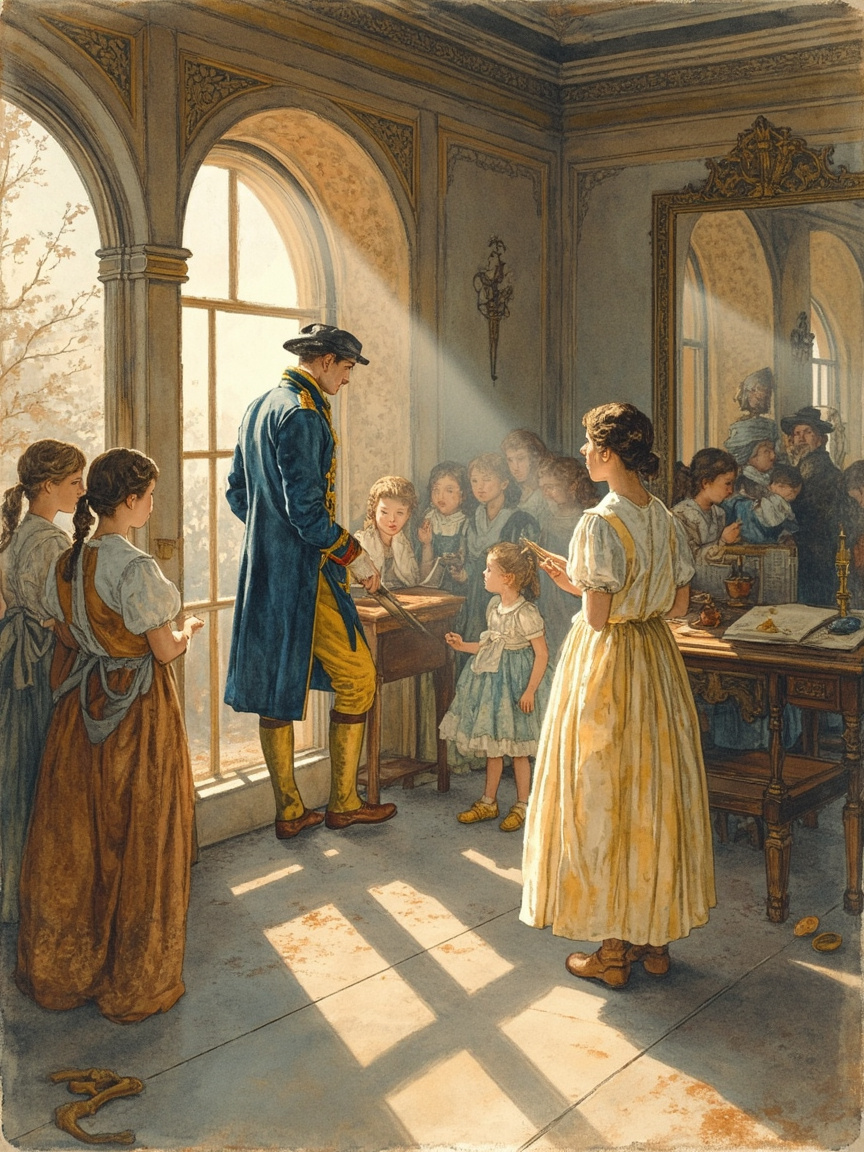
She was holding a rye loaf in her hand, and was cutting slices for the little ones all around, in proportion to their age and appetite.
她手里握着一个黑麦面包,正给围在身边的孩子们一片片切着,按各人的年纪和胃口分。
Original line · June 16 · Before the ball, Lotte cuts bread for her motherless siblings
3. Hopeless torment: three people, held at a careful distance
Albert returns. The three of them come to know one another, and Werther even becomes his friend — he admits Albert's virtues just as freely as he admits his own inability to let Lotte go. The two men have a famous argument: Albert holds that suicide is weakness and cowardice; Werther counters that a man who cannot even claim the freedom to end his own life hardly deserves to be called a man at all. This is not just two friends arguing — it is a rehearsal of the head-on collision between the Enlightenment and Romanticism. The rational side says living is a duty; the feeling side says that once the heart is already dead, there is no reason for the body to keep dragging it along.
4. Flight and return: humiliation at the legation
Unable to bear seeing Lotte every day with no hope of having her, Werther forces himself to leave Wahlheim and takes a post at a legation. He hopes a change of scene will let him breathe, but the snobbery of aristocratic circles suffocates him worse than his hopeless love did. He cannot stomach a world sorted by birth, title, and etiquette, and writes to Wilhelm that even the servants pouring the tea carry themselves with more dignity than he is allowed. In fury he resigns and runs straight back to Wahlheim. The neat trick of this section is that Werther believes he is fleeing love, when in fact he has been fleeing himself the whole time.
5. From light into dark: from Homer to Ossian
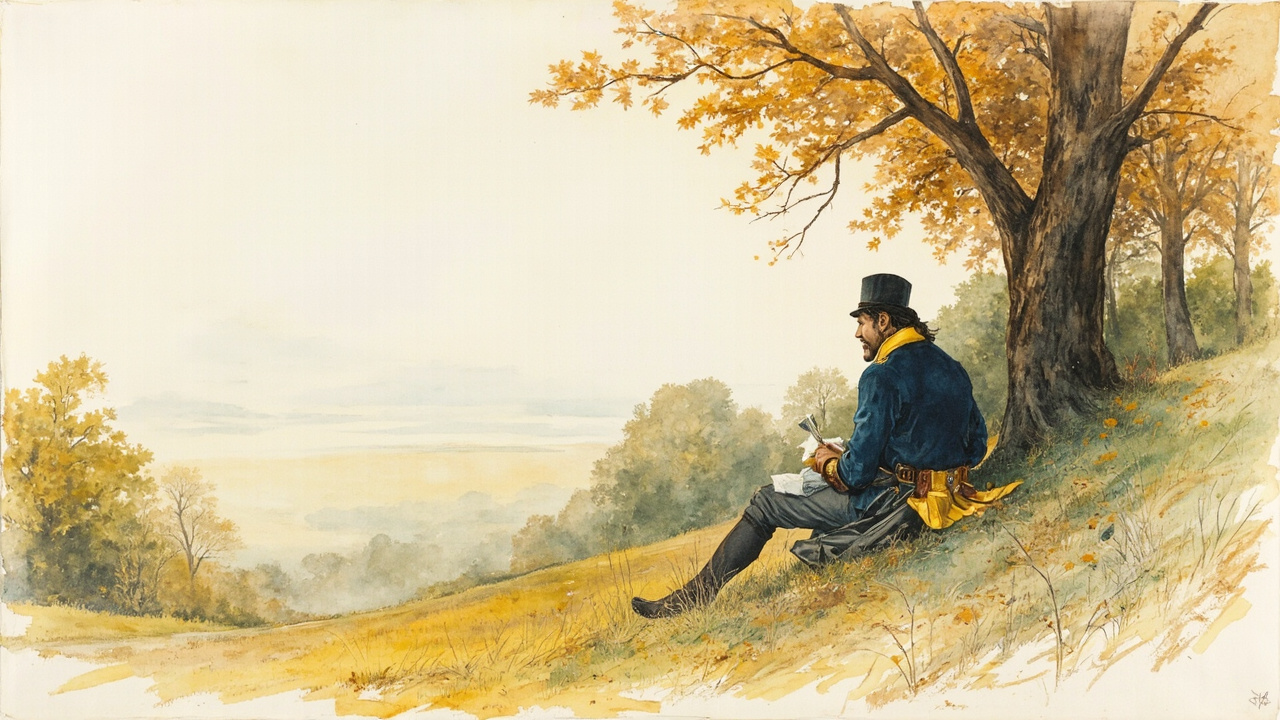
Back in Wahlheim, Lotte is now married to Albert. Werther's love does not break — it only goes deeper and darker. He stops reading the bright Homer and turns instead to the bleak Ossian, the blind Celtic bard whose register of autumn wind, gravestones, and fallen heroes now matches Werther's own state exactly. The key technical move here is that the landscape starts following the heart: spring is no longer bright, the countryside no longer cheerful, even the shade under the linden trees seems touched with frost. The central weapon of Romanticism — nature as a mirror of the soul — gets its first large-scale use here, in Goethe's hands.
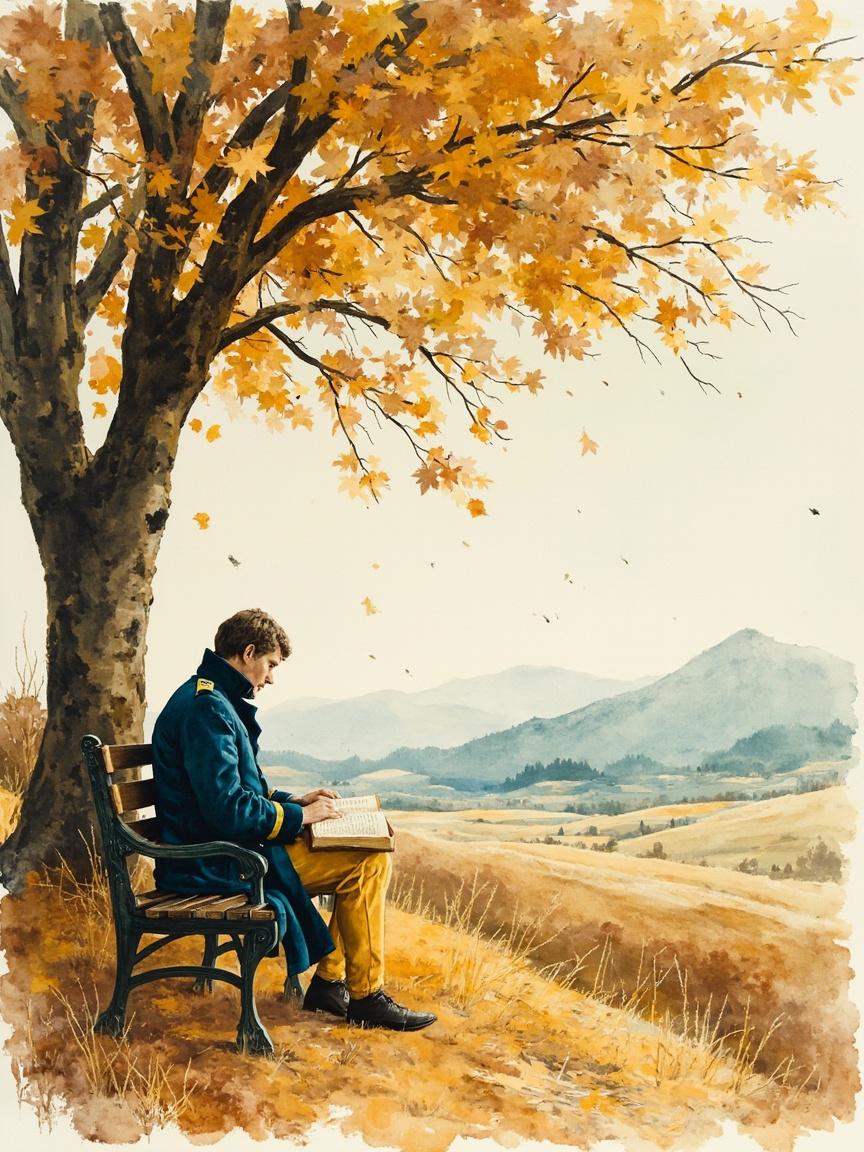
Ossian has superseded Homer in my heart.
在我心里,奥西恩已经取代了荷马。
Original line · October 12 · From light into dark, from Homer to Ossian
6. The night of parting: Ossian, and that embrace
Werther goes to see Lotte one last time. He reads her his own translation of Ossian's poems — lines about parting, loss, love beyond recovery. As he reads, the two of them lose their grip and embrace. The embrace is not the start of an affair; it is the finale. Lotte breaks free of him and, in tears, tells him not to come again. What she says is not that she does not love him — it is that seeing him again would destroy everything they still have left to keep. It is the coolest and cruelest scene in the whole book.
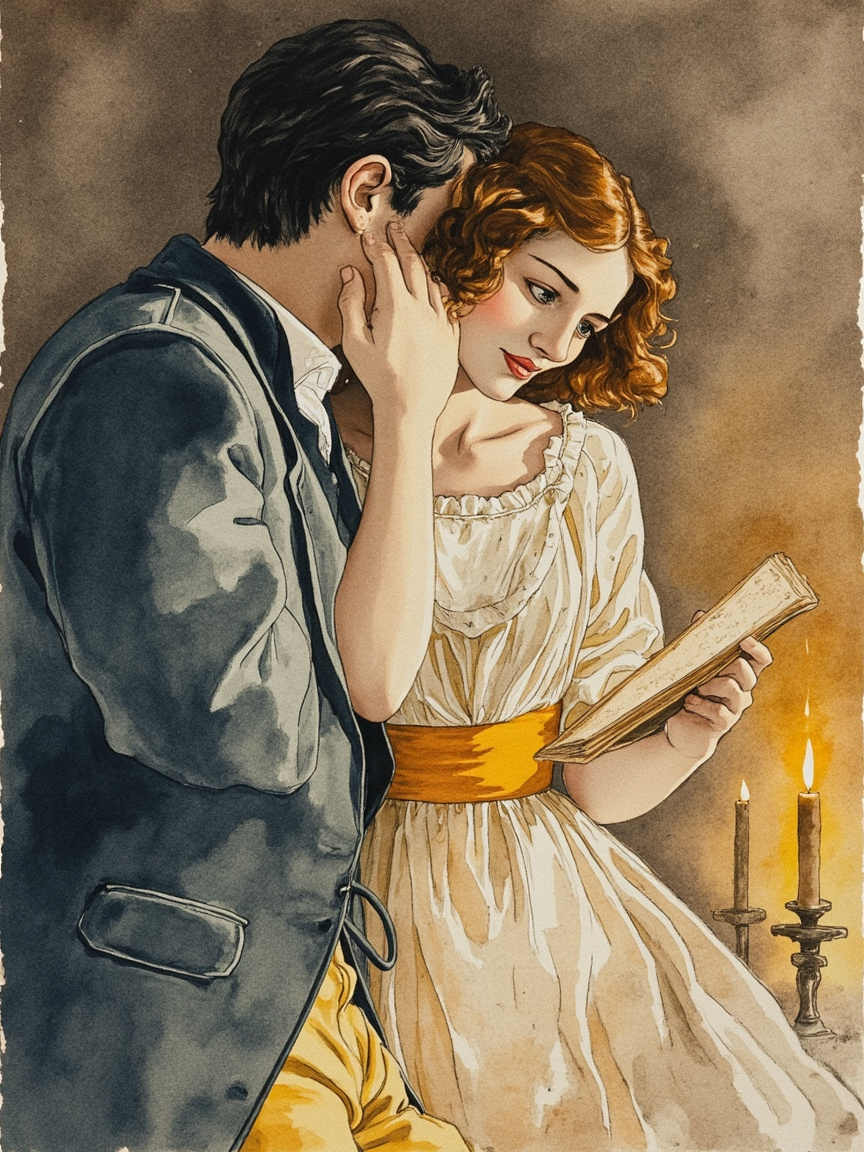
He clasped her in his arms, strained her to his bosom, and covered her trembling lips with passionate kisses.
他把她拥进怀里,紧紧贴在胸前,用滚烫的吻覆住她颤抖的双唇。
Original line · The Editor to the Reader · The night of farewell, the embrace after reading Ossian aloud
7. Death in blue: a gunshot at midnight
On the pretext of a long journey, Werther has Lotte ask Albert to lend him a pair of pistols. Lotte suspects nothing and hands them over. At midnight, he puts on the blue tailcoat and yellow waistcoat everyone in the countryside knows him by, sits at his writing desk, and fires a shot into his own head. He is still breathing when he is found in the morning, and dies at noon. After Werther's death, an anonymous editor who has never appeared in the story steps in with a cold, plain account — piecing together the letters and the witnesses to record Werther's final burial: under the linden trees he mentioned again and again in his letters, with no clergyman present, and neither Albert nor Lotte there to see him laid to rest.
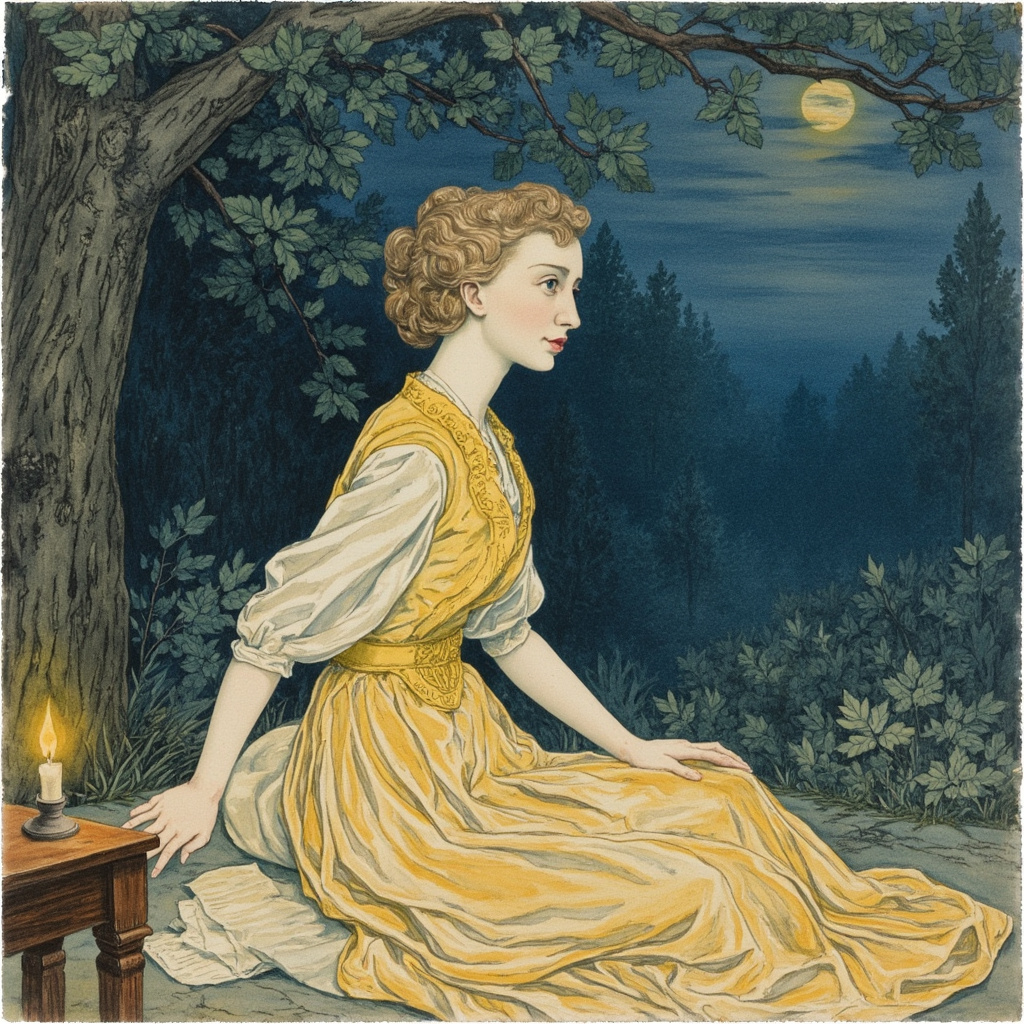
They are loaded—the clock strikes twelve. I say amen. Charlotte, Charlotte! farewell, farewell!
枪已经上膛了——钟敲十二点。我说,阿门。绿蒂,绿蒂!永别了,永别了!
Original line · Werther's last letter · Midnight, death in blue
There is a cruel detail here that often gets overlooked: the pistol was borrowed, and Lotte handled the borrowing herself. A woman hands her beloved husband's pistol to another man who loves her, and the shot goes off the next morning. No one intends murder, and yet everyone is a link in the chain. This is exactly where the book rises above an ordinary love tragedy: it lets no single hand get dirty, while leaving every hand with blood on it.
Yes, Heaven favours my design, and you, Charlotte, provide me with the fatal instruments.
是的,上天成全了我的心愿,而你,绿蒂,亲手把那要命的东西递给了我。
Original line · Werther to Lotte · The pistol passed through her hands
What it is really about
On the surface this is a story of hopeless love. Underneath, it is asking a more dangerous question: how fragile is a heart that takes pride in its own fullness? Werther is not weak — he is gifted, extraordinarily sensitive, moved to tears the instant he sees something beautiful. But it is exactly this kind of person, one who hands his entire self over to feeling, who leaves himself no cushion at all. When the outside world lands its blows one after another — Lotte's engagement, the snobbery of the nobility, the autumn note of Ossian — he has no way to absorb them, because his whole self is built out of these feelings. Once the feeling collapses, he collapses with it.
That is why later Romanticism venerates this book as its founding text — not because it tells a beautiful, sad love triangle, but because it invents a new kind of person: one in whom subjective feeling overwhelms all reason and propriety, whose soul takes pride in its own depth and is devoured by that same depth. Two centuries of literature after it, from the Lake Poets to Byron to Proust, are almost all still dealing with this Werther-shaped self.
The truly frightening thing about this book is not that Werther dies — it is that when you finish it, for one moment, dying inside a feeling that bright almost doesn't sound so bad.
It rewrote reality: the Werther effect
After this book came out, Europe genuinely had an incident on its hands. Young men started dressing like Werther — the blue tailcoat, the yellow waistcoat, the yellow boots; some pinned a bunch of flowers to their chest before going to a dance. Worse, a wave of young men across Europe began imitating Werther's suicide. The term Werther effect was later borrowed by psychology to describe the cluster of deaths that follows media coverage of a suicide — a phenomenon a single book set off more than two hundred years ago, renamed by modern researchers. It made people realize, for the first time, that art is not innocent: it can genuinely rewrite how a generation feels, dresses, and dies.
Why read the text itself
A guide like this one can tell you how Werther dies, why Lotte was never his to have, how important this book is in literary history — but there is one thing no guide can give you: the physical sensation of being carried, a little at a time, by one heart, down into the abyss. Werther's letters to Wilhelm are not analysis, not argument — they are sentences leaking out between the fingers of a living man as he comes apart. One day he is still writing about how great Homer is; three months later there is nothing left but I am about to die, with no transition in between. You have to walk into it yourself, word by word, to feel the speed at which the light drains away — and that speed is something no summary can fit under your skin.
Art Direction2 plates
Before the guide was written, this book got a visual foundation — every illustration you just read grew out of it.
