
The Story of Sinuhe (Tale of Sinuhe / Sinuhe the Sage) · Companion Guide
西努海的故事
四千年前西奈沙漠里一个埃及侍从的逃亡——异乡封王、暮年思乡、终被法老赦回故土的流亡者返乡原典
The Moment a Bronze Dagger Went Through His Shoulder
Four thousand years ago, one night, Sinuhe was crossing the desert. Behind him was the Egypt he had fled; ahead of him, the unfamiliar Levant. This young attendant of the Middle Kingdom court had already been walking alone under the sun for days. A little further on, he would collapse on a dune and be taken in by a foreign chieftain named Ammunenshi. A little further still, he would fight a strongman of the tribe in single combat, a bronze dagger driving through his opponent's shoulder. Many years after that, he would stand at a Mediterranean harbor, recognize a scroll sent from Pharaoh's court, and fall to his knees in tears.
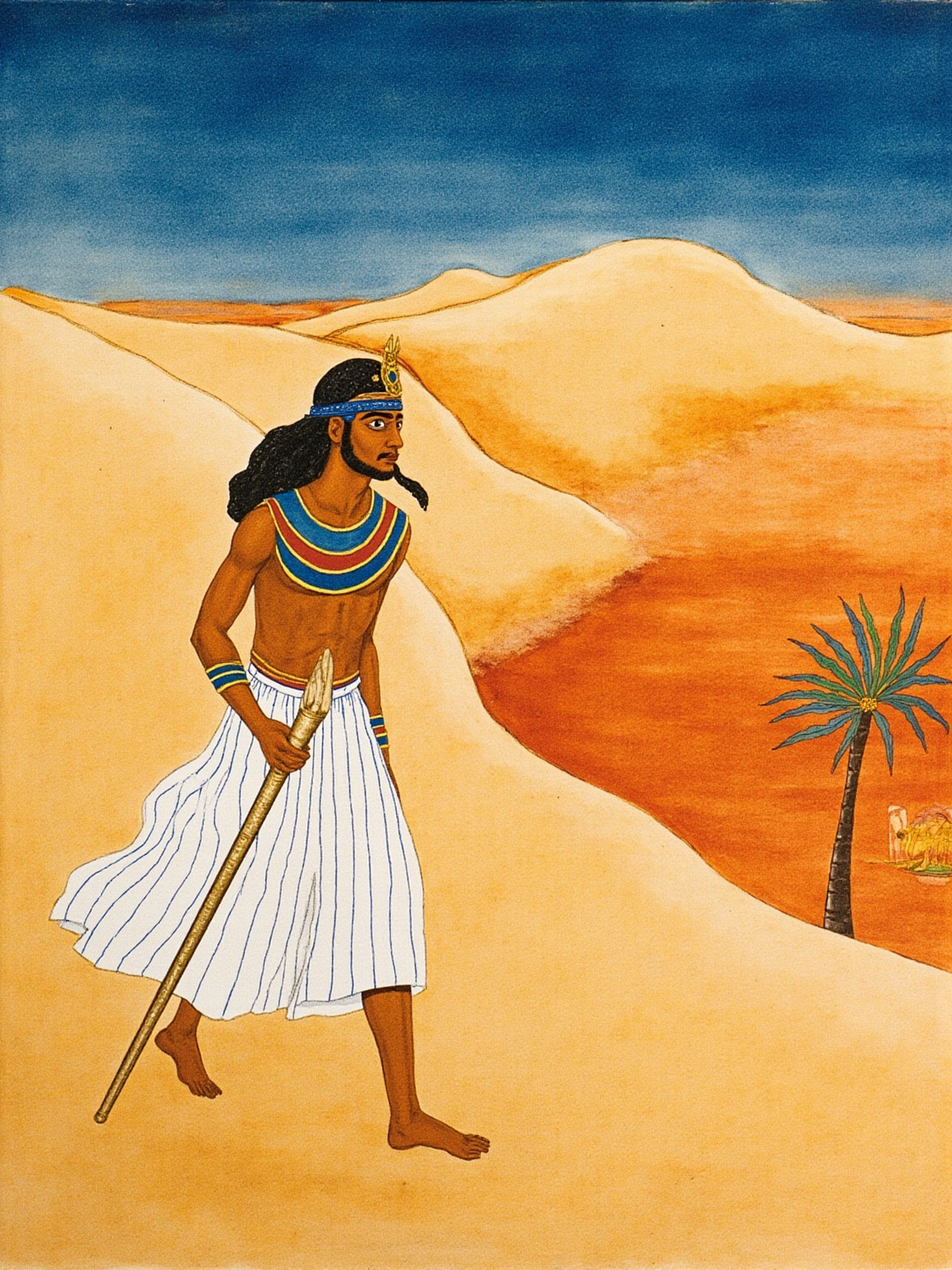
I fled, I did not know myself why; I was frightened, I did not hear and I did not see.
我逃了,我自己也不知道是为什么;我心里一慌,耳里听不见,眼里看不见。
金句 · 出奔之夜 · 西奈绿洲
A Novel of Adventure, Written on Papyrus
The Story of Sinuhe was composed around the mid-nineteenth century BCE, under Sesostris I of the Twelfth Dynasty, by an anonymous court scribe. It is the masterwork of Middle Kingdom Egyptian literature, and the earliest first-person adventure narrative that survives from any civilization. The whole thing is told in Sinuhe's own voice, from the night he flees during a northern campaign to the old age in which he is pardoned and brought home, a first-person voice that the West would not see again for another thousand years, when Greek and Roman prose fiction first took shape. When people think of ancient Egyptian narrative, the Book of the Dead usually comes to mind first, a guide for the dead, written to walk them into the afterlife. The Story of Sinuhe is different. It is about a living man's return home, a homecoming granted only once he had, in every sense that mattered, already died.
The Hero, and the People Around Him
Sinuhe began as a trusted attendant close to Pharaoh Sesostris I, quick-witted, sharp-tongued, capable. He had no royal blood, but he could hold his own in the king's presence, and that was the whole of his standing. Few people orbit him in the story: Sesostris I is the king who pardons him and grants him passage home; the Queen Mother Neferu is the maternal figure before whom he finally kneels at court; Ammunenshi is the Levantine tribal chieftain who takes him in, gives him his eldest daughter in marriage, and makes him one of his own people; and that eldest daughter bears him his firstborn son, then stays behind in that land when he leaves. These five people hold up a simple triangle: Egypt is home and royal favor, the Levant is exile and human warmth, and Sinuhe stands between them, spending a lifetime measuring the distance.
Word Comes of Pharaoh's Death on the Northern Campaign, and He Runs
The story opens on the march, with Sesostris I campaigning north into the Levant. Pharaoh's camp has already pushed to the frontier line at the Sinai oasis, which the text calls the Walls of the Ruler. Sinuhe is among the attendants. One day, word reaches the royal tent that Pharaoh has died. Panic seizes Sinuhe, and that same night he slips away. Why does he run? The text never says outright. One copy hints that he overheard a secret conference at court and feared he would be silenced for it. But it's more likely this: as a close attendant with no royal blood, standing in the crack between one reign and the next, he saw his own death coming. A man's instinct for danger arrives before any charge is ever laid against him. This is the most psychologically dense line in the whole work: three thousand years of exile literature since has been writing some version of 'I don't even know what I'm afraid of, but I have to run.'
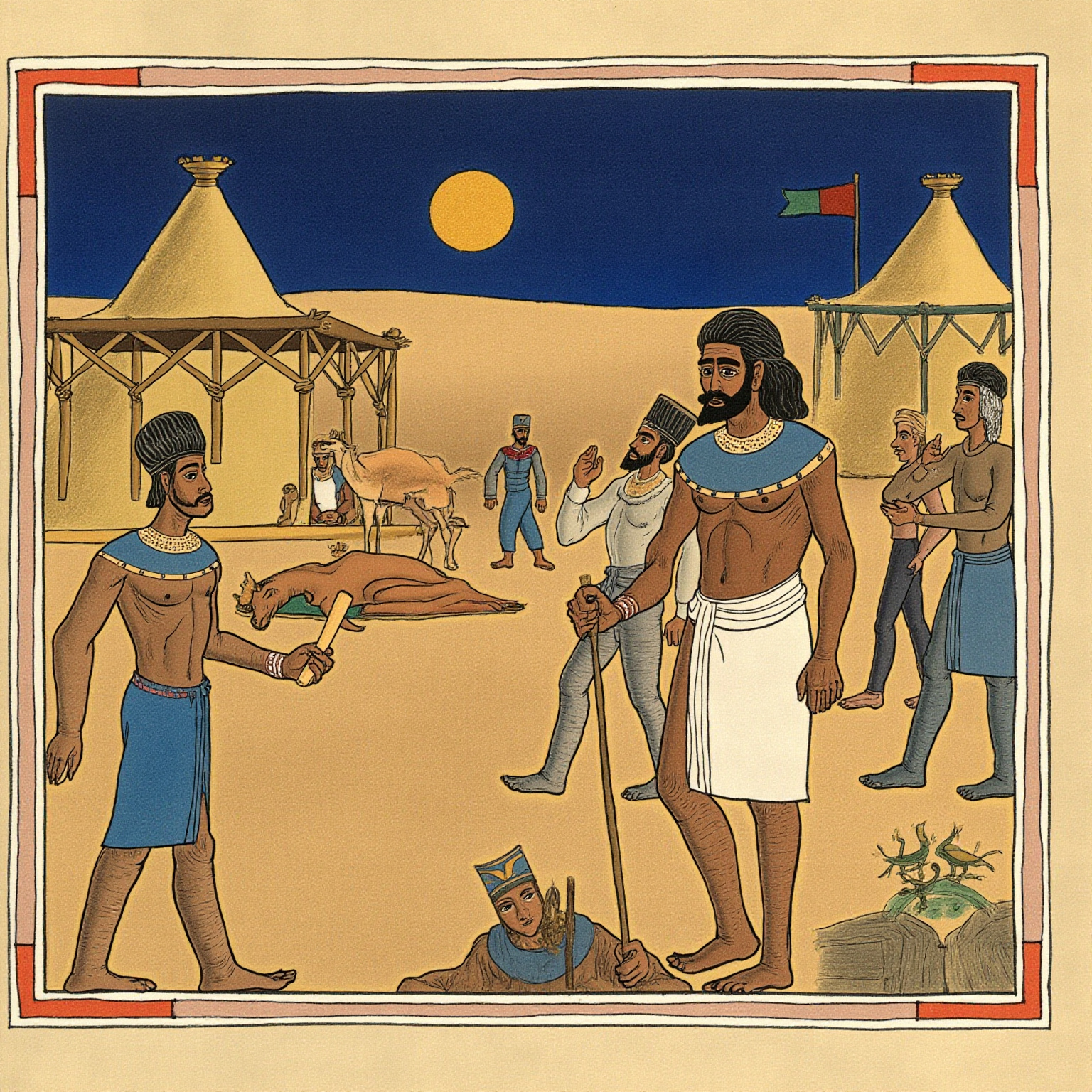
I gave water to one who was thirsty; I set one who had been strayed on the road.
我给渴的人水喝,我把迷路的人引回路上——阿姆是这么说的,族人也是这么传的。
金句 · 阿姆帐下 · 牧人款待
Desert, Near Death, and a Foreign Chieftain's Tent of Skins
The crossing of the Sinai desert is told with extreme economy: no heroics, just 'I nearly died of thirst.' By the time he is found, he is half-conscious. His rescuer is Ammunenshi, chieftain of the Retjenu nomads. A city man raised in the Egyptian court is suddenly pulled into a world of goatskin tents, curdled milk, and woven cloth in many colors. He survives on two things: the medical knowledge and rhetoric of an Egyptian scribe, and a sharp eye for people. Ammunenshi quickly sees the use in this outsider. He gives Sinuhe land, tribal standing, and his eldest daughter in marriage; Sinuhe has a son, and puts down roots in a foreign land. What's best written here is the rhythm of being taken in: not one grand act of generosity, but a slow accumulation of 'stay a while longer.' That is how the highlands of the ancient Near East received a guest, four thousand years ago.
Combat for the Chieftainship: Bronze Dagger, Stripped Bow, Broken Spear
The good years don't last long before a strongman of the tribe challenges him openly. The duel is the most vivid, most cinematic scene in the book, written with the clean economy of a storyboard: Sinuhe drives a bronze dagger through the challenger's shoulder, strips him of his bow and quiver, and snaps his spear shaft in two. The man kneels; the whole camp accepts Sinuhe as chief. This is the ancestor of every later hero-wins-the-crown-in-single-combat scene, earlier than Homer, earlier than Beowulf, earlier than nearly any European epic you could name. But the scene is staged, not naturalistic: a ritualized freeze-frame of action, stab, strip, snap, three verbs and a transfer of power finished in three seconds. The first time I read it, I went back and reread the previous page. That restraint hits harder than gore would.
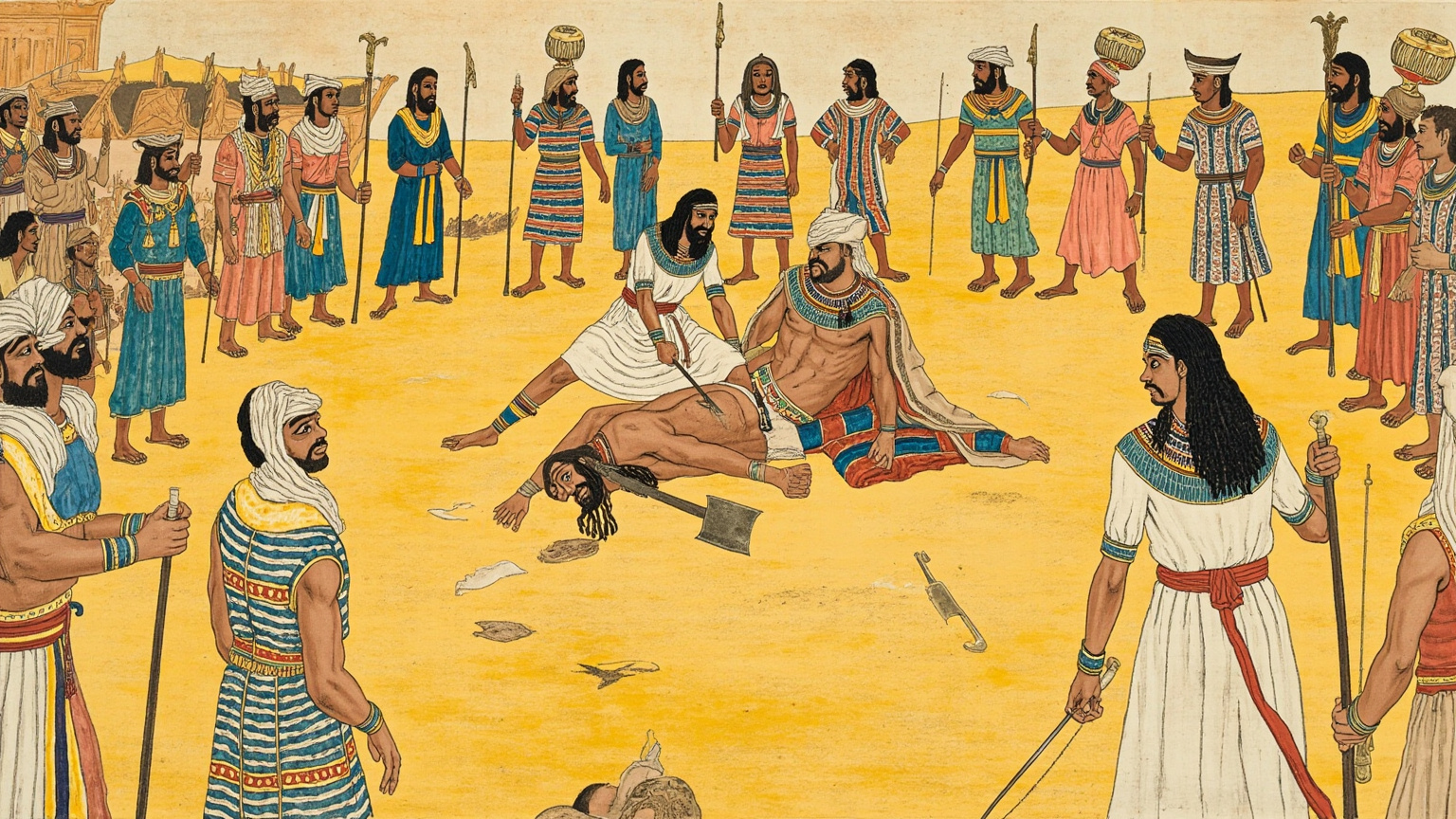
I stripped off his bow, I took away his arrows from his arm, and I broke his spear in two.
我剥下他的弓,卸去他臂上的箭袋,又把他的矛杆从中间折成两截。
金句 · 决斗封王 · Retjenu旷野
An Old Man's Homesickness: Praying by a Well in Sinai
Years into his chieftaincy, Sinuhe starts dreaming: rivers, palms, temples, all shaped like Egypt. He is old now, and one fear has taken hold of him: dying in a foreign land. To the Egyptian mind, being buried at home, buried properly, mattered more than staying alive. No chieftain's seat could save his bones. Under cover of sending tribute to Pharaoh, he attaches a petition, asking the temple to plead his case before the king. This is the first time the word 'home' steps out of his private thoughts and into the open; until now it had only been an itch inside him, now it is a letter.
The Pardon: A Royal Fleet on the Mediterranean Shore
Sesostris I doesn't posture. The pardon comes down as two direct orders: one to Sinuhe, granting him passage home; one to Ammunenshi, telling him not to stand in the way. This double decree is one of the great set pieces of ancient Egyptian political writing: royal favor has to be airtight, down to smoothing over even the obligations owed to the man being pardoned. When the royal fleet reaches the Levantine coast, Sinuhe recognizes the scroll and the royal seal at a glance. The text says he threw himself down on the sand and wept. A man who has been chief of his own people, in middle age, crying like a child to the sound of Mediterranean waves. This is the climax of the book, and it doesn't have a single line of dialogue, only one gesture.

Now that I have heard the summons of my lord, I will say: How sweet is your face, O King!
既已得闻我主的召还,我只能说:君王啊,您的面容何其可亲!
金句 · 御前双令 · 黎凡特海岸
Return to Memphis: Through Customs, Into the Palace, Offering a Figure of Maat
The ship carries him back to Memphis. Outside the palace gate, he bathes and changes clothes first; this matters, because a returning exile from the desert has to be made clean again before he can enter the court. He passes through the formalities, enters the palace, bows before Pharaoh, then bows again before the Queen Mother Neferu. What he offers her is a small figure of Maat, the Egyptian principle of order and truth, and such figures were a standard vehicle in the Middle Kingdom for royal dedicatory inscriptions. The gift reads as a pledge of order rather than a devotional offering: you pardoned me and brought me home, and I still keep your law. It's a shrewd choice of gift. Four thousand years ago at the Egyptian court, you learned the rules before you walked through the door.
A House, Land, Meals for Life, and Finally a Grave Among Pharaoh's Priests
Sesostris I grants him a house, an estate, and daily meals from the palace. He lives out his remaining years in comfort. The text never says how he dies, only how he is buried: he arranges to be laid to rest among the priesthood of Pharaoh's own tomb. It's the best ending an ancient Egyptian could imagine: the king's man in life, and still at the king's side in death. The Story of Sinuhe closes here, an exile finally returned to the one place that was truly his. His wife and children stay behind in the Levant; the text says nothing more about them, but the reader understands: he went home, and they were the ones who kept that other half of his life for him.
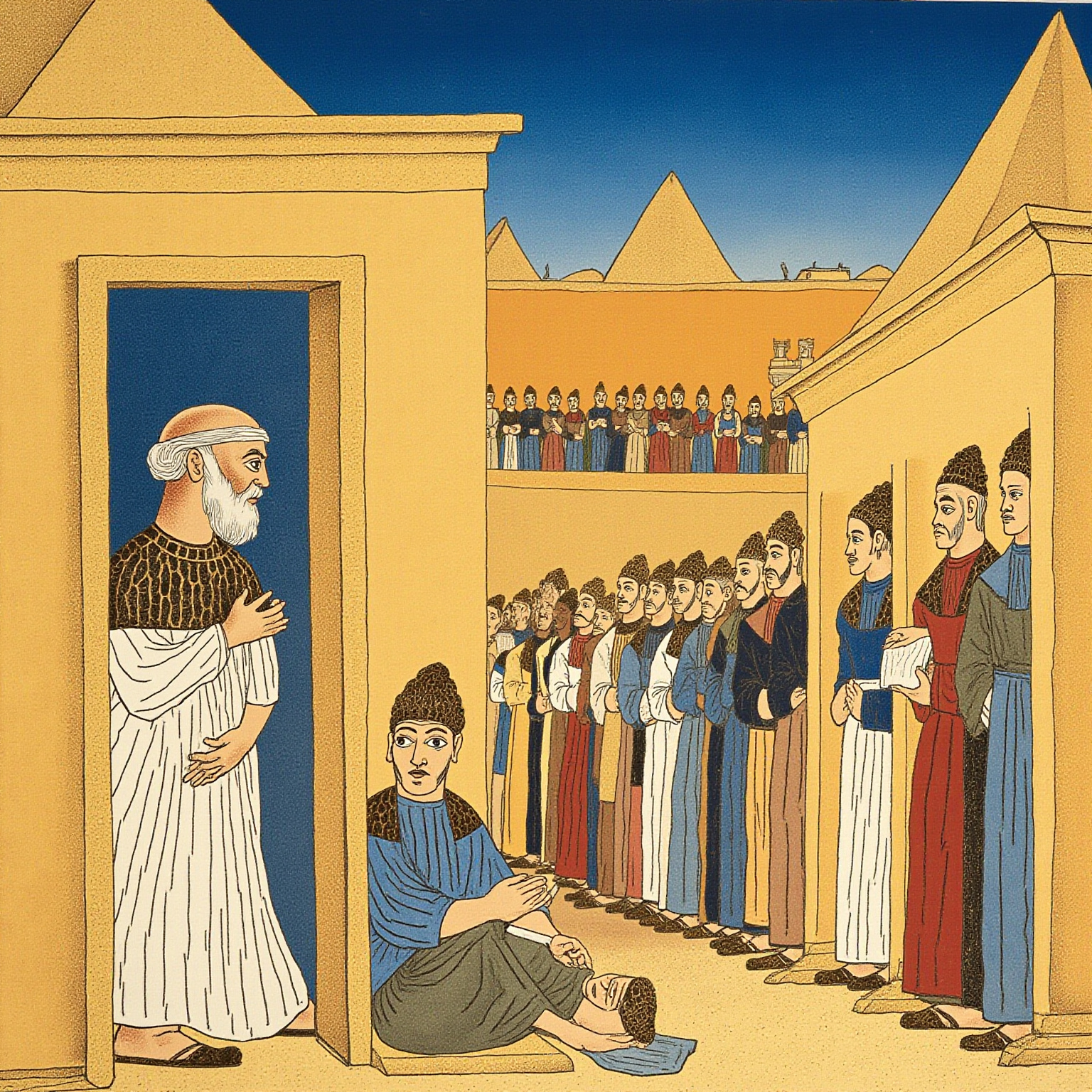
Let a coffin be given me, and let me be borne to my tomb, in my shroud of fine linen.
求您赐我一副棺木,让我身穿细麻寿衣,被抬回我自己的墓里去。
金句 · 御赐归葬 · 孟菲斯宫门
What It's Really About, and Why It Has Lasted
What the Story of Sinuhe is really asking is a question that got asked very early: where does a person actually belong? You can be taken in by a foreign land, made its chief, treated as one of its own, but where should your bones be laid? In the Middle Kingdom worldview, the answer is unambiguous: Egypt. The question of belonging was already being worked through four thousand years ago, and worked through with more nerve than a lot of books have managed since. It shares its central theme, the exile's homecoming, with Gilgamesh, with the Odyssey, with Exodus. But it is the earliest of them, the quietest, and the most restrained. What earns the most respect in how it's written is using action to carry feeling: Sinuhe's fear is never explained to the reader; it shows itself in the night he takes off running. His homesickness is never spoken; it leaks out the moment he kneels on wet sand. A scribe four thousand years ago already knew that one sentence left unwritten does more work than one written.
Why You Should Still Read the Original, Even Knowing How It Ends
I can tell you the whole plot, but there are two things no summary can ever hand you. The first is the rhythm of the first person. Sinuhe is the earliest adventurer in literary history to stand up and say 'I,' and every line of his own telling carries body heat: the vagueness of 'I don't even know what I was afraid of,' the bluntness of 'I threw myself down on the sand.' You have to walk the desert with him yourself, pass through the tent flap, kneel at the harbor, to actually hear it. The second is the breath of the ancient Egyptian language itself. The Chinese translation is moving enough on its own, but pick up A. M. Blackman's or R. B. Parkinson's English translation and you'll find that this four-thousand-year-old hieroglyphic narrative has a remarkably steady breathing pattern, long sentences and short ones trading off, like the Nile rising and falling. Read the original after you already know the plot, and the second time through, you can finally hear that rhythm instead of just chasing what happens next.
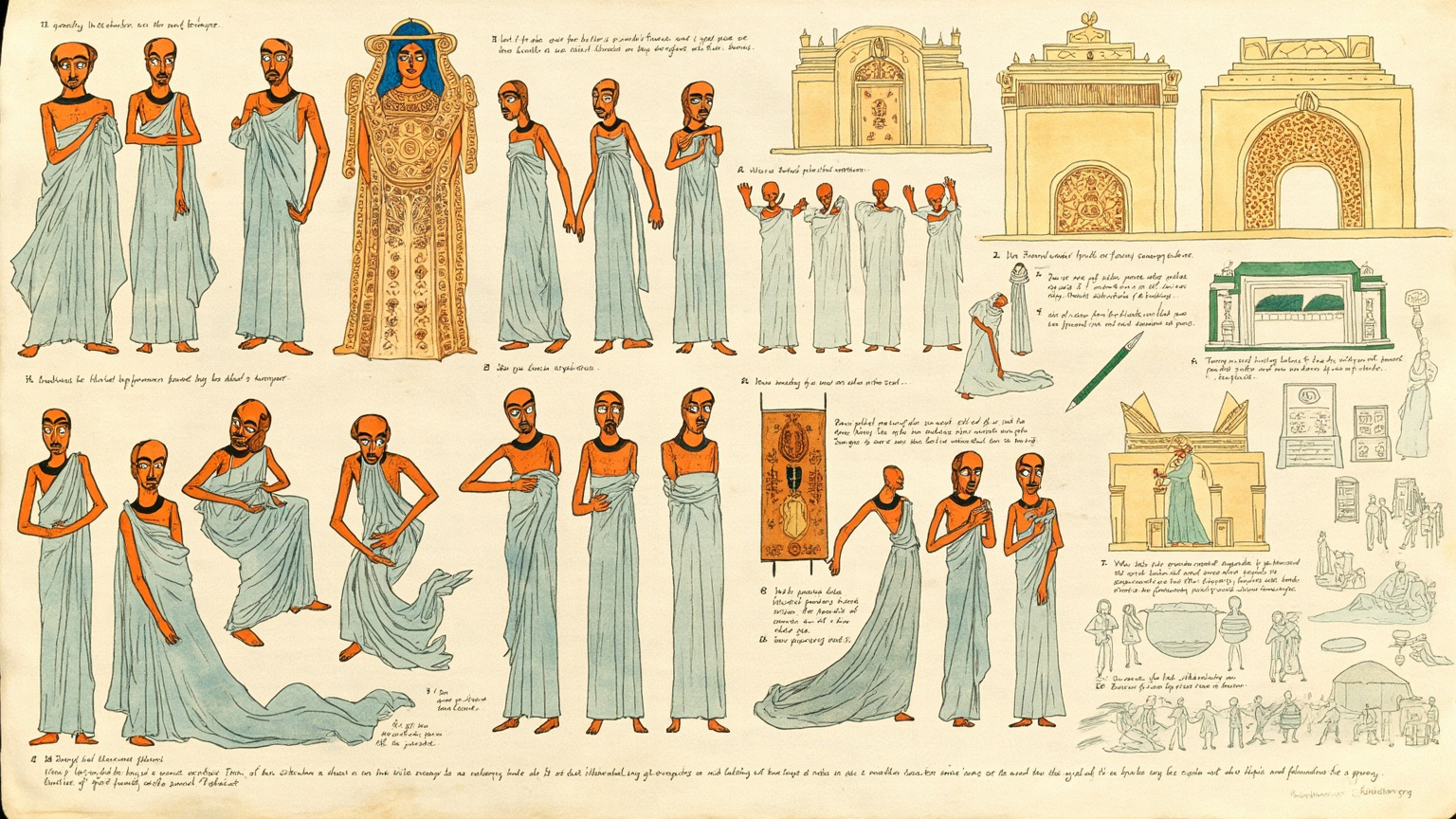
Art Direction4 plates
Before the guide was written, this book got a visual foundation — every illustration you just read grew out of it.