The Three Musketeers · Companion Guide
The Three Musketeers
A penniless young Gascon walks into Paris with a letter of introduction and picks three duels in one day — and from there, four swords go up against the Cardinal's whole machinery of state, and a woman named Milady.
Opening: a poor young man and a yellow horse
That April, from the Gascon countryside in the south of France, a young man set out for Paris on a scrawny yellow horse. His father had given him the worst-looking animal in the whole parish, and tucked into his coat a letter of introduction — his passage to Monsieur de Tréville, captain of the King's Musketeers. The young man was d'Artagnan, and he owned nothing else worth naming: a long, slender sword handed down from his father, a nerve entirely out of proportion to his prospects, and a line every Gascon seems born reciting — that one day people would know his name. He hadn't even cleared the first town before he ran into two strange figures outside an inn at Meung: a man in black humiliated him in public and made off with his letter, while a fair-haired beauty beside him smiled faintly, as if she had been expecting him all along. From that moment — before Paris was even in sight — d'Artagnan's fate was already tied to three enemies for life: Rochefort, the Cardinal's man, and the deadliest of the three, a woman the world would come to know only as Milady.
What kind of book this is
The Three Musketeers is the 1844 novel by the French writer Alexandre Dumas, first serialized in the Paris newspaper Le Siècle, and it set all of Europe alight the moment it appeared. It is the template for what later became known as swashbuckling adventure fiction — plumed hats, capes flaring, soft leather breastplates, long swords ringing through back alleys. For more than a century since, from Dumas's page to Hollywood's screen, from Pirates of the Caribbean to countless comics for young readers, the line "all for one and one for all" has traveled the world precisely because this book made it the emblem of the adventuring spirit. Dumas is a tyrant of pacing — his rhythm runs like a horse that has slipped its bridle, and his suspense hooks the reader by the collar and drags them on. Worth remembering: he did not write it alone. The novel was co-written with his collaborator Auguste Maquet, drawing its material from the semi-fictional Memoirs of Monsieur d'Artagnan — the characters have real historical originals, but the plot is the novelist's own bold invention.
People and world: four men, a pair of mortal enemies
The true core of the book is four men. The three Musketeers — Athos, Porthos, and Aramis — already had reputations inside the King's Musketeers: Athos is the brooding, noble elder brother of the group, a drinker of few words hiding a past he cannot bear to revisit; Porthos is a hulking, vain man who spends his days boasting about his new clothes and his noble mistresses, yet he is the bluntly brave, loyal one of the four; Aramis is handsome and amorous, forever announcing he is about to become a priest while actually working every angle between great ladies' skirts and court intrigue. And d'Artagnan — the poor Gascon who rode into the capital on a yellow horse — is not one of the "three Musketeers" at all. He is the newcomer who crashes into their company and does not formally join until partway through the story. But he is the true protagonist, because the engine driving the whole novel is his reckless, headlong nerve. He falls for Constance, a young lady-in-waiting to the Queen, and the two of them get swept into the secret affair of the Queen's diamond studs and the Duke of Buckingham of England. Standing against them is Cardinal Richelieu — the real power in France, commanding both the Cardinal's Guard and a spy network that reaches across Europe. Richelieu is shrewd and formidable; Dumas writes him not as a cardboard villain but as a strongman who commands a kind of respect. The true cardboard villains are his lieutenant Rochefort, and the lethal Milady de Winter — Richelieu's female spy, beautiful as a snake, branded on the shoulder with the executioner's fleur-de-lis mark of shame. She poisons Constance, seduces a Puritan into assassinating Buckingham, and is finally executed by the four friends on a riverbank at night. The whole story unfolds between 1625 and 1628, under the reign of Louis XIII and the rule of Richelieu, in a world built out of capes, swords, and court intrigue.
The plot: from Paris back-alley duels to the English Channel
D'Artagnan arrives in Paris and manages to arrange three duels in a single day — he collides with Athos outside Monsieur de Tréville's residence, offends Porthos beneath a window on the Rue des Fossoyeurs, and nearly draws on Aramis outside a church near the seminary. He has no idea that all three men he has insulted belong to the same company. On the appointed day, the four of them walk out, swords in hand, to a stretch of ground behind the Luxembourg to settle accounts — only for the Cardinal's Guard to come charging in to take them all at once. That is when the book's first great swerve arrives: four men who were about to kill each other instead turn, back to back, and cut the attacking guardsmen to pieces. Friendship is forged right there in the clash of blades — all for one, and one for all.
But this euphoria is only the setup — the real test arrives fast and merciless. Queen Anne had once given a set of twelve diamond studs to the Duke of Buckingham of England as a private gift, and Richelieu engineers a trap to expose it publicly at the King's ball and humiliate her. Word reaches Constance, who passes it to d'Artagnan and his three friends: the studs must be retrieved from London before the ball. The four ride out of Paris in different directions, racing the clock toward the English Channel. One by one the others fall away — Porthos is held up by a mistress, Aramis stops for an old flame, Athos breaks off alone to chase down Milady — and d'Artagnan reaches London by himself. This is the most dramatic stretch in the whole book: Milady has already snipped two of the studs off in advance, so Buckingham has goldsmiths work through the night to replace them, and d'Artagnan, with the recovered set in his coat, boards a ship and races back to Paris just as the ball is about to begin, pulling the Queen's honor back from the edge.
Retrieving the studs is only the surface plot — the real undercurrent starts here. D'Artagnan and Constance's love comes to light, and at the same time Milady sets her sights on him. She has already tried to seduce him, undressing in front of him, and in doing so lets him glimpse the fleur-de-lis branded on her shoulder. Milady swears on the spot that anyone who has seen that mark must die. That becomes the darkest hook in the book, hanging over every page that follows. Constance is soon kidnapped and vanishes; d'Artagnan finds himself fighting Richelieu's open attacks with one hand and dodging Milady's hidden arrows with the other, love and mortal danger tangled together.
The stage shifts, midway through, to the Siege of La Rochelle — a real historical event, the French royal army besieging a Huguenot stronghold, one of the bloodiest chapters of the age. The four men hold the Bastion Saint-Gervais, and while cannon fire shakes the ground outside the walls, they sit calmly among the rubble drinking from china cups and eating breakfast, using the noise of the guns to cover a private conversation — this is Dumas at his most inspired: heroism revealing its true face in the least romantic mud imaginable. It is here, too, that Athos finally tells the story of his history with Milady: as a young man he married a woman with a fleur-de-lis branded on her shoulder, believing her nobly born, only to discover she was the executioner's foster daughter, a practiced schemer — and he hanged her with his own hands. Except she did not die. She survived, and in time became the Cardinal's weapon. Only now does the reader understand that the brooding, silent Athos has been carrying a live coal in his chest the whole time.
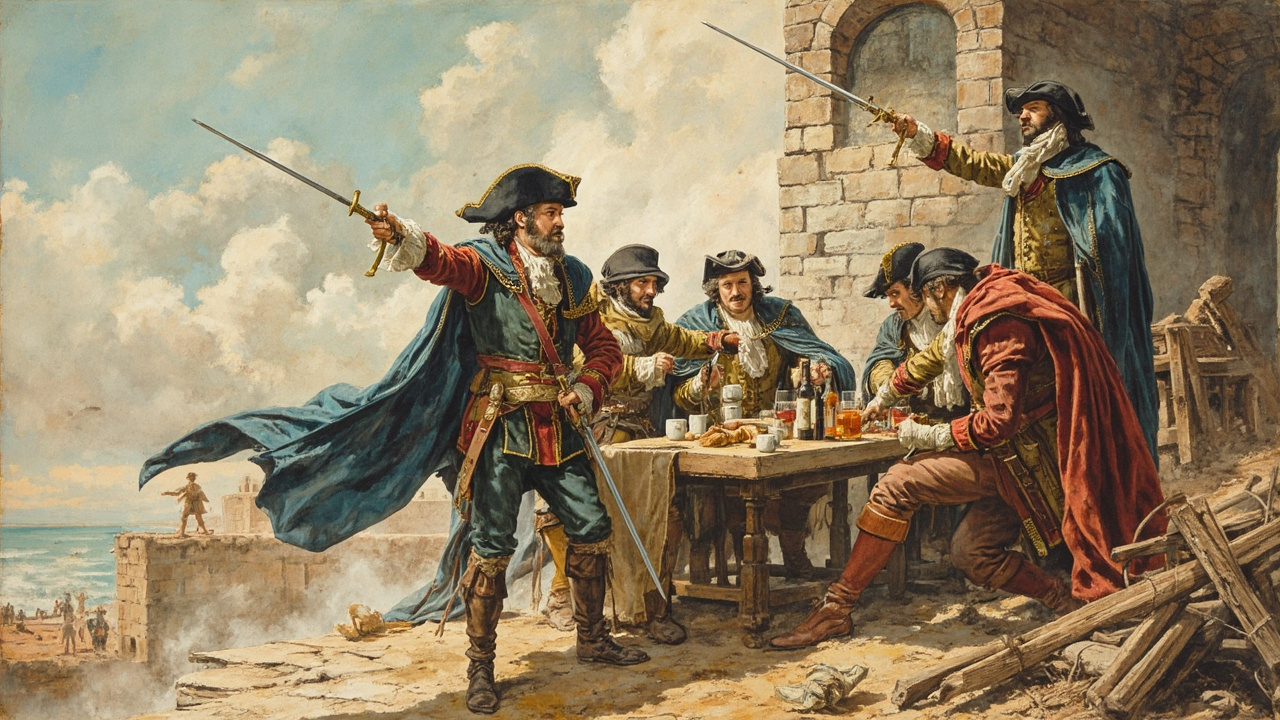
Gentlemen, a few friends and myself are about to breakfast in this bastion. Now, you know nothing is more disagreeable than being disturbed when one is at breakfast.
先生们,我和几位朋友正要在这座棱堡里用早餐。要知道,人在用餐时被打扰,是再扫兴不过的事了。
Original line · Chapter 47 · at the bastion of Saint-Gervais, Athos stands in the breach and shouts down at the enemy closing in
Meanwhile the hand Milady reaches back from England is deadlier than any cannon. Held prisoner in London, she seduces her jailer Felton, a Puritan burning with religious zeal, talks him into freeing her, and has him assassinate Buckingham with his own hand. Buckingham's death shakes all of Europe. She then slips back into France to finish what she really came for: poisoning Constance. D'Artagnan's love, the Queen's gentle young attendant, dies smiling into Milady's trap. From here the machinery of revenge grinds through the entire second half of the book — the four friends, together with Lord de Winter and the executioner of Lille, track Milady down to her hiding place and hold a trial with no judge on a riverbank at night. The verdict was written long before the trial began: she must die. And when the executioner raises his sword, the reader finds they trust the friendship among these four swordsmen more than they trust any code of law.
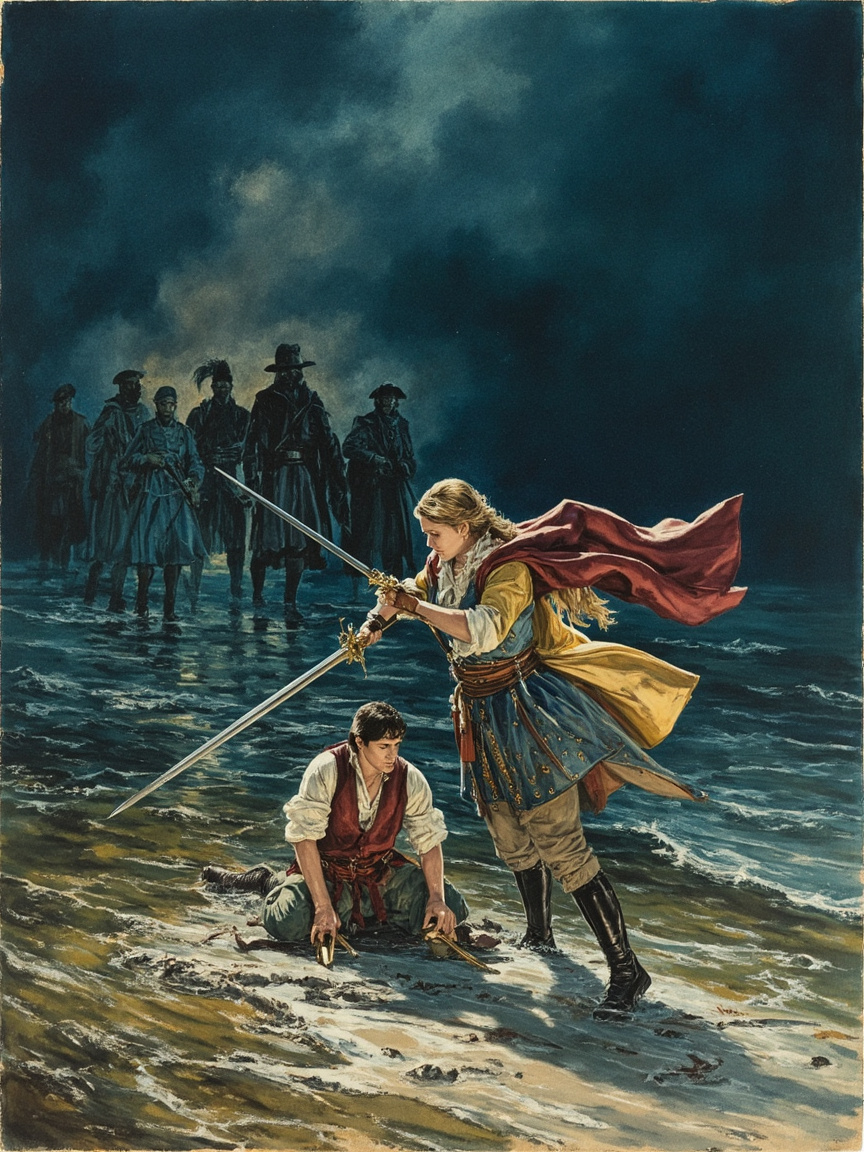
You do not belong to the human species; you are a demon escaped from hell, whither we send you back again.
你不属于人类;你是一个从地狱逃出来的恶魔——我们这就把你送回去。
Original line · Chapter 66 · the midnight execution on the bank of the Lys, Athos to Milady
The ending arrives with a twist. Richelieu had meant to use Milady to gain the upper hand, but the four friends have her executed first — outmaneuvered, he simply pardons d'Artagnan's overreach and even promotes him to lieutenant of the King's Musketeers. With nothing but a sword and his nerve, the young man has carved out a name for himself in the most dangerous cracks of seventeenth-century French power. The four friends settle back into themselves — Athos sinks back into his melancholy, Porthos goes on showing off his new clothes, Aramis goes on talking about becoming a priest — while d'Artagnan stitches "all for one, and one for all" onto his own banner. The story ends; the loyalty endures.
Why it is considered a great novel
What makes The Three Musketeers good starts with an almost brutal narrative drive — Dumas was the king of the serial, leaving a hook at the end of every chapter, so the reader knows it is time to sleep and cannot put the book down anyway. It forged every component of swashbuckling adventure fiction into its archetypal form: plumed hats, capes, slender swords, soft leather breastplates, court intrigue, a deadly beauty, four friends sworn to each other, heroism calmly eating breakfast in the worst of circumstances. This aesthetic template has ruled adventure fiction and film for more than a century since, and you can measure how deep it runs from the fact that the phrase "the three musketeers" alone is enough to stand for a whole human feeling. But it is far more than a thrill ride. Milady is one of the most fully realized femmes fatales in European literature — the fleur-de-lis on her shoulder is both a physical brand and a moral original sin. Athos's tragic past casts a shadow over all his youthful bravado. Even the villain Richelieu is no cardboard evildoer, but a strongman who commands both fear and a measure of respect. Beneath all the exuberance runs a constant undertow of conspiracy and revenge — and that is the real reason this book still reads as well in the twenty-first century as it did in the nineteenth: it understands human nature at its most complicated.
It is the story of four men prying open a machine of state with nothing but a sword each — and of friendship revealing its true face in the least romantic mud there is, which is exactly where every great adventure story earns its keep.
Why you should read the original: the map is not the territory
You already know who the four musketeers are, how Milady dies, how d'Artagnan makes his name. But an explainer only gives you the map; the novel itself is the territory. What makes Dumas genuinely good, you can only get by turning the pages yourself — the tremor hidden in Athos's monologues every time he gets drunk, the few seconds of sudden, startling humanity that cross Milady's face as she faces the executioner on that riverbank at night, the strange calm of d'Artagnan and his three friends raising their breakfast cups amid the cannon fire at La Rochelle, as if to say death can wait until tomorrow, but today we drink. And there is the craft that belongs only to serial fiction — the hook at the end of every chapter, the small props everyone forgets to notice (the yellow horse, the sword handed down from his father, the letter of introduction that gets stolen) — all of which only show their real weight across the full length of the book. Knowing the plot in advance actually lets you watch more closely how Dumas threads these details together, one strand at a time. One more thing: this is only the first book of the d'Artagnan trilogy. His later story continues in Twenty Years After and The Vicomte de Bragelonne, where the secret of the Man in the Iron Mask is waiting — but that is an easter egg to unwrap only after you have finished this one.
Art Direction3 plates
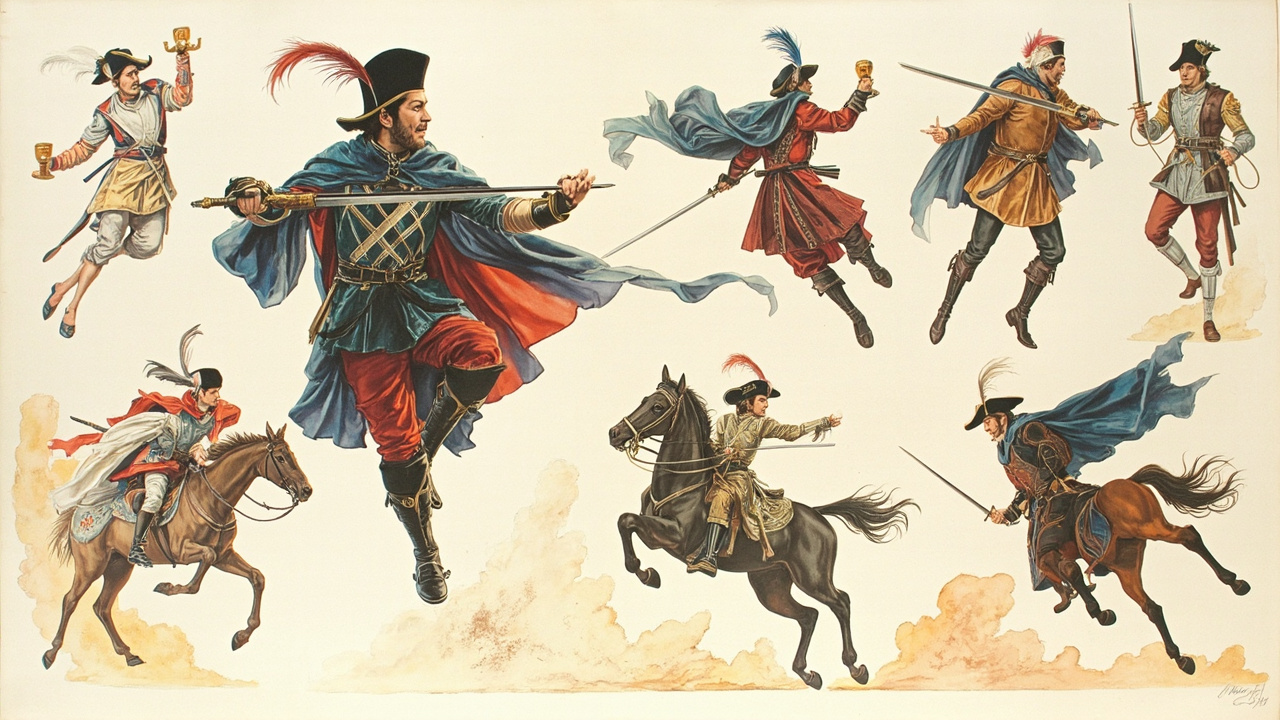
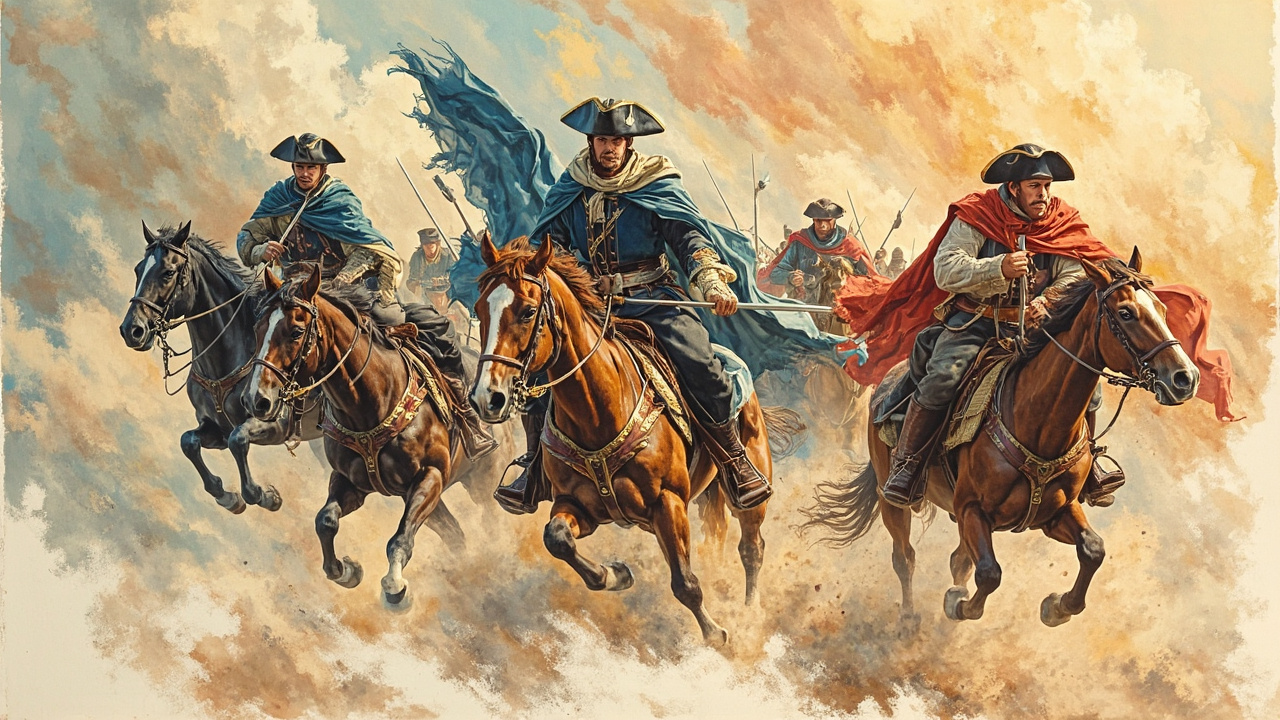
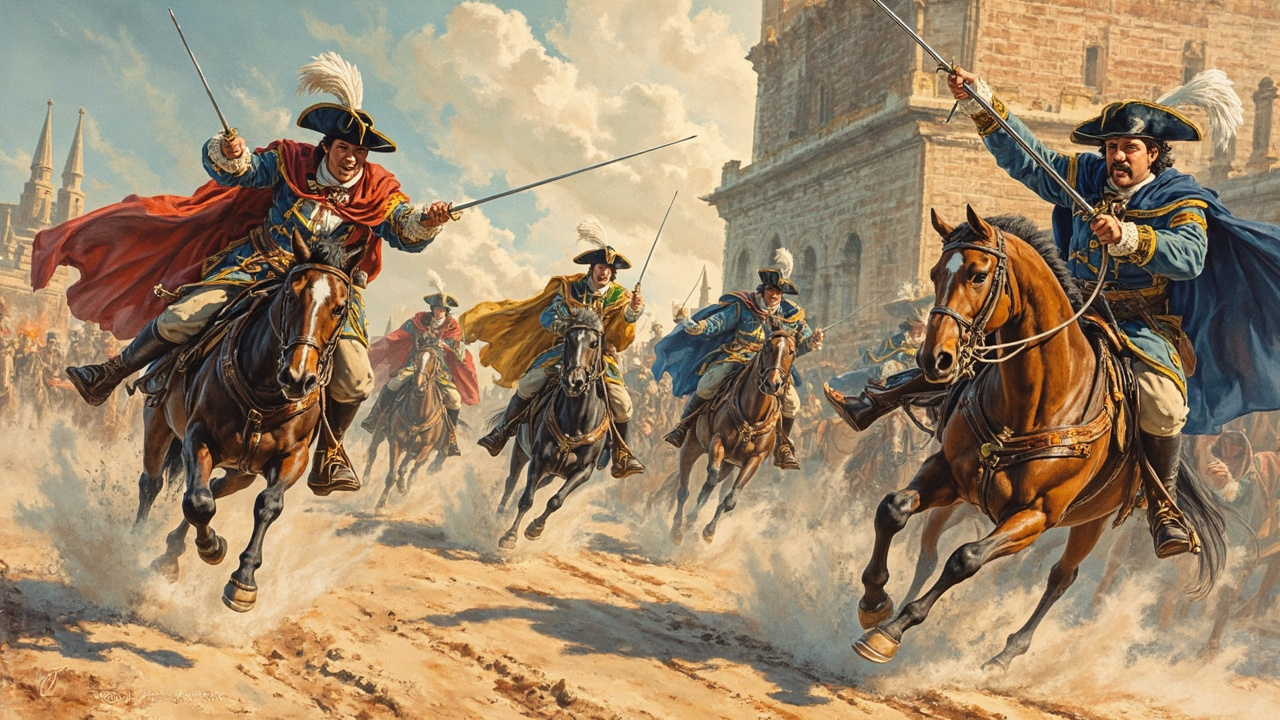
Before the guide was written, this book got a visual foundation — every illustration you just read grew out of it.