The Vegetarian (Korean: 채식주의자) · Companion Guide
素食者
一个韩国家庭主妇把肉从嘴里剔除,再剔除掉一切食物,最后想把自己活成一棵树
Opening: The Piece of Meat She Would No Longer Touch
A plate of grilled meat is set on the table, and she puts down her chopsticks. No one understands what she's saying — she probably can't explain it herself. From that day on, an ordinary Korean housewife removes meat from her mouth, then removes food altogether, and finally tries to turn herself into a tree.
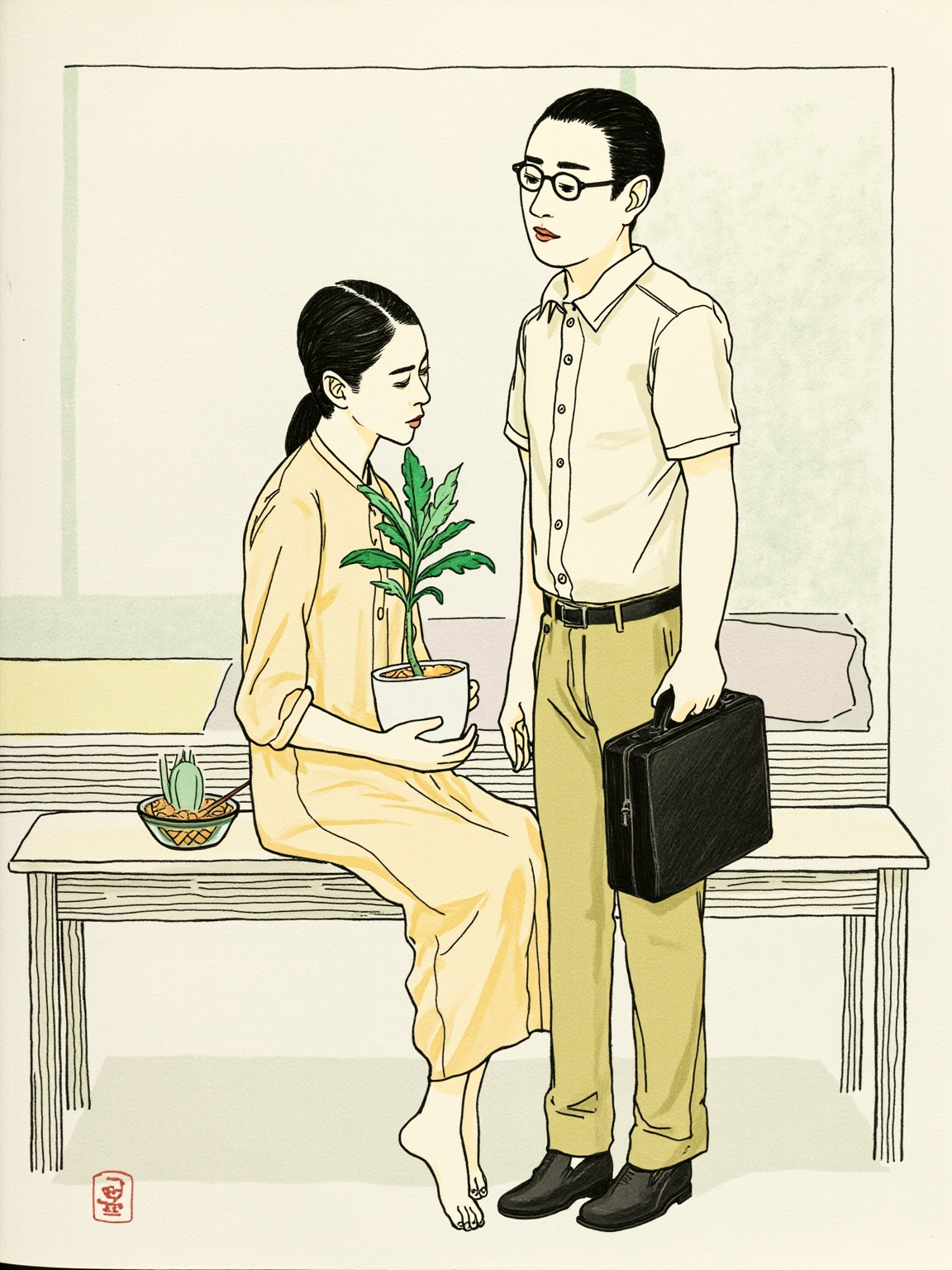
The first idea to clear out before reading this book is: this is not about how vegetarianism is good for you. When Yeong-hye pushes the meat away, she's pushing away an entire way of life — a arranged marriage, a woman served up and consumed, and the days she herself once swallowed obediently.
What Kind of Book Is This
The Vegetarian is a novella in three parts that Han Kang completed in 2007, each section narrated by a different person — the husband tells one, the brother-in-law tells another, the sister tells the third. Han Kang herself went on to win the Nobel Prize in Literature in 2024, and this book had already won the International Booker Prize in 2016 with English translator Deborah Smith, which was when she first came to the world's attention.
Its most remembered trick is stretching the smallest act — eating — into a social parable: one person refuses to eat, and three people around her take turns scrutinizing her, each view more out of sync than the last, until no one sees her at all.
Character and World
The protagonist Yeong-hye is a housewife in her early thirties with no voice of her own — she never speaks her mind directly anywhere in the book.
Around her are three people, three viewpoints, three kinds of selfishness. Mr. Jung, her husband, is a mediocre office worker who married her precisely because she was 'completely ordinary.' After his wife refuses food, all he can think about is how embarrassed he'll look in front of her colleagues. Her brother-in-law is a visual artist; his professional habit makes him see in her increasingly emaciated body a kind of 'inhuman plant-like quality,' and he dives right in, treating her as material for his lifelong work. Her sister In-hye runs a cosmetics shop — she's the closest of the three to empathy, but she's also worn down by responsibility and exhaustion until little energy remains.
The story unfolds in contemporary Seoul's ordinary middle-class circle: the apartment kitchen, the hospital's white-lit corridor, the artist's studio, the rain-soaked mountain forest outside the city. There are no spectacles; the rooms are small, the lighting cold, and the more everyday it gets, the more oppressive it becomes.
Plot Summary
After the nightmare, the first crack appears
Yeong-hye has a recurring nightmare filled with blood-soaked flesh. After waking, she abruptly announces: she will no longer eat meat, she will not touch anything animal-related. Her family thinks she's dieting or being stubborn, figures a few words of persuasion will pass. But she doesn't stop — vegetarianism is just the beginning, and soon she vomits even vegetarian food.
In terms of technique, Han Kang deliberately writes this decision with no drama at all, as casually as a neighbor saying 'I don't feel like eating pork today.' That lightness is precisely what makes all the heaviness later feel so stark.
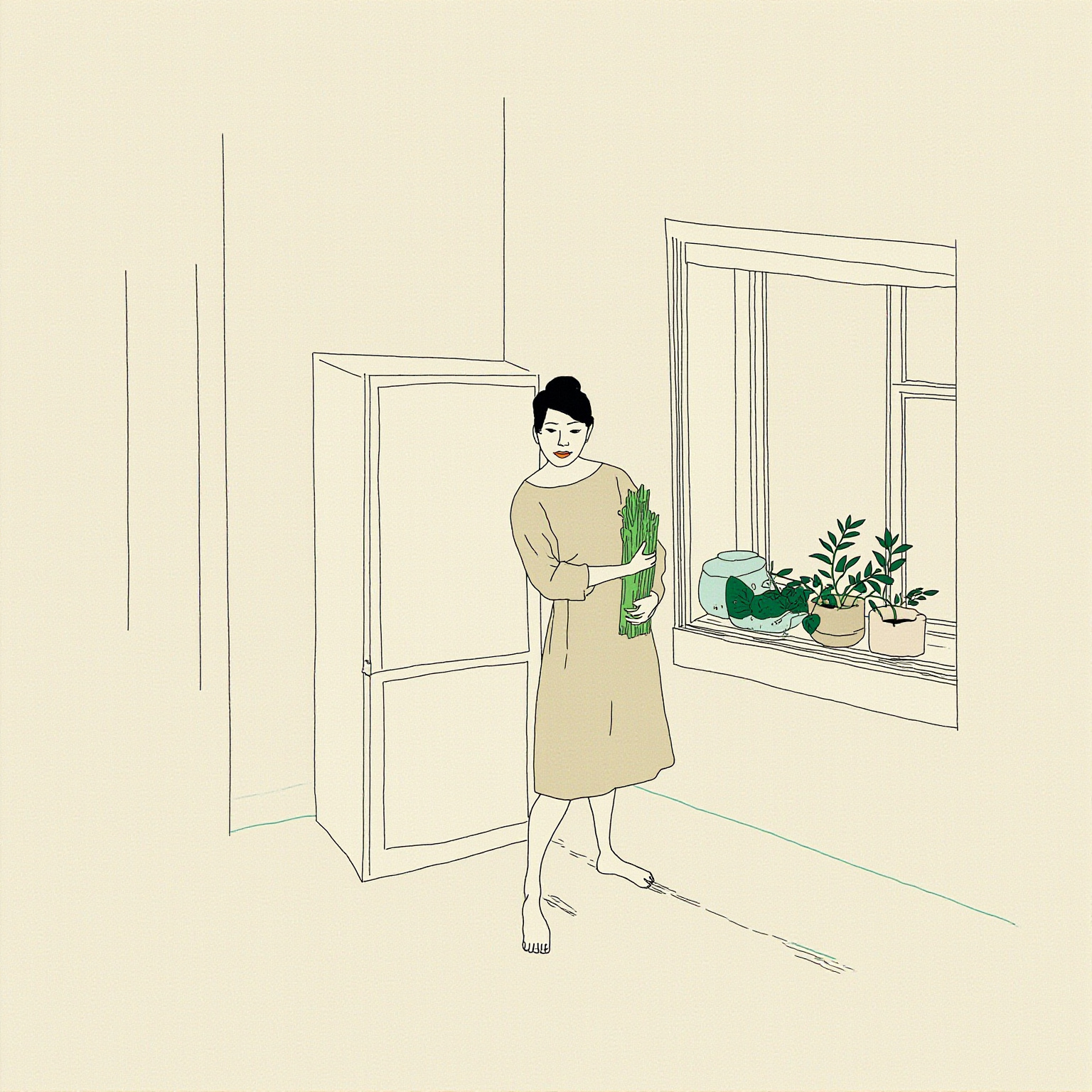
I married her because she was utterly unremarkable in every way.
我娶她,正因为她平凡得无可挑剔。
金句 · 第一部 · 丈夫视角
The husband's perspective: the dinner table incident
Part One is narrated by Mr. Jung. He doesn't understand what a 'nightmare' means at all — he only sees: no meat can appear on the dinner table, he has to warn his mother-in-law ahead of time when visiting, his wife embarrassed him at the company dinner. He tried to make an effort, tried to coax her, and when that didn't work, he got annoyed.
Han Kang's coldest trick: the more normal, more logical, more "I had no choice" her husband's narration reads, the more isolated Yeong-hye appears. In the first part she's like a specimen sealed in a glass case, and we can only see her through a man who never wants to get truly close.
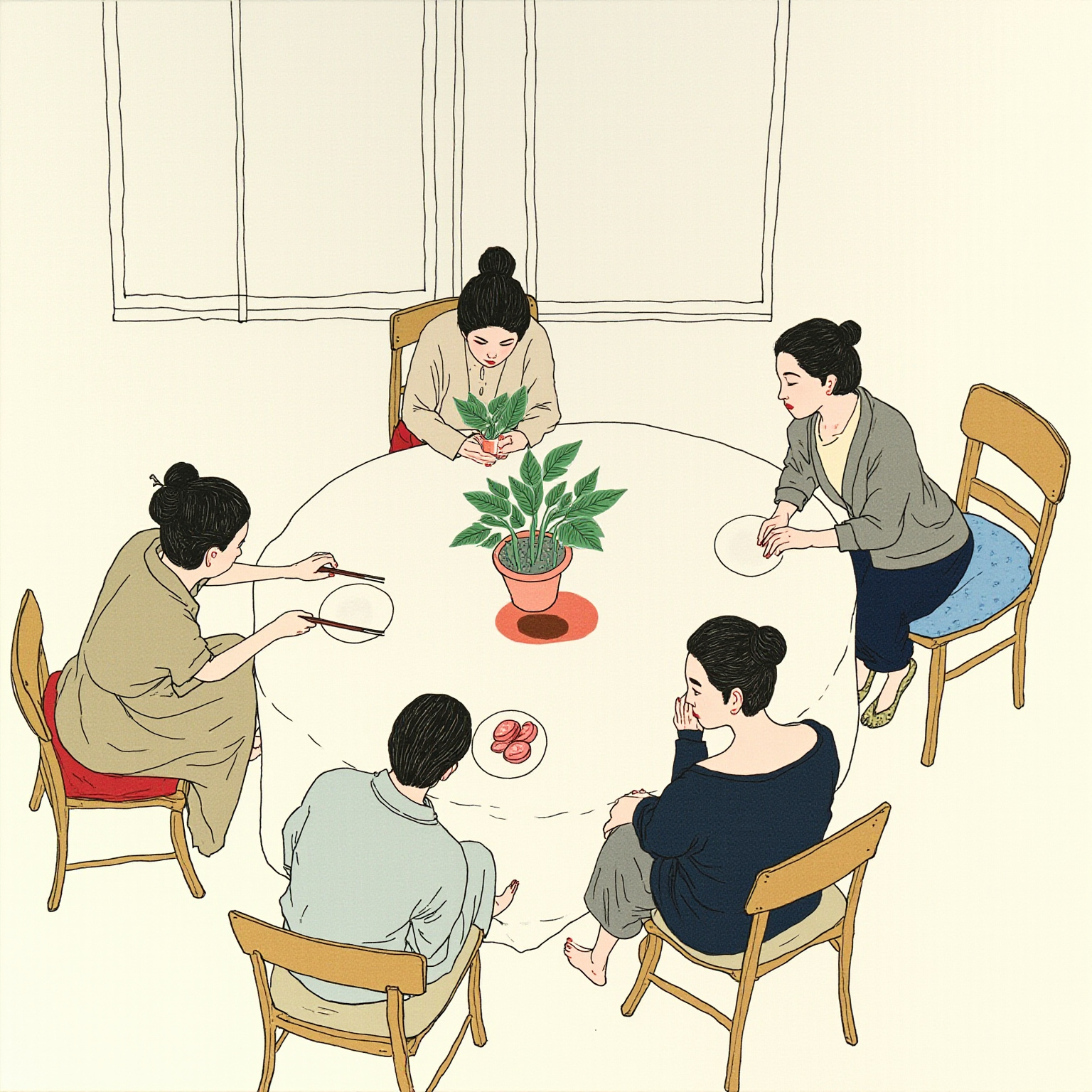
Family dinner: confrontation
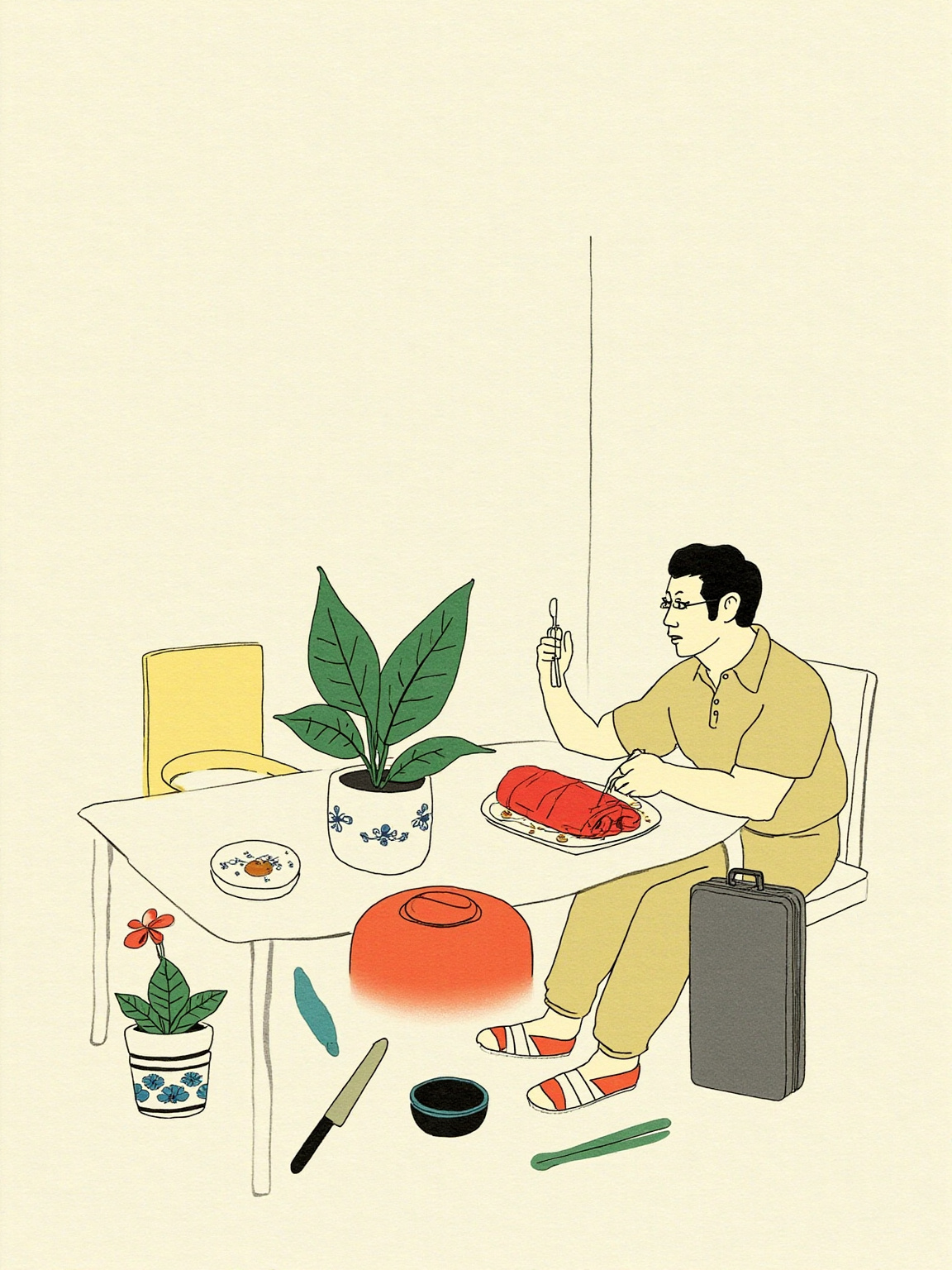
The family dinner scene is the first time the book compresses everyone into a single frame: father lifting his bowl of meat broth, sister picking up a rib, Yeong-hye shrinking into herself and staying perfectly still. Her brother-in-law sits across from her, looking at her for the first time with an artist's eye—not watching whether she'll cry, but watching her sunken cheeks, her wrists, her collarbones, the way one might look at a plant that hasn't yet pushed out its leaves.
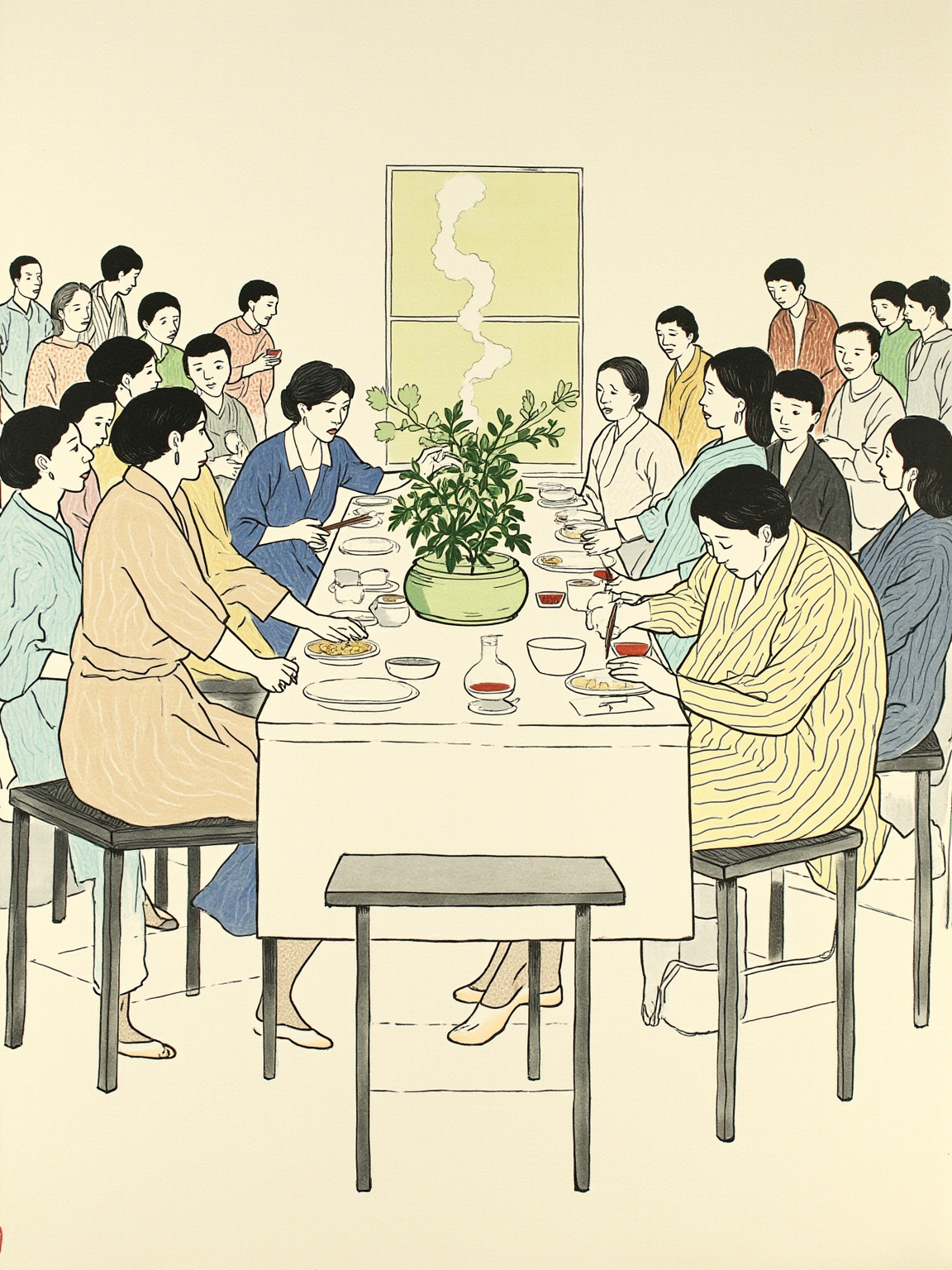
There was a kind of terrible symmetry in the way she sat there while everyone around her ate.
她缩成一团坐在那里,周围的每一个人都在动筷,那种静比任何争吵都更刺耳。
金句 · 第一部 · 家族聚餐
The scene is written with restraint that borders on cruelty—no arguments, no flipping tables, just the arrangement of seats, lines of sight, and where the grease floats on the plates, pushing the tension up to the throat.
Brother-in-law: she becomes a living canvas
The second part shifts to the brother-in-law's perspective. He's obsessed. He invites Yeong-hye into his studio, first tracing flowers on her skin, then projecting entire images of green plants onto her naked body with a projector, making her lie still in the light. He photographs, he paints, convinced he's finally touched the work that was destined for him.
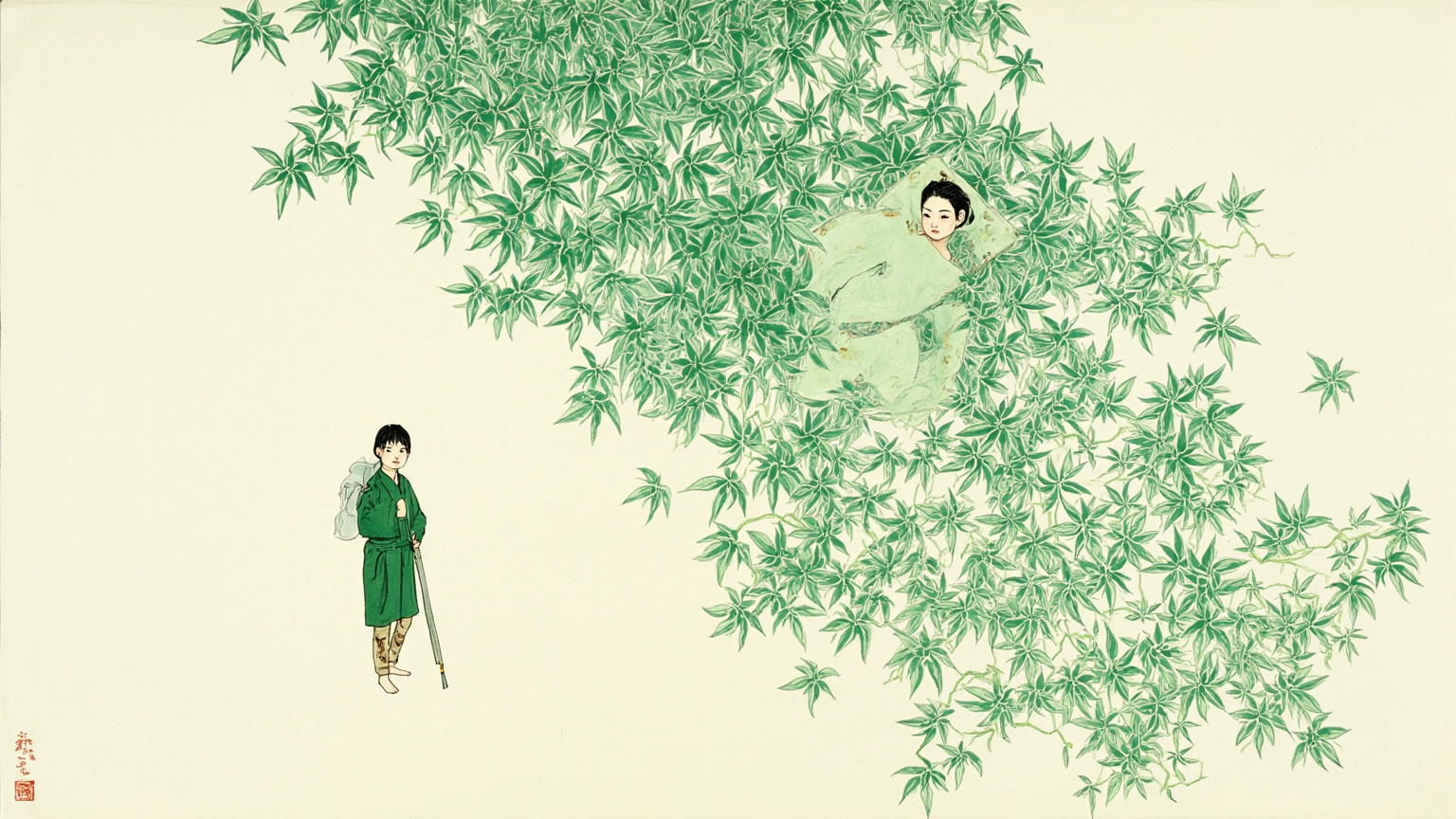
I wanted to paint on her body the image of a flower that had been blooming for years in some remote, abandoned garden.
我想在她身上画一株花,一株在无人照料的废园里独自开了许多年的花。
金句 · 第二部 · 姐夫视角
Han Kang's sharpest cut: the more artistic theory the brother-in-law invokes, the more romantic he sounds, the more he talks about "redemption," the clearer it becomes to the reader that he's doing something that treats a person as less than human. What separates him and Yeong-hye isn't paint—it's a layer of narcissism he himself can't see. From this door Yeong-hye receives something she never had before—someone addressing her in the language of "becoming a plant." The price is complete objectification. The brother-in-law's marriage burns to nothing in this section.
Sister takes over: the hospital room's reflection
In Part Three, In-hye appears. She commits Young-hye to a psychiatric hospital and begins shuttling between the ward corridors, visiting days, and the counter of her own cosmetics shop — dealing with her sister's deteriorating body while looking back at how she herself has been devoured, year by year, over the course of her marriage.
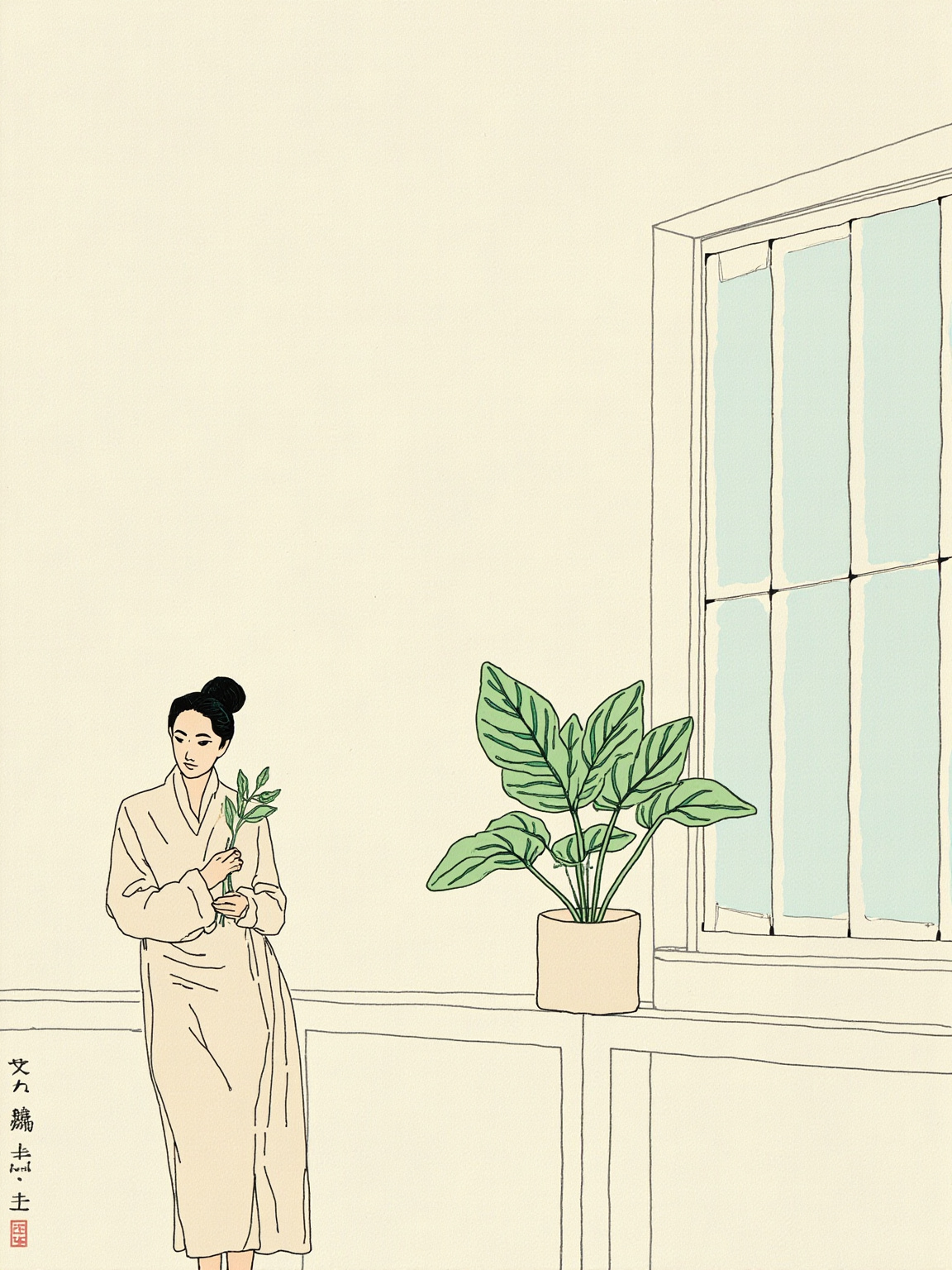
I have to get her out of here, I thought. But even as the thought formed, I knew I had no place to take her.
我得把她从这里带出去——可这个念头刚冒出来,我就知道,哪里都不是她的去处。
金句 · 第三部 · 姐姐病房独白
Of the three, In-hye is the only one who has wept for Young-hye, the only one who has wondered what happened to her. But her own strength has run dry. All she can do is drag her sister to the hospital, hook up the IV, change the nightgown. The most crushing thing about this passage is not that Young-hye is becoming less human — it's that In-hye, looking in the mirror, realizes they are on the same path, and her sister has simply fallen first.
The final approach to becoming plant-like
The ending stays in the hospital room. Young-hye stops eating entirely, fed through a nasal tube, so thin her ribs show one by one. She repeats the same motion over and over — standing on her head, imagining her feet pointing up and her head pointing down, letting roots grow from the soles of her feet into the soil, living on nothing but sunlight and water.
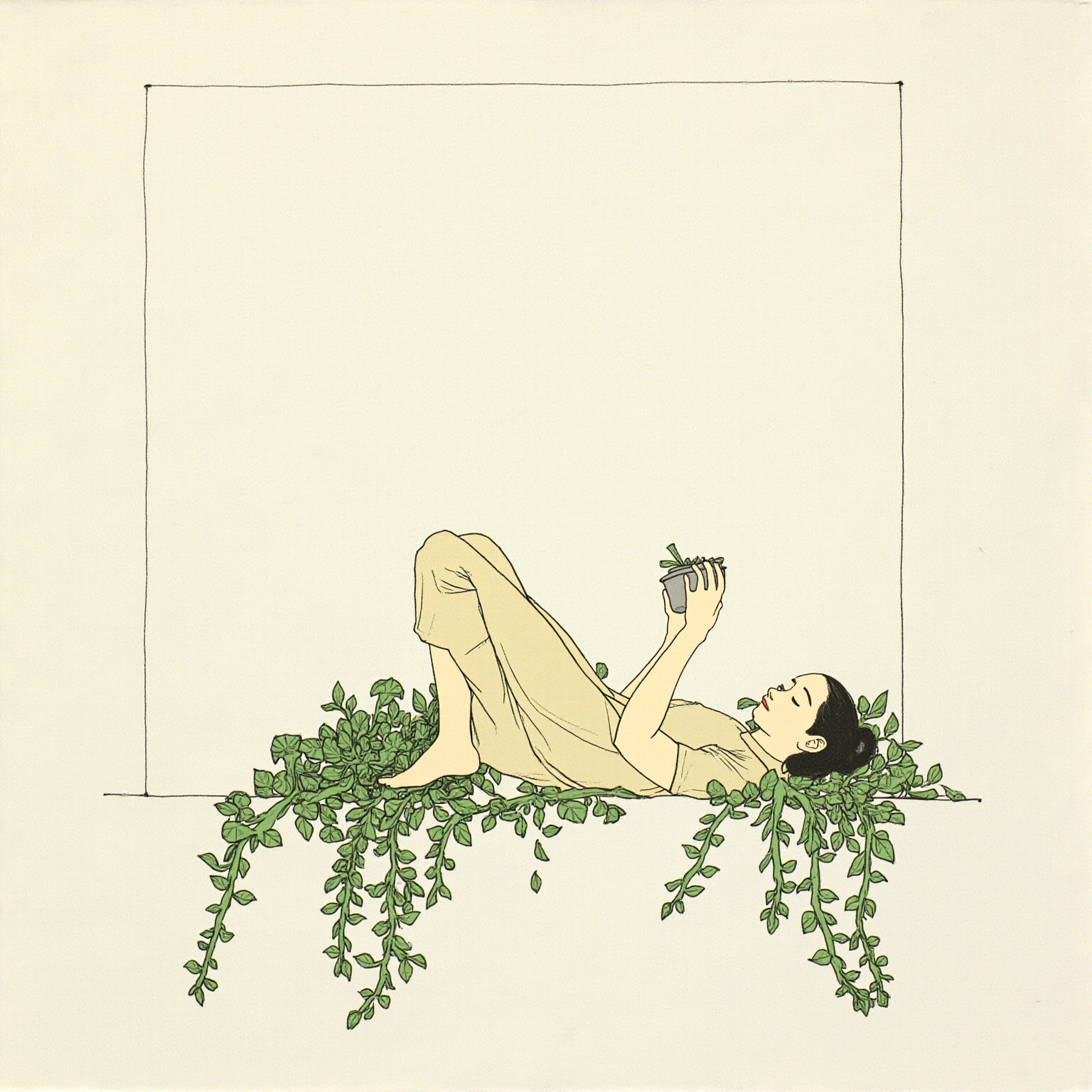
If she could just stand on her head, she whispered, the roots would finally grow down from her feet, and then she would only need water and sunlight.
她轻声说,只要能把脚朝上、头朝下地立着,根就会从脚底长出来,到那时候,她只需要水和阳光。
金句 · 第三部 · 病房尾声
Han-gang writes this passage with extreme stillness. No death sentence, no dramatic final act. Young-hye simply moves closer and closer to a state that is no longer human — alive, but no longer living as a human does.
Three mirrors, all reflecting the wrong person
The book ends with In-hye's tears, and the misalignments of the three narrators are pinpointed in a single line: none of them saw Young-hye. What they saw was only their own emptiness. The husband saw the loss of obedience, the brother-in-law saw artistic material, the sister saw a fate she herself could not escape.
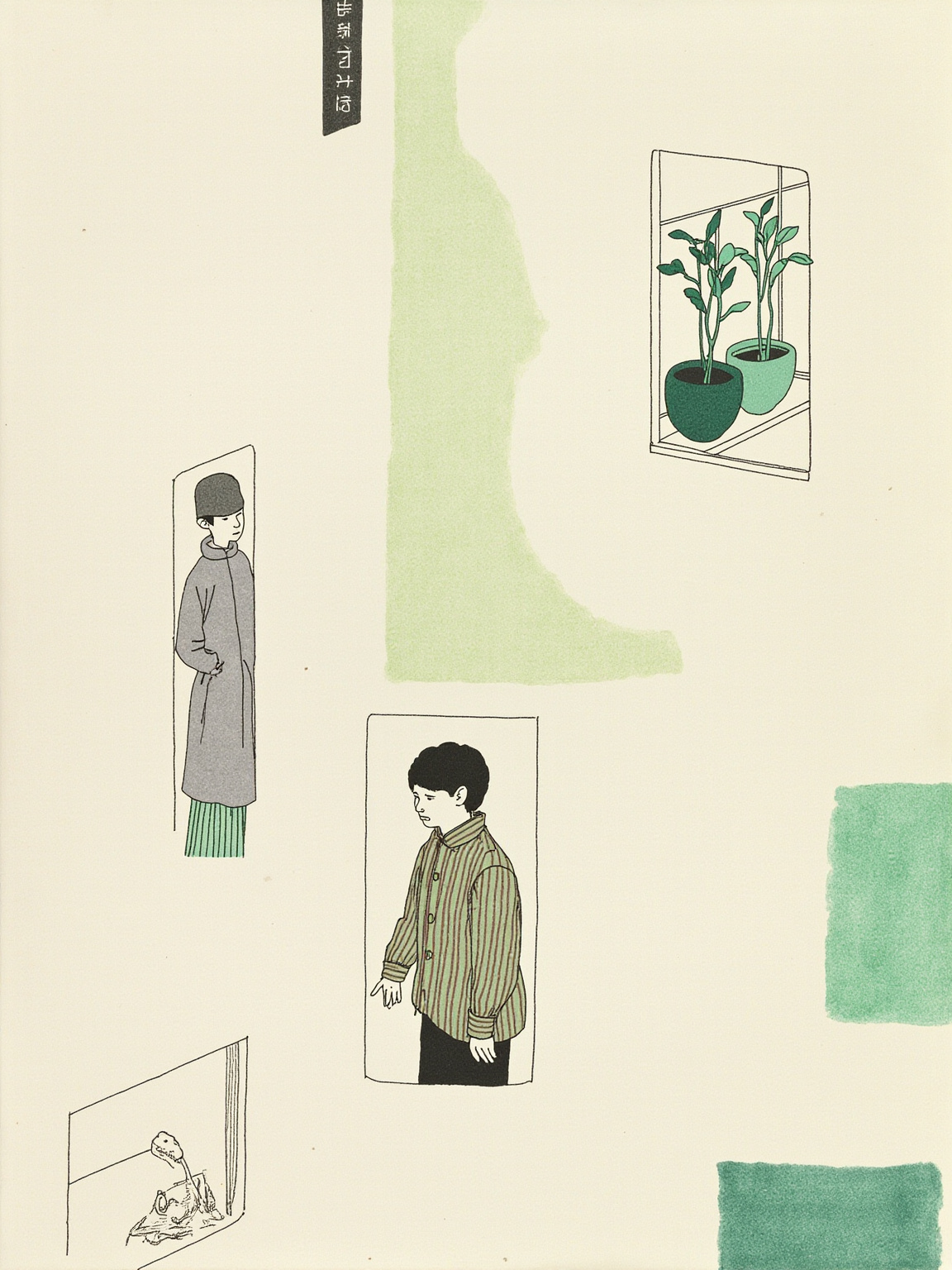
Han-gang spends an entire book telling us something counter-intuitive: a person can be in a room full of people who love her, and never be seen once. And her only act of rebellion is to spit the meat out of her mouth — and then shut her mouth forever.
Theme and Technique
The most powerful thing about The Vegetarian is that it dares to turn a meal into an existential rebellion. Vegetarianism is the surface; refusing to be "digested" is the core: digested by family, by society, by the meat industry, by the gaze of art. Yeong-hye's silent refusal to eat is the only gesture left to her — a "I won't participate" in a world that has consumed everything else.
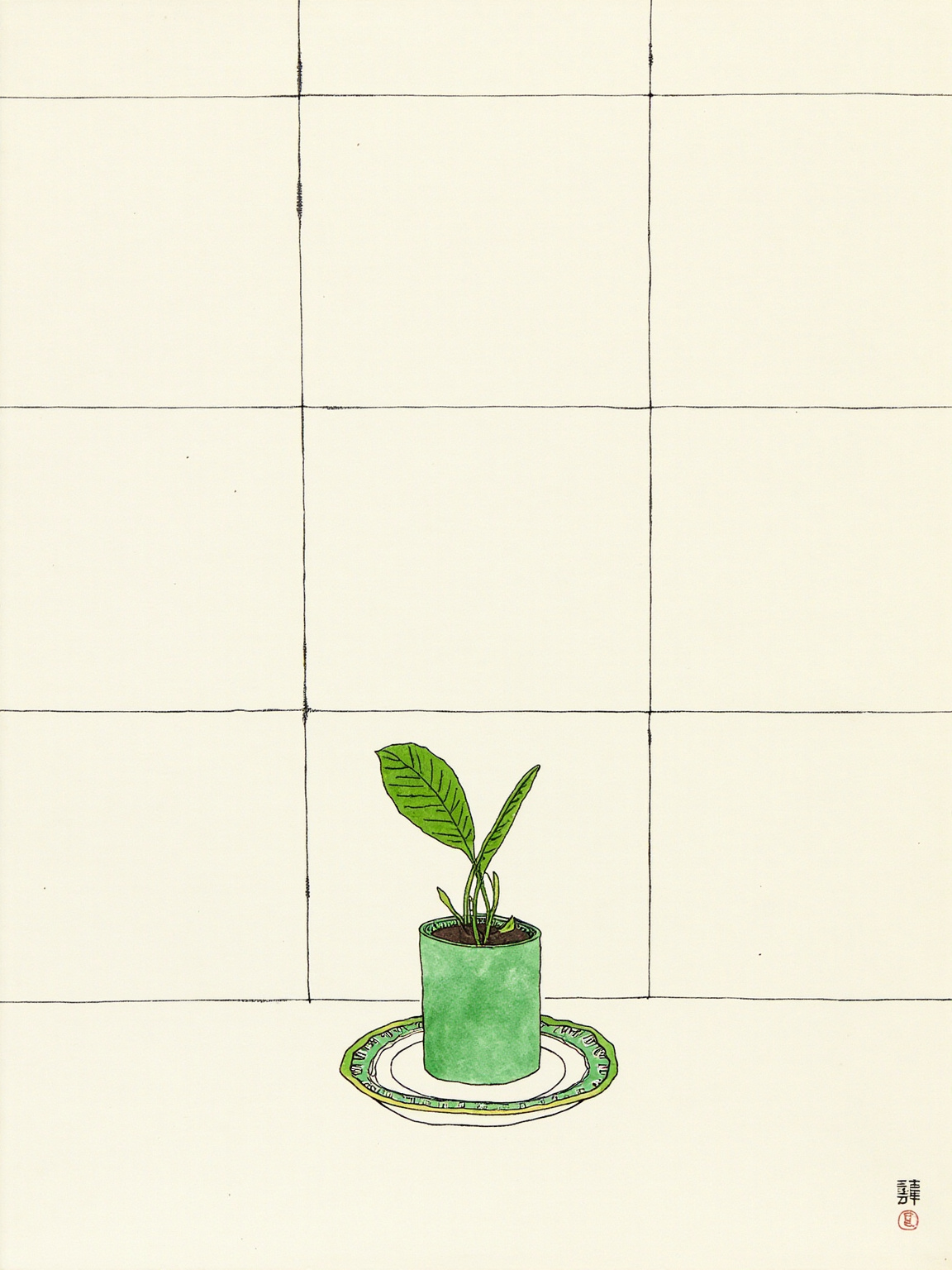
Technically, the three-narrator relay is the most intriguing structural choice. Yeong-hye never gets first-person narration. Exactly because of that, the three people around her speak with growing confidence, and the dislocations become more glaring. Han Kang uses viewpoint as a mirror — not to reflect her, but to show what each of her observers is missing.
For readers today still pressed by various "shoulds," this book carries a dull ache: an ordinary person refuses one small thing taken for granted, and everyone together hauls her into a hospital room. It forces the question — if you too suddenly said "no" to something habitual, how much room would the world give you?
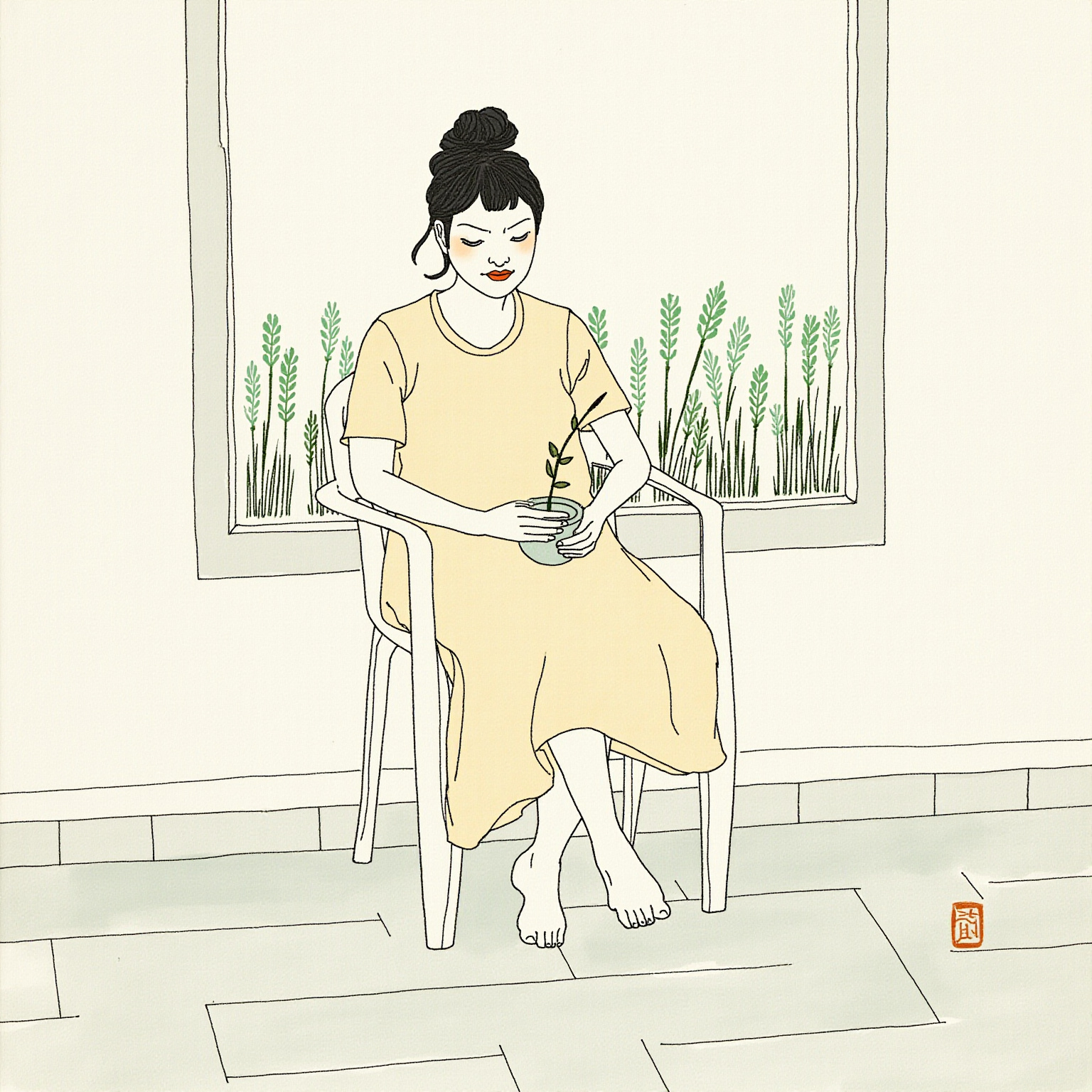
Hook to read the main text
Commentary can give you the story's skeleton, but it can't give you a physiological response that only comes from turning pages — reading the second part, the brother-in-law's passage, that oily chill when he speaks the most cruel words with such tenderness will slowly crawl up the back of your neck; reading those hospital pages, the image of Yeong-hye inverted will linger in your eyes for a long time. You have to read it to know what this book is really doing.
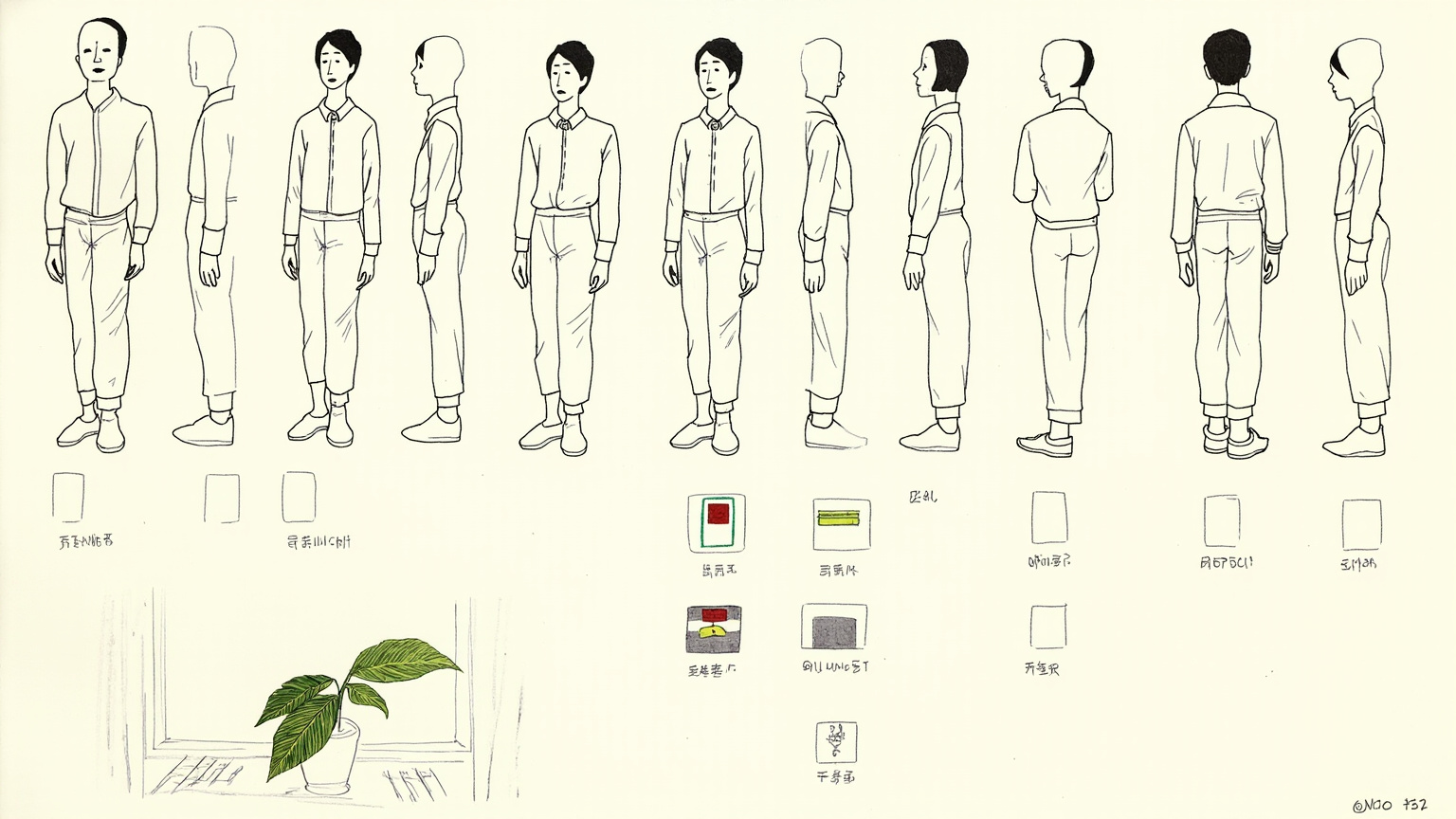
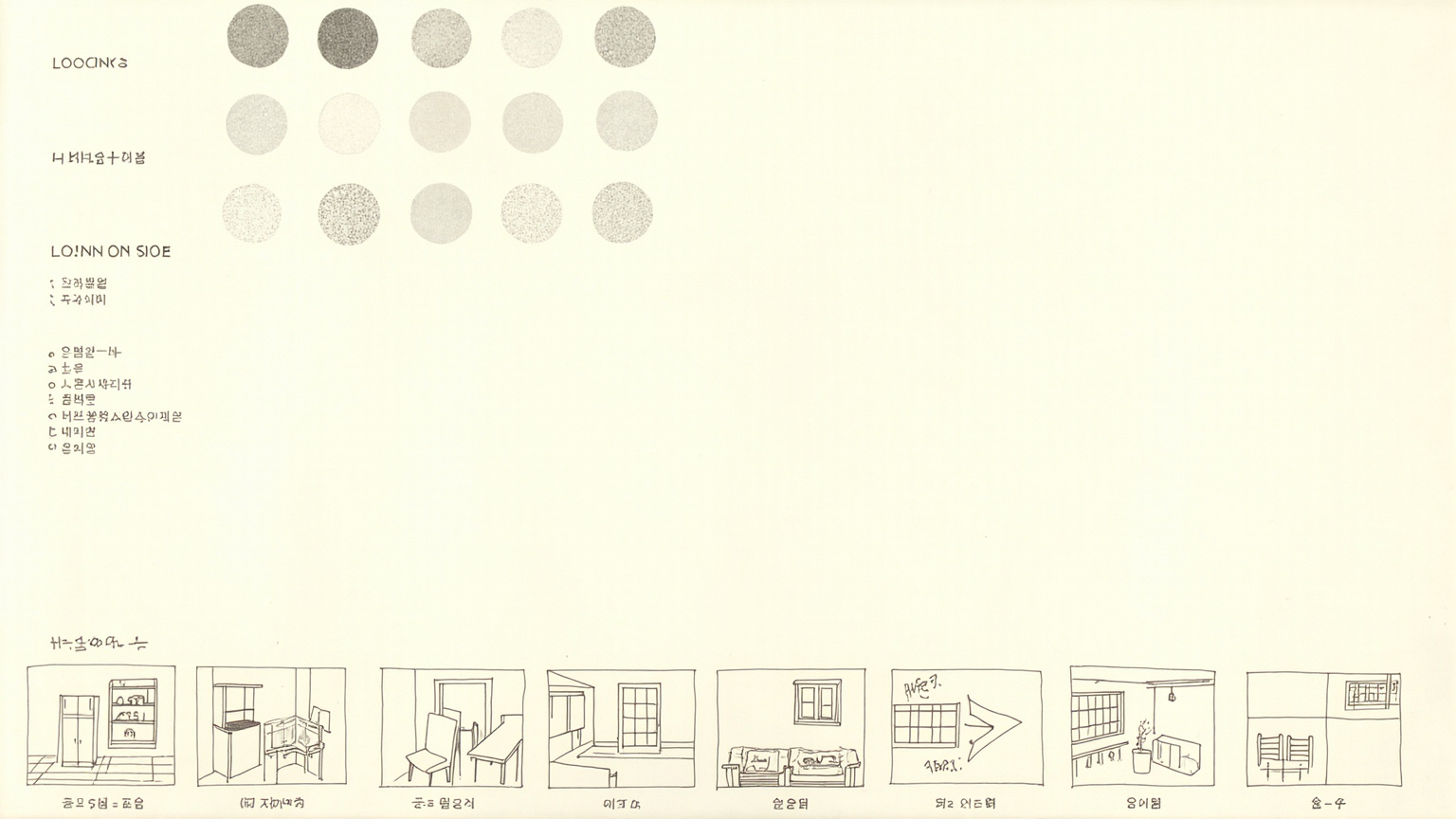
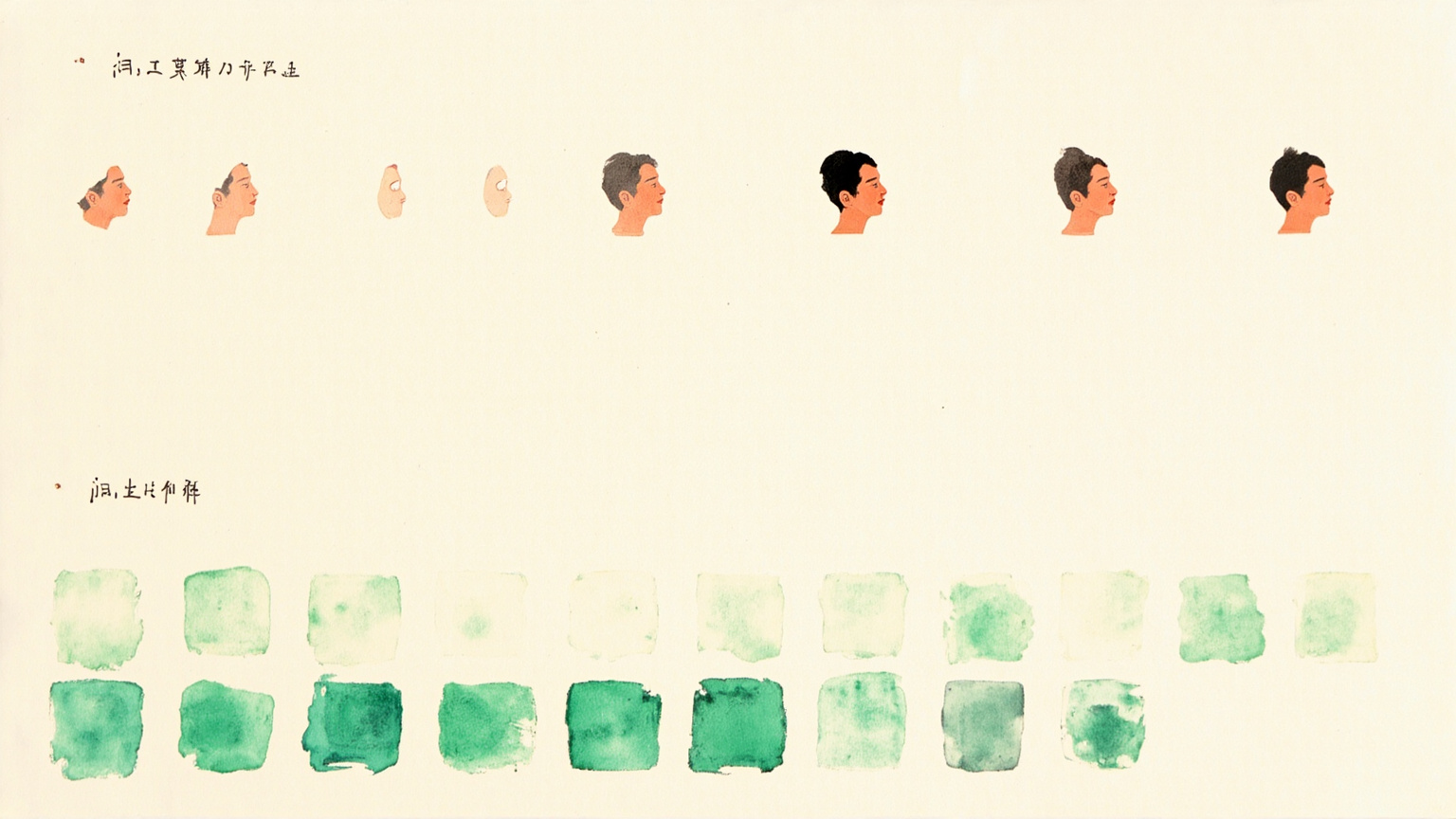
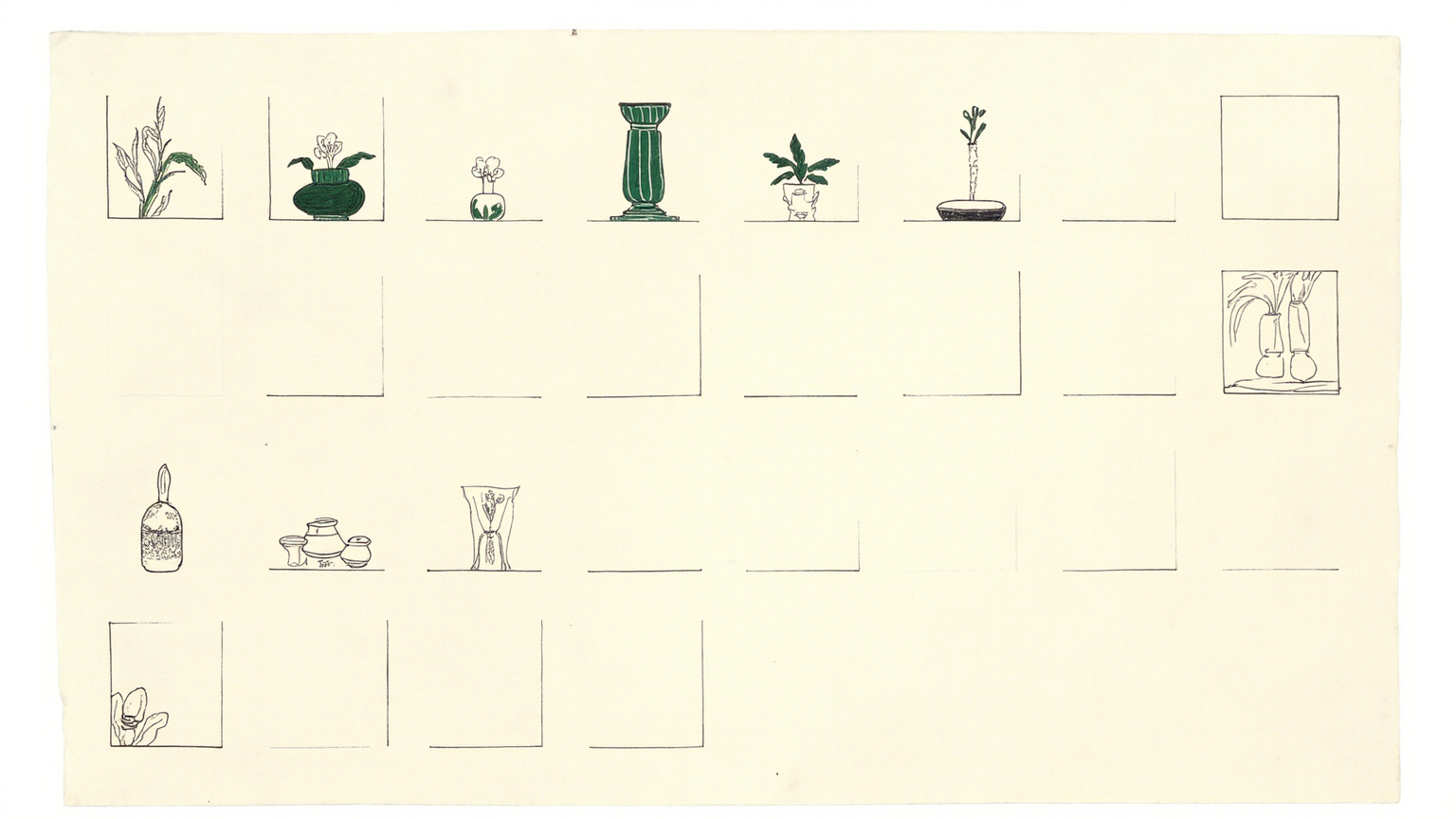
Art Direction4 plates
Before the guide was written, this book got a visual foundation — every illustration you just read grew out of it.