The Woman in the Dunes (砂の女 / Suna no Onna) · Companion GuideStories · Issue 00
10 minutes to The Woman in the Dunes — the rope ladder that gets taken away
Freedom inside a sand pit, a Sisyphus who never finishes shoveling, and a court document colder than death itself.
Text and illustrations produced by the pipeline
ImaReadFolio 02 — 06
Opening
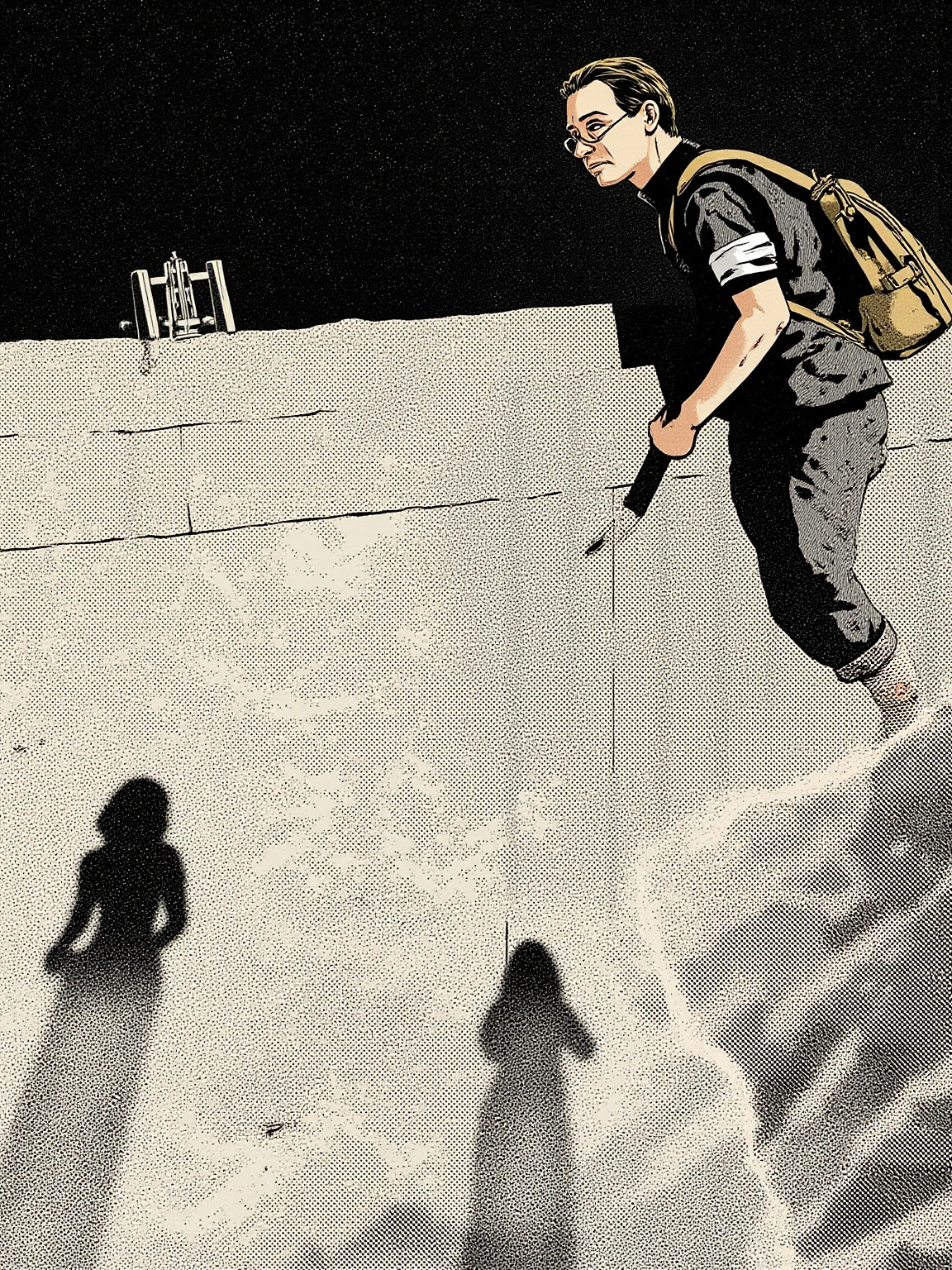
The rope ladder was still there at the rim of the pit, sand still sliding in from every direction, and Niki Jumpei turned around and walked back into the wooden hut at the bottom. Nothing was stopping him from climbing out. In that moment, seven years of captivity felt like a joke that never got its punchline.
This is The Woman in the Dunes. It gets filed under Kafkaesque existentialist parable, and just as often misread as a lurid captivity story. It is neither as cold as the first nor as sordid as the second — it is more ordinary than both. Finish it, and you start wondering whether the office you walk into every morning is missing a rope ladder of its own.
What kind of book this is
Kōbō Abe was born in 1924 and died in 1993. The Woman in the Dunes, published in 1962, is the work of his prime and one of the load-bearing stones of postwar Japanese existentialist literature. It won the Yomiuri Prize for Literature that year, and the film adaptation went on to take the Special Jury Prize at Cannes and an Academy Award nomination for Best Foreign Language Film. Between the novel and the film, Abe drove a stake into twentieth-century world literature.
What makes it endure isn't a shocking plot. It's the method: Abe writes an utterly absurd situation like a geological survey report, and turns big words like freedom and captivity into something as small and real as the sound of sand sliding onto a roof at night.
The people and the world
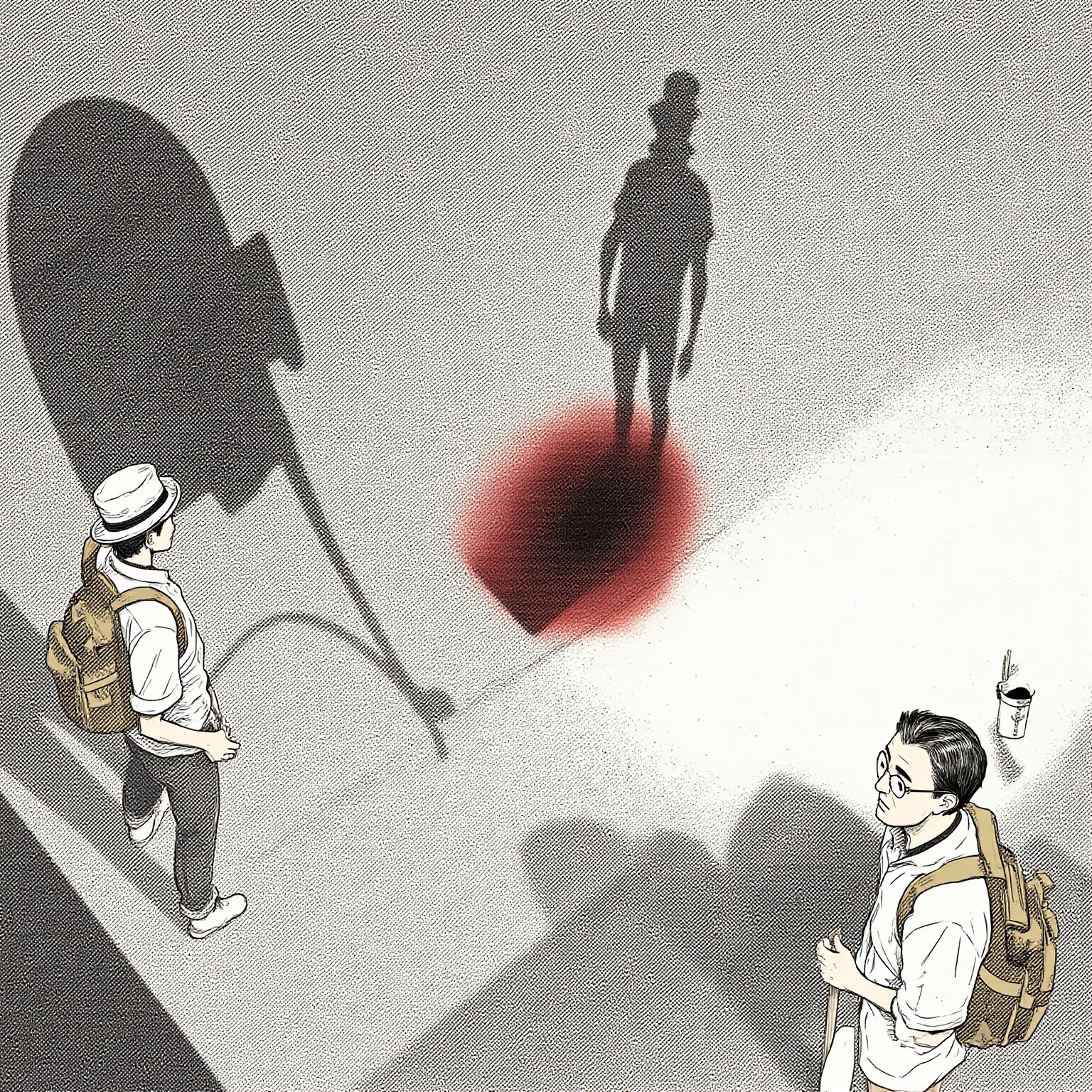
Niki Jumpei teaches biology at a middle school in Tokyo and collects insects on the side. He came to these dunes hoping to find an undocumented species of sand-dwelling beetle, the kind of find that would put his name in the taxonomic record books. The obsession sounds trivial, but it is the engine that drives everything that follows. A nobody's hunger to be remembered, set against a sand pit that swallows people whole, turns out to be an even match.
This is the coldest stroke in the whole novel, colder than any life-or-death ending could be. Abe never tells us what happened to Niki afterward, whether he went back to the city, died in the sand, or invented something else entirely. He buries the answer inside a bureaucratic form and seals the question of whether Niki ever really left inside that ambiguity for good. From this point on, whether he escapes or not stops mattering.
What it is actually saying
On the surface this is a book about captivity. One layer down, it's about the meaning of labor. Deeper still, it's about identity getting ground away by structure. Niki arrives as a middle school teacher, an insect collector, a husband; seven years in the pit sand every one of those labels flat. The woman never has a name to begin with, she was already ground down into a symbol before the story started. Abe is asking what is left of a person once every social identity has been stripped away, and the answer is whatever small task is in their hands right now.
For a reader today, that question stings. We walk into an office every morning, open our messaging apps, answer email, sit through meetings, pay down a mortgage. No one has us tied to a rope, and yet the ladder is being pulled up somewhere we can't see. The Woman in the Dunes isn't asking us to go dig a tunnel. It's asking us to look up and check whether our own ladder is still there.
Why the novel itself is still worth reading
A guide like this hands you a map; you still have to walk the ground yourself. The sound of sand sliding, the damp chill of condensation at night, the ache in your shoulders from shoveling, the glare of light at the rim of the pit, none of that reaches you until you turn the page yourself. The closing document is the same. Reading that dry official language firsthand is ten times colder than hearing it summarized secondhand. Abe took an entire philosophical question and wrote it as the sound of falling sand grains, and that's something you have to hear for yourself.
Art Direction4 plates
Before the guide was written, this book got a visual foundation — every illustration you just read grew out of it.
The hut at the bottom of the pit belongs to a widow who lives alone; the novel never calls her anything but the woman. Her husband and child died in the sand before the story begins. She digs alone and lives alone, and toward Niki she moves from wariness to dependence to something closer than either, something that has no name. The namelessness is deliberate. Abe wants her to read as a symbol, as the fact of surviving at the bottom of this pit.
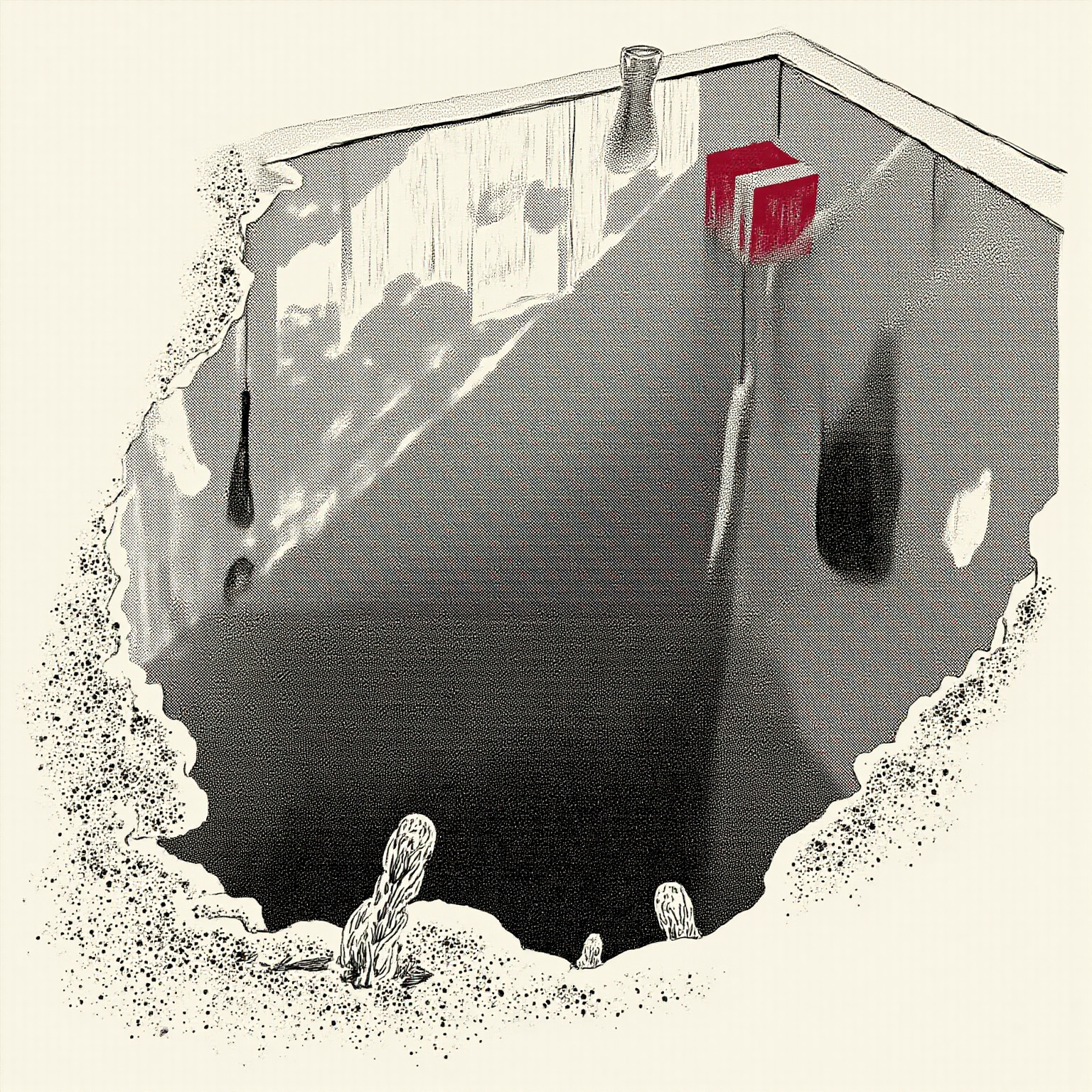
The rules of this world are simple. The village sits among dunes that keep advancing inland, and every household's hut sits in a sand pit several meters below ground level, connected to the outside only by a rope ladder that can be pulled up at will. Leave the sand unshoveled and a hut is buried within days. The sand that gets dug out is sold to builders as construction material, salt-contaminated and well below code, but the builders take it anyway. The whole village's livelihood, and the whole apparatus of captivity, rests on that substandard sand.
Wandering into the pit
The story opens on the most ordinary mistake imaginable: Niki misses the last bus home. Smiling villagers offer him a bed for the night in the hut at the bottom of the pit. The ladder goes down, he climbs it step by step, and he doesn't even glance twice at the sand already sticking to his shoes. He has no idea this descent will last seven years.
The writing here is clean almost to the point of cruelty. Abe refuses to build up dread; he simply lets Niki be shown to a room like any commuter who has missed his train. Only later does the reader realize that the last time the ladder vanished from the rim that night was the exact moment he set his shoes down outside the threshold.
A captivity the whole village conspires in
The next morning Niki looks up and the ladder is gone. The pit wall runs four or five meters, the sand too soft to climb. An old man who speaks for the village appears at the rim and lays out the terms at his leisure: shovel sand and you get water and food; refuse, and the whole village cuts you off. This isn't some sadist's private cruelty, it's the village's livelihood. No shoveling, and the hut at the bottom is buried within days, and the village loses its supply of sand along with it.
This is the coldest stroke in the whole book: what holds Niki prisoner isn't a person, it's an entire economic structure. Every villager is just one link in a chain, selling the sand, pulling up the ladder, driving the trucks, cutting it with salt, and no single one of them is the culprit, yet none of them is innocent either. Abe writes evil as a system, and that is far more frightening than any one abuser could be.
ImaRead3
Four escapes, four failures
Of course Niki tries to escape. He makes four attempts. First he ties up the woman and holds her hostage, trying to force the village into letting him go; it doesn't work. Then he twists his own rope and tries to climb the pit wall; the rope snaps in the sand and he falls and hurts his back. Later, over who knows how many nights, he digs a tunnel out to the marsh beyond the dunes. That is the closest he ever comes to freedom.
The mudflat at low tide is a stroke of genius: the harder you struggle, the deeper you sink, as if the ground itself is swallowing you alive. In the end Niki can only shout for help from the villagers looking down at him, and in that moment dignity, freedom, every shred of an educated man's self-respect collapses into the mud. The day they haul him back to the pit, he is no longer a teacher from the city. He is just a man who shovels sand.
A device invented out of despair
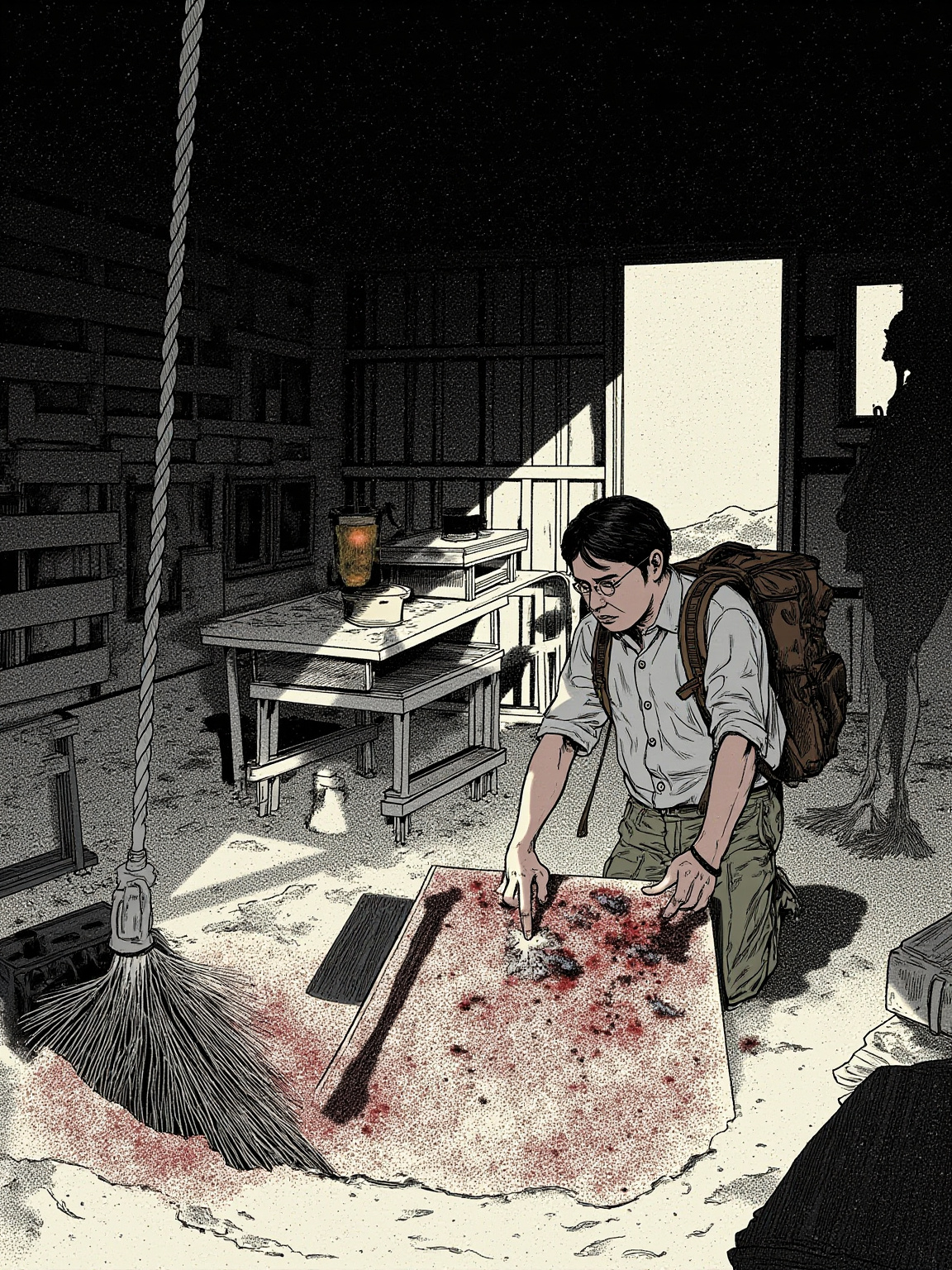
With escape closed off, Niki turns his mind to something nobody asked him to do. The sand near the sea condenses moisture at night, and the sand layers draw water upward by capillary action, so could some kind of device collect that moisture from the damp sand, drop by drop? He starts experimenting, again and again, with boards, cord, and old tin cans.
The world has no use for a device like this, and entomology has even less use for it. But it turns Niki back into an inventor. Shoveling sand is Sisyphus without end; collecting water gives him one small thing he can finish and see the results of. Abe's point here is unsparing: meaning does not fall from the sky. It gets chiseled out, by hand, in the least meaningful situation imaginable.
His relationship with the woman starts to loosen up around this point too. At night she quietly passes him water; in the morning he quietly shows her what his device collected. Neither of them says much that sounds like affection, but their bodies have already worked each other into the routine of daily life. It's an intimacy with no romance in it, and it holds.
The first time the ladder is really left behind
ImaRead4
One night the woman suddenly starts bleeding heavily, an emergency tied to an ectopic pregnancy. A few of the village women rush to haul her up the ladder and get her to a doctor. In the panic, nobody pulls the ladder back up this time, and the rim of the pit is left standing wide open.
This is the most ironic moment in the whole book: he doesn't escape through his own cleverness, he escapes because a woman's life hangs in the balance. Niki looks up and sees the sea, right there; his home is in Tokyo; his specimen box is still buried at the bottom of a trunk somewhere. He can climb out now.
He turns and goes back down
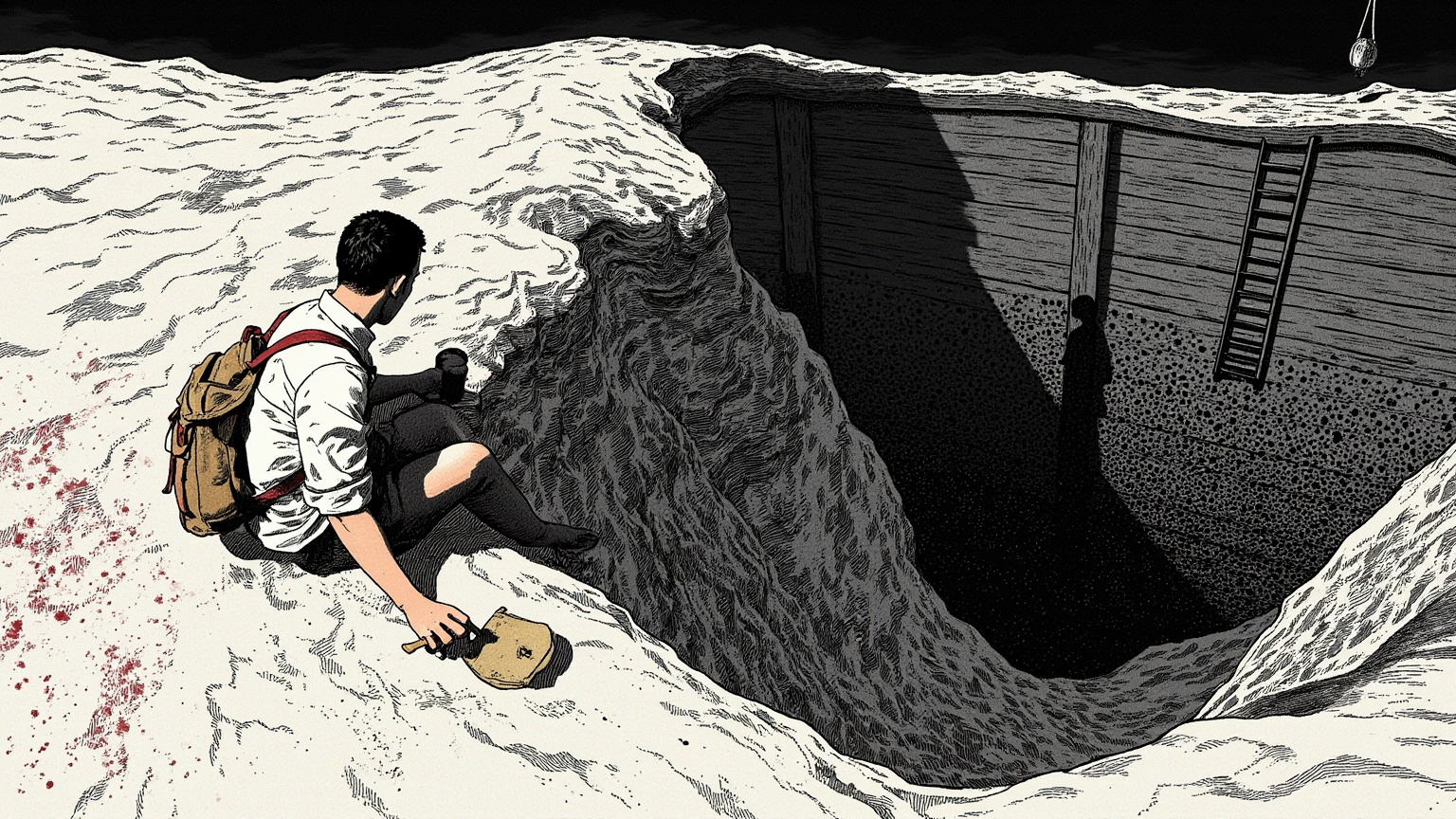
He doesn't leave right away. He climbs to the top of the pit and sits there a while, looking at the sea, and one thought comes to him: he has never told anyone about the water-collecting device. He can always come back, whenever he wants. He climbs back down into the pit, back to the hut.
The first time I read this passage, a chill ran down my back. It isn't the cheap explanation of Stockholm syndrome. Abe never has Niki fall in love with his captivity, never has him grow afraid of the outside world, never hands him some grand realization. Abe simply has him remember one unfinished, small task, and that task turns out to be more concrete to him than an entire city.
Freedom was never about the ladder. It was always about whether there is one small thing you have to finish.
The ending arrives as a document
The novel's final section changes shape entirely: it becomes a formal document from a family court. Niki Jumpei has been missing for seven years; his wife has petitioned the family court, and the court has declared him legally missing, presumed dead under the law, struck from the family register. It is written in that flat, formulaic legal Japanese, cold as a shipping invoice.