The Yoga Sutras of Patanjali (Yoga Sūtras of Patañjali) · Companion Guide
瑜伽经
196 条短到不能再短的口诀,只为把心里那片翻涌的水面一寸一寸按下,直到纯粹的觉知如镜独立
Opening: The Shortest Possible Definition
A blanket. A feather settling into raw cotton: that is what the mind looks like when it comes to rest. In the second of his hundred and ninety-six sutras, Patanjali sets the direction for the whole system: yoga is the stilling of the mind's fluctuations. A few words, and they have carried two thousand years of weight.
What Kind of Book This Is
Classical India, sometime in the long stretch of oral transmission and compilation before the common era that mainstream scholarship dates roughly between the second century BCE and the fourth century CE, a compiler gathered scattered practical instructions handed down from earlier teachers into a hundred and ninety-six short verses, arranged in four chapters: Concentration, Practice, Attainment, Liberation. It is not a poem, not a story. It is a technical manual. Set beside the Bhagavad Gita's dialogue on the eve of battle, or the philosophical prose of the Upanishads, the Yoga Sutras stays fixed on one question: how do you practice? Several enduring Chinese translations circulate today, by Huang Baosheng, Wang Zhicheng and Linghai, Wen Zhong, and Jianawa among others, and one reason is simple: anyone looking for the source text of classical yoga will not find a shorter one.
Characters and World
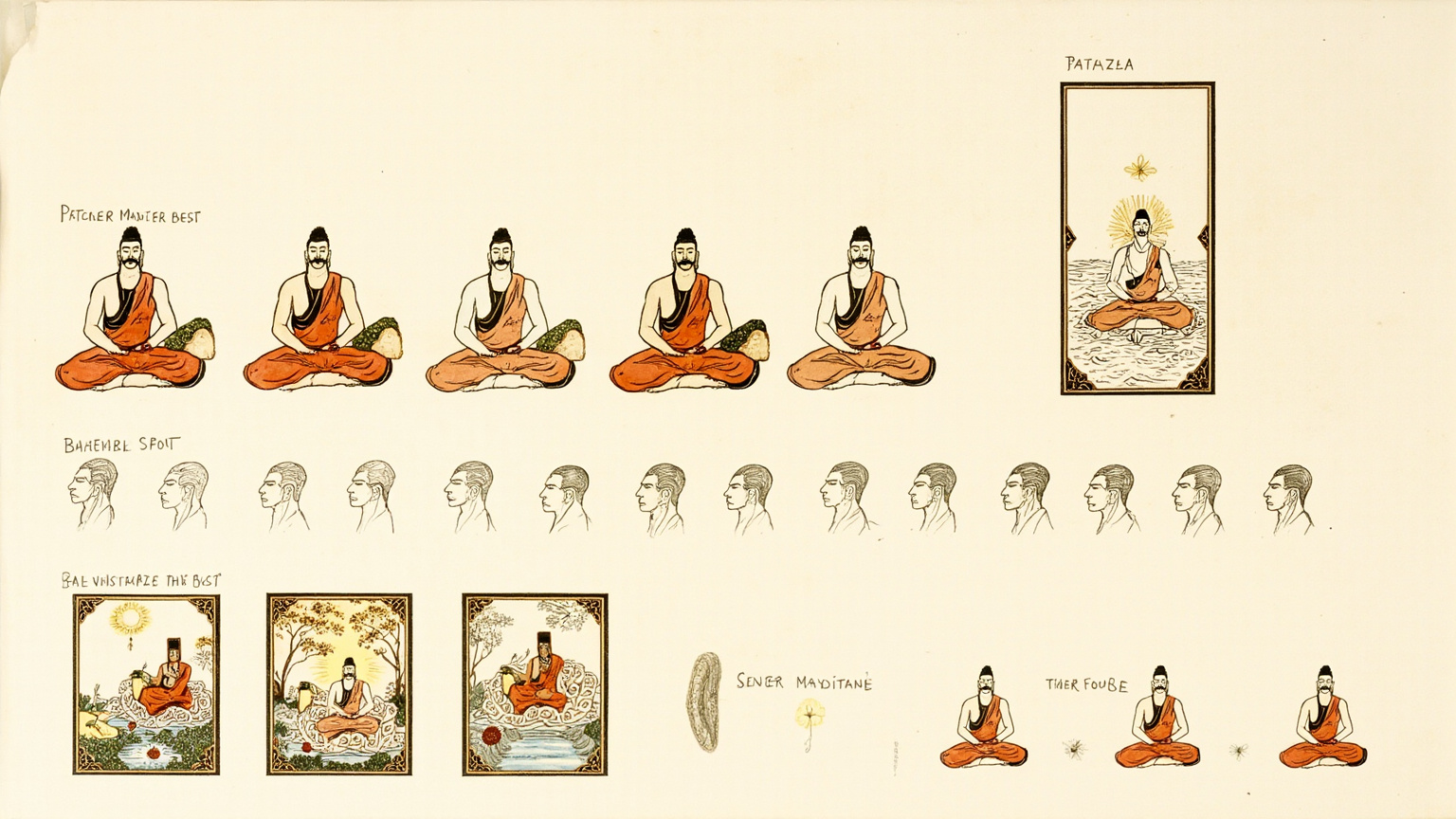
This book has no protagonist. In traditional images Patanjali is half man, half serpent. The upper body is human, wrapped in saffron robes, palms joined in prayer; the lower body coils from the thousand-headed serpent Ananta, its hoods stacked like a crown. Ananta means 'the endless one,' the same serpent Narayana sleeps upon. The image gives 'endless stillness' a body: the compiler paints himself as a figure offering up endless practice as his own breath. He never writes about himself in the text, never gives himself a name, and hands all authority to the words alone. Two other figures appear, but they are functions, not characters: a nameless teacher, who surfaces only in the passages of oral transmission between master and student, and a nameless student, who is really anyone who wants to practice. A person sitting cross-legged, breathing, eyes closed — that is the only human image the whole book offers.
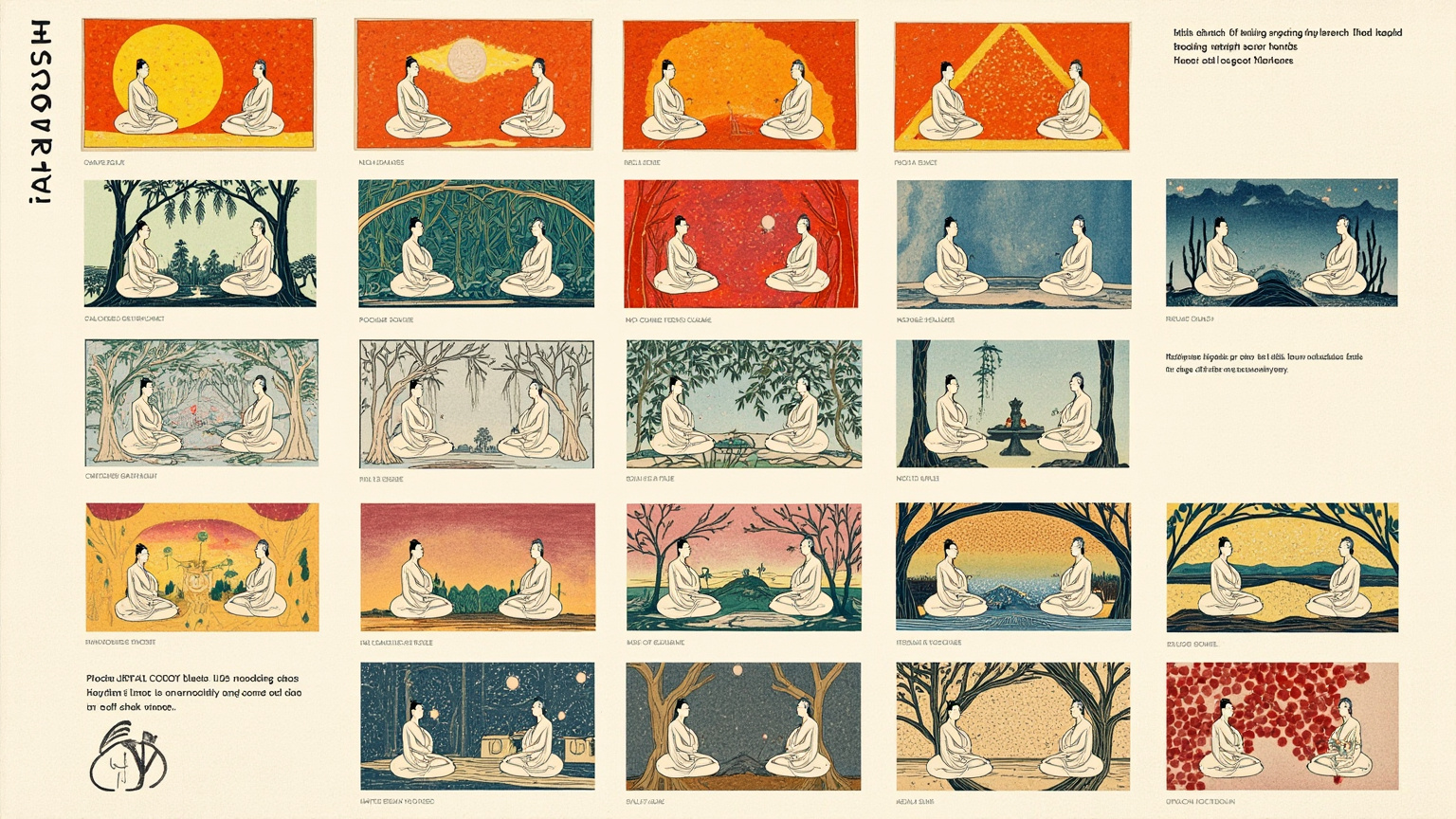
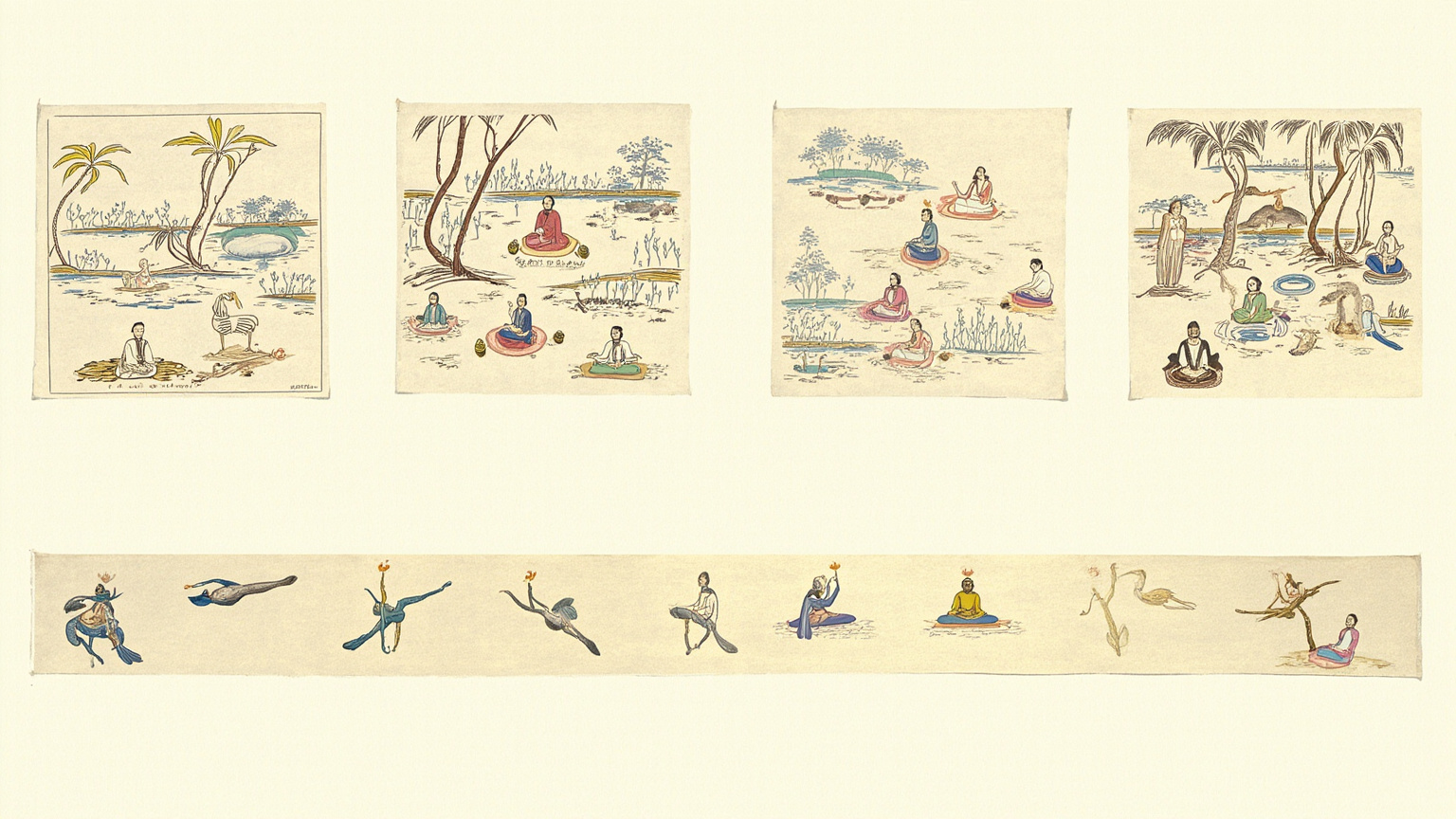
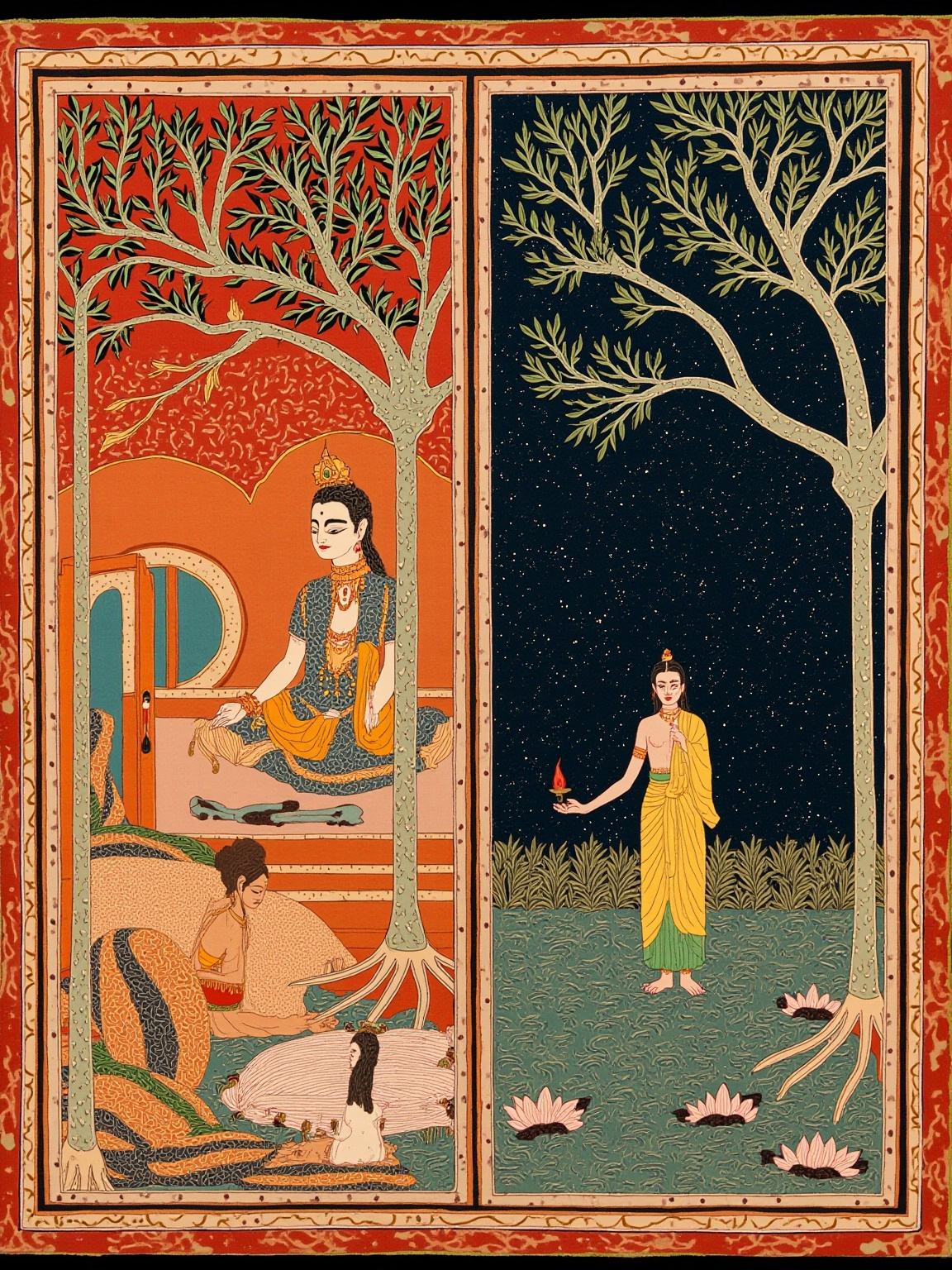
The world it happens in is not a court, not a battlefield. It is a forest hermitage by a river: palms, banyan trees, lotus ponds, peacocks calling, the morning wash, palm-leaf manuscripts spread open, teacher and student sitting face to face. It is a householder's home, where keeping the precepts means the daily grain of family life. It is inside meditation, breath held and released, the senses drawn back in, one small steady flame. And it is a metaphysical space out of the paintings, the half-man, half-serpent Patanjali seated on a cloud, the thousand-headed serpent coiled beneath him, tier upon tier.
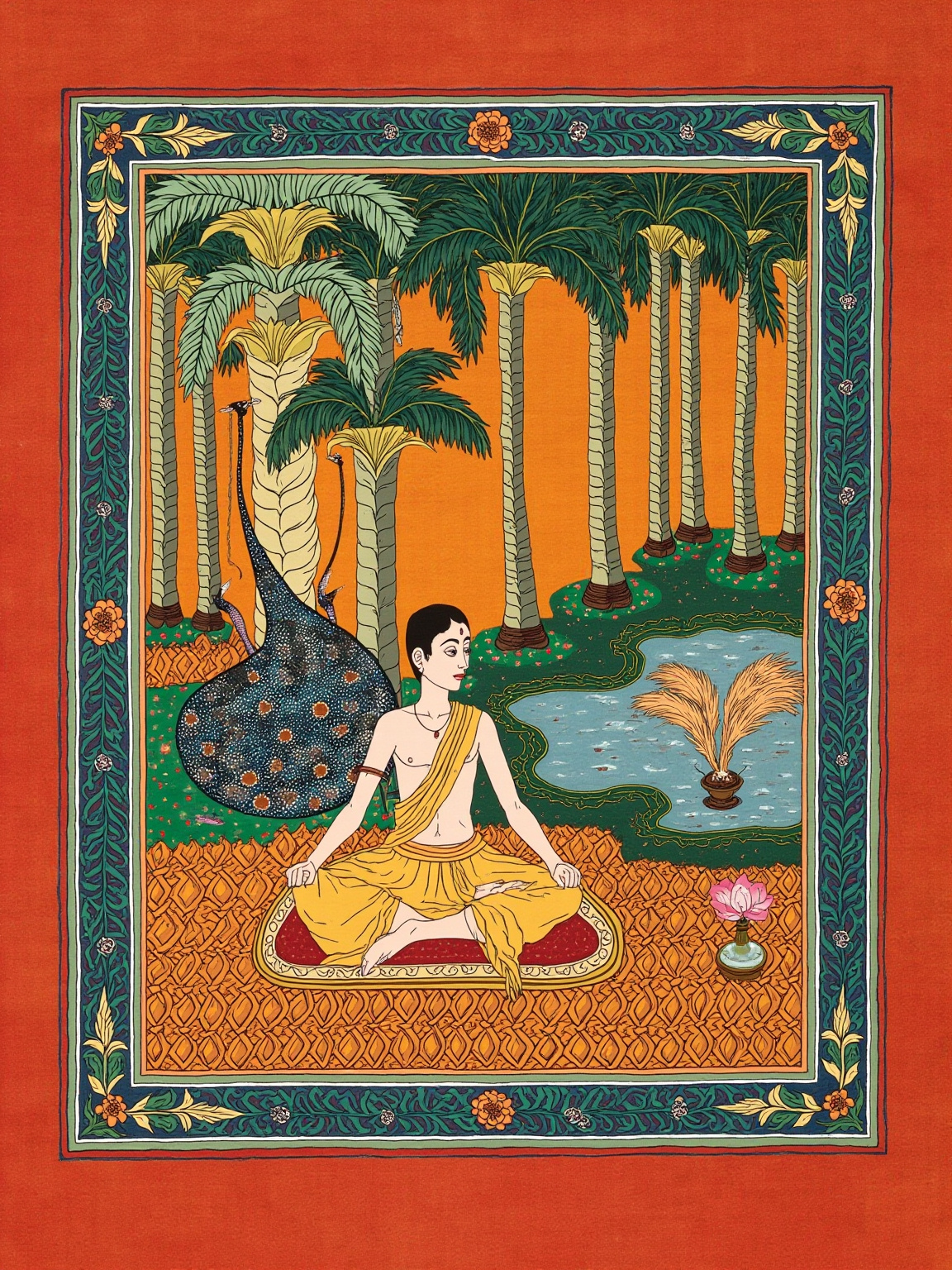
Yoga is the stilling of the fluctuations of the mind.
瑜伽,即心念之止息。
金句 · 第一品 · 第2则
The Second Sutra Decides Everything
The whole book's decisive move lands in the second sutra of the first chapter: yoga is the stilling of the mind's fluctuations. The Sanskrit original is barely a breath, about eight syllables: Yogas citta-vrtti-nirodhah. He does not explain what yoga's postures are, or its breathing, or its energy. He tells you first that yoga is one thing: making the churning mind stop. The Sanskrit word for these fluctuations is vrtti, which literally means a whirl, a ripple. Practicing yoga is not doing something. It is letting the surface of the water go still.
Diagnosis: What the Churning Water Looks Like
Where does the disturbance come from? Patanjali sorts the mind's fluctuations into five kinds: correct perception, misperception, imagination, sleep, and memory. Some bring suffering, some do not, but all of them stick to asmita, the sense of 'I' — 'I saw this,' 'I thought that,' 'this is my feeling' — and that sticking is what turns into a habit. He then names five afflictions: avidya, ignorance; asmita, ego; raga, attachment; dvesha, aversion; and abhinivesha, fear of death. The five afflictions are the cause; the churning mind is the effect. His method is worth pausing on: he fuses psychology and ethics into a single diagnosis, symptoms first, then the cure. Later Yogacara Buddhism took this same method and expanded it. The model of the seed and the logic of perfuming can both be traced back to something already germinating in these thin verses.
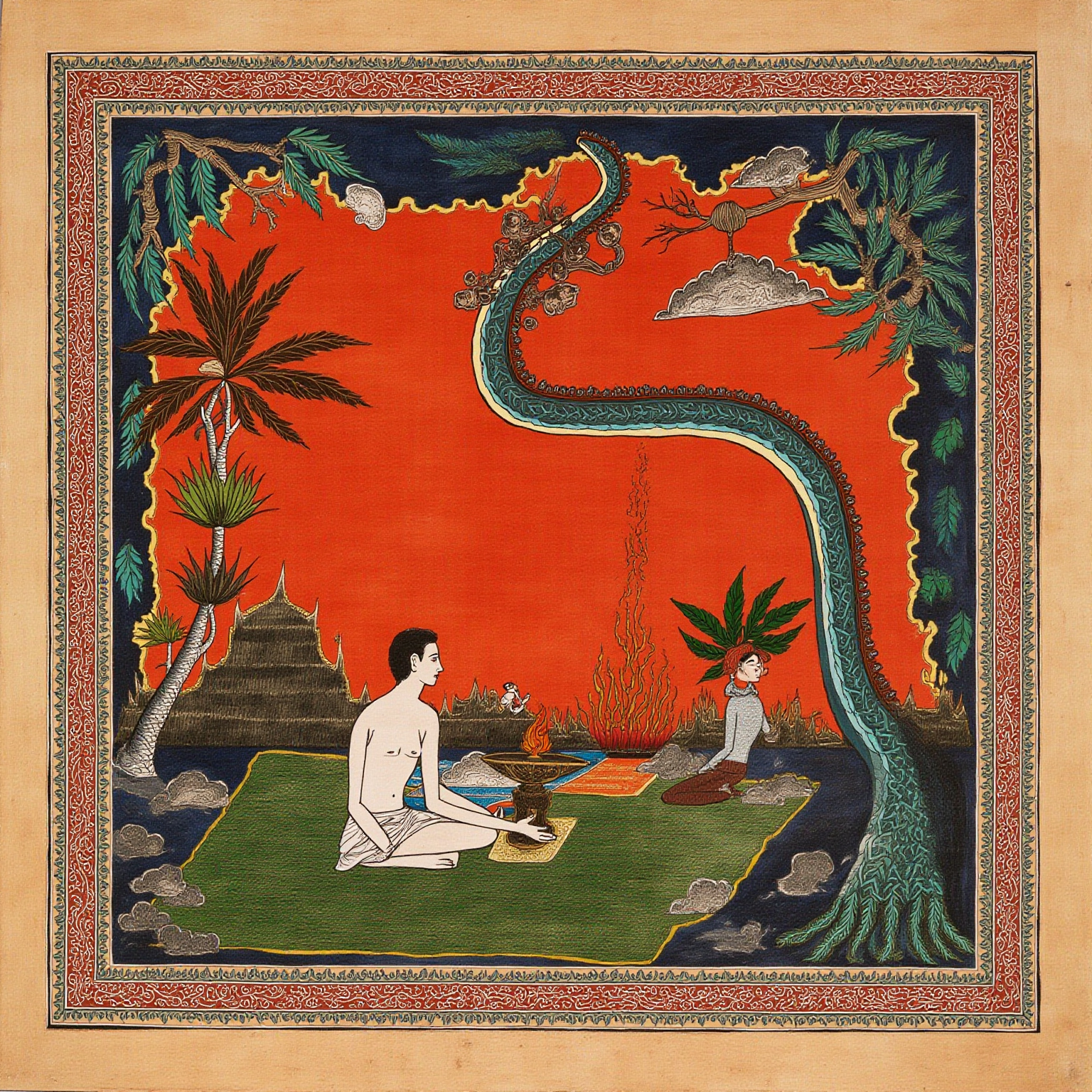
The five fluctuations are right cognition, mis-cognition, imagination, sleep, and memory.
心念之翻涌有五:正确认知、谬误认知、想象、睡眠、记忆。
金句 · 第一品 · 第5-6则
Prescription: Eight Limbs, Coarse to Fine, Outside to Inside
How does the water go still? Patanjali gives eight steps, called Ashtanga Yoga, the eight limbs. Note the word 'limb': these are not eight electives to choose among. They are eight levels, moving from outer to inner, from coarse to fine, each one drawing tighter than the last. Yama, restraint, covers non-violence, truthfulness, non-stealing, continence, and non-possessiveness: five stances toward the world. Niyama, observance, covers purity, contentment, austerity, study, and devotion to Narayana: a cleaning of the self. These two sit on the outside; they are the foundation. Asana, posture, is a steady, comfortable seat, not the hundred and eight stretches the word has come to mean. Pranayama is the lengthening and holding of breath. Pratyahara is the senses no longer pulled outward by the world. These three govern the body and the senses. Dharana, concentration, pins the mind to a single object. Dhyana, meditation, holds that object and lets sustained observation of it begin. Samadhi is the point where even the gap between the observer and the object disappears; the seed drops into a stillness deep enough that it never sprouts again. These three govern the mind. The order cannot be shuffled. It is a ladder that draws inward, not a menu laid out flat.
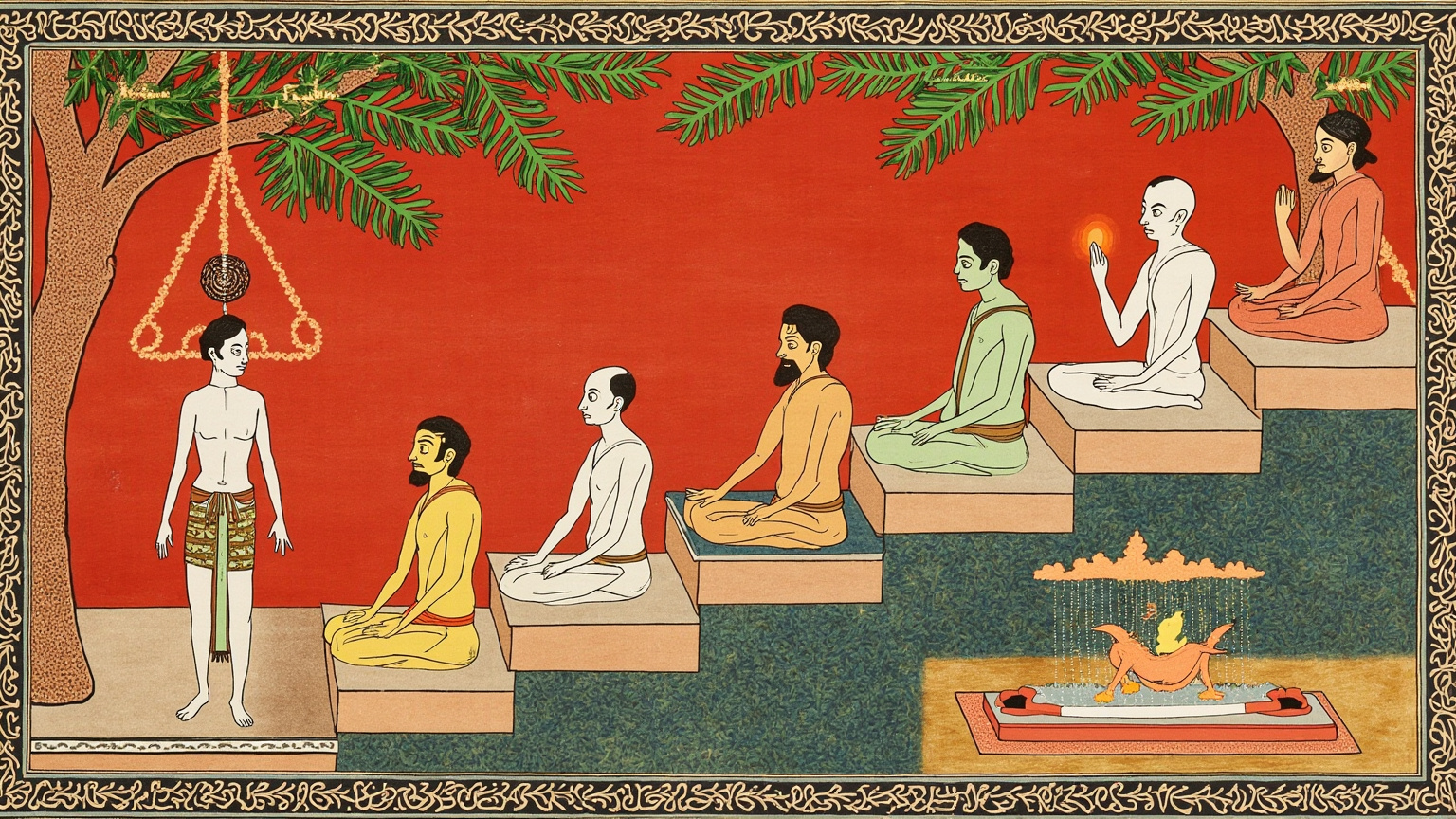
The eight limbs are yama, niyama, āsana, prāṇāyāma, pratyāhāra, dhāraṇā, dhyāna, samādhi.
八支为:持戒、精进、体式、调息、制感、专注、禅定、三摩地。
金句 · 第二品 · 第29则
The Two Wings of the Method, and What Catches You at the End
Climbing these eight steps takes two wings beating together. One is abhyasa, practice: steady, unbroken repetition. The other is vairagya, non-attachment: not clinging to pleasure in the moment or to results down the road. One pushes, one lets go, and neither works without the other. At the deepest point, the method has to hand off to something else. Here Patanjali does something that looks like a contradiction. On one hand he writes instructions that read close to modern experimental psychology; on the other, at the end of the first chapter, he brings in a divine object, Ishvara, the classical name for Narayana. He writes that this god is untouched by time and causation, the teacher of even the earliest teachers. Another door into samadhi is devotion to him, Ishvara-pranidhana, together with the recitation of the sacred syllable Om, which he says is that god's own signature. It is a jolt to read: he has spent the whole book taking the mind apart mechanically, and now he calls in a god? The point becomes clear later. Pushed to its limit, technique admits that a person needs something larger than himself to catch him.
The Seed Model
A fluctuation of the mind is not just a gust of wind. Patanjali treats it as a living seed, bija. A seed lands in the right soil — whatever the mind is currently fixed on, touching, thinking — and sprouts; that sprouting is called manifestation. Manifestation produces new seeds in turn, stored in the field of consciousness, waiting for the next rain. The five afflictions are the most stubborn weeds in that field — ignorance, ego, attachment, aversion, fear of death — and until they are pulled, new seeds never stop growing. The point of practice is not to burn the seeds away. It is to bring them to nirodha, stillness: the seeds remain, but they no longer sprout, no longer manifest, no longer churn up into a present thought. How is that stillness reached? Through the last five limbs, drawing the mind inward step by step, until consciousness settles into a state neither hot nor cold, neither tight nor slack, and the seeds sink too deep to sprout. Later Yogacara Buddhism took this model, expanded it, and wrote it up as the doctrine of seeds and perfuming, and the point it traces back to sits inside these hundred and ninety-six short verses.
The Powers of the Third Chapter: What Comes After the Seeds Go Still
The powers are not the destination. They are a byproduct of the seeds going still, and writing that down took more composure than most readers ever manage.
Once the seeds have gone still to a certain depth, the third chapter, the Vibhuti Pada, the chapter of attainments, opens a list: knowing everything, entering everything, surpassing everything. The powers catalogued here are what naturally surfaces once consciousness has been scoured clean, the way a wiped mirror starts catching finer detail. But the moment the list ends, the fourth chapter pulls its rank straight back down.
The Fourth Chapter's Close: Alone, Like a Mirror
The true endpoint is the fourth chapter, Kaivalya: aloneness. Consciousness no longer reflects the outer world, and it no longer reflects itself either. Awareness stands apart from everything, pure as a mirror. A mirror shows everything in it, but the mirror is not any of those things, and it is not another mirror either. The hundred and ninety-six sutras close here. A reader fixed only on the powers of the third chapter will mistake them for the ending. Only by sitting with the fourth chapter's aloneness does it become clear that even the thought 'I can know everything' has to be set down too, or the mirror ripples again. The close is unforgiving. It strips away every attainment that came before it, while making all of that same practice the only road that reaches here.
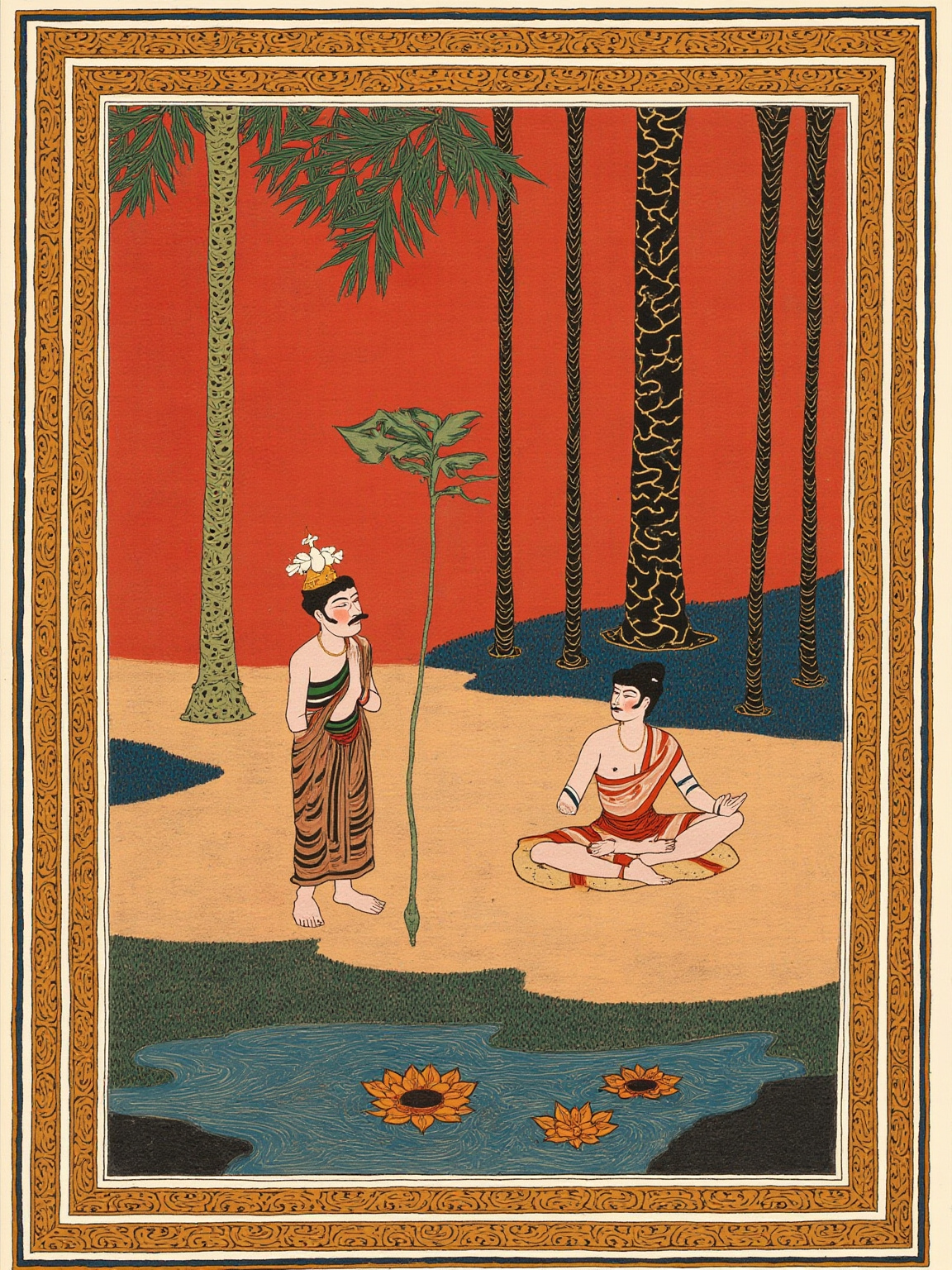
When the seed of solitude has been sown, purity of being shines forth; then comes the end of sorrow.
独存之种得静定时,本性之纯净朗照,苦终熄。
金句 · 第四品 · 第34则
Why It Is Still Remembered
Every yoga studio and every meditation app on the planet today, whatever it calls yoga, is running on this book's skeleton. A hundred and ninety-six sutras, this short, this tightly built, still usable as a working manual two thousand years later: almost nothing else in Indian intellectual history matches it. What deserves more attention is the other half of it. Two thousand years ago it already treated the mind as something that could be taken apart — five kinds of fluctuation, five afflictions, seed, manifestation, stillness — an analysis that reads close to modern psychological vocabulary. And it admits, in the same breath, that analysis has a limit, past which something devotional has to catch you. Psychology and divinity, technique and devotion, diagnosis and cure, all hold together at once in this thin book. Nobody has written that same balance shorter since.
Why Read the Text Itself
What a companion guide can give you is a map: which five afflictions, in what order the eight limbs run, why the fourth chapter cancels the third. What it cannot give you is the sheer shortness of the original, a sutra of two or three sentences, driven in like a nail, no wind-up, no transition. The second sutra of the first chapter lands, and the whole system's direction locks into place. By the time you reach the close of the hundred and ninety-sixth, you suddenly realize you have been walking a road laid two thousand years ago, every step a stair someone else already wore smooth. The mat in a modern studio is a long way from this book. Opening it means taking apart everything you already assume about the word 'yoga,' and then putting it back together.
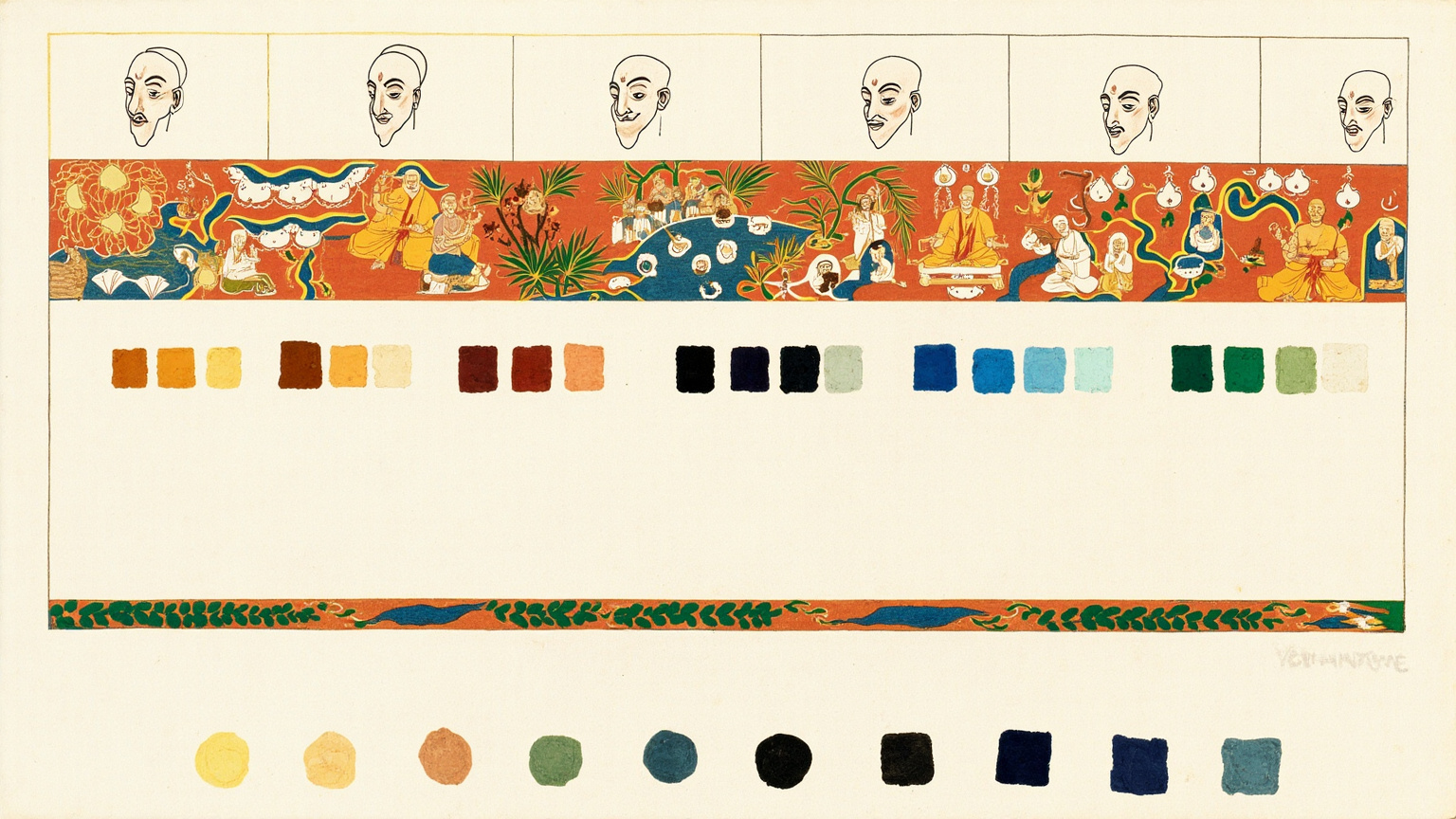
Art Direction4 plates
Before the guide was written, this book got a visual foundation — every illustration you just read grew out of it.