Toilers of the Sea (Les Travailleurs de la mer) · Companion Guide
《海上劳工》
为一段不属于自己的爱情,他孤身迎战风暴、章鱼与潮水,最终把赢来的一切都还给了大海。
Opening
In the snow, a little girl writes a boy's name with a stick. She is only playing, laughs, runs off, goes home for dinner, and forgets the whole thing by the next day. The boy crouches down and looks at the name for a long time — from that moment he never forgets her. This happens before Toilers of the Sea opens, and yet it echoes through the whole book: how a joke grows into half a lifetime's obsession.
The girl is Déruchette; the boy is Gilliatt. Years later, for a marriage that already belongs to someone else, he climbs alone onto the most dangerous reef in the whole channel and spends weeks fighting storms, hunger, and a giant octopus denned in a sea cave. He wins. He hands over the steam engine he fought to recover, and then he hands over the bride too. That is what this book is about — a man the whole village calls a sorcerer, and how he turns his own life into a silent sacrifice.
What Kind of Book This Is
Toilers of the Sea is a novel Victor Hugo wrote in the 1860s. By the time it came out he was already famous the world over as the author of Notre-Dame de Paris and Les Misérables. This time he wrote neither the barricades of Paris nor a medieval bell tower — he shut himself up in Hauteville House on Guernsey, in the Channel Islands, and spent his days lying on the rocks watching the tides, the boats, and the way salvage men worked a wreck. All of that firsthand observation went straight into the book.
It is not the most famous title in Hugo's body of work, but it carries real weight: this is Hugo's most extreme rewriting of what a hero is. Other heroes save a nation, save a life, and get celebrated for it. The hero of this book saves a ship, saves a marriage, and once he has saved everything there is left to save, quietly drowns himself on a rock. That is why French literary history ranks it alongside Notre-Dame de Paris and Les Misérables as one of Hugo's three great novels.
People and World
The story is set on Guernsey in the early nineteenth century — a small island in the English Channel where steamships have only just begun appearing offshore and the old sailing ships still do most of the work. The islanders fish for a living, and they regard anyone who deals too closely with the sea with a mix of respect and fear: a man who reads the tides too well, mends boats too well, or spends too many nights alone on the rocks gets called a sorcerer behind his back. Gilliatt is exactly that kind of man — silent, solitary, living in a stone house he built himself out of scrap by the bay, skilled enough to make old sailors jealous, and cold enough to unsettle his neighbors.
The most respected shipowner in the village is Mess Lethierry, who sank half a lifetime's savings into the Durande, one of the first steamships in the Channel Islands — it is his life's work and the whole island's pride. His niece Déruchette (his niece, not his daughter) grew up in his house, pretty, lively, her laugh carrying across the harbor. The man she actually loves is a young Church of England clergyman, Ebenezer Caudray, who has not properly entered the story yet but is already a thorn planted for later. Gilliatt has loved her for years without her knowing it; by the time she finds out, it is already too late.
How the Plot Moves
Everything begins with the sinking of the Durande. The ship's pilot, Sieur Clubin, has the best reputation for honesty on the whole island — everyone believes it, but his ledgers hide a second set of books. An old business partner named Rantaine returns from abroad to repay Lethierry a large sum he once made off with, and the money passes through Clubin's hands. That same night, Clubin decides: once the money is in his grasp, why hand it over? He holds up the strongbox at gunpoint. The problem is how to cover his tracks, and he picks the most ruthless solution available — he steers the Durande straight onto the Douvres, the deadliest reef in the whole channel, so the ship goes down, the crew is lost, and the evidence sinks with them.
Over the door, passers-by read the inscription in charcoal, "Curiosities sold here."
说到眼下——我若开枪,你就得去坐牢。
原文金句 · 第二部 · 克吕班的阴谋
Clubin has left himself a way out: he has chained the strongbox to his waist, meaning to swim ashore after the wreck, where a smuggling boat is waiting to pick him up. He has calculated every step except one — the smugglers, seeing how badly the Durande has gone down, get nervous about being implicated and quietly weigh anchor while he is still halfway through the swim. He is left alone, chained to a box full of money, trapped in a crevice of rock as the tide comes in inch by inch. In the end his own greed drowns him — nobody kills him, nobody comes to save him, the tide simply closes out his account. Hugo writes this death with striking restraint, no dramatic struggle at all, just cold, exact cause and effect.
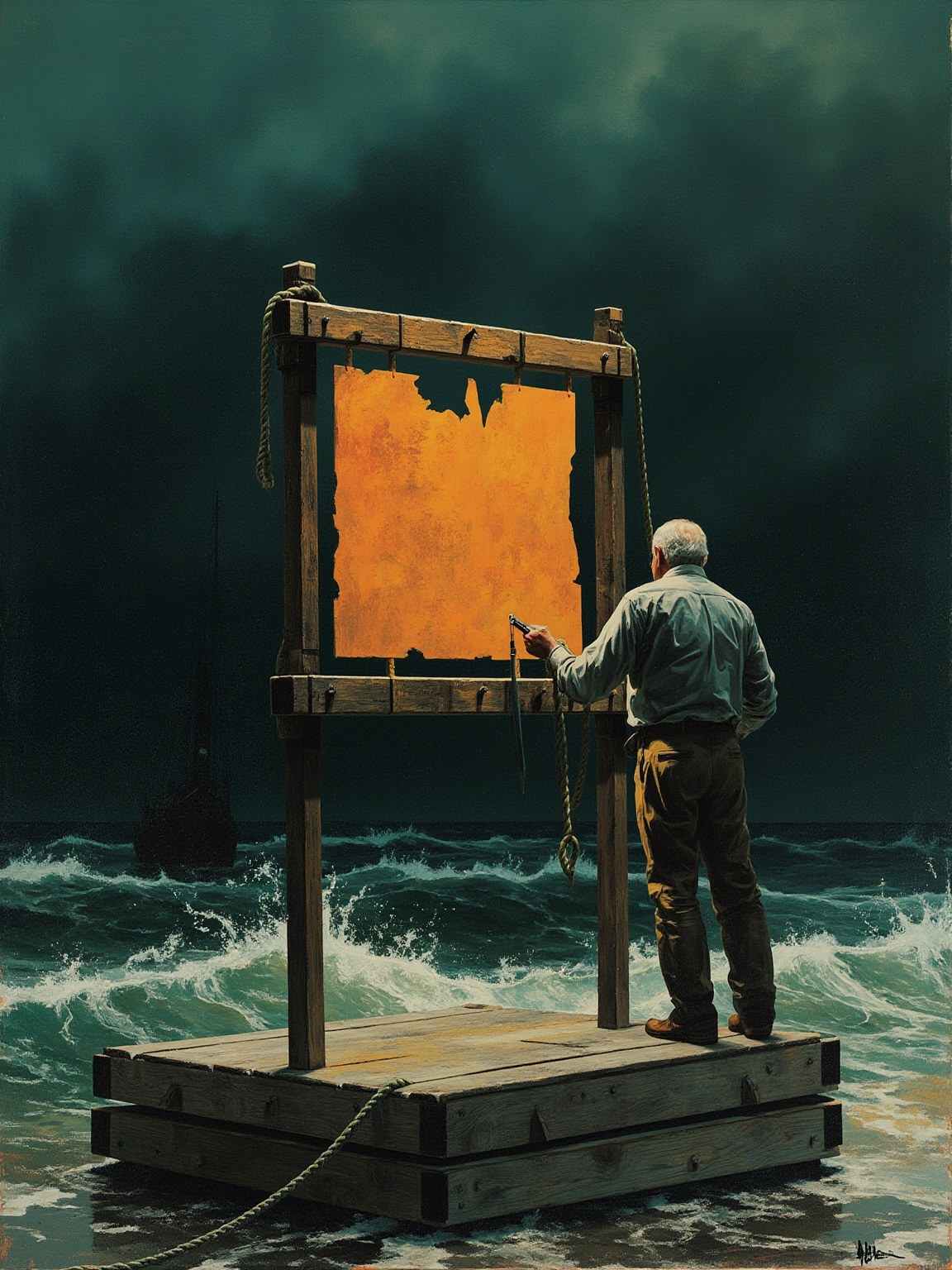
With the ship gone, Lethierry becomes desperate to recover the engine — his life's work, and the island's ticket into the steam age. He posts a notice on the docks: whoever brings the engine back intact from the wreck on the Douvres can have his niece Déruchette's hand in marriage. The whole island reads the notice and laughs — at high tide a boat can barely approach that rock, let alone haul out several tons of iron. No reward is high enough to tempt anyone. Then Gilliatt walks up to the notice and tears it down.
XI DISCOVERY A rock near the coast is sometimes visited by men; a rock in mid-ocean never.
近岸的礁石偶尔有人踏足;远洋的孤礁,从无人迹。
原文金句 · 第二部 · 孤礁
What follows is the most Hugo section of the whole book. He does not write the climb onto the reef as an adventure story — he writes it as a craftsman's engineering log: how Gilliatt studies the tide tables, rigs scaffolding in the cracks of the rock, uses pulleys, ropes, and log rollers to work the heavy iron engine free of the wreck inch by inch, and pins the ropes down with his own body through a night of storm so the wind cannot carry them off. Hugo writes it almost like a manual for a skilled worker doing his job, and that near-technical prose is exactly the point he is making: labor itself deserves the dignity of an epic.
By the third week, worn down but persisting, Gilliatt finally makes his way into a cave deep inside the Douvres — the sturdiest part of the wreck, and the only place to shelter from a storm. Wading in water up to his waist, he has just touched the edge of the engine when something moves beneath the surface. Five arms shoot out of the dark, wrap around his arms and torso, and begin fastening onto his skin. A giant octopus lunges out of the depths of the cave. This is not the cartoon octopus from Finding Nemo — it is a mass of living flesh clamped to your skin, sucking blood. Gilliatt has only a small knife and only one chance; he drives it into the creature's vital point behind the head — one strike, no second try. The fight lasts less than a minute, and it is the most suffocating page in the whole book. Hugo writes every inch of the tightening arms, every choked breath, at excruciating length, as if he wants to pin you against the cave wall and make you suffocate alongside him.
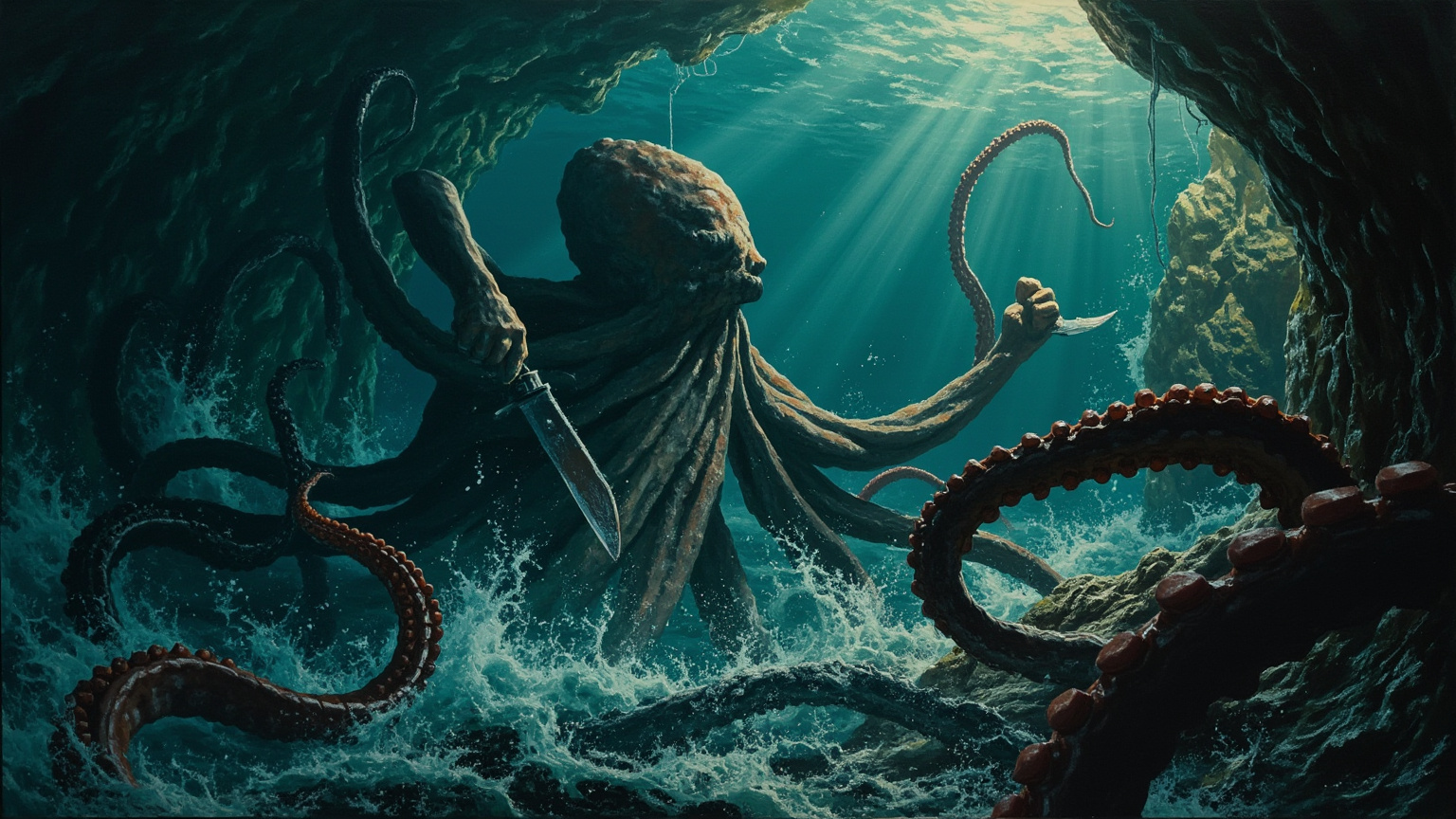
The spectre lies upon you: the tiger can only devour you; the devil-fish, horrible, sucks your life-blood away.
这幽灵伏在你身上:老虎只会吞噬你;而那魔鬼鱼……它吸干你的生命之血。
原文金句 · 第二部 · 章鱼洞
The octopus is dead. Gilliatt crawls out of the cave, covered in blood, and goes back to work. A few more days pass before the engine finally comes loose, is hoisted up onto the rock, loaded onto a small barge, and rides the tide back into Guernsey's harbor. He comes back alive, bringing Lethierry the machine he asked for. The whole village cheers on the docks. Lethierry announces to everyone that the promise stands — he will give his niece to Gilliatt.
But Déruchette does not smile. In her eyes is the shadow of someone else — the young clergyman Ebenezer Caudray. The two of them had already fallen for each other before Gilliatt ever set foot on the reef, only their positions had kept them from saying so openly. Gilliatt understands the moment he sees her face. He could hold her to the engagement, let the whole village's cheering force her hand, cash in the claim he nearly died to earn. He does not. He goes to Lethierry and calmly releases her from the engagement, then quietly arranges for Déruchette and Caudray to board a ship called the Cashmere and leave the island together, to marry somewhere else.
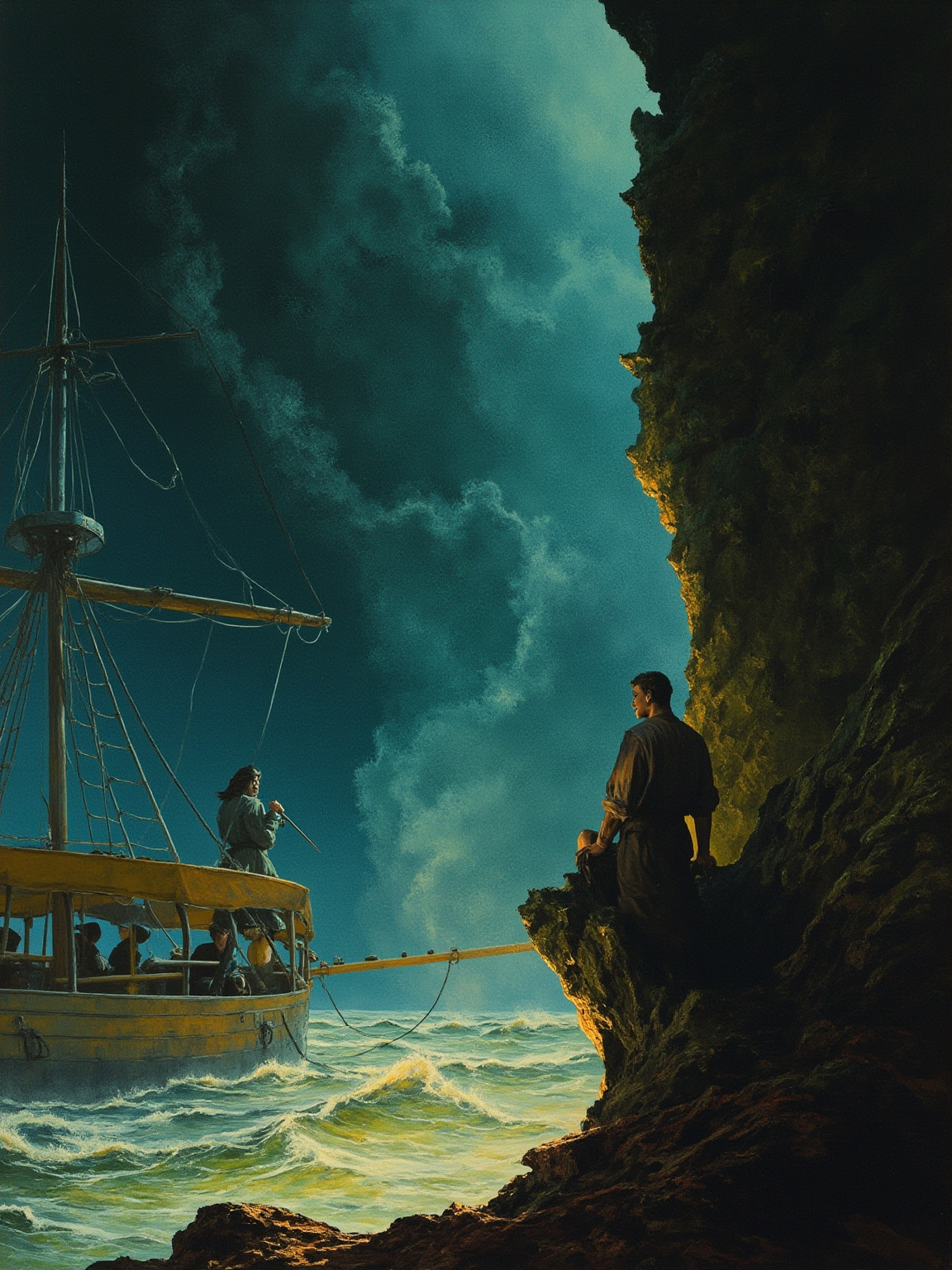
"I've come, good woman, from the new rector of the parish, the Reverend Ebenezer Caudray, who desires to pay him a visit."
我来这儿,好心的太太,是受教区新牧师艾比尼泽·考德雷之托,他想来拜望先生。
原文金句 · 第一部 · 意外来客
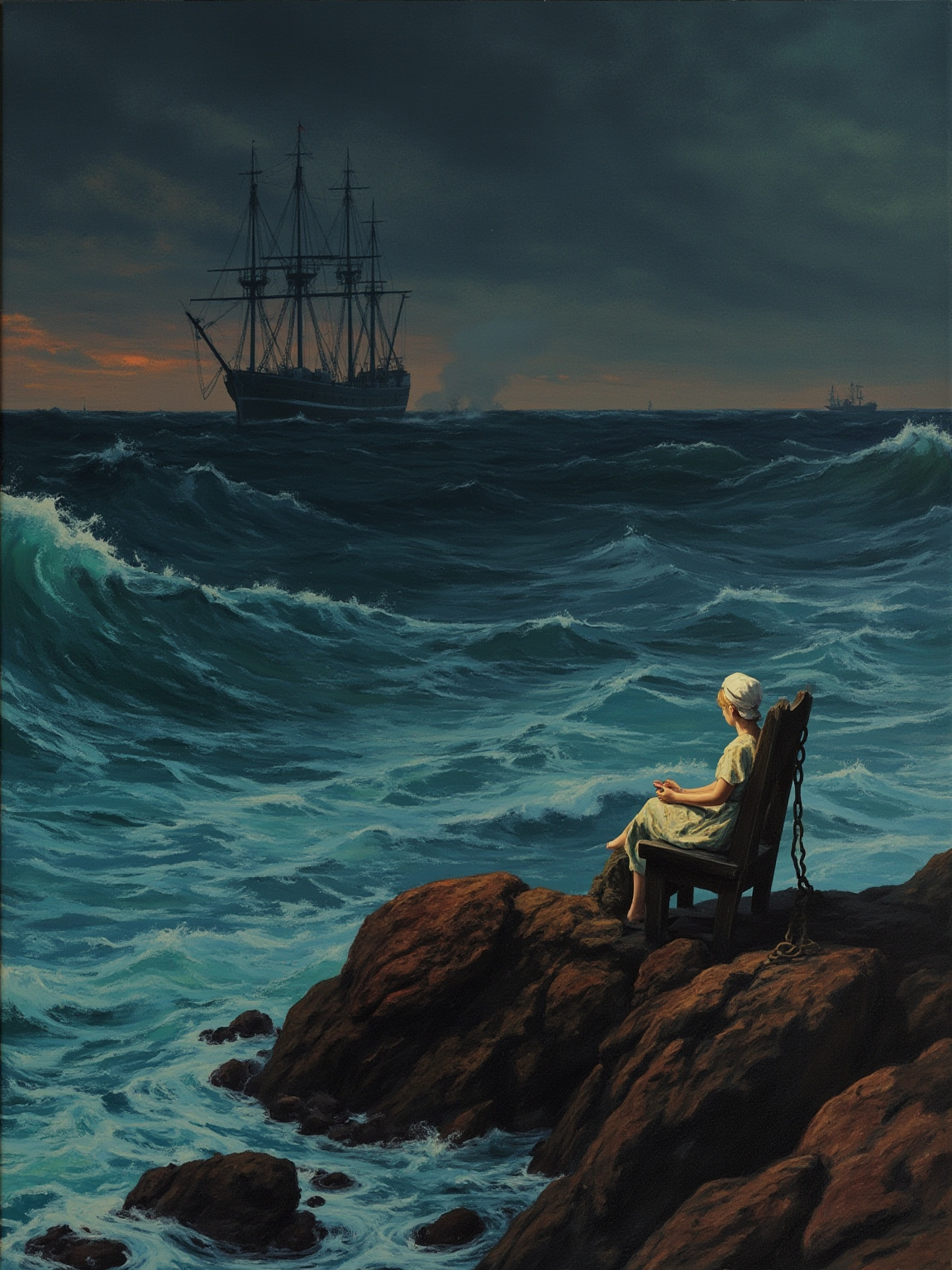
That day, the ship leaves the harbor. Gilliatt does not go to see them off. He walks alone to a cluster of rocks by the shore, to a natural seat the sea has worn out of the stone — the islanders call it the Gild-Holm-'Ur Chair. He sits down facing the water and watches the Cashmere's sails shrink into a speck on the horizon. The tide begins to rise, and he does not move. The water climbs over his ankles, his knees, his waist, and he still does not move. Not until the sea has swallowed him whole. There is no cry, no struggle, no note left behind — only him and the silent chair of rock.
Themes and Craft
By the time Hugo wrote Toilers of the Sea, he had already spent years in exile on Guernsey, defeated in politics and worn down in his personal life, and the book is in some sense a conversation with himself. On the surface it is about a man fighting the sea; underneath, it is really about three things. First, that labor itself is a form of heroism — every rope Gilliatt ties on that reef, every inch he pries the engine free, comes closer to the true meaning of the word greatness than any campaign fought by kings or generals. Second, that solitude is not the result of being misunderstood but the price of becoming yourself — he is called a sorcerer, shut out, treated as strange, and none of it is wrong, because he really is someone who cannot live at the same temperature as everyone else. Third, that love at its most extreme is not possession but release — this is the third time Hugo writes this theme, after making Quasimodo let go in Notre-Dame de Paris and Jean Valjean let go in Les Misérables, and each time he writes it harder than the last. This time he has the man who lets go drown himself outright.
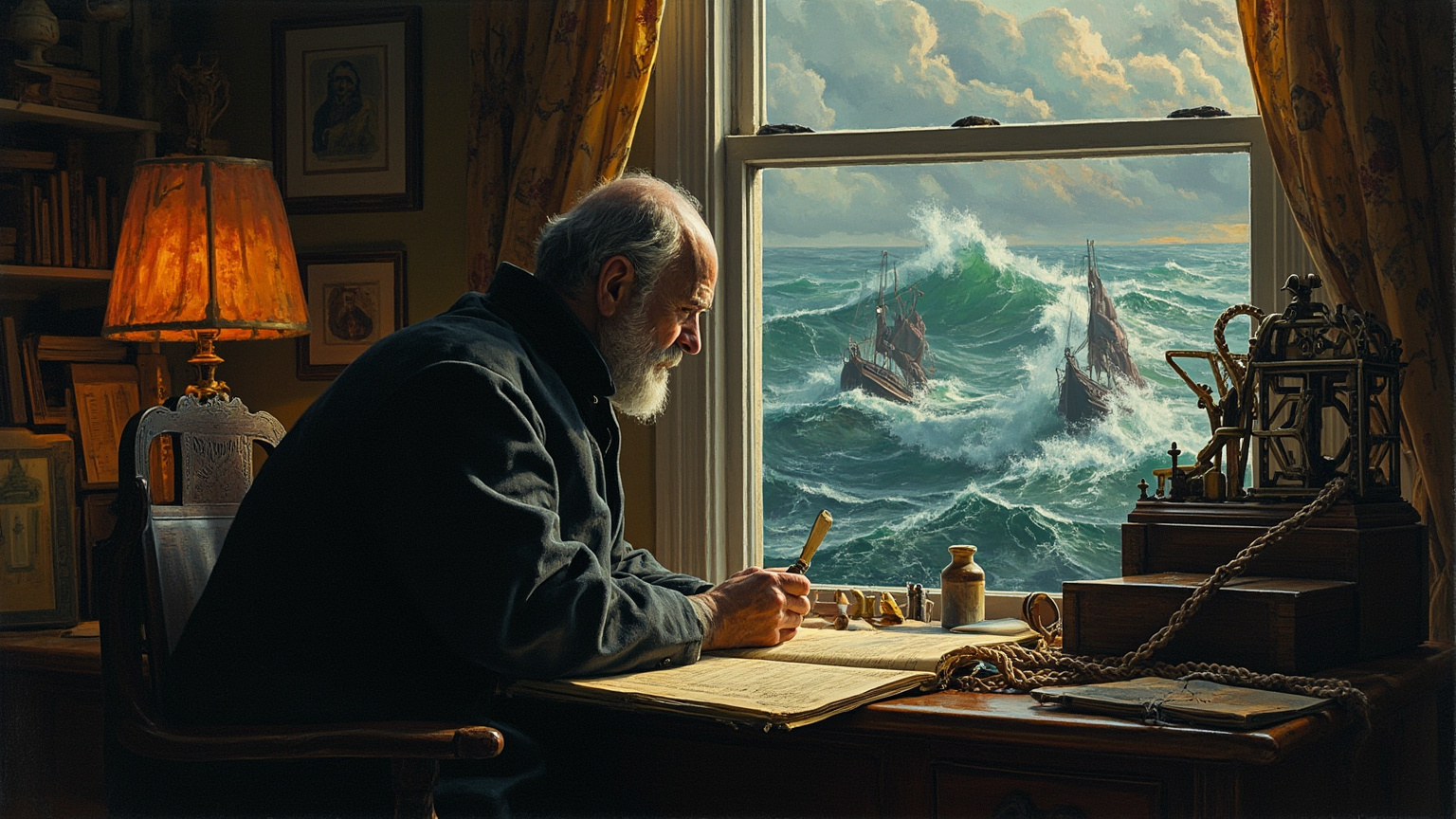
Gilliatt observed it closely, and muttered to himself, "I am thirsty enough, but you will give me plenty to drink."
我是渴极了,可你会给我足够的水喝。
原文金句 · 第二部 · 暴风雨
Hugo lets Gilliatt win everything, then has him give it all away with his own hands — the engine, the marriage, his life — until nothing is left but him and a chair of rock. It may be the quietest act of self-destruction in literary history.
Why Read the Novel Itself
What a companion guide can give you is the map: where the Douvres are, who Clubin is, who drowns whom. What it cannot give you is the smell of the rock. Hugo does not write the tide in adjectives — he writes the water rising inch by inch, the rope cutting a line of blood into a palm, a man crouched at the mouth of a cave listening to his own breath. However carefully you retell the octopus scene, it stays a summary; you have to climb into that cave yourself to feel the five arms tighten. And you have to read the last pages of Gilliatt on the rock chair yourself — Hugo writes that ending so slowly that every inch the tide rises sounds like a bell, and no summary can ring that bell for you.
Art Direction4 plates
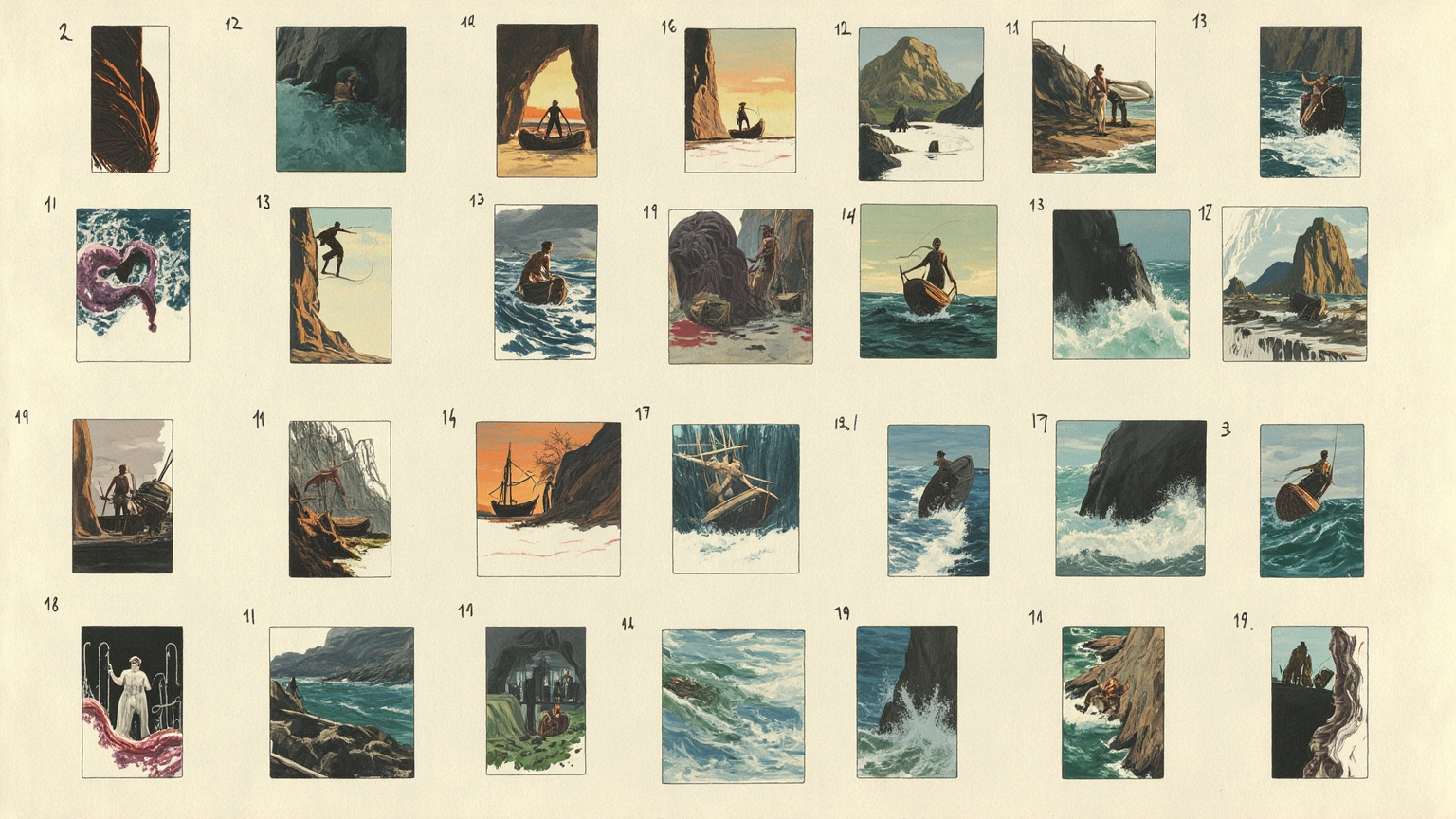
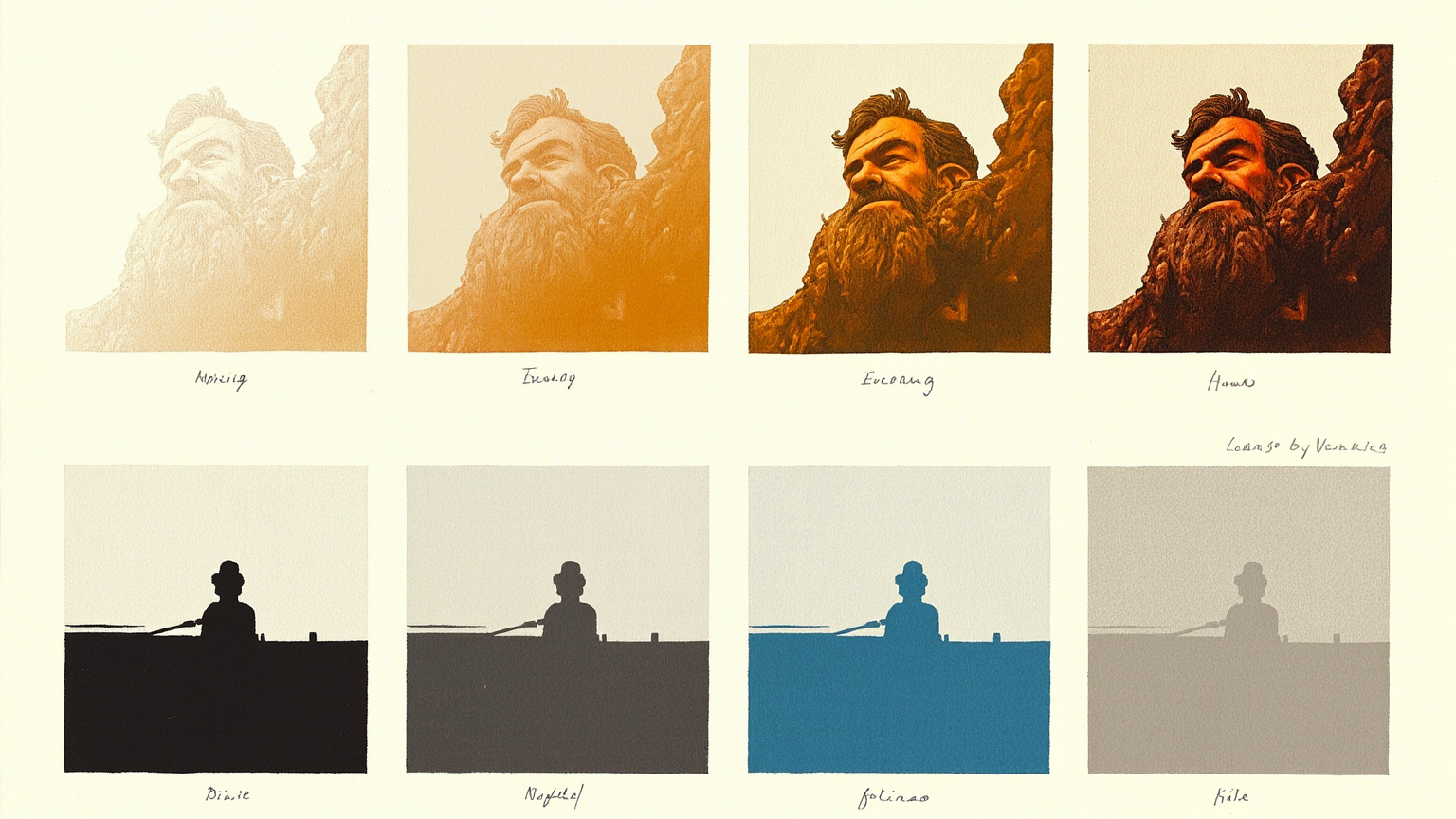
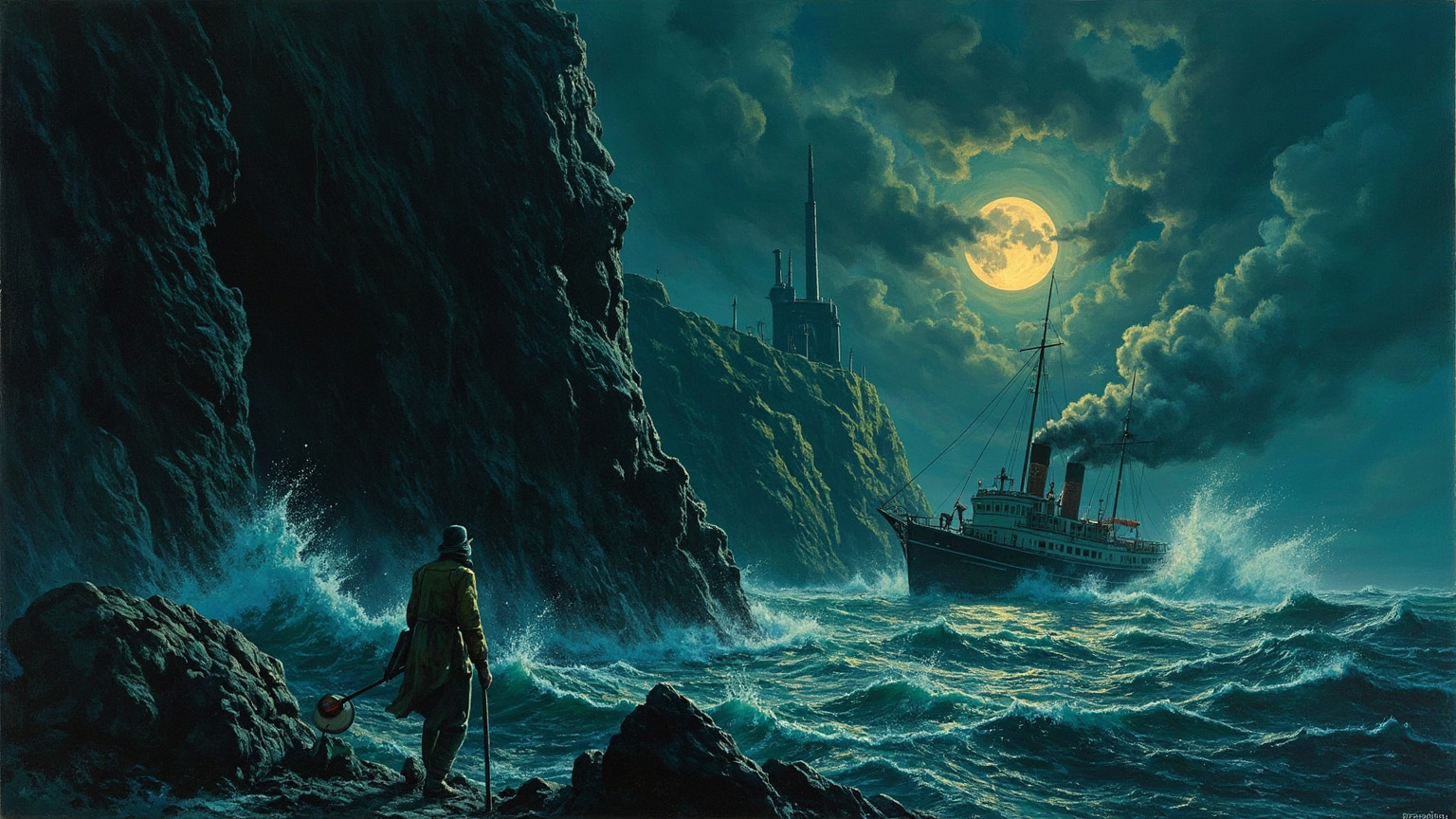
Before the guide was written, this book got a visual foundation — every illustration you just read grew out of it.