Twenty Thousand Leagues Under the Sea · Companion Guide
海底两万里
博物学家被困深海潜艇,周游奇迹世界,却逃不开文明与复仇的漩涡。
The Opening Hook
On a pitch-black stretch of sea, every ship kept telling the same story about a sea monster — something that glowed, roughly whale-shaped but unlike any whale ever seen, absurdly long, and with an odd habit of ramming the fastest ocean liners. This was happening in an age when steamships had already crossed every ocean on earth, which is exactly what made it so unsettling. So nation after nation sent out its newest, fastest warships to hunt the thing down, and nobody could make sense of it: there was no blank space left on the nautical charts for an unknown creature to occupy, and yet everyone swore it was out there. Just picture it — for a moment, the common sense of the world's best engineers, naturalists, and ship captains all failed at once.
What Kind of Book Is This
This book was written in 1870 by the Frenchman Jules Verne, later crowned the father of science fiction. It first ran as a serial in a Paris magazine aimed at education and entertainment, then came out as a standalone volume. In literary history it carries a few titles nobody can take away from it: the first novel to make a submarine of the future its protagonist — Verne pieced together a vessel nobody had ever seen using the electrical, mechanical, and nautical knowledge available at the time; second, it created one of literature's earliest and most complicated antiheroes, Captain Nemo, a man who hates land-based civilization so thoroughly that he shuts all of human society out behind him and founds his own nation at the bottom of the sea; third, it invented a way of writing — seeing the world through a scientist's eyes, welding natural history, geography, and adventure narrative into a single voyage. This book went on to define, almost single-handedly, the whole genre of oceanic science-fiction adventure.
Characters and World
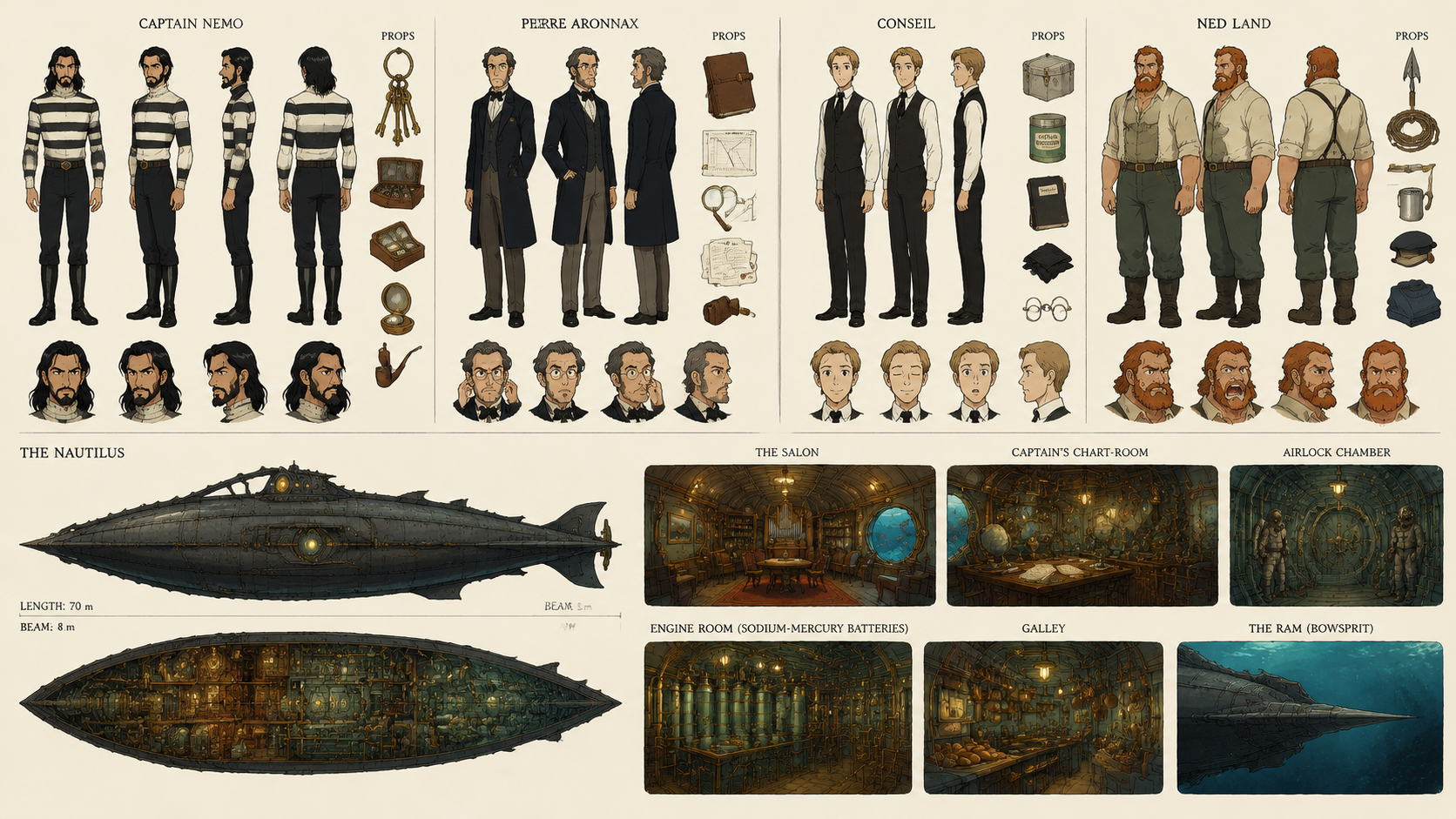
The book's point-of-view character is Pierre Aronnax, a French naturalist. He is the expert the government calls in to identify the sea monster — composed, curious, restrained, and the voice for everyone else aboard. Two men go into the water with him: his servant Conseil, a walking encyclopedia who dutifully rattles off classifications and looks things up no matter where his master has been thrown, providing the deadpan comic relief of a high-pressure situation; and the Canadian whaler Ned Land, hot-tempered, who from the moment he's aboard wants exactly one thing — to escape. The three of them end up spending most of a year on a submarine, and their relationship shifts from sea-monster investigation team to guests who've been taken in to, in effect, prisoners.
The submarine is called the Nautilus — a name drawn both from the extraordinary sea creature and from the early real-world submarines that bore it before. It runs on electricity, is nearly self-sufficient from air to food, and amounts to a sealed little society that can sail the ocean floor indefinitely. On the outside it's a smooth cigar shape; inside it's divided into a library, a drawing room, a kitchen, and cabins, gliding silently through the sea on electric power. The man who designed and commands it is Captain Nemo — a man of undisclosed nationality and hidden history, astonishingly learned, capable of hunting sharks with a hand weapon in an underwater forest, and possessed of something close to religious devotion to the ocean. He calls himself an avenger driven under the sea by some nation that once oppressed him, and he regards the whole of land-based civilization as his enemy.
How the Plot Unfolds
It all starts with that sea monster. At the opening of the story, merchant ships around the world report colliding, one after another, with a glowing, elongated creature — moving far faster than any known whale, and on a course too precise to be an animal's. The U.S. Navy sends out its newest, fastest frigate, the Abraham Lincoln, to hunt it down, and the French government seizes the moment to put the naturalist Aronnax aboard — he has no real choice, since this is his own country asking him to render a scientific verdict. That's how the three of them end up on the flagship of a hunting expedition.
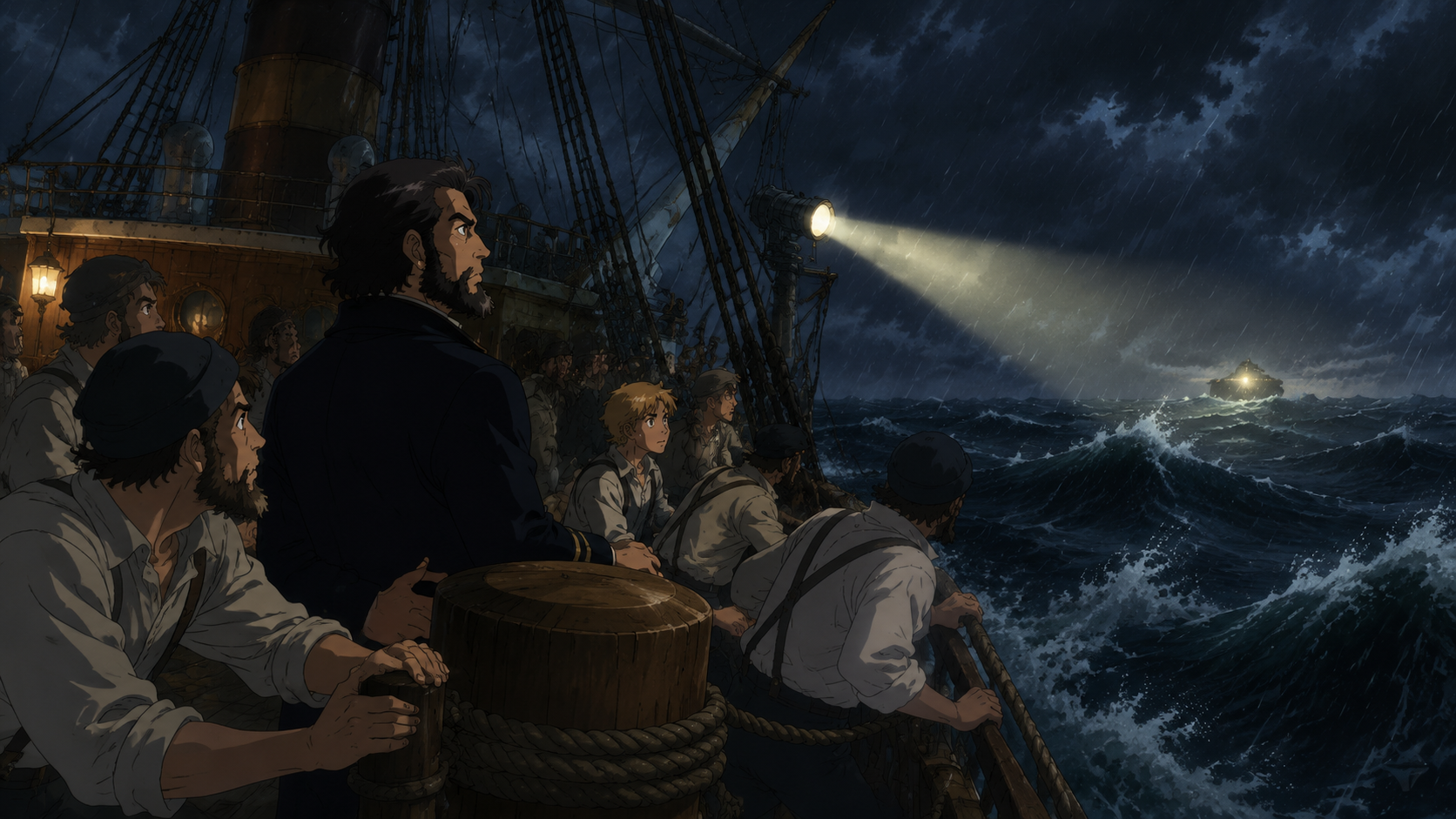
I looked and looked, till I was nearly blind, whilst Conseil, always phlegmatic, kept repeating in a calm voice: "If, sir, you would not squint so much, you would see better!"
我睁圆了眼睛看,直看到眼花,康塞尔却一贯冷静,用平静的口气反复说:“先生要是把眼睛眯一点儿,许就瞧见啦!”
原文金句 · 第8章 · 追踪海怪
Rammed by the Monster, Aboard the Nautilus
The Lincoln shadows its mysterious quarry for months, and one night the two finally collide — the creature surges up from below and flips the warship upside down. Aronnax, Conseil, and Ned Land are thrown into the sea and, in the pitch-black water, are hauled up by the edge of a metal monster. When they come to, they find themselves inside a submarine that has never been made public and appears on no ship registry in the world — the sea monster turns out to be a vessel, and its owner is Captain Nemo.
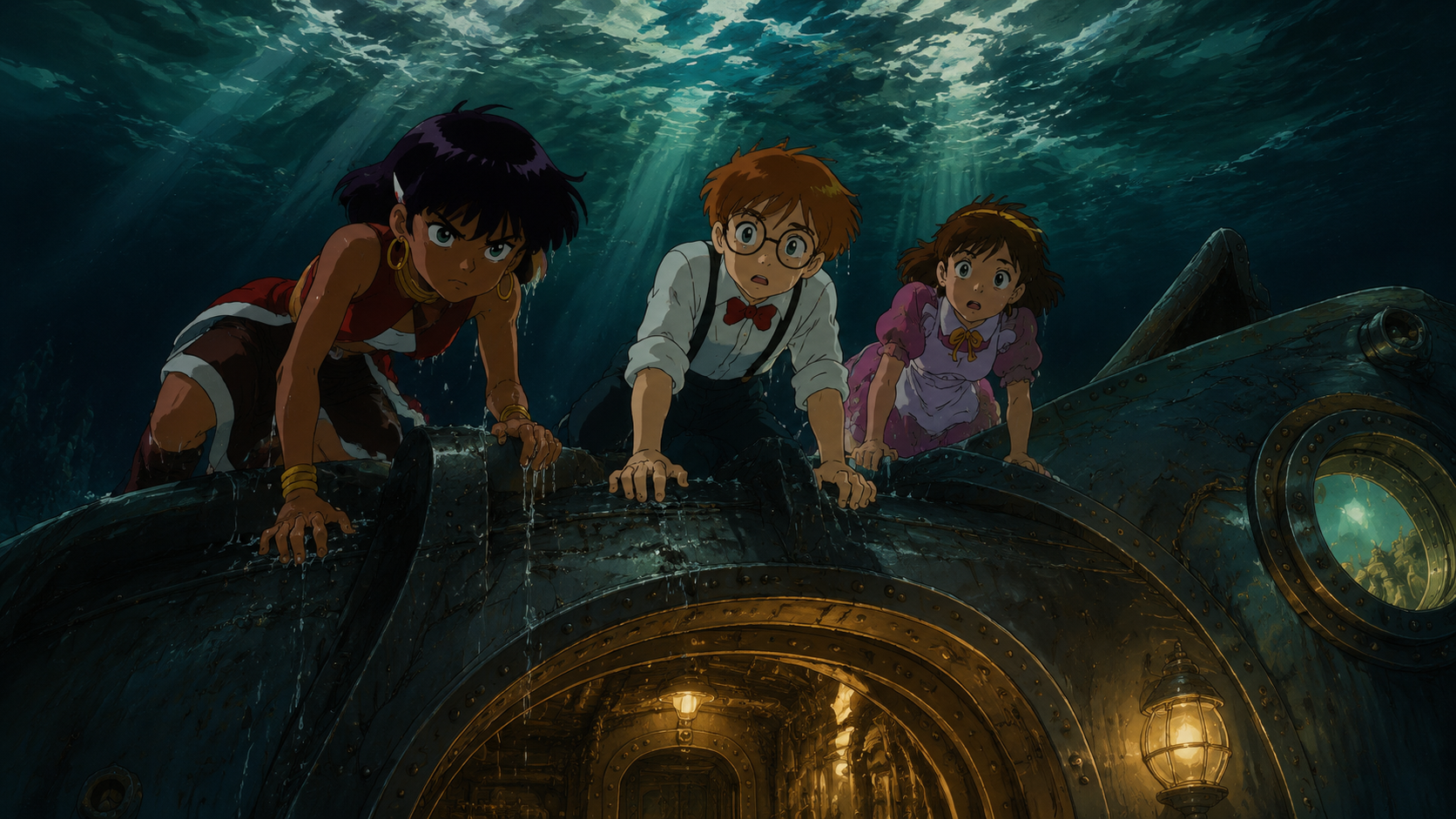
"I say that, at the time I threw myself into the sea, I heard the men at the wheel say, 'The screw and the rudder are broken.'"
我说,我投海的一刹那,亲耳听见舵轮旁的水手喊道:‘螺旋桨和舵都碎了。’
原文金句 · 第11章 · 落海获救
The Underwater Forest and a First Look at the Nautilus
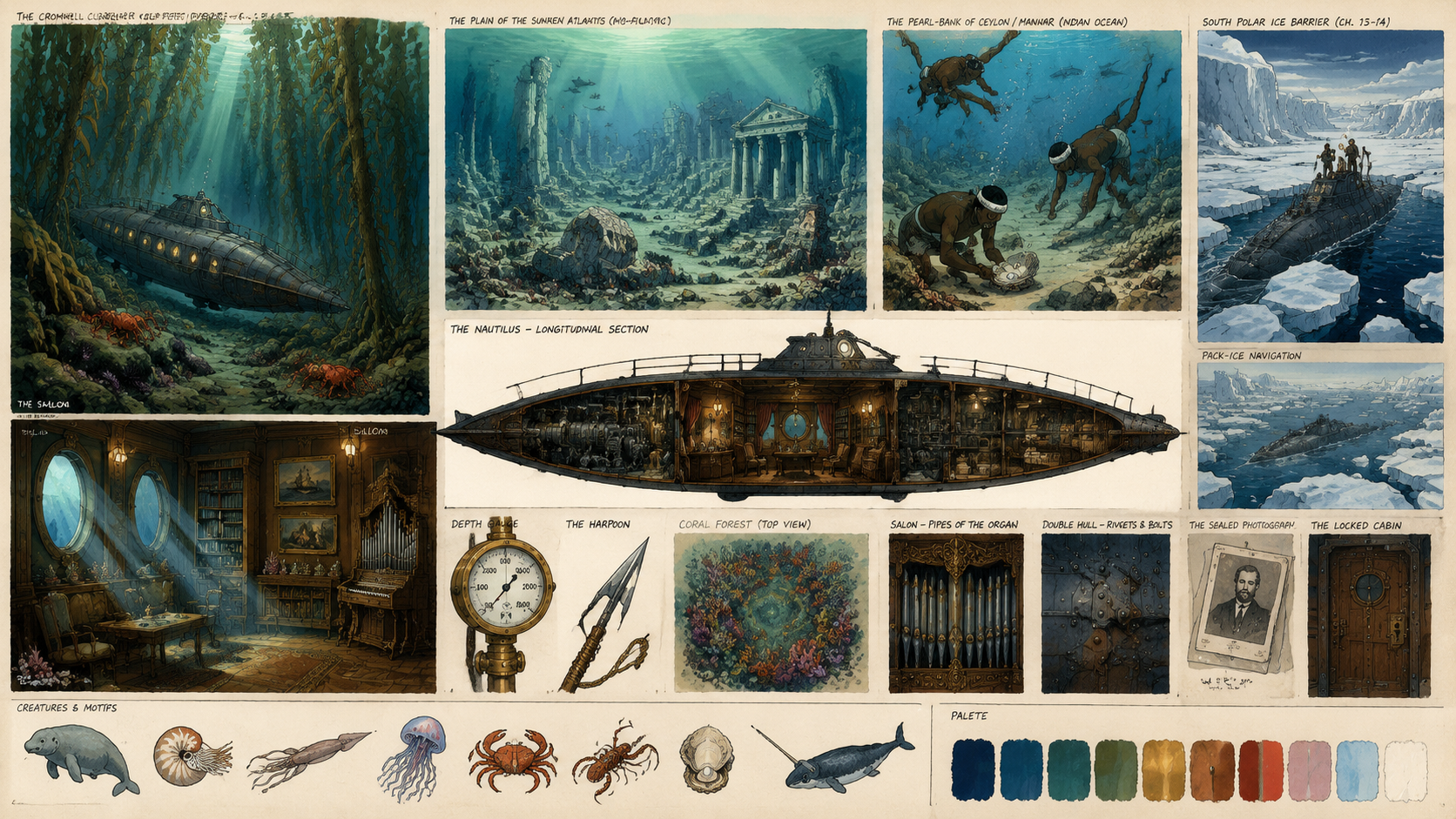
Captain Nemo doesn't kill them, and he doesn't let them go either — instead he keeps them as guests, which is to say, under house arrest aboard the ship. To prove his generosity, he takes the three of them somewhere no one else could go at the time: dressed in diving suits, they walk into a forest on the sea floor to hunt. Air is fed from small tanks carried on their backs, and the woods hold deer, bears, and sea lilies in colors too rich to be believed. For the first time in their lives, the three of them breathe with their lungs and walk on their own feet below the edge of the continental shelf. Verne's writing here is remarkably restrained, reading almost like a proper field-survey report, and it's precisely that restraint that turns the phrase underwater forest into a wonder that had never existed before.
Atlantis, the Arabian Tunnel, and the Shark Fight
The Nautilus presses on, and the route unfolds as a string of spectacles that look like sightseeing but are really something closer to a mission: they visit the ruins of an ancient civilization sunk beneath the sea — Verne borrows the name of Greek myth to write a lost continent older than Egypt; the submarine passes through an undersea tunnel linking the Red Sea and the Mediterranean, cutting straight through a route that mythology had called impossible; and finally, at a pearl-diving ground, Captain Nemo charges bare-handed into a school of sharks to save a Black pearl diver caught in one's jaws — one of the most widely retold scenes in the whole book. In terms of craft, Verne is deliberate about following every spectacle with a jolt of adrenaline: museum, tunnel, menagerie, then slaughterhouse, so the pacing never turns into a mere inventory.
Planting a Flag at the South Pole, and a Narrow Escape Under the Ice
The story's high point comes in Antarctic waters. The Nautilus breaks a path through the ice to a place no ship in history had ever reached — the South Pole itself — and the crew step onto the ice and plant a flag, a feat on the scale of humanity's first landing on the moon. But the real ordeal is the trip back: the floating ice closes up again behind them, sealing the entire submarine beneath a ceiling that is shutting like a lid. Everyone aboard can only watch the oxygen supply tick steadily downward, and the whole crew, including the three protagonists, has to get into the water with picks and chip away at the ice, inch by inch, to survive. Verne writes this passage with real ruthlessness — no mythical rescue, only physics: muscle, heat, and oxygen pulled from electrolyzed water. When the ice finally gives way, he sums it up in a single line: the pressure of the sea shoves them violently out from under it. It's the tensest stretch in the whole book, and also its most modern.
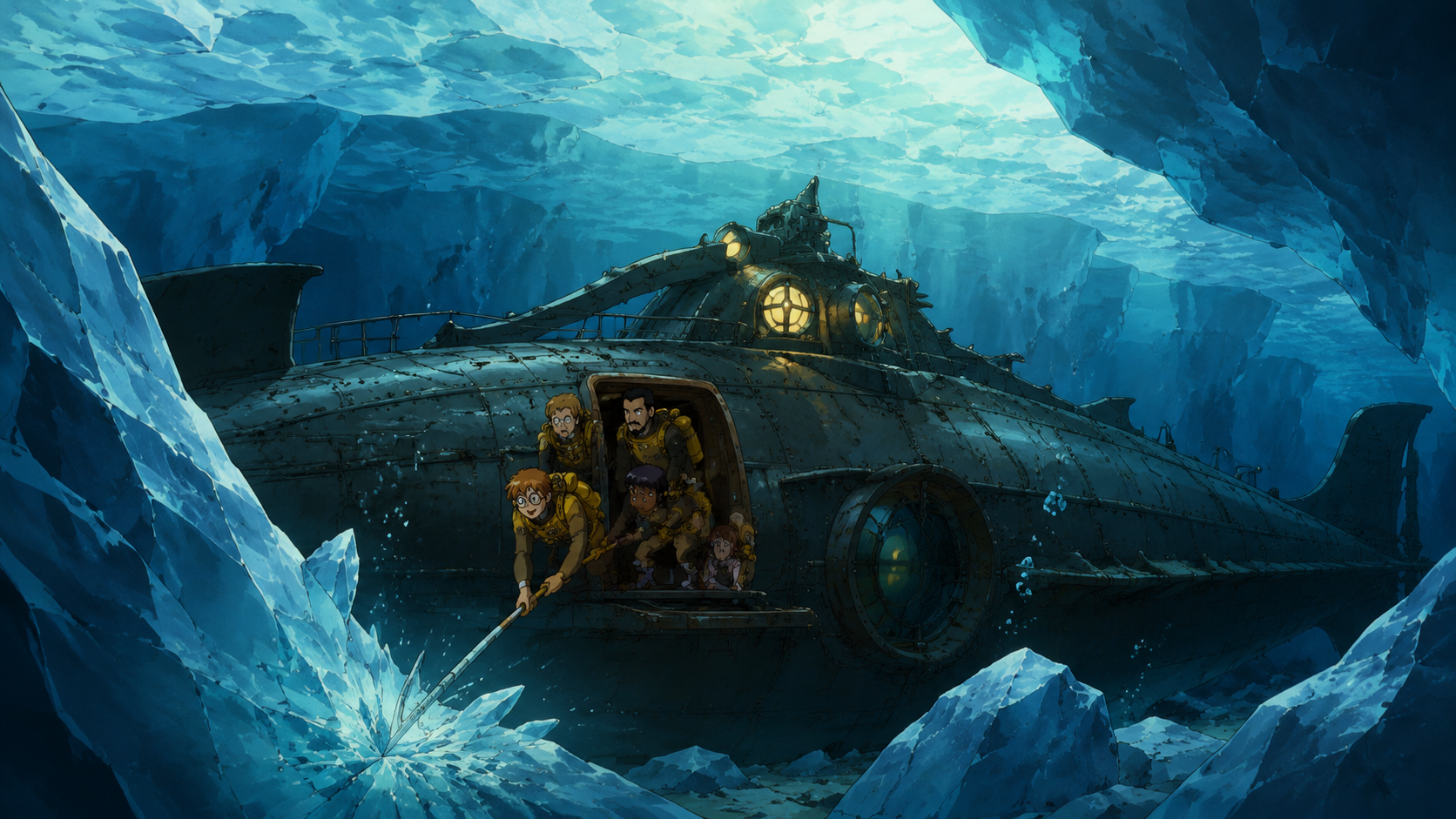
It then came into my head to ask Captain Nemo if he had ever discovered that pole which had never yet been trodden by a human creature?
这时,我突然想到问尼摩船长,他是否已经发现了那个从来没有任何人踩踏过的极点。
原文金句 · 第77章 · 南极插旗
Nemo Rams a Warship
After the South Pole, Captain Nemo's image begins to change. In a standoff with an unidentified warship, he gives the order to ram it head-on with the submarine's steel ram — he has confirmed the ship belongs to the nation that once oppressed him. Aronnax stands inside the vessel through all of it, watching a ship split open like paper. This is Verne at his most unsettling: he never lets Nemo step out into a raging speech; the submarine simply presses a button, and steel carries out the sentence. From this point on, Aronnax begins to fear Nemo — not because Nemo has changed, but because the same ship, the same smiling man, is read, for the first time, as meaning something else entirely.
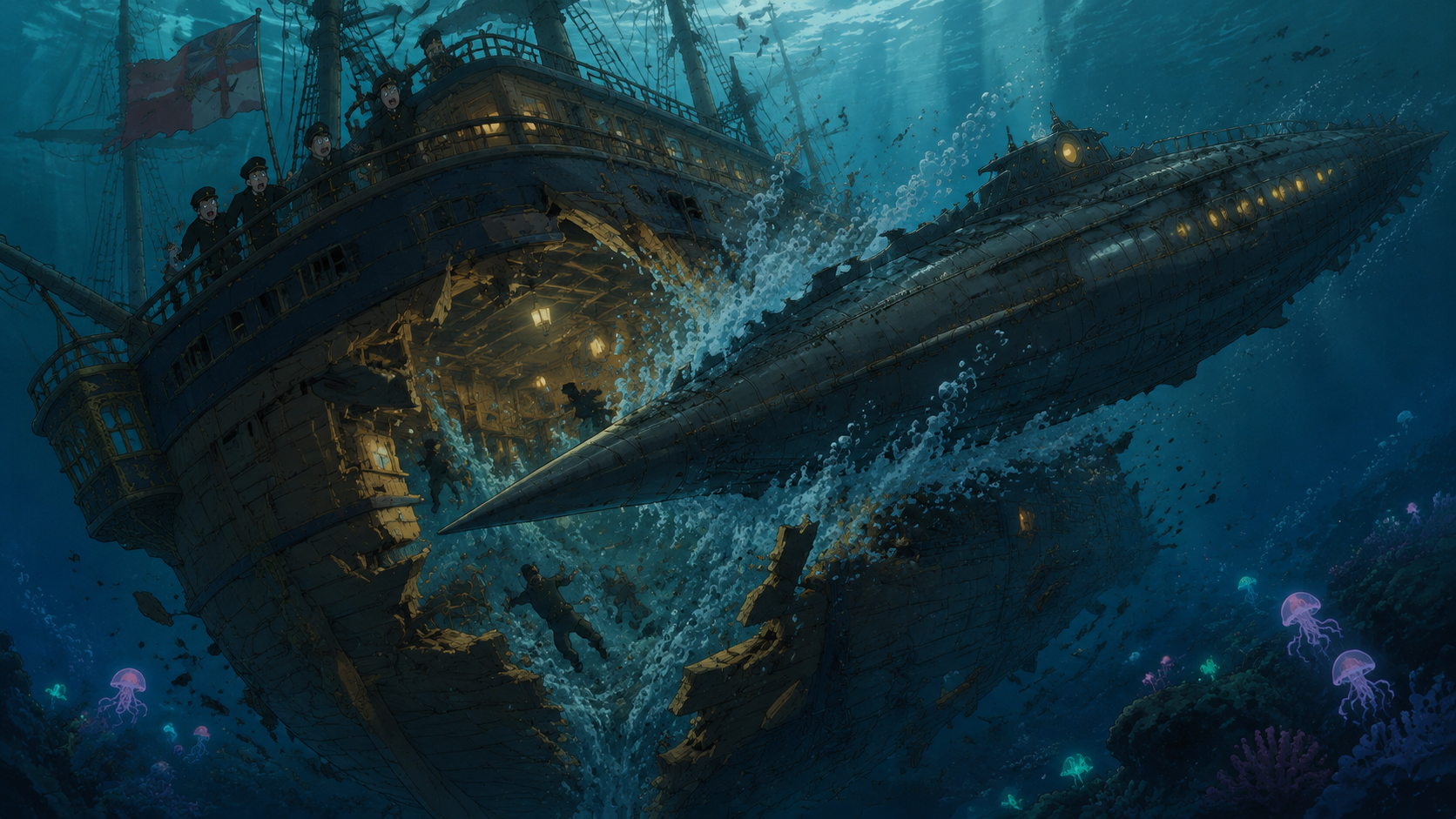
"You must be confined, with your companions, until I think fit to release you."
您和您的同伴必须待在艇上,直到我认为适合放您走为止。
原文金句 · 第45章 · 尼摩的囚禁
The Maelstrom and the Escape
The story comes to rest off the coast of Norway, in the great Maelstrom. A storm drags the Nautilus into this real whirlpool, one believed at the time to let nothing escape. In the chaos, Ned Land takes the chance to get Aronnax and Conseil into the ship's boat, gambling on a way out of a relationship that was never going to end well. The three of them leap out into the storm, the submarine spins away in the current, and the remaining men of the land are separated from it and its captain for good. Verne gives Captain Nemo no death, and the submarine no sinking — he lets us see only the boat flung clear of the whirlpool's center, and leaves the fate of the submarine and its master blank. It's the most anticlimactic choice in the whole book, and also the most Verne: he hands the future to the reader instead of writing it to a close.
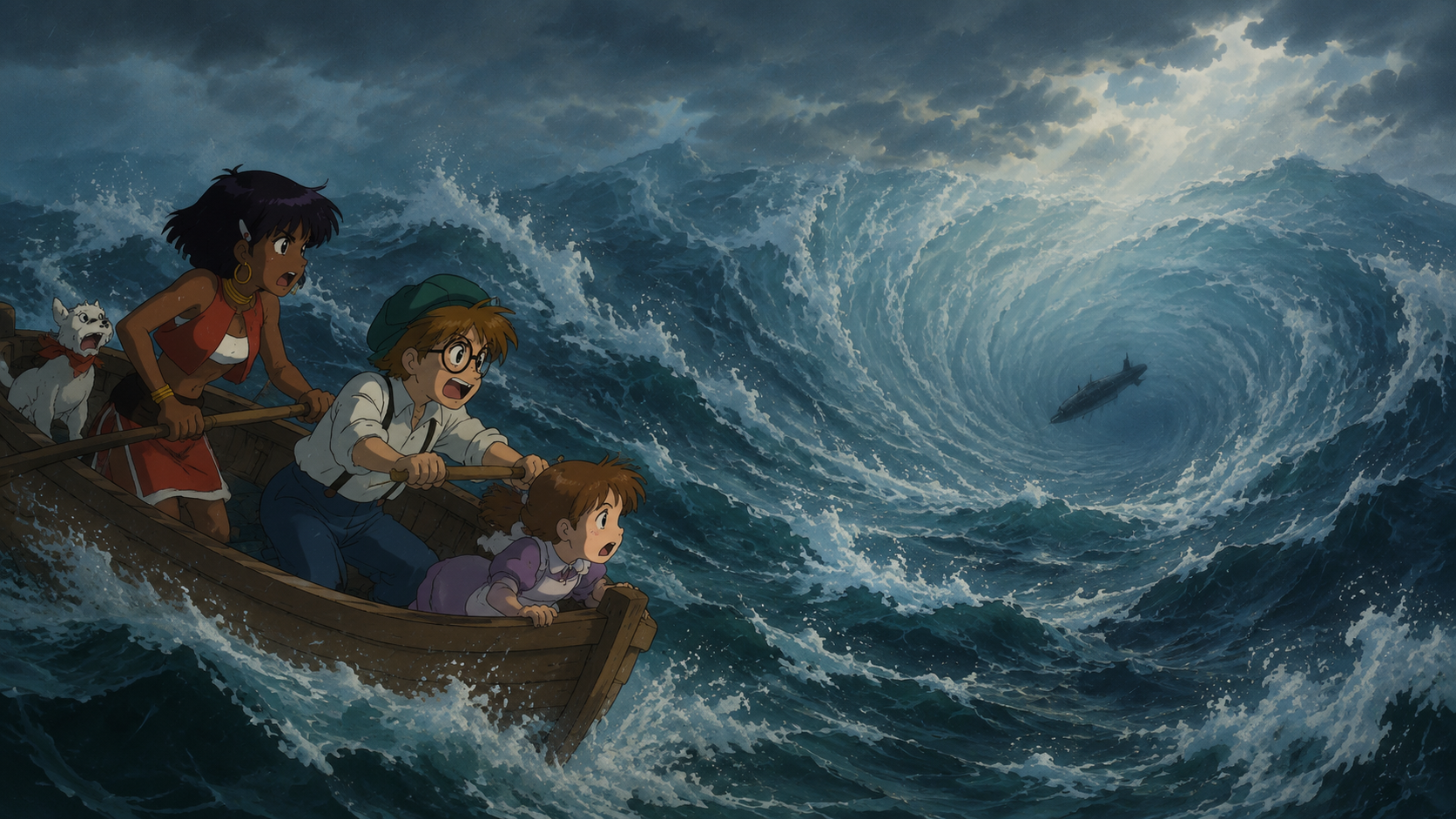
"Well, I think-I do not say I hope-I think that this favourable opportunity will never present itself."
好吧,我想——我不想说我盼望——我想这有利的机会是永远不会自动出现的。
原文金句 · 第60章 · 逃生时机
Themes and Craft
Twenty Thousand Leagues Under the Sea does something no other nineteenth-century sea novel did: it lets a submarine become a nation in its own right. Captain Nemo isn't a seafaring adventurer — he's an exile who uses technology to turn the ocean into a temporary home more equal than any found on land. This double idea of techno-utopia plus self-exile has been borrowed from for a century and counting, from Pandora in Avatar to every cyberpunk setting where people found their own nation in the sea, in the mountains, or off-world — trace enough of them back and you land here.
On the level of craft, the thing most worth noting in Verne is what might be called restrained exhilaration. He never shouts just because something is a spectacle — the underwater forest reads almost like a scientific survey, and death scenes are folded into the pacing rather than given their own chapter. It's actually a strikingly modern move: he assumes the reader is already fed up with novelty for its own sake, so he lets the horror speak for itself and lets the excitement come from the science itself. Reading it today, what sets it apart from most so-called classic science-fiction adventures is this: Captain Nemo is not a heroic device, he's a walking contradiction — a man who can let strangers live like gods on the sea floor and also snap a ship in two on a battlefield; Aronnax's feelings for him keep swinging between reverence and fear throughout, and Verne never resolves it for him.
For today's reader, what's most gripping is actually Aronnax's position: he is both honored guest and prisoner at once. It's a remarkably modern condition — you're invited into a perfect world, you get everything you always wanted, and yet you can't leave, you can't object to your host, and even your most lyrical moments might be turning over some other intention above your head. Nearly every modern metaphor for platforms, walled gardens, and people locked up in the most beautiful possible way can find its prototype on this submarine.
The Hook to Send You to the Text
A companion piece can tell you where the submarine went, but it can't give you the cold of the seawater, the shudder of the pick against the ice, or the feeling of slowly growing afraid of the man who saved your life inside a perfect world — only the text itself can give you that.
The Hook to Send You to the Text
You already have a rough sense of the plot, but there are several very concrete reasons why knowing the plot still leaves the book worth reading. First, Verne's sentences carry their own kind of calm exhilaration — the cold of the water, the shudder of the pick biting into ice, the suffocating tightness of breathing air split from water by electrolysis — no summary can hand you these physical sensations. Second, you have to read Captain Nemo yourself to feel that crack in him; he stays a friendly, dangerous man from start to finish, and that shift in degree is something you only catch by counting his silences in the original text. Third, the story is told in the first person by a naturalist, and Aronnax grows steadily more restrained as the pages turn — the more restrained he gets, the more clearly you can hear how frightened he is, and that is where the real terror of this voyage actually lives. You already have the map. The sea is still down there.
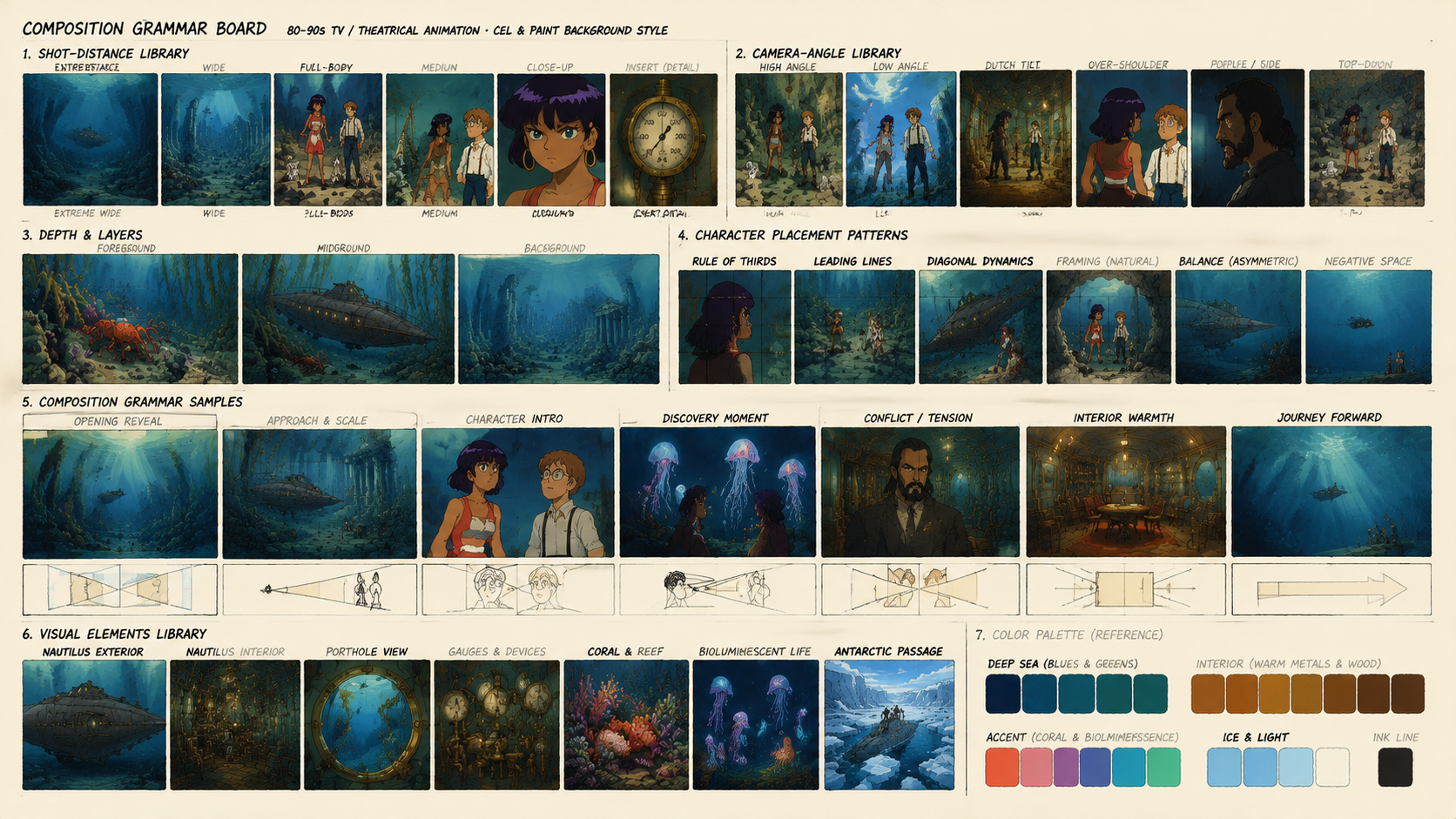
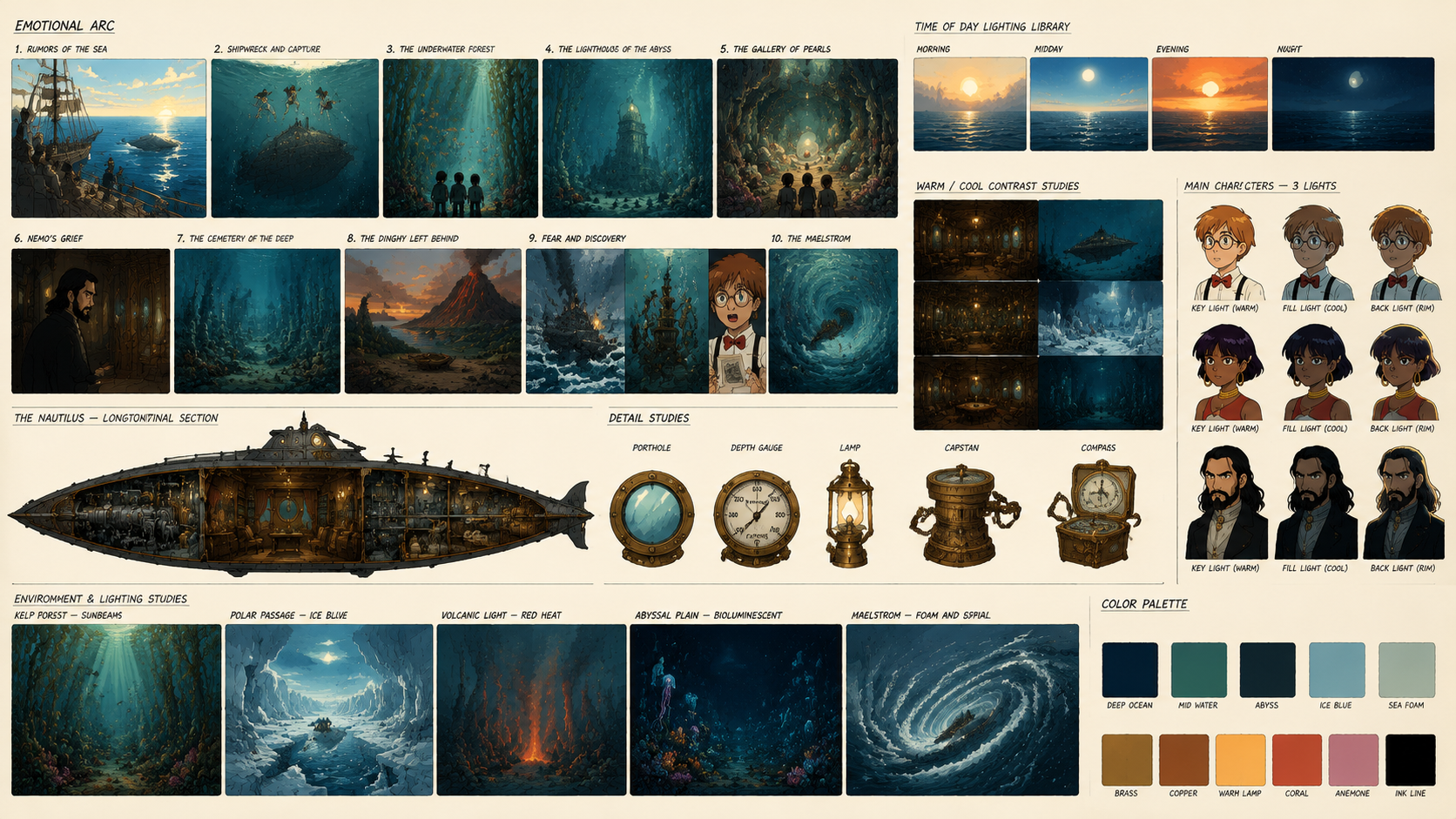
Art Direction4 plates
Before the guide was written, this book got a visual foundation — every illustration you just read grew out of it.