Typhoon · Companion Guide
台风
一个不肯想象的人,驾驶两百条命驶入台风中心,最后用一封信把整场风暴写成四个字。
Opening: A Broken Barometer
The wheelhouse glass lay shattered on the floor. Captain MacWhirr stood by the helm, the waves beating the entire ship to one side, the tilt so steep the sea seemed pressed against his face. He didn't let go. This is the opening Conrad wrote in 1902 — not a hero drawing his sword, not a coward jumping ship, but a middle-aged captain who has no access to the emotion called "fear," gripping an iron helm for dear life. If you asked him what just happened, he'd look down at the barometer, then up at the sea, and tell you: "A bit windy."
What this slim book actually contains
Typhoon was first serialized in 1902, then collected in Conrad's short story collection over a year later. Along with Heart of Darkness and Lord Jim, it's among his most famous works — but it's the lightest in weight and the most concentrated in impact. A novella's length, devoted to a single storm, and yet it has become a specimen that English sea literature keeps pulling out for discussion. Conrad's real name was Józef Teodor Konrad Korzeniowski. He was Polish, later made his living on British merchant ships, and eventually commanded his own vessel. What he wrote wasn't adventure — it was what remains of a person once you strip away all social identity at sea. This book goes further than any: stripped down to the end, what's left is a man who "cannot imagine."
The men on the ship
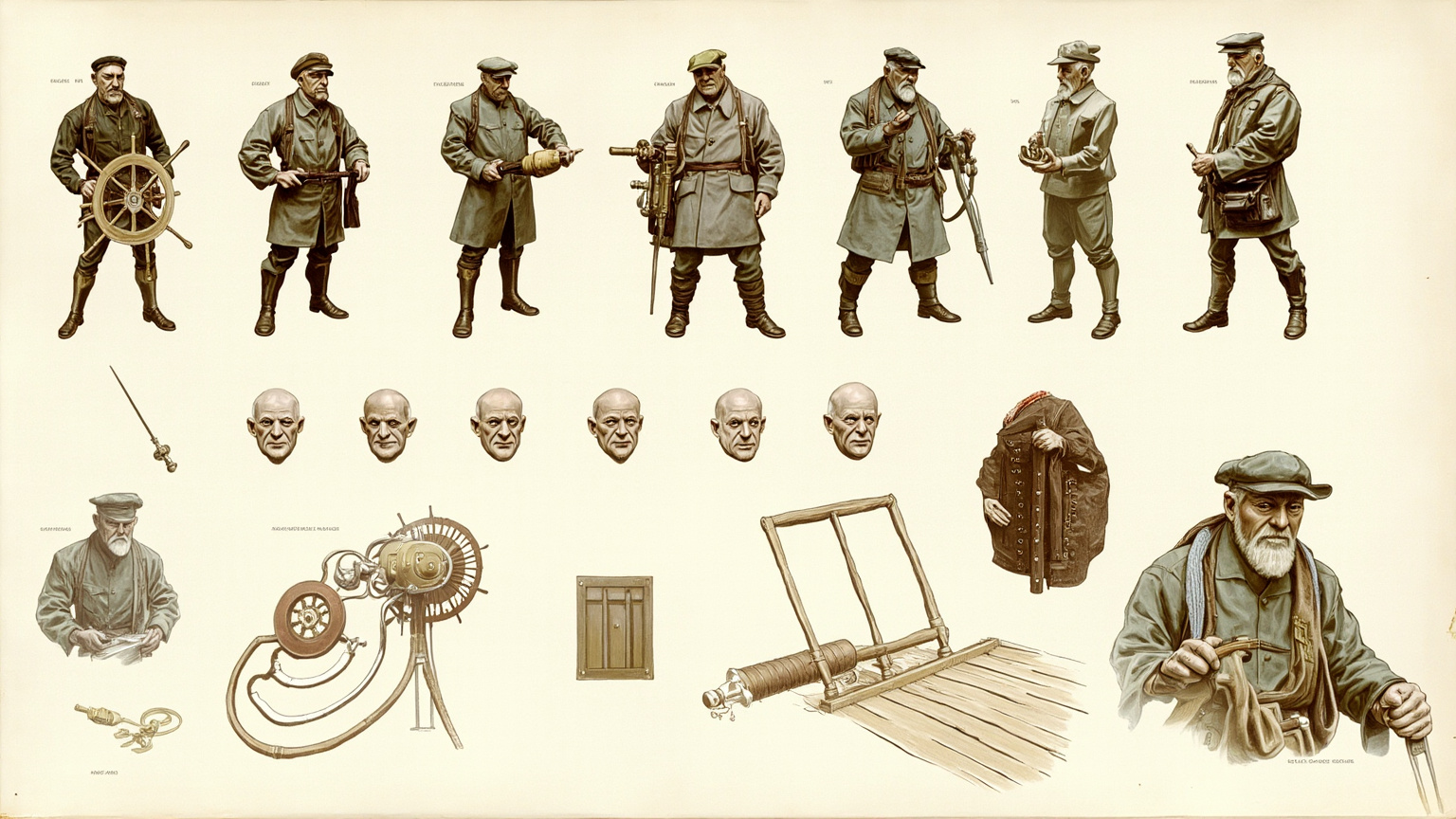
The South Mountain was a decrepit steam cargo boat, its smokestack rusted through, its iron deck pitted and scarred by salt. It was sailing from some southern port back to Fuzhou, carrying two hundred Chinese coolies and the silver dollars they'd brought with them — the sweat and blood money the coolies had saved, hidden in their chests and bundles. Captain MacWhirr: middle-aged, average build, simple mind. He had a whole set of creeds: check the barometer, follow the rules, never change course because you "feel like something's going to happen." First mate Jukes: young, sensitive, capable of imagining what a storm would look like, what death would look like, so he kept urging the captain to take a detour — and got shot down every time. Engineer Rout was the steadiest of the three, spending the whole time in the engine room making sure the steam engine never stopped, sweat dripping into his boots without him ever once looking up. Beneath the ship, there were two hundred Chinese men with shaved heads and queues, wearing cloth garments. They weren't crew. They were cargo.
The barometer starts falling
The story starts with a very small detail: the barometer reading drops sharply. Jukes takes the instrument to the captain, suggesting they head east to skirt around the storm center that's forming. MacWhirr looks at the instrument, looks at the sea, then hands it back and delivers what is almost the book's central line: "You don't change course because you're afraid." He isn't brave, isn't showing off — he simply doesn't have the program for "fear." A man without imagination can't even picture what failure looks like. The first mate sighs and doesn't argue further. The ship sails straight into the typhoon's eye.
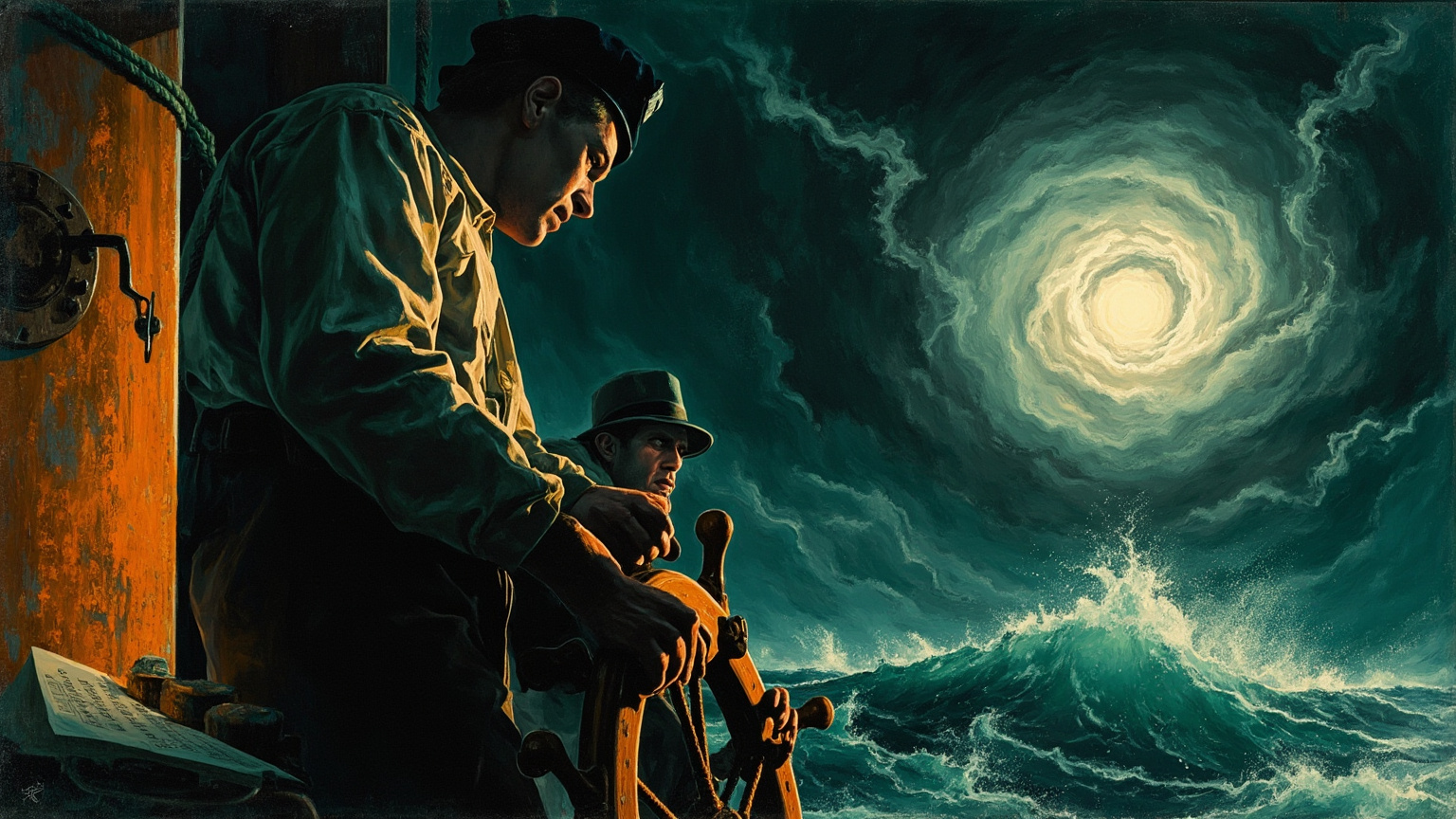
There was a low barometer, and the wind freshened a bit from the south-west.
气压计在往下掉,西南风也紧了几分。
金句 · 开篇 · 气压骤降
A giant wave slams into the wheelhouse
Then the typhoon arrived—not creeping in gradually, but a whole wall of seawater slamming sideways. The wheelhouse glass shattered completely, the helm violently jumping in MacWhirr's hands, the sky and sea beyond the porthole becoming indistinguishable. The ship was pressed to its extreme angle of heel, the iron deck screaming in a way metal shouldn't. In the wheelhouse only MacWhirr and Jukes held fast to the helm. Below in the engine room, Rout battled the flooding seawater and coal dust, watching the boiler pressure gauge—once the steam stopped, the ship was dead, he knew that better than anyone. Conrad wrote this passage with almost no adjectives; what he wrote was angles: the deck tilted to X degrees, the funnel sliced off by wind, the wave cresting over the wheelhouse. You're not reading a story—you're reading an accident report—but in that report someone is betting their life.
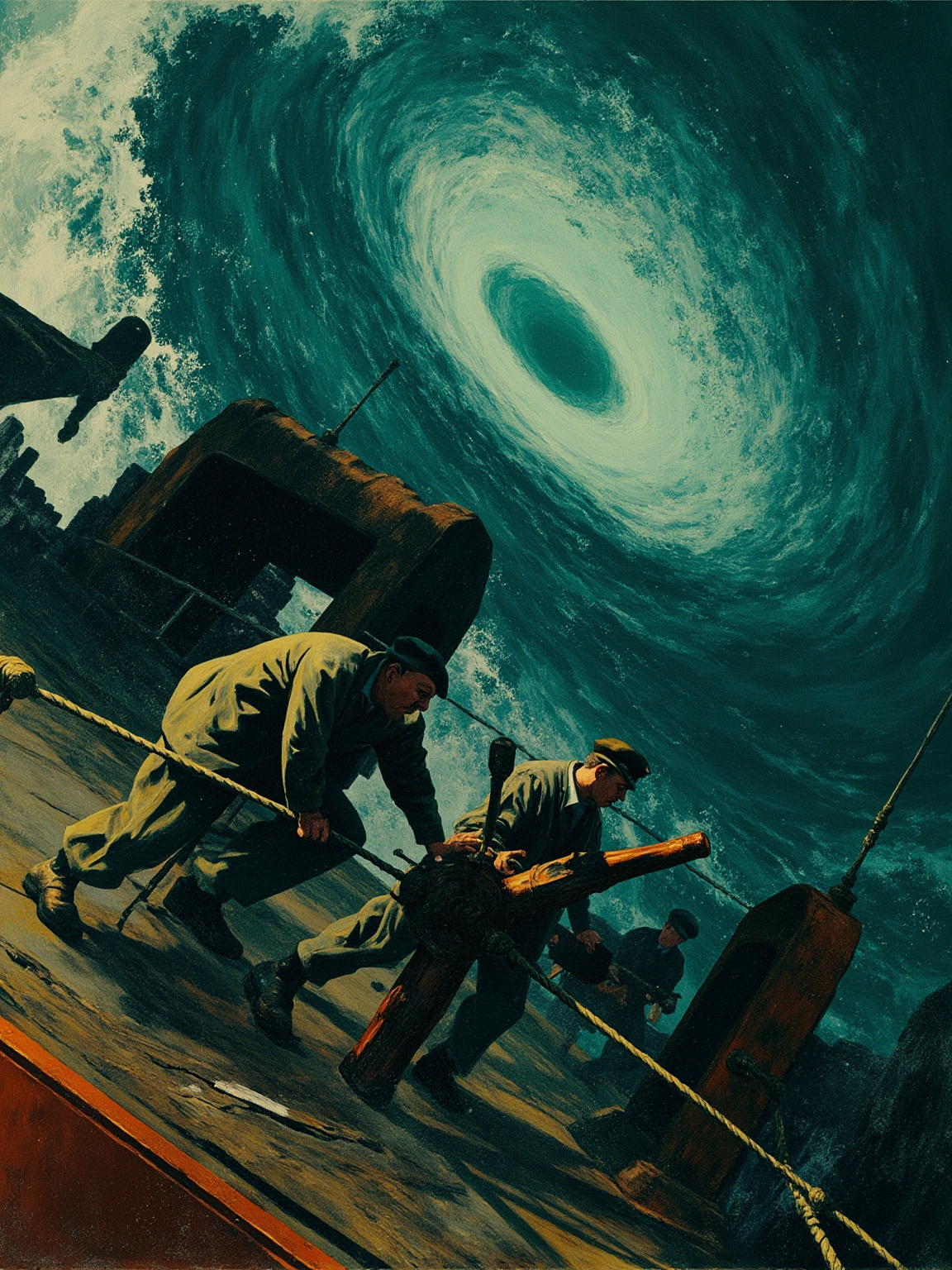
The sea, as if it had been crushed under a weight, lay for a moment still—and then a great wave, with a noise like thunder, came rolling over the ship's side.
海面像被什么压住了似的静了一瞬——接着一堵巨浪挟着雷声从船舷翻了过来。
金句 · 风暴正面袭来 · 巨浪入驾驶室
Trouble starts in the cargo hold
The ship was pitching too violently in the storm, and the two hundred coolies in the cargo hold started to panic. They were thrown about, trampling each other, some screaming, some clutching their money boxes—the silver dollars they'd saved their whole lives—scattered across the deck when the crates overturned. Fear and greed tangled together, wilder than the storm itself. MacWhirr sent Jukes down to the hold to take a look. Jukes went down with a lantern, and what he saw made his legs go weak—not that he'd never seen dead people, he'd never seen so many living people acting like the dead at once. He tried to shout orders, no one listened; he tried to stop people, got shoved aside. He climbed back to the wheelhouse and told the captain, "I can't control them."
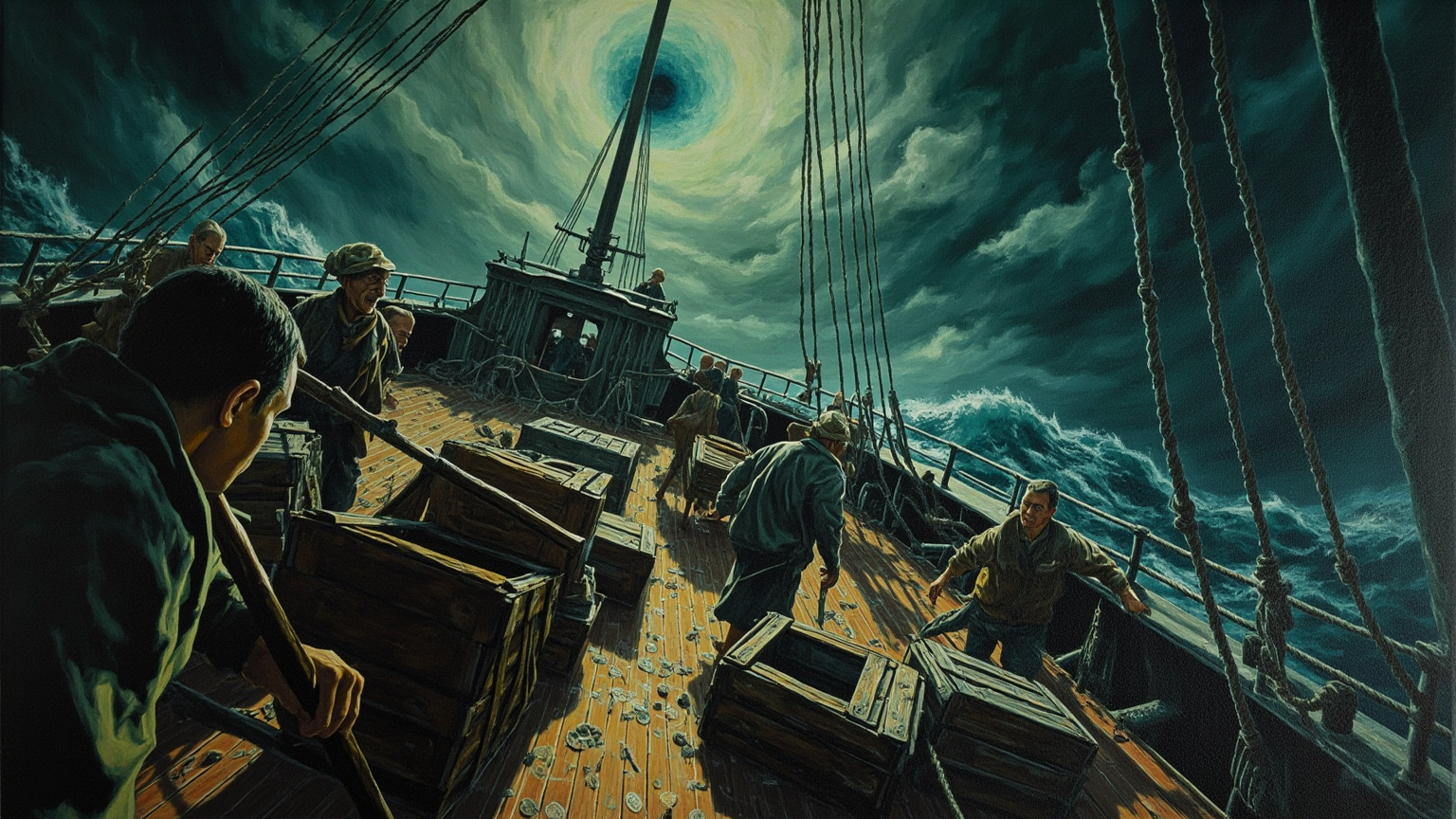
He saw a vague mass of heads, dark bodies, and a confusion of flung arms, stamping, swaying, jostling, scuffling, scrambling on the floor of the hold.
他只看见一团模糊的人头、深色的身子,混着一片乱挥的手臂——在货舱底板上踩、摇、撞、抢、爬。
金句 · 货舱骚乱 · 苦力争抢银元
Prying open the money boxes, dividing the silver
In the brief calm of the storm's eye, MacWhirr did something that left both Jukes and Rout stunned—he himself went down to the cargo hold and ordered all the money boxes pried open, scattering the silver dollars among the coolies. This was not an act of kindness. Back in the wheelhouse his explanation was coldly rational: "Once the money is divided up, they won't cause any more trouble." This was a transaction. The captain bought order with money, and with order he kept the ship afloat—a man who cannot imagine came up with the most practical solution. An older coolie took the lead in gathering up the silver, and the turmoil subsided.
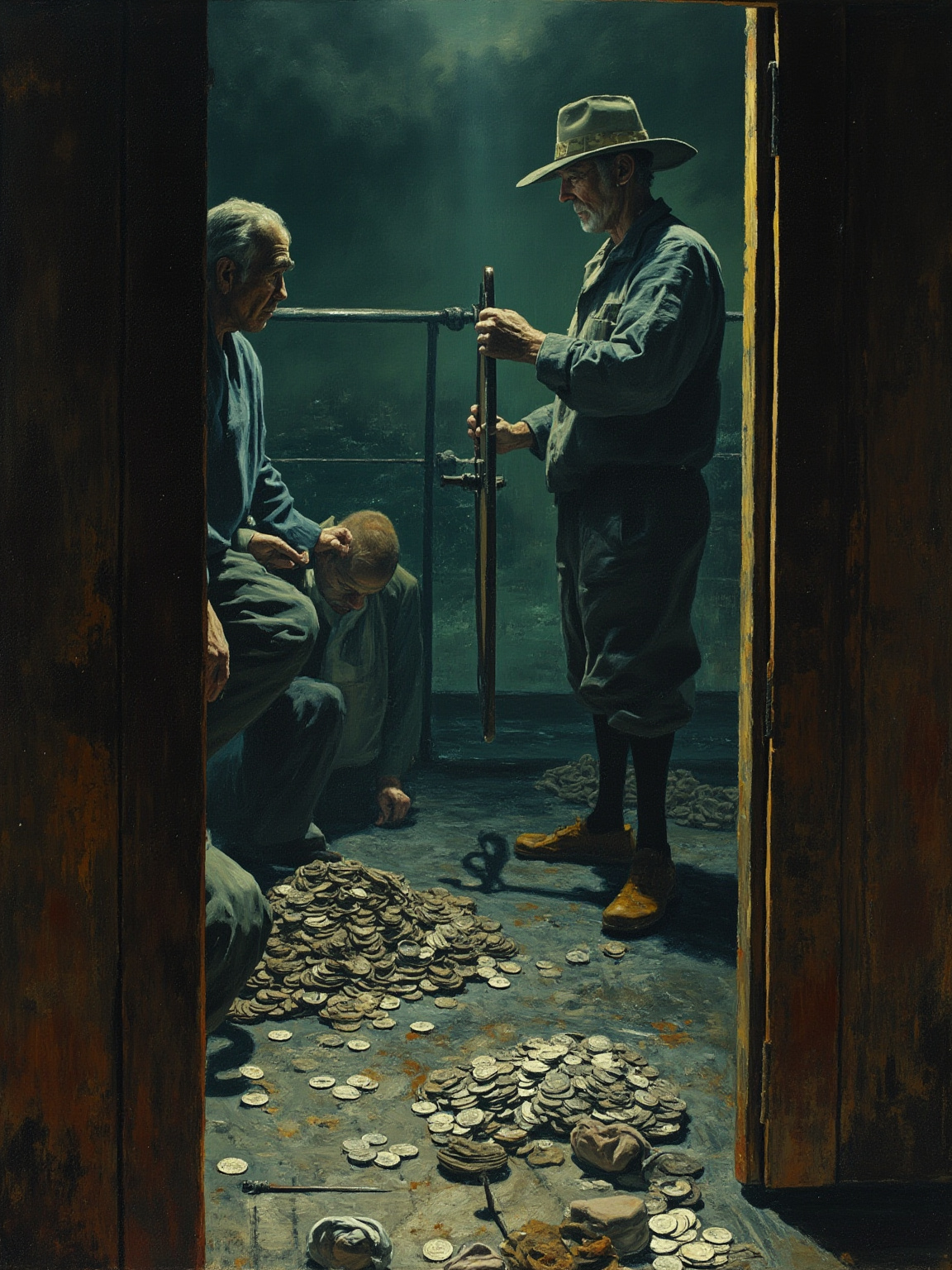
When it's divided, there'll be no more trouble. They'll sit quiet enough.
钱分完了,他们就不会再闹——自会安安静静坐下。
金句 · 风暴眼 · 撬开钱箱分银
The storm passes, the sea is dead silent
Then the typhoon was over. The ship was flung out of the eye, the sea flat as a lead plate—no waves, no wind, not even a bird calling. The Nan Shan was battered—the wheelhouse had no glass, the funnel was missing a chunk, the hull had several dents, but it was still floating. Rout crawled out from the engine room, looking like he'd been dredged from a coal pile, half a boot of black water pouring from his boots. He didn't speak, just leaned against the cabin wall and lit a cigarette. Alive. Everyone was alive.
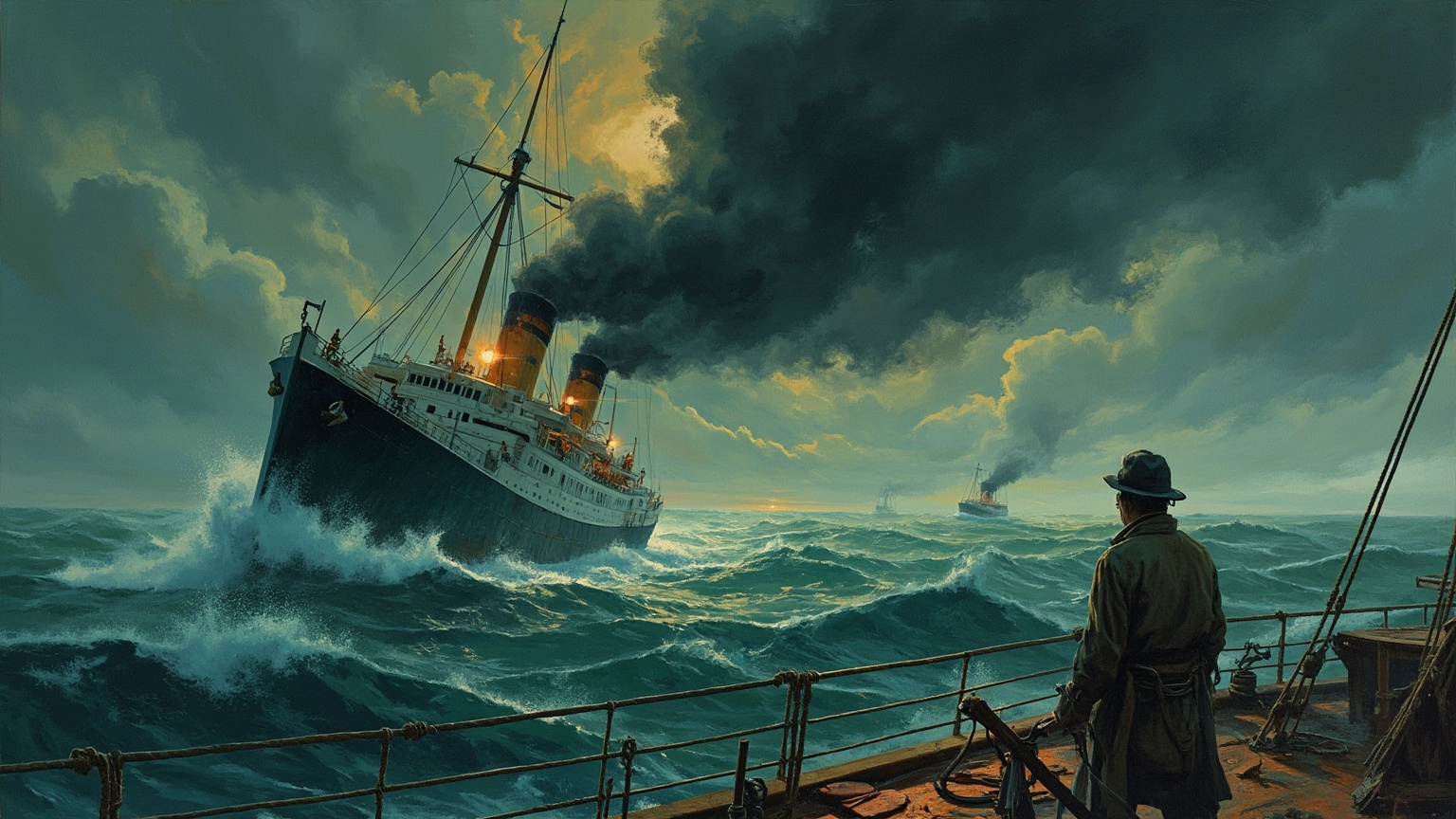
The sea after the typhoon lay flat as a sheet of lead, without a wrinkle, without a stir.
台风过后的海面平得像一块铅板——没有一丝皱,也没有一丝动。
金句 · 风暴过境 · 海面死寂
Arriving in Fuzhou, a Letter Home
A few days later, the Nan Shan tied up at the Fuzhou docks. MacWhirr went back to his cabin, sat down, and wrote to his wife in England. In that same matter-of-fact tone he used for ordinary household matters, he described the whole typhoon that had nearly drowned the whole ship: "This passage was a bit windy." That is the ending. No commendation, no reflection, no "we survived as a miracle." MacWhirr sealed the letter and sent it off. Conrad deliberately lets this anti-climax land — he is not writing about a miracle, he is writing about a man who turned a miracle into the everyday.
What Conrad Is Actually Writing
On the surface, Typhoon is a sea-disaster story: a stubborn captain rides out the storm and saves the whole ship. But Conrad wanted much more than that. He was writing about the two faces of "imagination" itself. Jukes has imagination, so he fears, so he suggests going around — that fear is reasonable, but when the storm actually arrives, fear cannot save the ship. MacWhirr has no imagination, so he does not go around, so in the wheelhouse the only thing he can think to do is "hold the wheel" — that very dullness keeps him from falling apart in the storm. Conrad does not say who is right. He puts both kinds of men on the same ship and lets the typhoon grade them.
Conrad's sharpest stroke is not the storm itself — it's MacWhirr sitting down afterward to write to his wife. A man who almost let two hundred people die at sea puts pen to paper and only has four words: "a bit windy."
Why We Still Read It a Century Later
Typhoon is almost an oddity in English sea literature. It lacks the epic ambition of Moby-Dick, the tragic grandeur of The Old Man and the Sea — it simply and plainly writes about a storm. But it writes with such precision — barometer readings, deck angles, boiler pressure — these technical details pile up until you feel the storm is not something "experienced" but something "measured." That is Conrad's gift. He spent more than a decade on merchant ships in his youth, knew the Pacific, Indian, and South China Seas intimately. Every detail he writes has a source; the whole novel reads like an actual marine accident log, except it has breath in it. Another reason: a character like MacWhirr is too rare. In literature you get heroes or anti-heroes, but "a man who thinks nothing and survives" — that kind of protagonist is almost impossible to find. He is not brave, not clever, not noble; he is merely conscientious. Conrad is paying tribute to a silent kind of professional spirit that never makes it into history books.
Knowing the Ending, Why Read the Text
The commentary tells you what happens—how the barometer drops, how the waves crash, how the silver dollars are divided, how the letter gets written. But there's one thing it can't give you: that "angle of tilt." When Conrad writes a storm, the sentence itself tilts. He suddenly inverts a long string of subordinate clauses, like a deck lurching sideways; he cuts you off with an extreme short sentence, leaving you breathless, like being slapped by a wave. A reader of the commentary knows MacWhirr lived. A reader of the text knows how—he lived through an actual typhoon, and between "knowing he'll survive" and "knowing how he survived" lies the whole storm. There's another thing language can't carry over: the "sound" of two hundred Chinese coolies tumbling through the hold. Conrad wrote that passage using dense onomatopoeia and rhythm shifts—the Chinese translation alone has lost seventy percent of it. To hear the full sound, you have to go back to the original. Go read it. Two hours to finish, but you'll remember it for a long time.
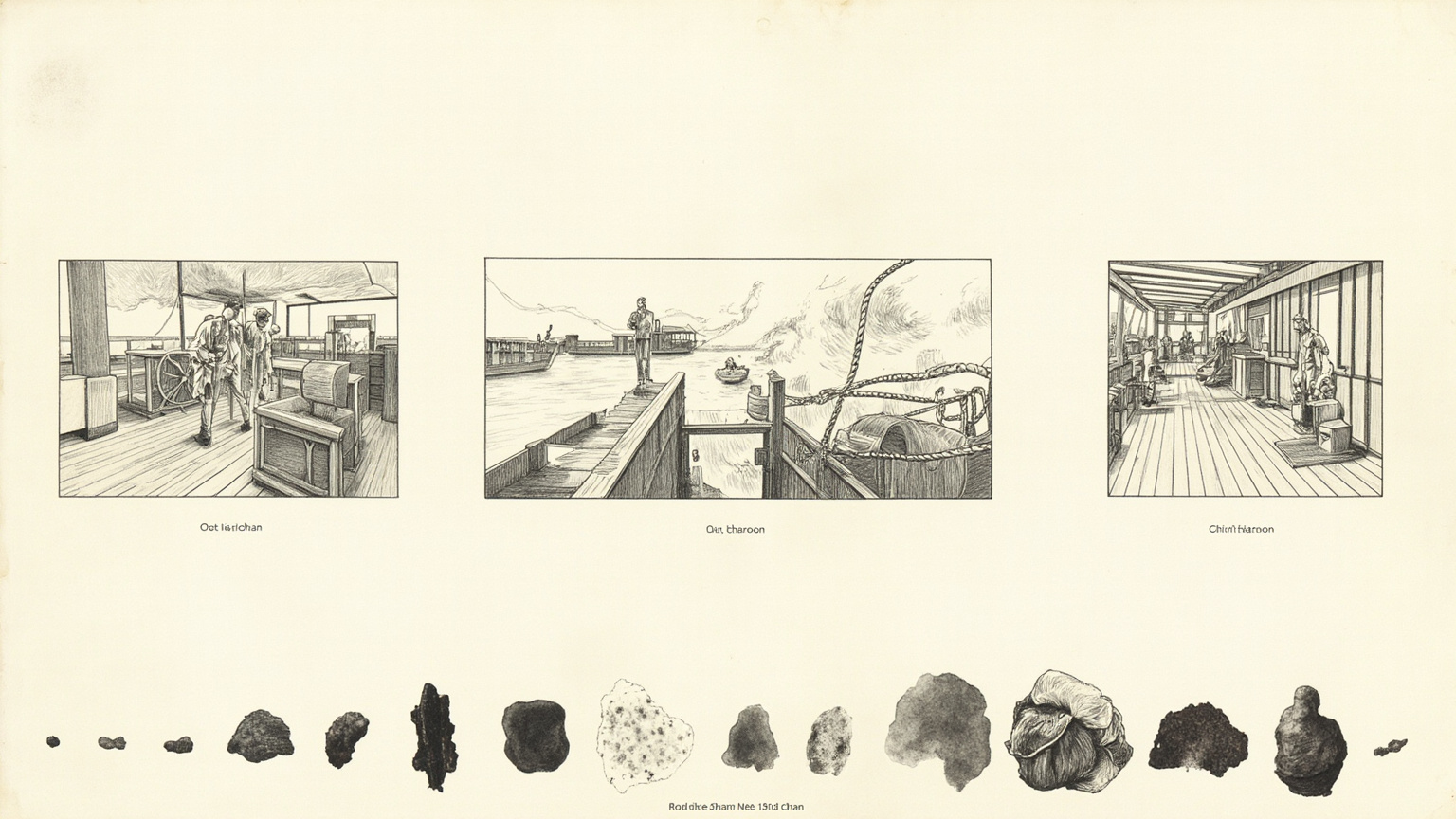
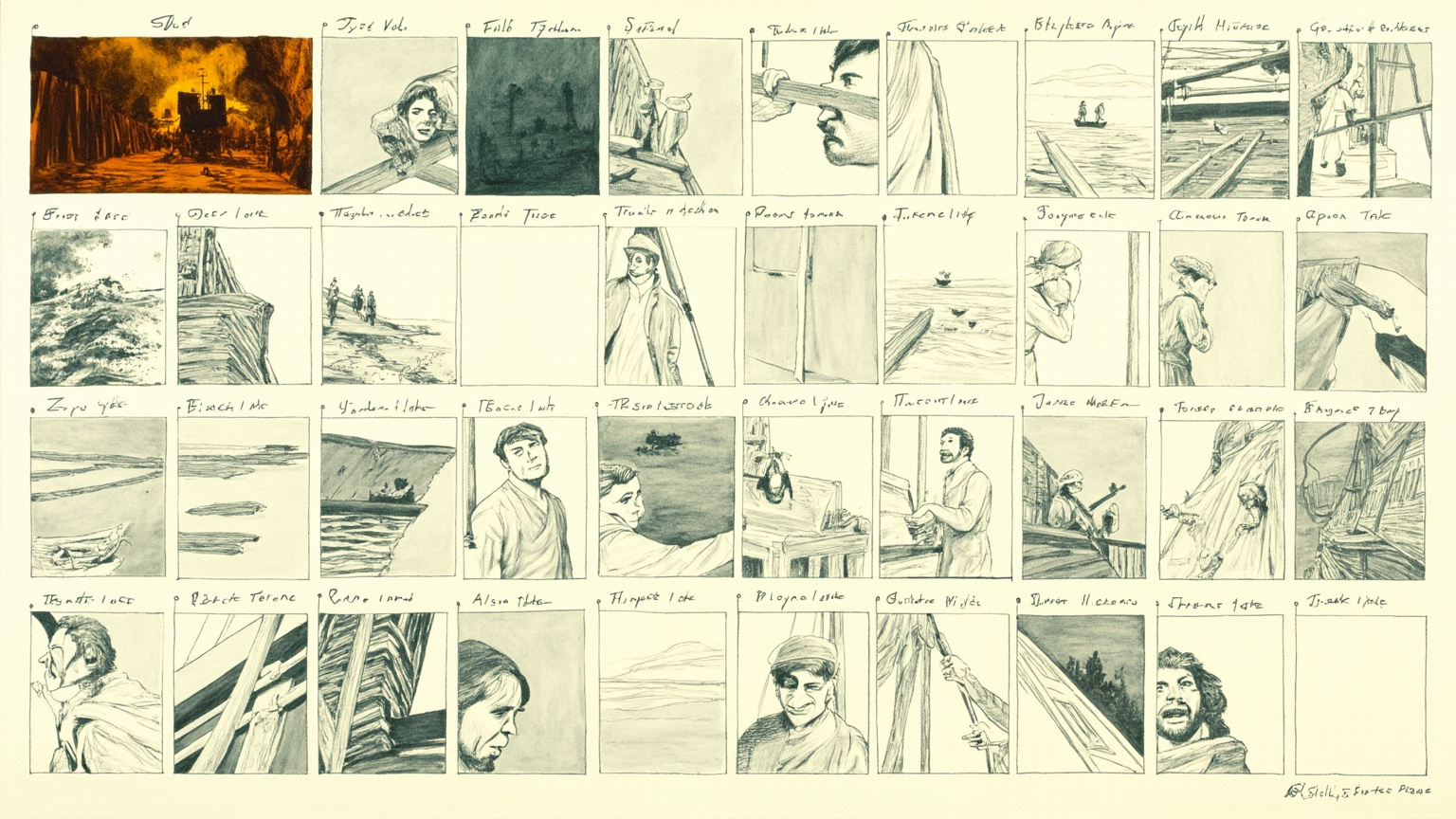
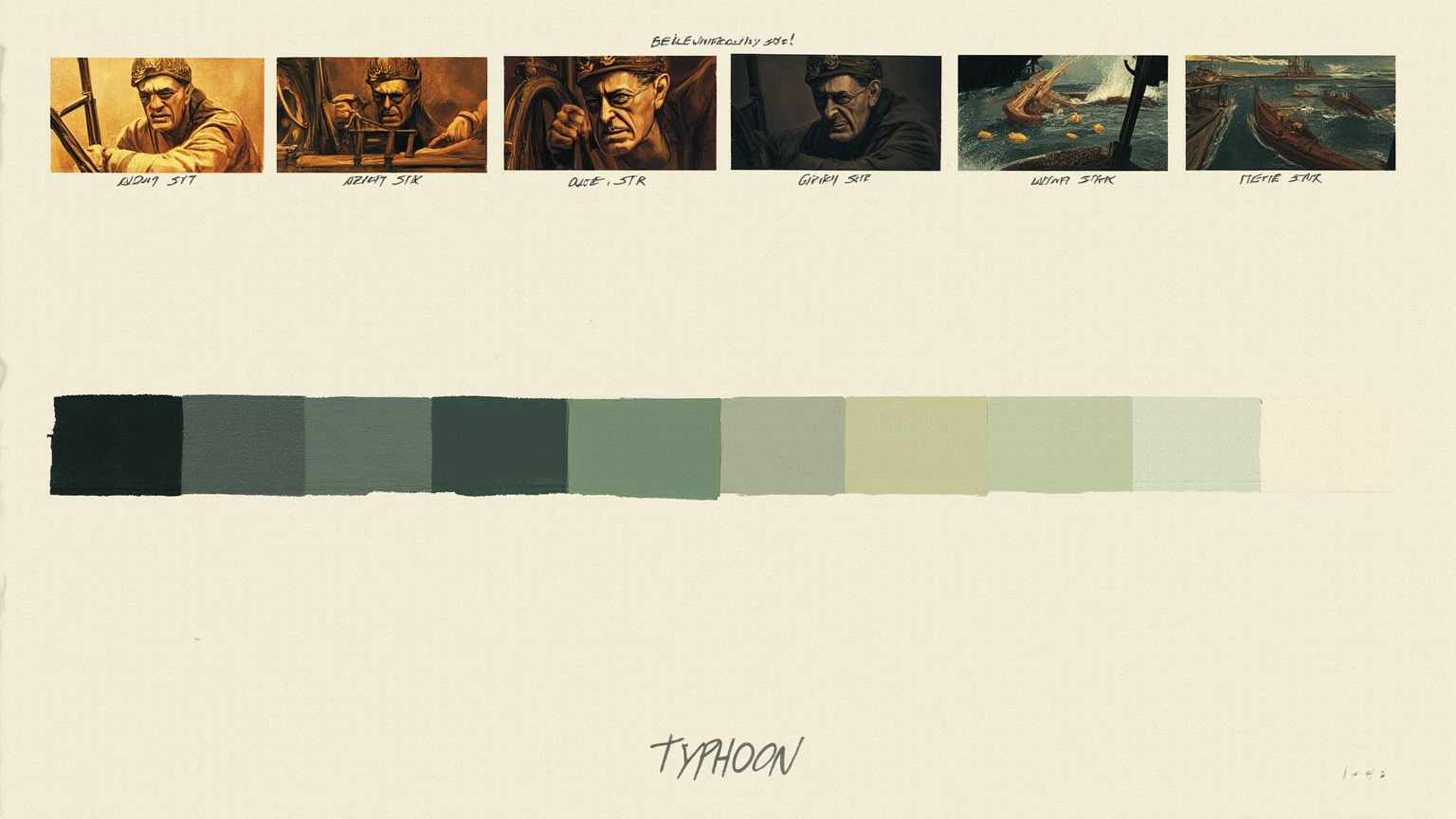
Art Direction4 plates
Before the guide was written, this book got a visual foundation — every illustration you just read grew out of it.