War and Peace · Companion Guide
War and Peace
Five families, fifteen years, ballrooms in two capitals, and three pitched battles — what Tolstoy wants you to see is that history is never a few great men drawing arrows on a map. It is millions of ordinary people crawling through the mud together.
Opening: a candlelit drawing room, and a man lying beneath the sky
A candlelit Petersburg drawing room. Aristocrats sip wine and chatter away in French — not affectation, just the uniform of their class. Then the scene cuts, hard, to the battlefield. The same man is lying in the snow at Austerlitz, blood welling from his chest, looking up at a sky he has never seen before — vast, remote, and utterly unconnected to the medals, the reputation, the promotions he'd just been fighting over. That's the first image War and Peace hands you: one moment you're on the dance floor, the next you're lying among the dead. This is not a novel that eases you in. It drops you straight into the gap between war and peace and lets you spend the rest of the book discovering how many lives are crammed into that gap.
What kind of book this is: a thousand-page epic by a stubborn old Russian
The author, Leo Tolstoy, was the most stubborn old man in nineteenth-century Russia, and he wrote this book somewhere between his early thirties and early forties. It first ran as a long serial in a Russian magazine, then came together in the late 1860s as four fat volumes. The setting is pinned to the Napoleonic Wars — 1805 to 1813, with an epilogue that jumps forward to 1820. Countless people have called it the greatest novel ever written, and that chorus isn't marketing copy — Dostoevsky's own generation of writers started saying it first. It's remembered because other novels write about one family, one love affair, one mind. This one writes an entire society, an entire national history, and tacks on a philosophical essay about how history actually happens. It's big enough to make you wonder if the author was even human.
People and world: five families — half the book dancing, half the book running for its life
The book keeps cutting between two worlds. Peace means the candlelit drawing rooms of Petersburg and Moscow, the hunting parties and dances at country estates — the Bolkonskys' bleak, exacting Bald Hills, the Rostovs' Otradnoye, as boisterous as a market fair. War means the snowfields of Austerlitz, the bloody mud of Borodino, Moscow burned to char, and the killing Russian winter that finishes off the Grande Armée in retreat. The plot follows five families' fortunes: Pierre Bezukhov, the illegitimate son of old Count Bezukhov, a bespectacled, heavyset, awkward good man; Prince Andrei Bolkonsky, a clever, proud young officer who finds fault with everything; Natasha Rostova, the Rostov girl whose eyes seem to throw off sparks; Nikolai Rostov, Natasha's brother, a hussar; and Princess Marya Bolkonskaya, Andrei's plain, deeply devout sister, worn down by a lifetime under their tyrannical father. Then there are the Kuragins, cast as the villains — the ravishing Hélène and her handsome, dissolute brother Anatole. These five families are cousins to each other, first loves, enemies, rescuers, and any given family gathering might rewrite the rest of somebody's life.
The plot: eight years of war and peace, start to finish
The story opens in a Petersburg salon in 1805. Napoleon's shadow already hangs over Europe, but the Russian aristocracy is still gossiping in French about the coming campaign. Pierre Bezukhov, an unloved illegitimate son, suddenly becomes the richest bachelor in the country when his father, the old count, dies — and, against every expectation for a mistress's bastard son, leaves him the entire estate. Overnight, every mother in Petersburg has him marked as a prospect. Prince Andrei watches all of it with weary disgust, abandons his pregnant wife, and heads for the front, determined to make a name for himself on a real battlefield.
Cut to the Battle of Austerlitz. The Russo-Austrian coalition is routed, and Andrei goes down, shot, while charging forward with the regimental banner. Lying among the dead, he looks up and sees a sky higher and vaster than anything he has known in his life — and has his epiphany: the glory, the medals, the emperor's notice he had just risked his life for are all empty. This is the novel's most famous image, the sky at Austerlitz — Tolstoy uses a literal, physical vastness to nail down, once and for all, the emptiness of the whole enterprise of war. In the same battle, Natasha's brother Nikolai Rostov, still a green young hussar, gets his first taste of what war actually is — not glory, but mud, blood, and comrades who die for no reason anyone can explain. He has his own disillusionment too, though of a different kind: a boy's worship of the tsar and the uniform, shattered.
The fighting stops, and peace returns — these years are where the peace half of the book lives. Pierre blunders into marriage with Hélène Kuragina, ravishing and hollow, and realizes almost at once that the whole thing was a calculated trap; he very nearly duels her brother Anatole over it. Looking for some meaning in his life, he throws himself into Freemasonry, mystical pamphlets, and charitable schemes meant to save his soul — and comes up emptier every time. Andrei fares worse: his wife dies in childbirth while he's away at the front, and he comes back to Bald Hills half-dead inside, resigned to giving the rest of his life to his son and his estate. Then, one day, visiting the Rostovs, he meets Natasha — a girl brimming with life, whose eyes talk and whose voice seems to laugh on its own — and something in Andrei's dead heart catches fire. He proposes. They're engaged. It's the sweetest moment in the whole book — and the very next moment is the cruelest cut.
Here's the cut: Anatole Kuragin, the dissolute brother of Pierre's own wife, has had his eye on Natasha for a while. Knowing full well he is secretly already married, he seduces the engaged girl anyway, and comes within a hair of getting her into a carriage and eloping, which would have ruined her for good. Natasha comes to her senses at the last moment, sick with shame and half-suicidal; Andrei, hearing what happened, swears a furious vow to duel Anatole. The engagement is destroyed. The collapse of this private world arrives almost in the same breath as the national catastrophe bearing down on everyone — this is Tolstoy's signature move. He never writes a broken heart alone, or a lost battle alone. He always twists the two together.
never decline a prison or a beggar's sack!
牢狱与讨饭的口袋——别说你就一定躲得过。
Original line · Platon Karataev · Pierre's years in captivity
The epilogue jumps to 1820. Andrei is dead, Hélène is dead, the old prince is dead — the follies of that older generation have finally left the stage. Pierre and Natasha have married and become parents; Nikolai Rostov marries Princess Marya, once the browbeaten girl of Bald Hills, and rebuilds the family fortune. This is no fairy-tale ending — nobody reaches some peak of triumph. Everyone simply climbs out of the wreckage and keeps living. Tolstoy folds a quietly conservative answer into these reconciliations: family, land, faith, children — these small things are what's actually left once the war is over. The second half of the epilogue appends a long essay asking who really drives history — and the answer is: not Napoleon, not Alexander, not Kutuzov, but the combined will of countless ordinary people. It's Tolstoy's formal declaration of war on every great-man theory of history.
What it's actually saying: why this novel is considered a masterpiece
Start with the sheer scale: something like five hundred characters, a span of fifteen years, five great families, three major battles, the social worlds of two capitals, a scattering of country estates, and a philosophical essay on top of it all — the sheer bulk of the thing is a kind of miracle on its own. But Tolstoy doesn't win by piling up names. He wins by stitching the most delicate psychology — how a girl's heart races at a ball, how a clever man suddenly sees through everything on a battlefield — into the same seam as an entire national history. And how far does the battle writing go? He'd lived through the Crimean War himself; he knew what the front actually smelled like. So Austerlitz and Borodino are never Hollywood set pieces — they're confusion, chance, and the fear of dying for reasons nobody can quite name.
Now for why it matters. Published in 1869, it effectively rewrote how everyone after it understood war and history — it turns out history isn't a handful of great men drawing arrows on a map, it's millions of ordinary people crawling through the mud together. It also rewrote what a novel was allowed to do: no novel before it had dared to bolt an entire philosophical essay onto its ending and make it feel inevitable rather than tacked on. What can a reader today still get out of it? A proposition that still holds up two hundred years later — the pretension of a social world that performs itself in a foreign language, the naivety of believing a new leader will fix everything, the obsession with pinning the meaning of one's life to some grand idea. These are the same failings, and humanity hasn't outgrown a single one of them.
What War and Peace actually answers isn't who beat Napoleon. It's this: when your entire world burns to ash beneath your feet, what do you hold onto to keep living.
Now that you know the plot, is it still worth reading — the case for the text itself
A companion piece can give you the map, but it can't give you the land. There are a few things in this book that no summary can hand you. First is the physical sensation of something catching fire in Natasha's chest the moment she first really hears Andrei speak — you have to walk there with Tolstoy's own sentences to feel it. Second is the weight of Andrei's revelation the instant he looks up at the sky, the way it drops onto you literally, from directly overhead. Third is the rhythm of Karataev's speech, like a Russian folk song — it loses its flavor no matter how you paraphrase it. Fourth is the long argument about free will in the second half of the epilogue — you can disagree with Tolstoy, but you can't come away unshaken by the sheer ambition of welding a novel and a philosophical treatise together by force. And there's one more thing, harder to name: the sheer size of this book is itself an experience. Spend a month or two reading it slowly, and you've lived a full fifteen years alongside five families. Closing the last page, that feeling of having aged a little yourself is something no companion piece can ever walk for you.
Art Direction4 plates
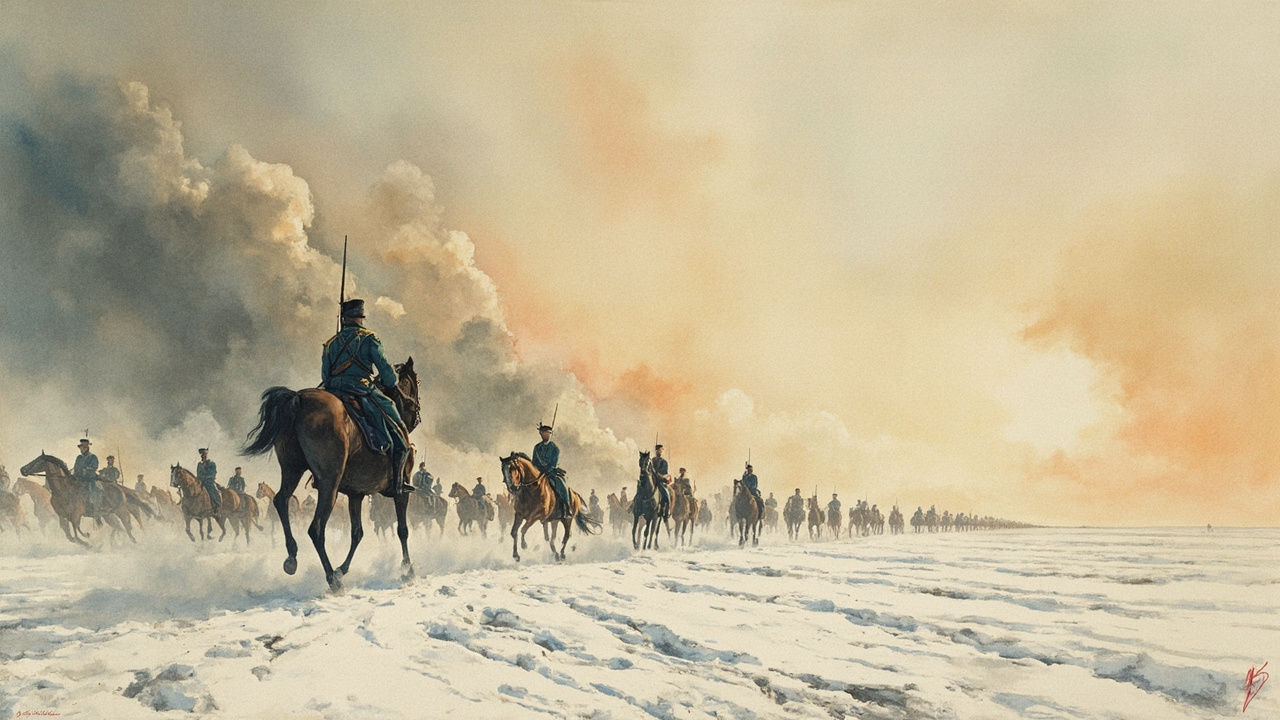
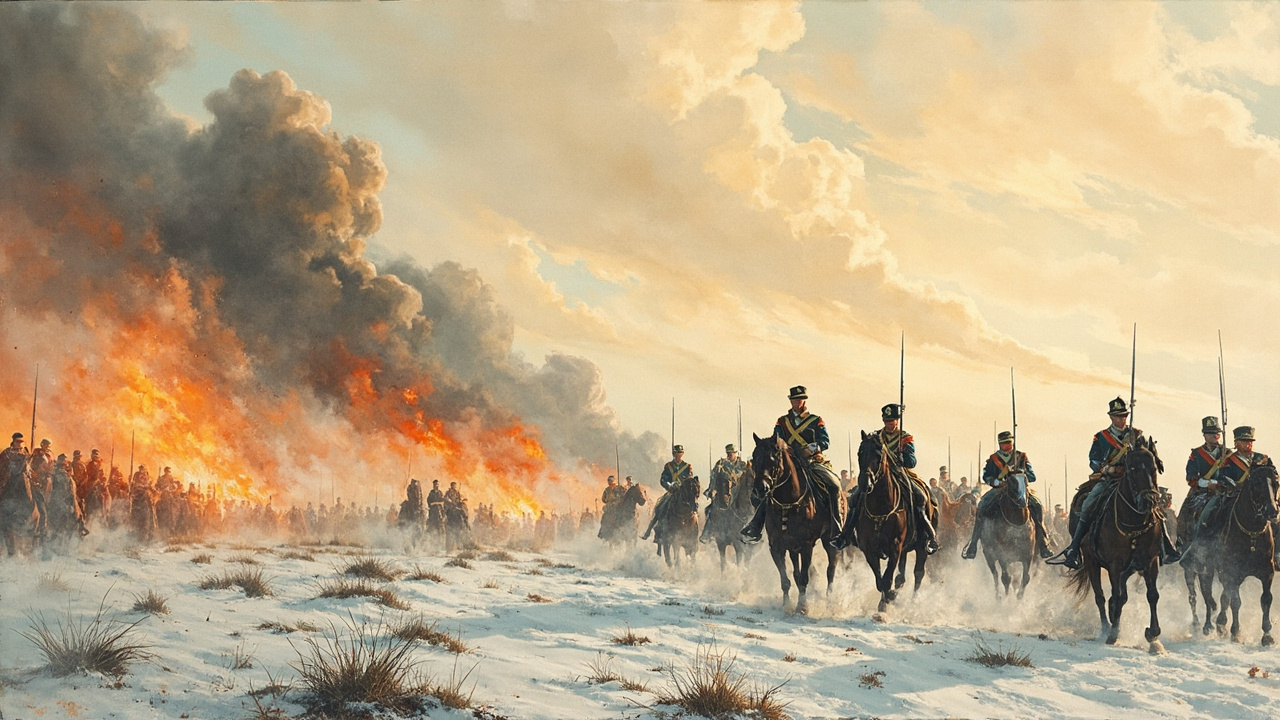
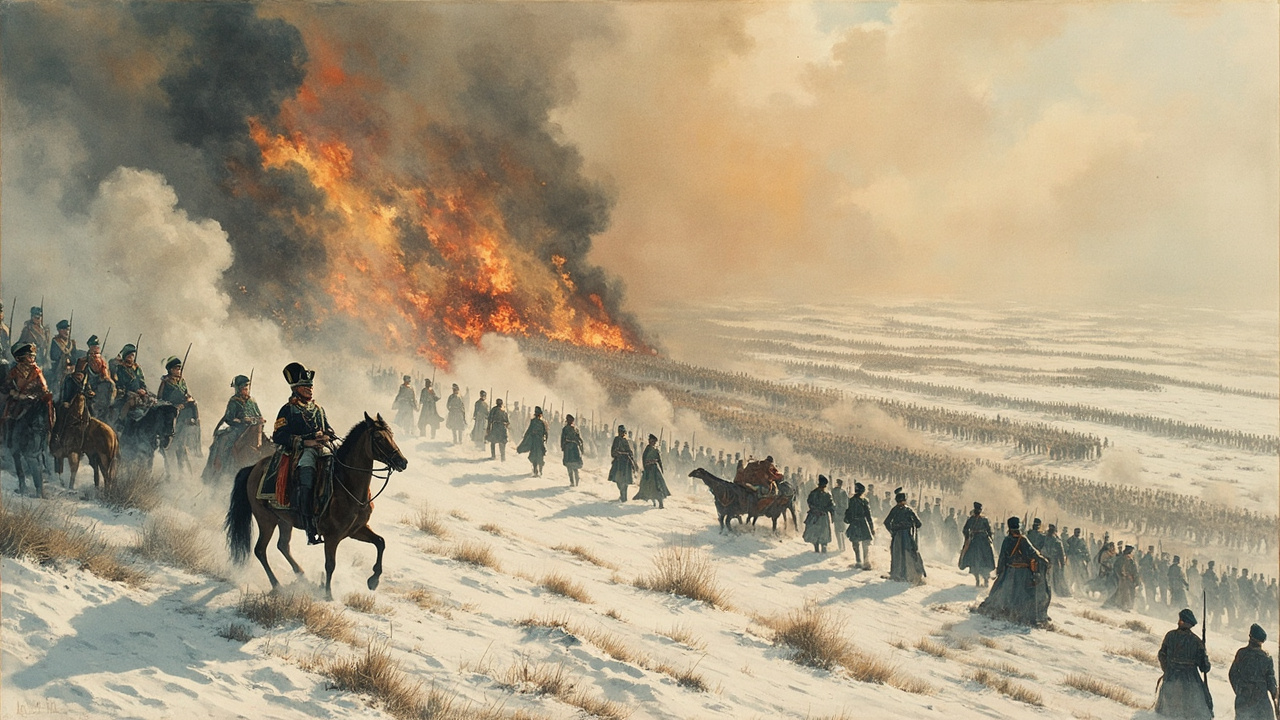
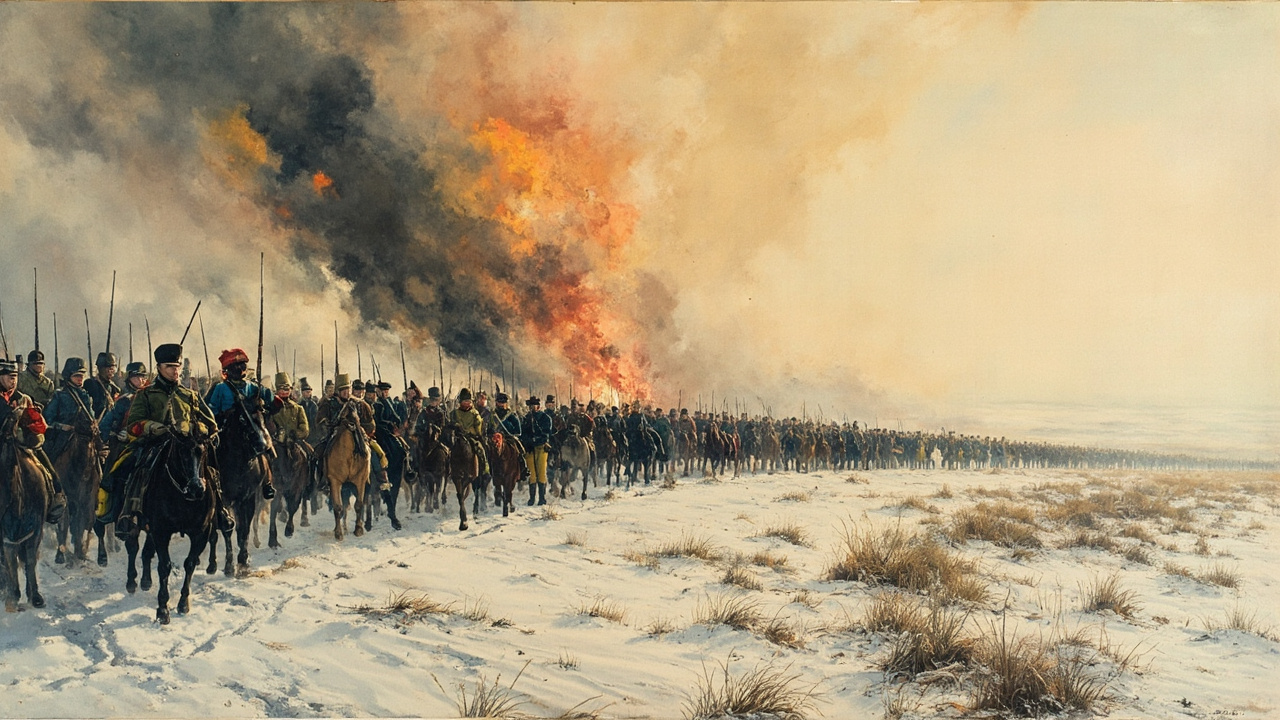
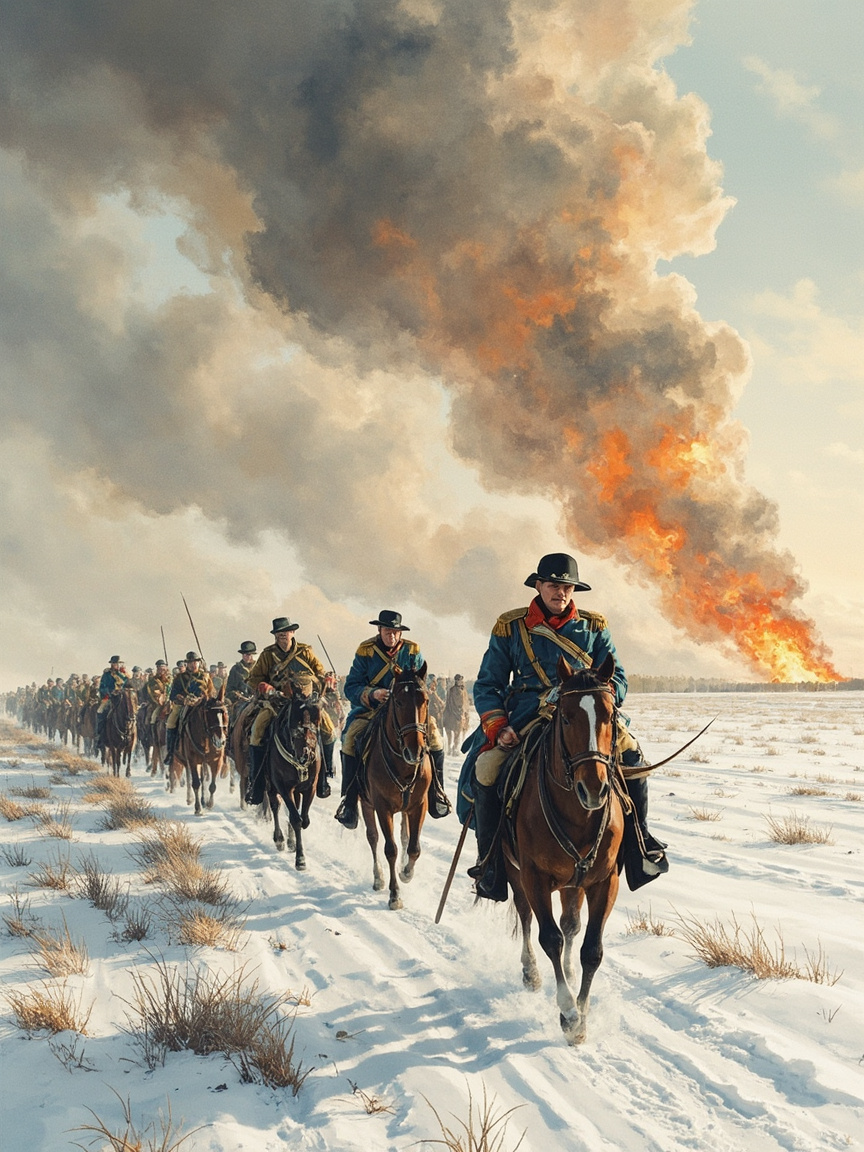
Before the guide was written, this book got a visual foundation — every illustration you just read grew out of it.