Glass houses, people who are numbers, invisible walls: a book banned in its own country for almost seventy years
Text and illustrations produced by the pipeline
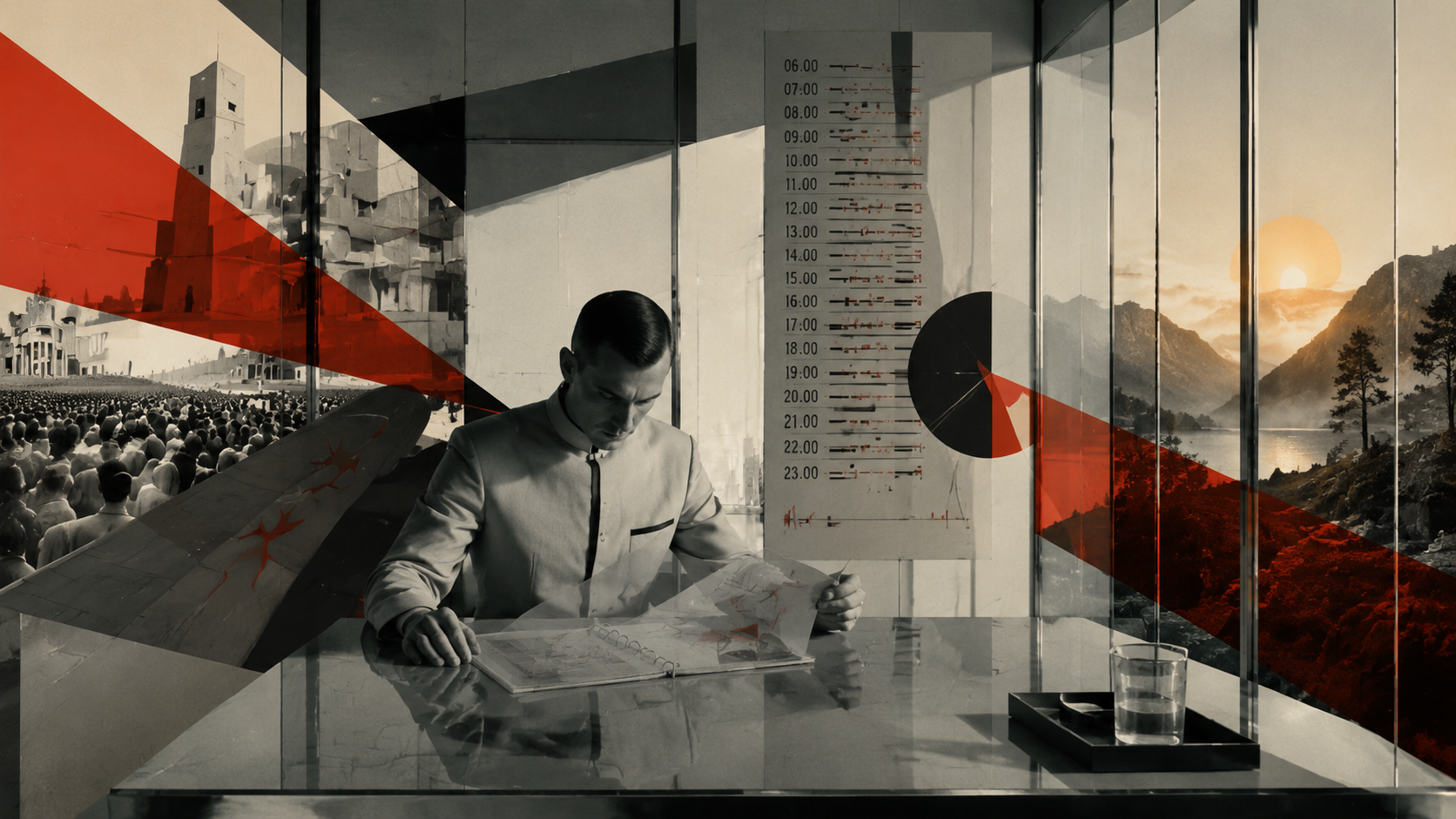
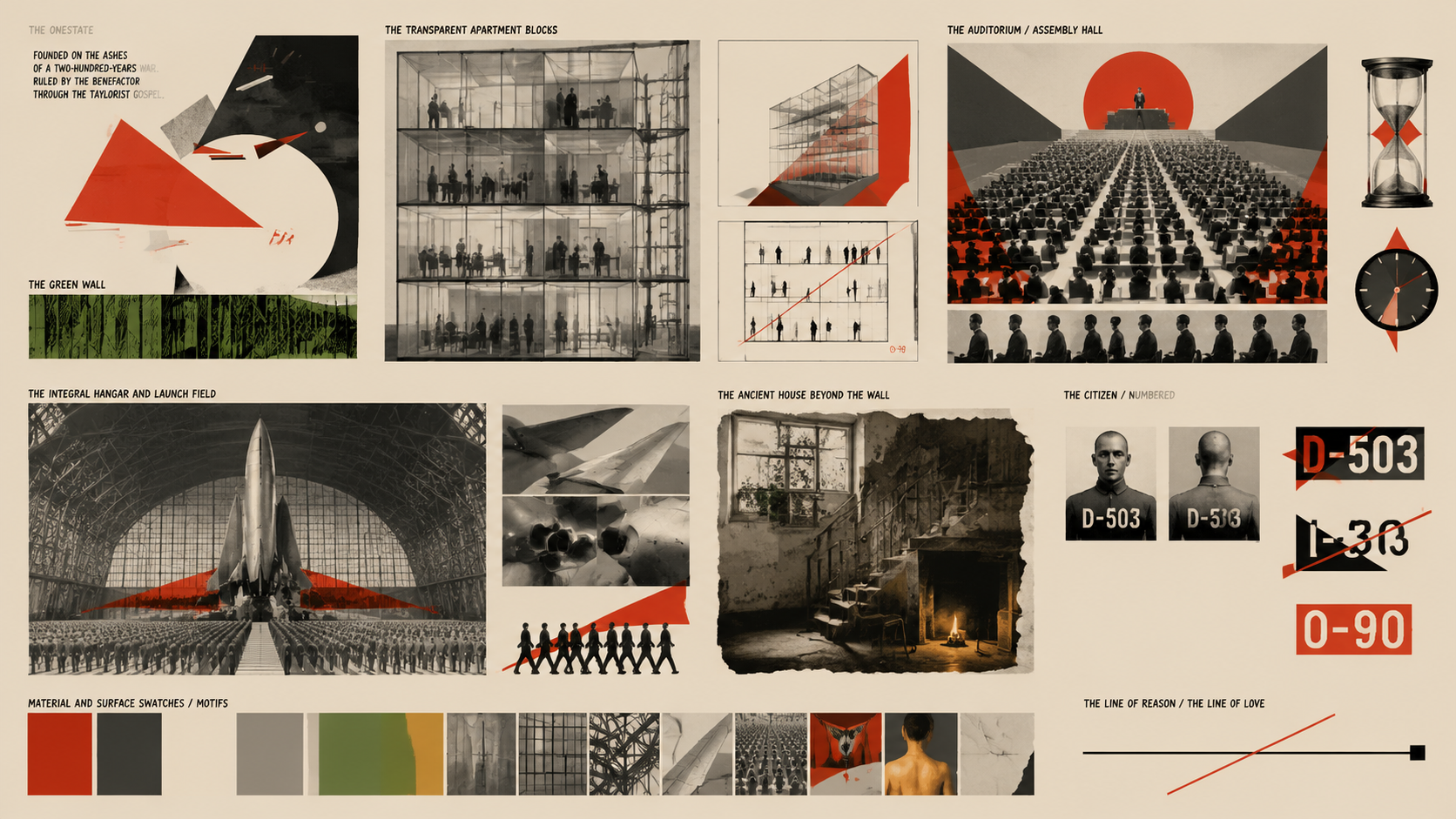
A glass wall leaves nowhere for a diary to hide. Neighbors can see you clearly from outside — because the state says happiness requires transparency. You have no name, only a number. What time you wake up, what time you eat, what time you have sex: all of it is written into the Table of Hours pinned to your wall. Fail to go to sleep on schedule, and someone will yank you up by a cord; do it again, and your room gets collectively steamed and bleached. This isn't a joke. This is how the novel opens.
Here's the question: when you start dreaming, start feeling jealous, start missing the shape of someone's mouth — are you sick, or have you finally become a person? This book begins with that sickness.
We is a novel by the Russian writer Yevgeny Zamyatin, written in the early twentieth century. It was never legally published inside Soviet Russia — the first edition to appear anywhere was an English translation in 1924, the complete Russian text didn't return into print until 1952, from a Russian emigre publisher in New York, and in the author's own country it had to wait for the glasnost reforms of 1988 to be officially published. From the writing to the reading: nearly seventy years late.
It's generally regarded as the founding work of the modern dystopian novel, and it directly inspired both Huxley's Brave New World and Orwell's Nineteen Eighty-Four — Orwell himself admitted to having read it and drawn on it. Here was an old Bolshevik who had lived through the October Revolution himself, standing up to say: if the new world the revolution built keeps following this logic, this is what it grows into. That insider's turn against his own side is exceedingly rare among books of this kind, and exceedingly painful.
The whole story takes place in OneState, a totalitarian nation founded after two hundred years of war. Its supreme leader is called the Benefactor, and his signature doctrine is: happiness means giving up freedom. Every restless impulse gets filed under a single disease, called a soul — meaning the capacity to imagine, to drift off alone in thought, to want something you're not allowed to want.
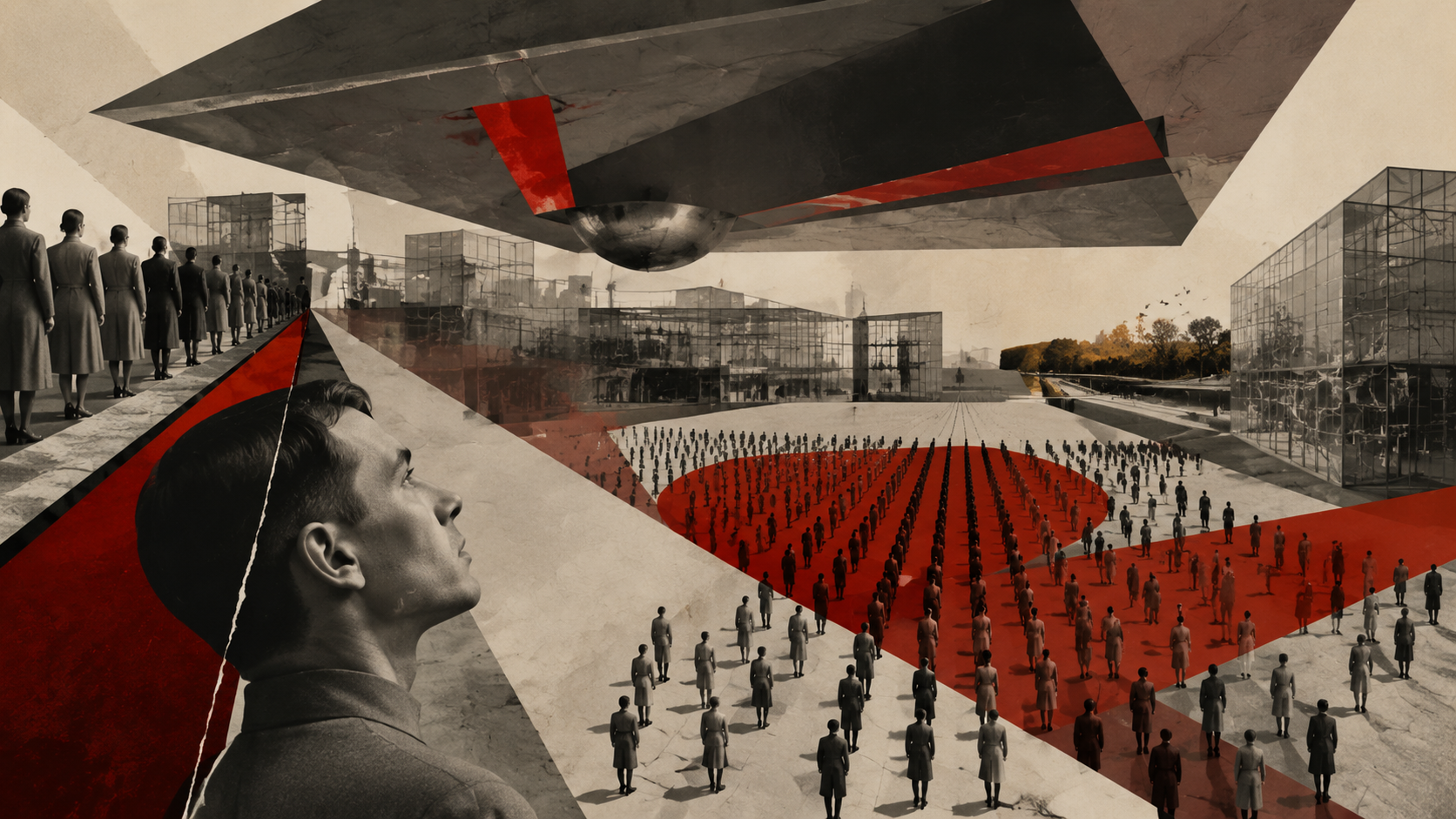
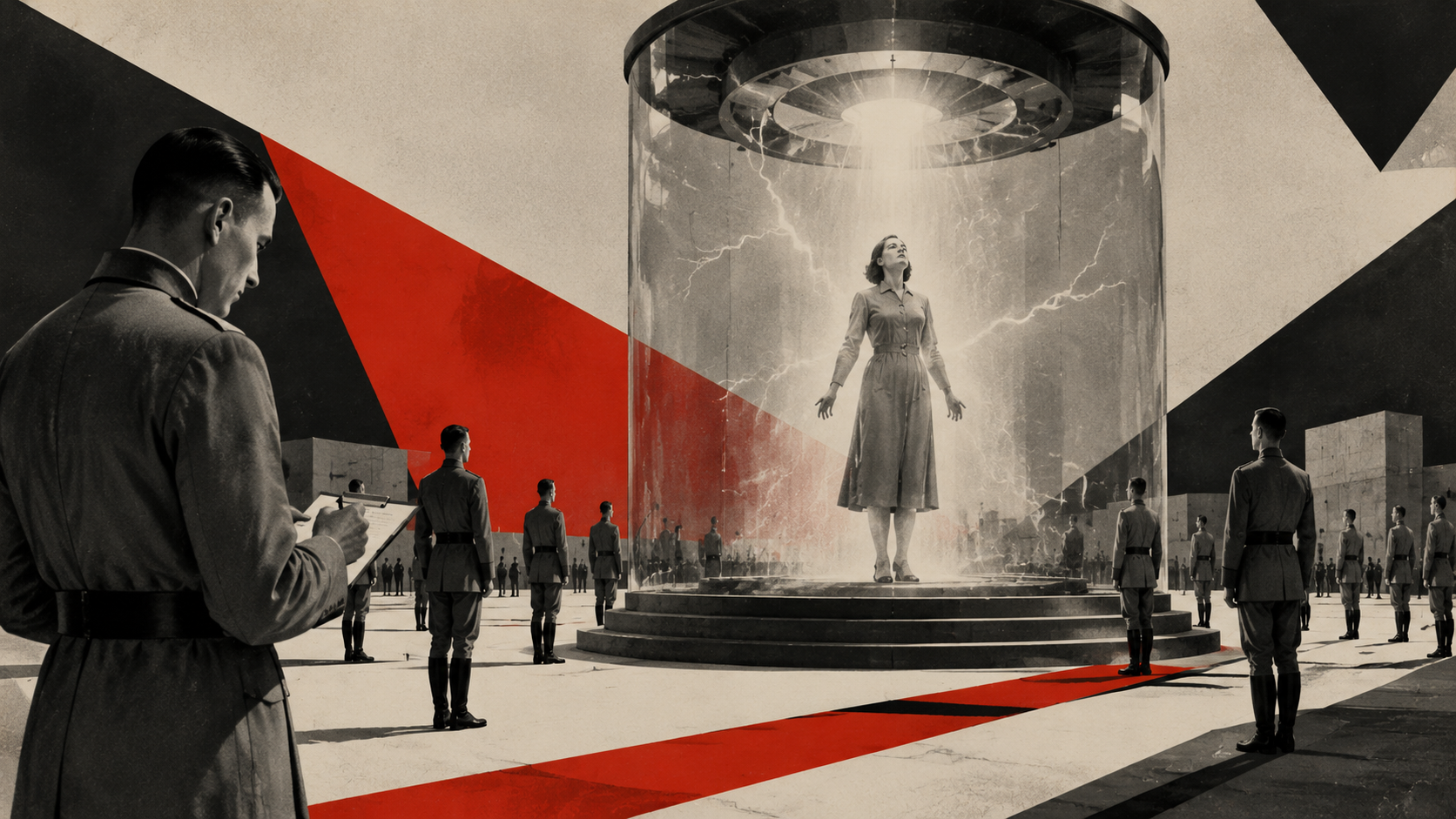
Act Seven: Her Under the Bell Jar, Him Signing His Name. Once the operation is done, D-503 is cured — a machine again, one that no longer dreams. He follows the crowd to the execution square and watches, in person, as I-330 is sealed inside a transparent bell jar and shocked again and again — she never confesses. And he, perfectly at peace, calmly signs his number to the confession. This scene is the novel's endpoint, and its coldest irony: happiness, it turns out, is watching the person you loved most be tortured and feeling nothing at all.
Because what's truly terrifying about this novel isn't the plot — the plot fits in three sentences. What's truly terrifying is that as you read, you may catch yourself sympathizing with D-503's cure. That untroubled ease, that calm of no longer dreaming, that normalcy of watching your lover tortured and still signing your name with a straight face — by the end you can't help wondering: would I resist? Or have I, at some point, already quietly handed over my own soul? No summary can give you that doubt. It only creeps up your spine when you're alone, late at night, reading that transparent diary for yourself.
In a perfect world that reshapes people into parts, the cruelest thing isn't the cruelty itself — it's that everyone mistakes it for happiness.
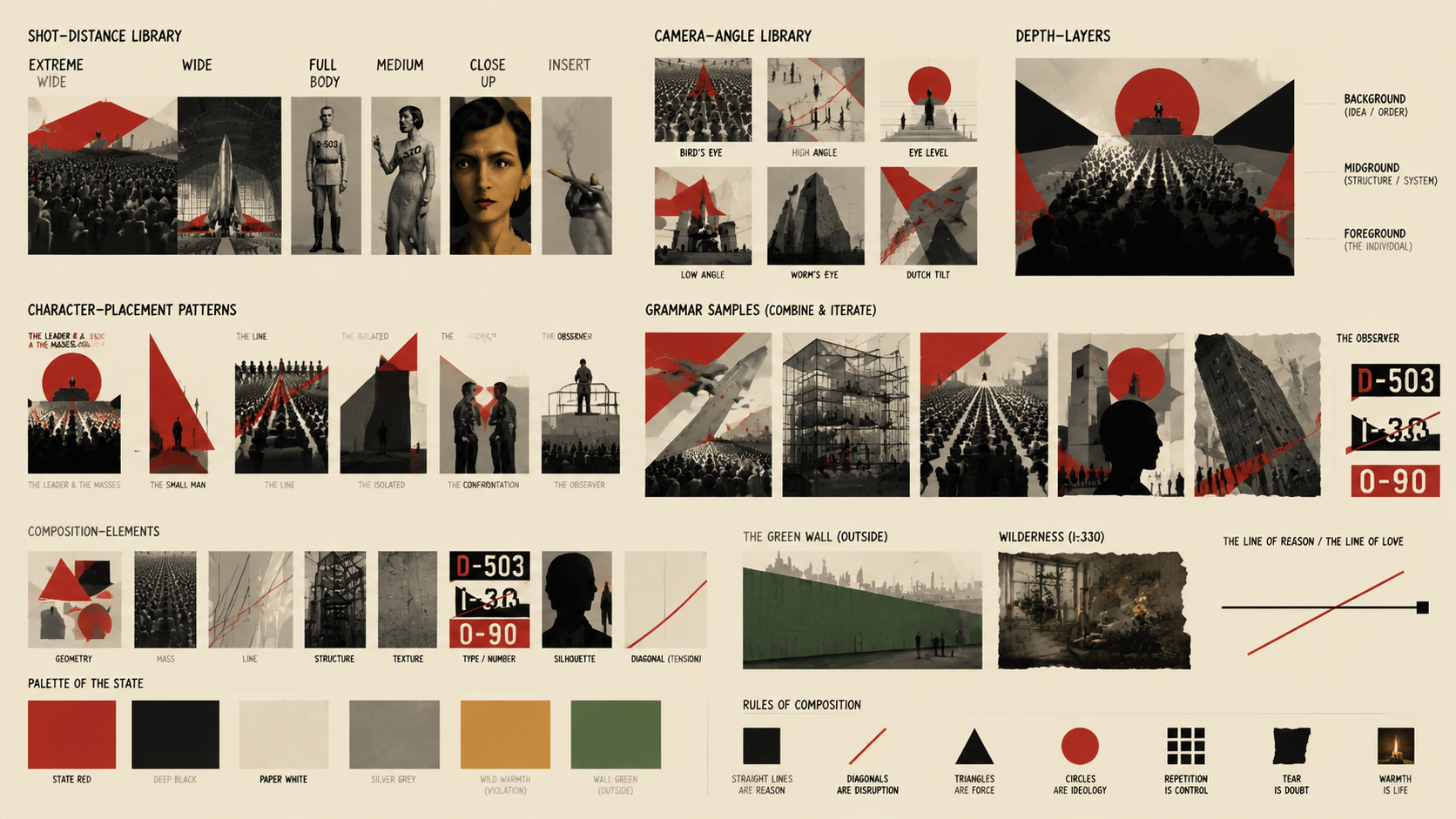
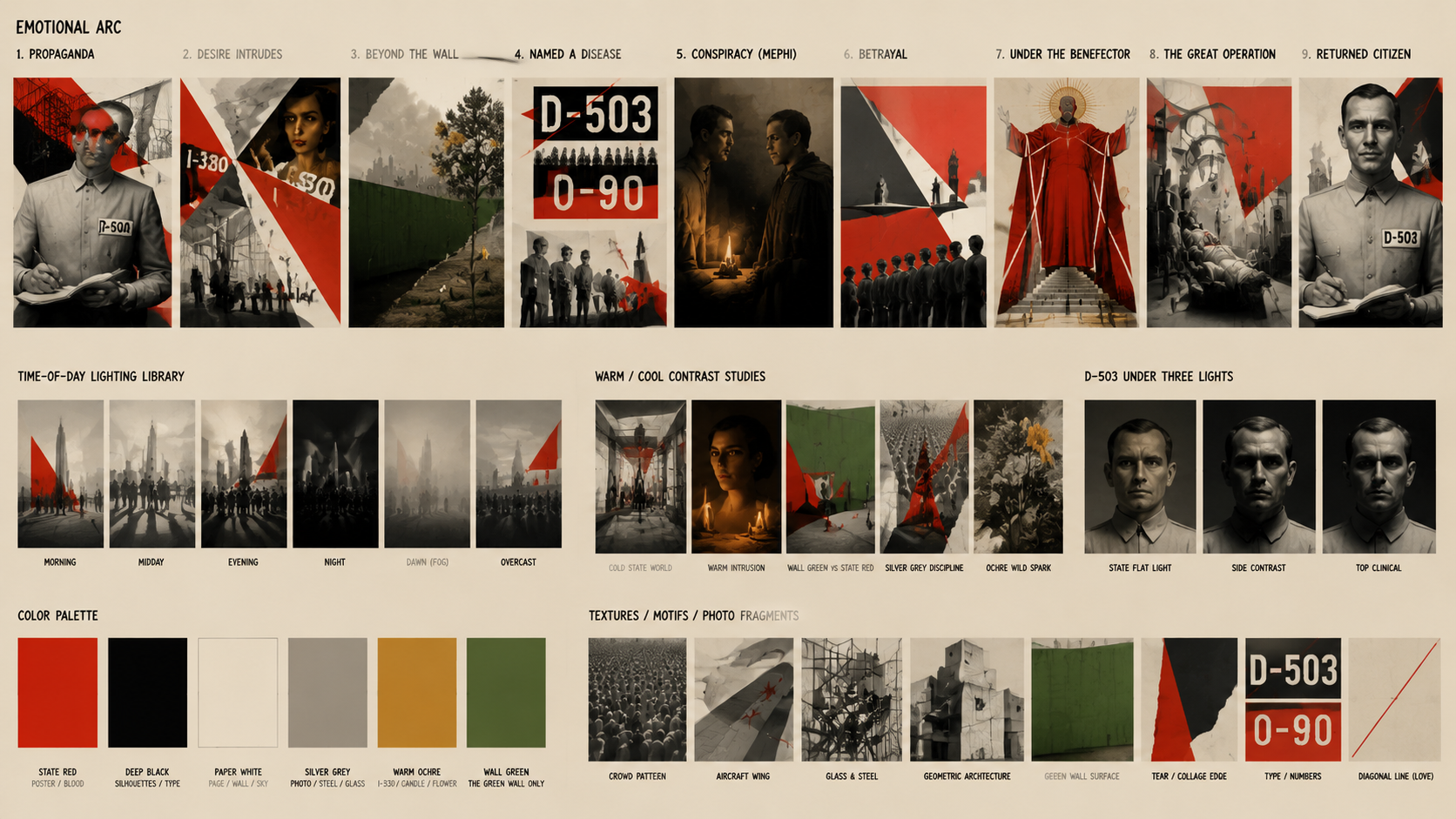
Before the guide was written, this book got a visual foundation — every illustration you just read grew out of it.
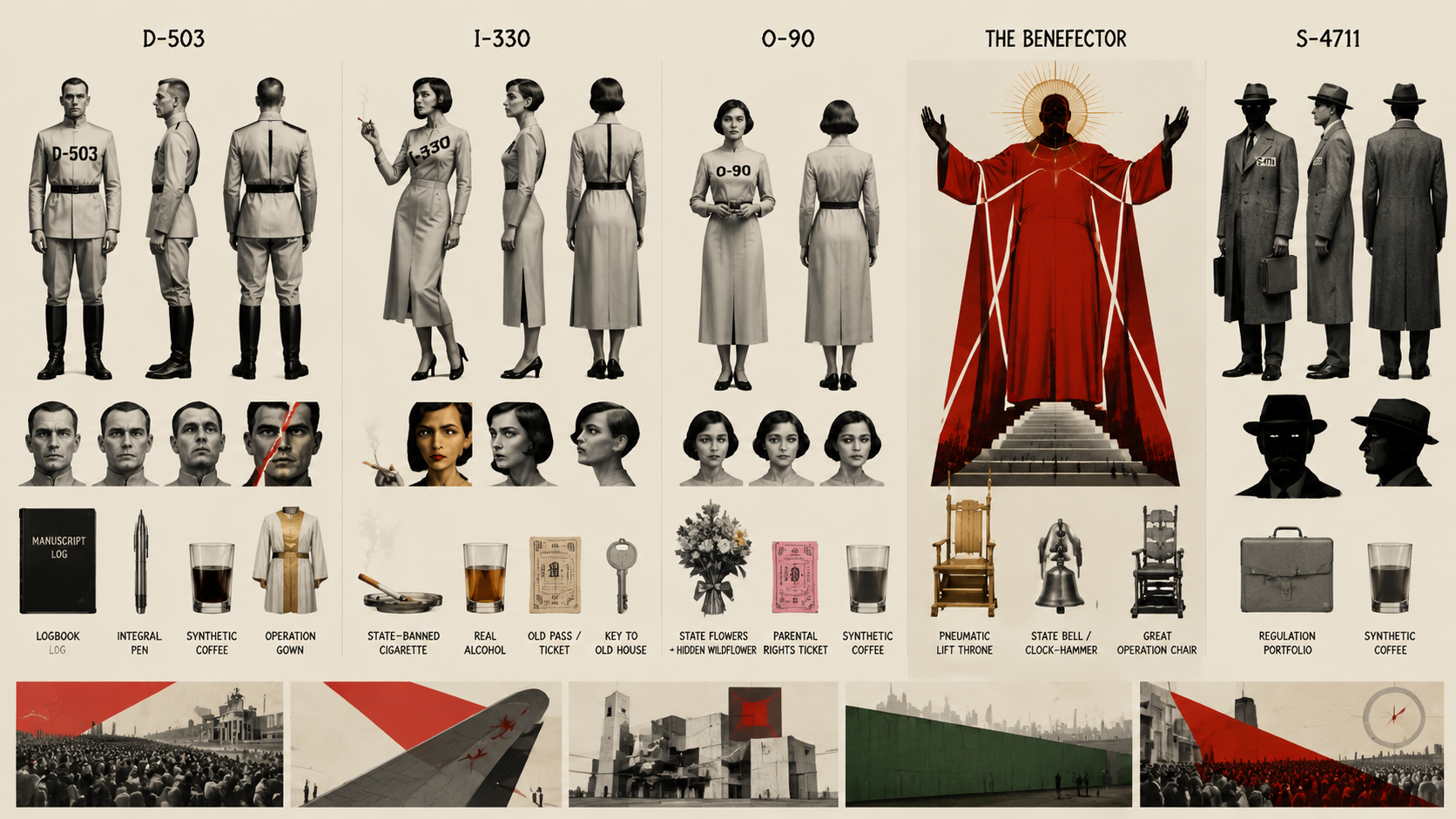
The protagonist is D-503, chief engineer of the spaceship Integral and the author of the diary that makes up this book. At the start he's OneState's model citizen: trained in mathematics, clear-headed, and convinced that the state's project of stripping people of their animal instincts and scheduling them to the minute is civilization's greatest achievement. His trouble arrives in the shape of two women: I-330, a smoking, provocative woman with the air of someone who answers to no one, and O-90, the gentle, small woman assigned to him by the state, who carries his child and is later smuggled out beyond the Green Wall. There's also S-4711, an agent who shadows D-503 throughout, claiming to be his guardian while actually watching and reporting on him.
Act One: A Love Letter to Aliens. D-503 picks up his pen to write a record praising OneState, meant to be launched aboard the Integral to invite other civilizations in the cosmos to share in this transparent happiness. The craft here is that the diary's own disciplined language is the novel: his sentences start out as tidy and clean as a textbook, like a machine filing a work report.
Act Two: The Woman Who Smokes. At a public assembly, I-330 appears. In front of the crowd she lights a cigarette, drinks, does everything expressly forbidden, like a cat that has wandered into a museum. D-503 condemns her in his diary as depraved, even as he can't help being drawn to her — she is the first exception in his precise world. The craft to notice here: Zamyatin lets his narrator resist and sink deeper at the same time, and that tone of a man arguing himself into something is far more sophisticated than simply writing that his heart skipped.
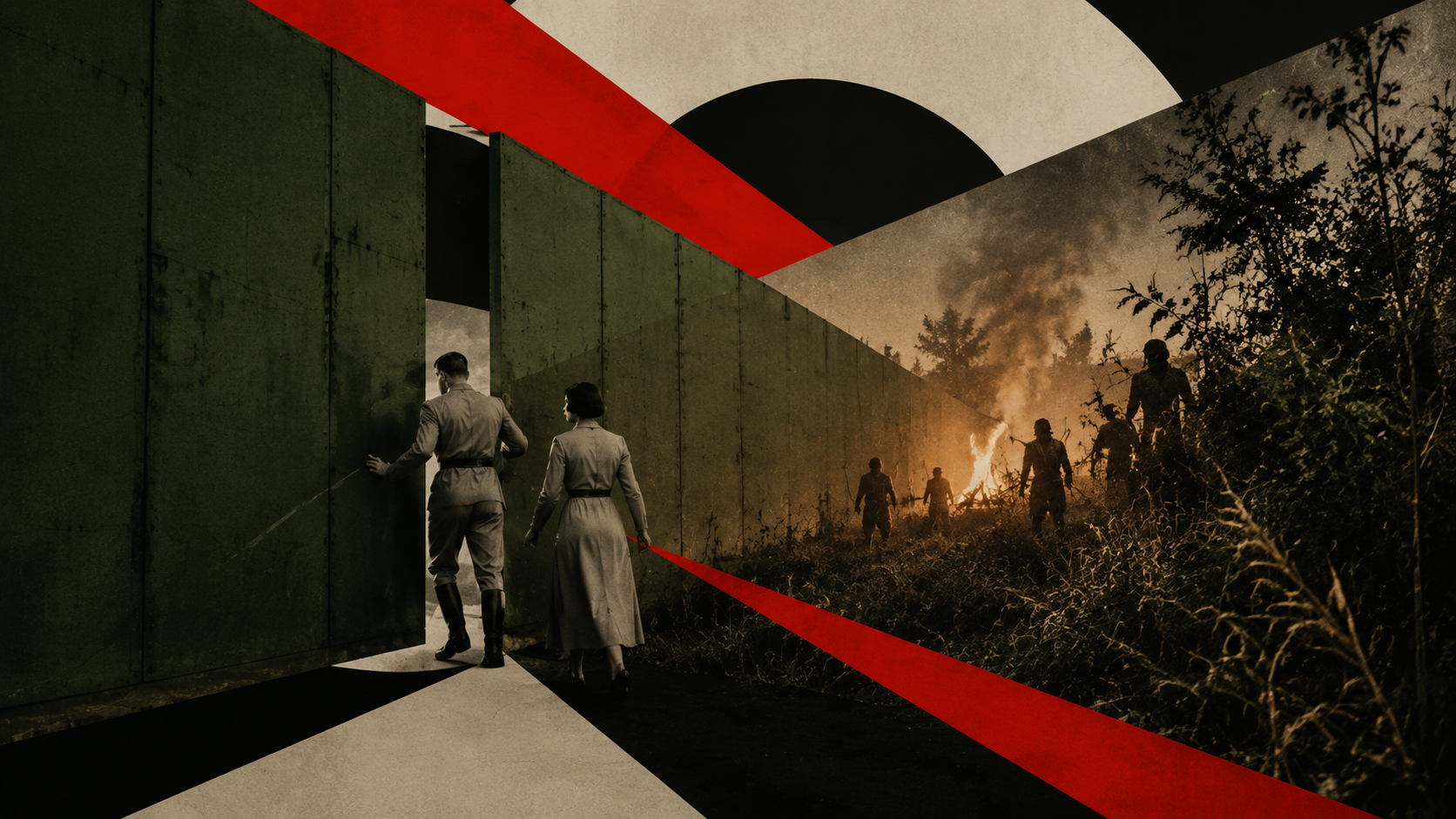
Act Three: Beyond the Green Wall. I-330 smuggles him past the city's green wall, out into the wilderness beyond. There live the shaggy natural people, with no numbers and no Table of Hours: noisy, filthy, wild. D-503's reaction isn't liberation but terror — this is his first sight of anything outside civilization, and it's the moment his faith in the rational utopia begins to crack.
Act Four: Diagnosed with a Soul. Back in the city, D-503 starts dreaming, starts feeling jealous, grows restless whenever I-330 is away. A doctor examines him and calmly announces: you've developed imagination — congratulations, you have a soul. It's a disease. In OneState, catching it isn't romantic; it's the start of trouble. The cruelest touch here is diagnosing the capacity to love as an illness requiring treatment — it's the kind of detail that runs cold down your back.
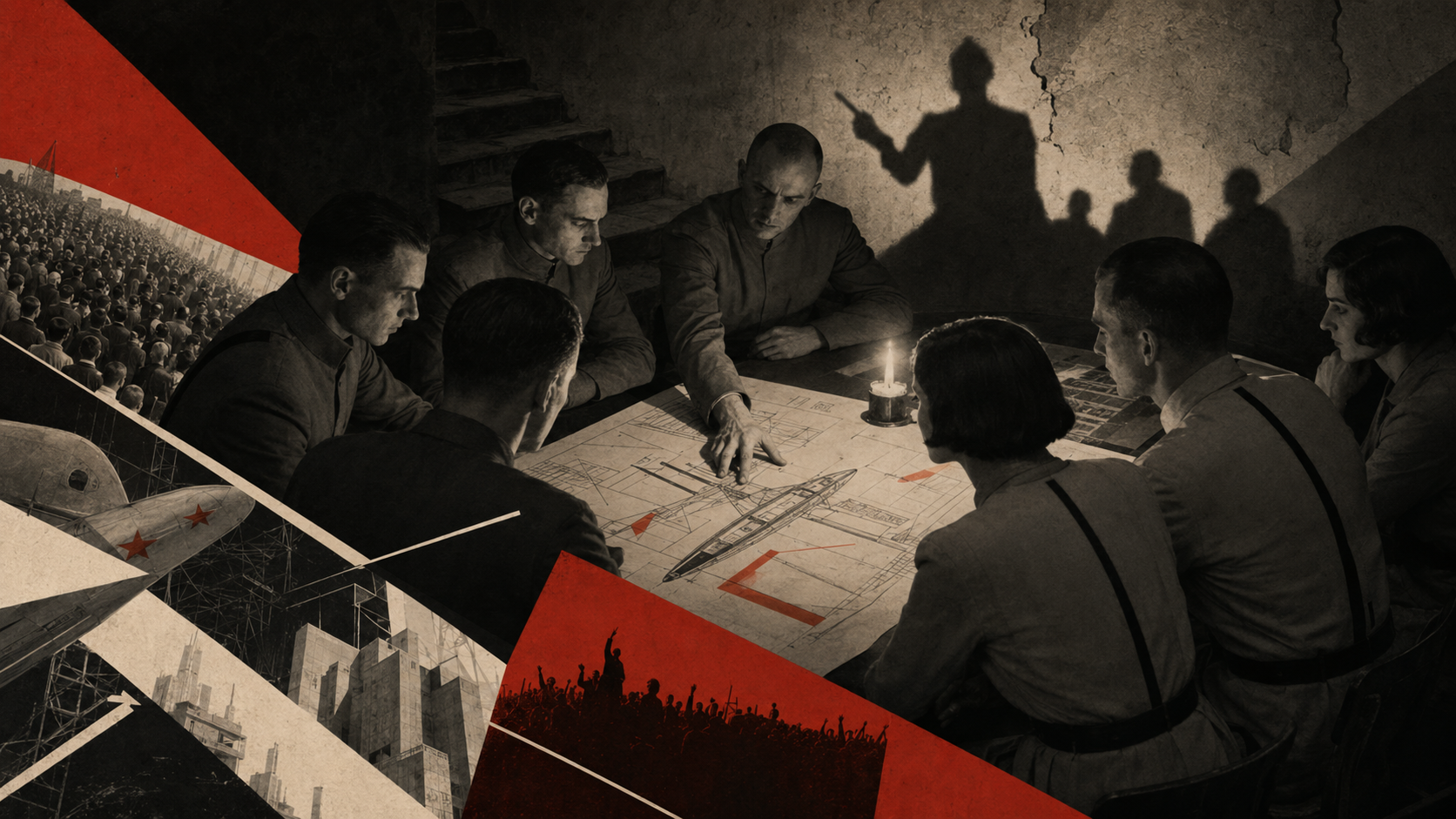
Act Five: The Truth Comes Out. I-330 gradually confesses that she's a core member of the underground resistance, the Mephi. Their plan is to seize the Integral — the very ship D-503 built — and use it to launch an uprising from within, overthrowing the Benefactor with help from inside and out. By this point the diary's language has started coming apart: whole passages tremble and fracture, because a mind disciplined for over twenty years is, for the first time, having to write a defense for the irrational.
Act Six: The Great Operation. On the day of the uprising, the state doesn't wait to be overthrown — it moves first. A vast machine descends over the entire city, forcing every citizen to undergo an operation that removes the fantasy nerve. The justification is impeccable: the state loves you, and so it must cure you of your disease. The cruelest cut of all: when D-503 lies down on the operating table, what gets removed is exactly the part of him that made him human.
On the surface, We is a fable set in the future. Underneath, it's asking a very old question: when a society claims it can make everyone happy, what is it actually trading away? The answer: freedom, imagination, privacy, love — everything that makes you you. The glass walls aren't there for the light; they're there so you have nowhere to hide. Numbers replace names so that you stop bothering to ask who you are at all.
Love in this book functions as a political force — the force that turns a part back into a person. I-330 isn't just D-503's lover; she's a key. So when the state takes a scalpel to that force, it isn't administering a cure. It's defusing a bomb.
First, the form itself is doing the talking. The whole book is a diary, and Zamyatin uses language that starts out increasingly tidy and mechanical to simulate how a domesticated mind operates — and the further in you get, the messier and more fragmented the diary becomes, the more it reads like a real person fighting back. This meshing of form and content is a rare, difficult experiment even by the standards of modernist fiction.
Second, more than twenty years before Nineteen Eighty-Four, and earlier still than Brave New World, it stated the core premise that happiness can be manufactured — and it did so in the voice of a man who once genuinely believed in the revolution himself. Third, it's a book banned in its author's homeland for nearly seventy years, one whose first appearance anywhere was an English translation in 1924 — a fact that is itself part of its legend.