Wuthering Heights · Companion Guide
呼啸山庄
一个弃儿闯入荒原,两代人的爱恨与复仇如狂风席卷——当灵魂被另一个灵魂定义,毁灭才是最终的告白。
Opening: a scene that will crawl under your skin
On a winter night the wind is rattling the windows. You pull an old diary off the shelf and flip to a few lines at random. The handwriting is scrawled and frantic: a man begging the ghost of a woman dead more than a decade to come back and haunt him, not to leave him alone on this moor. Before you have even worked out who wrote it, an icy hand reaches through the bedroom window, trying to get in and seize you. You scream, and when the housekeeper comes running to explain, she sighs and says: well, that story starts thirty years ago, the day old Mr. Earnshaw picked up a black-haired foundling off the streets of Liverpool—
That is the spine-chilling opening of Wuthering Heights: an outside observer, a rational city man, stumbles into a family history gone mad, and the whole story spills out like a wound reopened. This is not an ordinary tragic romance; it is closer to a long, slow-burning study of love, hatred, and one soul devouring another.
What kind of book this is
Wuthering Heights was written by Emily Brontë, an Englishwoman of the early nineteenth century who spent almost her entire life on the Yorkshire moors and died at thirty. The novel was published in 1847 under a masculine pen name, Ellis Bell, because in that era a woman who wrote novels was mocked, let alone one who wrote something this violent, this dark, this close to immoral. When it came out, critics were in an uproar: some called it repulsive, others called it mesmerizing, but almost everyone agreed on one thing—English literature had never heard a voice quite like this.
It is still argued over, still adapted again and again, still ranked among the most extreme love stories in literature. Most people remember it by two names: Heathcliff and Catherine. But what really lodges in the memory is how the book writes love and hatred as almost the same thing—equally violent, equally scorching, both ready to burn everything around them to ash.
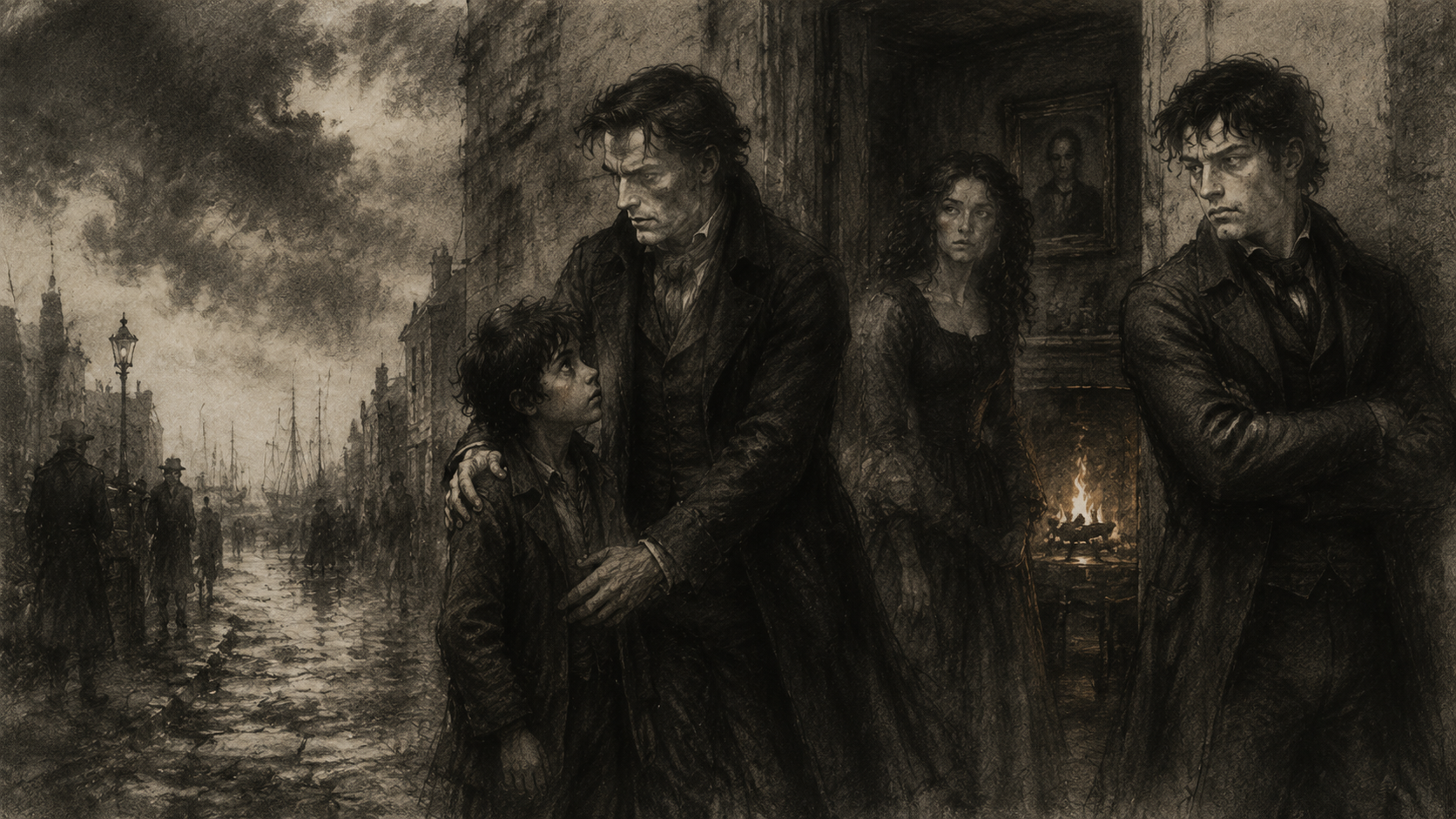
The intense horror of nightmare came over me: I tried to draw back my arm, but the hand clung to it, and a most melancholy voice sobbed, "Let me in-let me in!"
让我进去——让我进去!
原文金句 · 第3章 · 窗外鬼魂的哀求
People and place: two manors on the moor
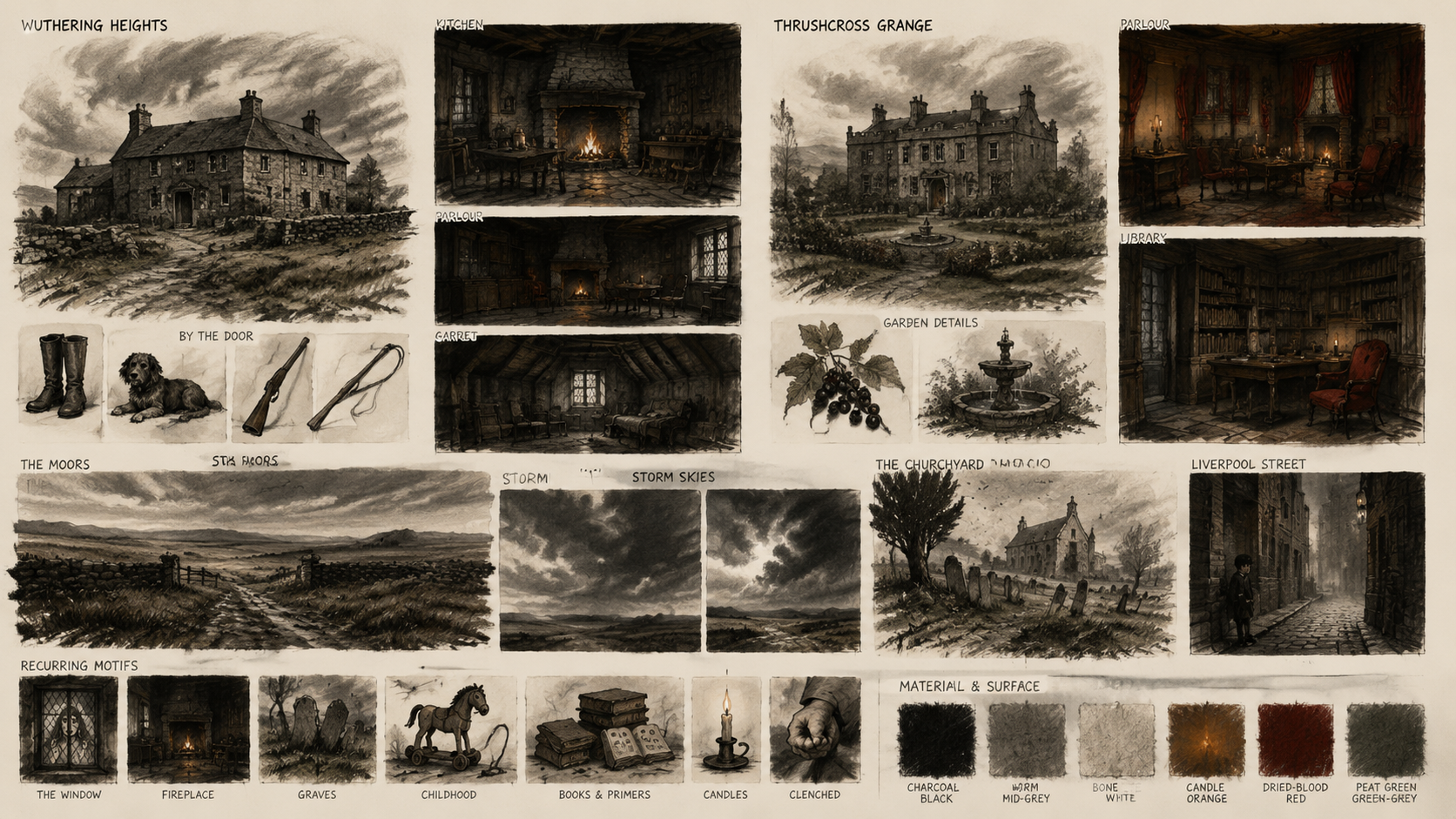
The story unfolds on two manor houses standing not far apart on the Yorkshire moors. Wuthering Heights is the Earnshaw family's old house, named for the howling wind that sweeps over it; it is perpetually cold, the servants are ill-tempered, and the people who live there seem to take after that wind—hot-tempered, repressed, always on the verge of breaking out. Thrushcross Grange belongs to the Lintons, and is warmer, more genteel, more "civilized"—a symbol of comfort, refinement, and social standing. The two houses face each other across the moor like a pair of uneasy neighbors.
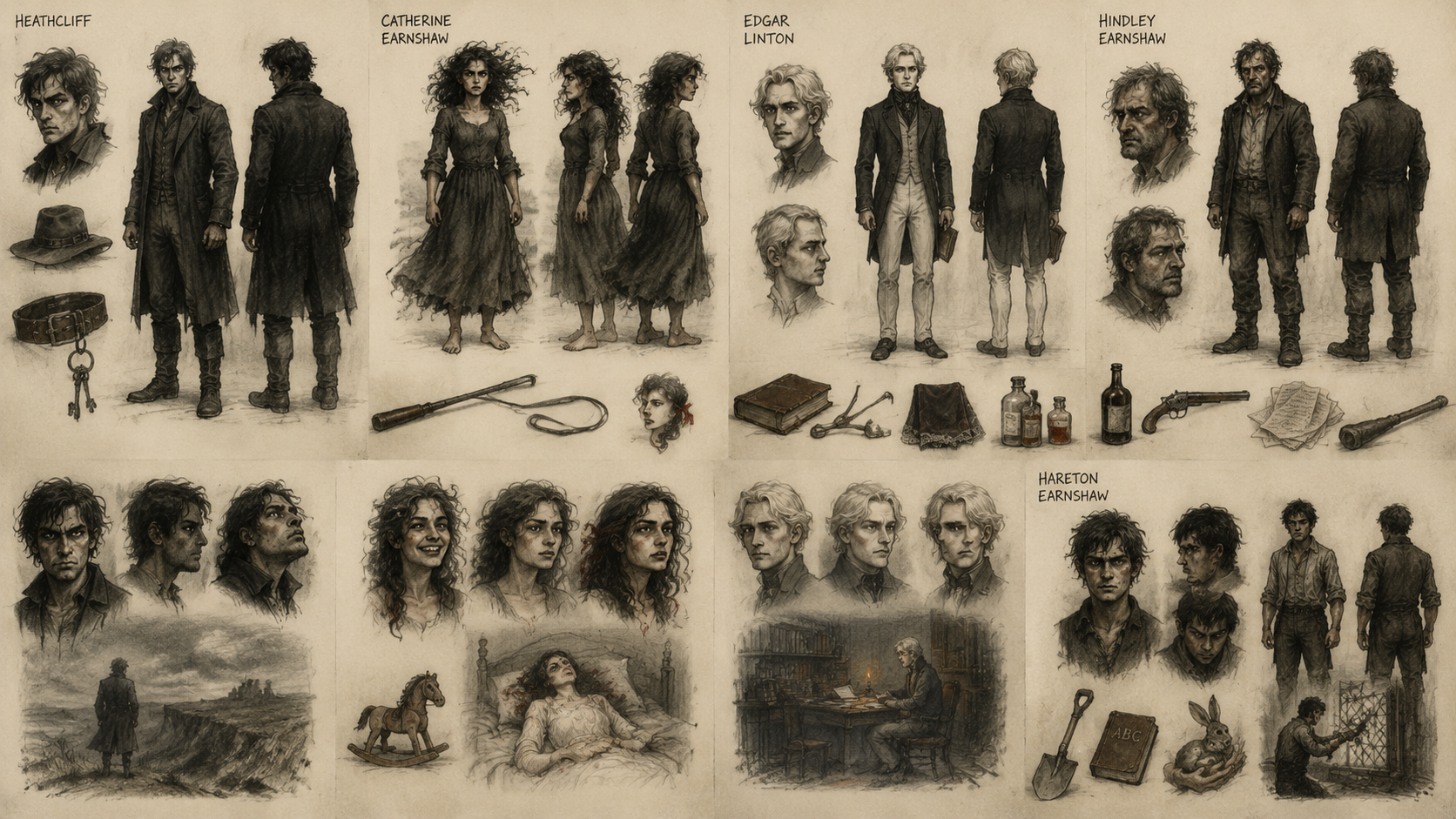
There are four central figures. Old Mr. Earnshaw is the master of Wuthering Heights; he picks a black-haired foundling off the streets of Liverpool and names him Heathcliff, and dotes on this wild child even more than on his own son, planting the seed of ruin for the whole family. Heathcliff grows up running wild on the moors with Earnshaw's daughter Catherine, and the two become soul-bound to an almost pathological degree. Catherine's brother Hindley hates Heathcliff for stealing their father's favor, and the moment their father dies, he demotes Heathcliff to a servant. Across the moor at Thrushcross Grange lives the gentle, well-mannered Edgar Linton, who later becomes Catherine's husband, and Heathcliff's rival for life.
One more character has to be mentioned: the housekeeper Ellen Dean. She serves both the Earnshaw and Linton households for more than thirty years, and is the witness and narrator of the whole family's rise and ruin. Nearly everything we read is what she tells a visiting lodger named Lockwood—a curious city man whose arrival is what pulls this thirty-year feud out of the drawer in the first place.
The plot: thirty years of love and ruin
Act One: the foundling arrives. The moment that black-haired boy from the streets of Liverpool walks into Wuthering Heights, the whole family's fate begins to tilt. Old Earnshaw raises him like his own son, dresses him well, has him study alongside Catherine, while Hindley is left out in the cold. The two children run wild over the moors, call themselves "two wild things," and swear to belong to each other forever. This childhood is written with a ferocity that has almost nothing of the well-behaved Victorian child in it.
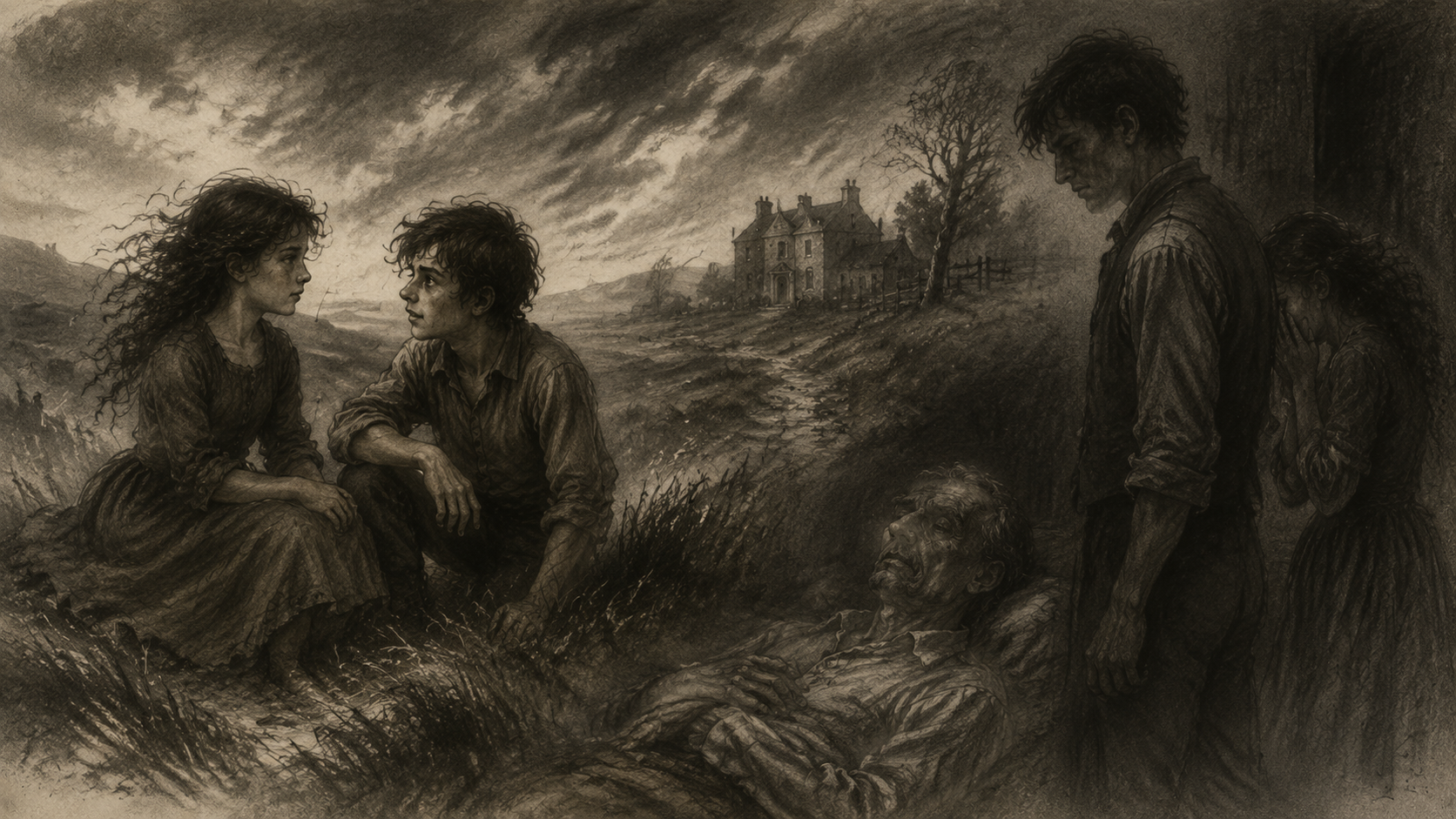
"You never told me before that I talked too little, or that you disliked my company, Cathy!"
你以前从没说过我话少,也从没说过你不喜欢我陪你,凯茜!
原文金句 · 第8章 · 荒原的争吵
Act Two: growing up, torn apart, married off. The moment old Earnshaw dies, Hindley shoves Heathcliff straight back down to servant status, beating and cursing him. Catherine, meanwhile, is taken in by the Lintons at Thrushcross Grange to recover from an accident, and there she meets the gentle, respectable Edgar. She is drawn in by the curtains, the carpets, the candlelit dinners—torn between the moorland foundling her soul cannot do without and the socially "superior" life on offer. In the end she marries Edgar, telling herself that respectability will raise her up, so that "Heathcliff won't disgrace me" later on. Heathcliff, listening at the window, hears her say that marrying Edgar will let her help Heathcliff rise in the world, not that she loves him more, and vanishes that same night, swearing that when they meet again he will make both the Earnshaws and the Lintons weep.
Act Three: return and death. Three years later Heathcliff comes back, with money from some unexplained source, dressed and carrying himself like a gentleman, but with a look in his eyes more frightening than before. The first thing he does is marry Edgar's sister Isabella—not out of love, but purely to torment Edgar and Catherine. Catherine is torn in two between the two men: the one who once made her whole on the moor, and the husband who gives her a settled life. She breaks down in a violent quarrel, falls ill, and dies in childbirth. Heathcliff reaches her just before she dies and howls at her bedside, vowing that on this moor Catherine's ghost will never let him go, and that he does not want to be let go.
Act Four: twenty years of revenge across a generation. After Catherine's death, Heathcliff's hatred does not stop—it turns on the next generation instead. He ruins Hindley completely through gambling and debt and seizes Wuthering Heights outright; Hindley's son Hareton, the young master who should have inherited the estate, is deliberately denied any education and thrown in among the servants until he grows into a rough, illiterate man. Heathcliff means to do to Hindley's son exactly what Hindley once did to him: an eye for an eye carried down a generation, however the last generation hurt me, that is how I will hurt yours.
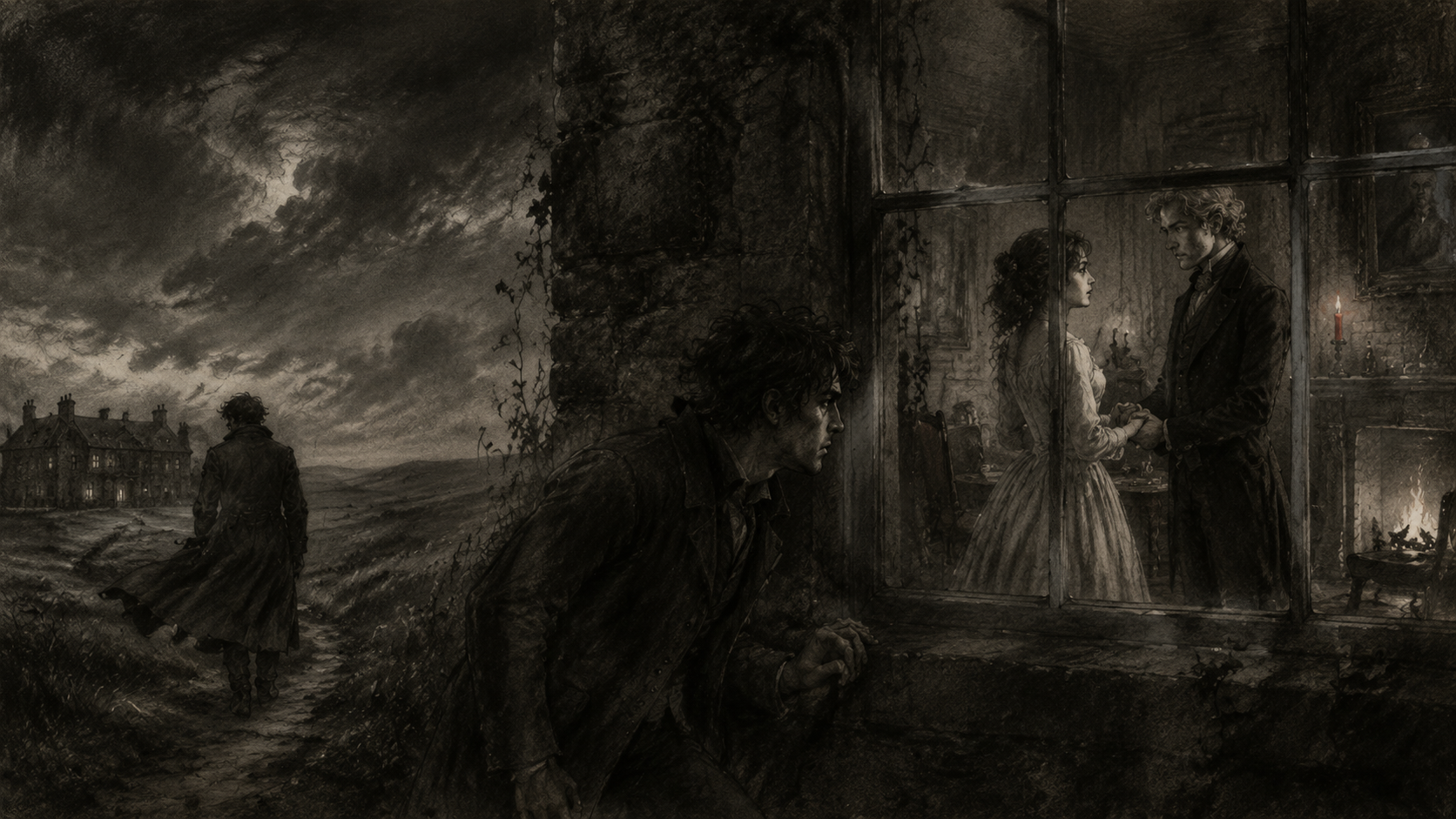
"But Maister Hareton nivir ate naught else, when he wer a little 'un; and what wer gooid eneugh for him's gooid eneugh for ye, I's rayther think!"
可是哈里顿少爷打小就吃这个,从没别的;他能吃的,想必你也该吃得。
原文金句 · 第21章 · 仆人约瑟夫的讥讽
Act Five: seizing Thrushcross Grange. Heathcliff also uses his own son, young Linton, the sickly child he had with Isabella, as a tool, forcing this boy, who will not live many more years, to marry Edgar and Catherine's daughter, young Catherine. The moment Edgar dies, Thrushcross Grange falls into Heathcliff's hands along with Wuthering Heights. Two manors, two families' fates, all gripped in one man's fist.
Act Six: a delirious death on the moor. But then comes the story's strangest reversal. Having completed his revenge, Heathcliff feels no triumph—instead he grows more and more unmoored. He claims to see Catherine's ghost on the moor, sometimes as a child, sometimes as the Catherine of his boyhood, sometimes as she looked when she died. He stops eating, saying death is close. In the end he starves himself into delirium and dies, and just before the end he has the housekeeper leave him alone in a room with the window open, waiting for the ghost to come in.
Act Seven: the end of the hatred. After Heathcliff's death, the weight of the whole story shifts onto the next generation: young Catherine, once a prisoner at Thrushcross Grange, and Hareton, the Wuthering Heights heir who was denied an education. The two of them meet and fall in love through their shared hardship. Hareton learns his letters from scratch, and young Catherine teaches him word by word. They plan to marry and move back into Wuthering Heights to build a decent life. This final note is oddly light, like rain after a great fire has burned itself out: the moor is still the same moor, but the fire has finally gone out.
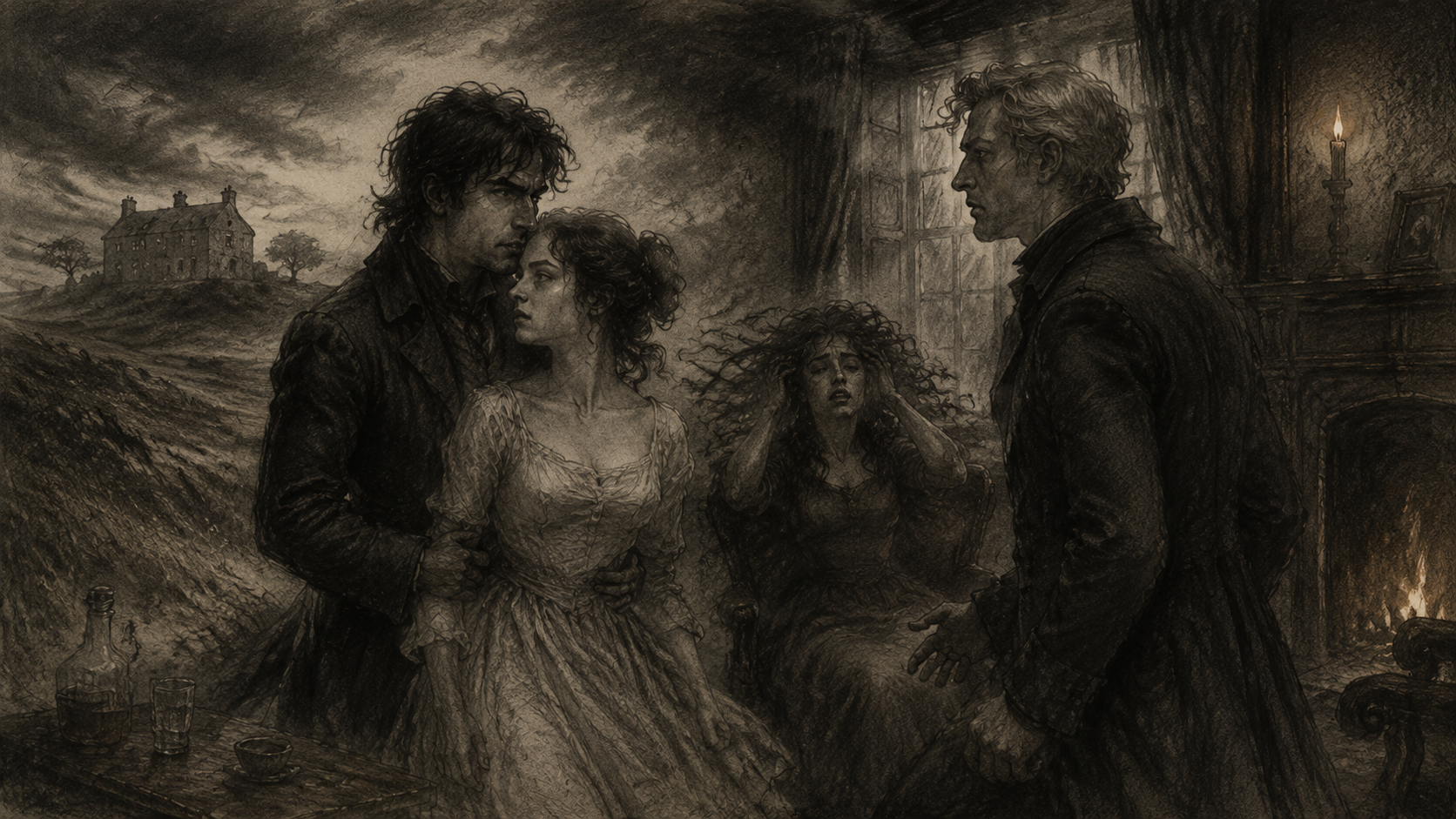
I am worthless, and bad in temper, and bad in spirit, almost always; and, if you choose, you may say good-bye: you'll get rid of an annoyance.
我一无是处,脾气又坏,心里也总是恶毒;你要是想走,就走吧:正好摆脱个累赘。
原文金句 · 第32章 · 哈里顿的自弃
What it is really about
Many readers finish the book thinking it is about love. It is really asking a harder question: once a person has been completely defined by another person's love, what is left of them when that love is taken away? When Catherine says "I am Heathcliff," she is not exaggerating; she genuinely means it. So when she "betrays" that love by marrying Edgar, what she betrays is not one man, but half of her own soul. Heathcliff's later madness is not simple jealousy; it is a hollowed-out man deciding to fill himself with hatred instead.
A deeper layer of the book is about violence and class. The instant old Earnshaw brings the foundling home, every tangle of class, identity, love, and belonging is planted at once. Heathcliff has no family, no surname, no known origin—in that era, that amounts to being no one at all. He is pampered and trampled, loved and abandoned, taken in and driven out. The whole novel reads like a long case study in what a person becomes after being humiliated by society again and again.
There is also a quieter thread running through the book: the cycle passed down between generations. However the last generation was hurt, the next generation gets hurt the same way, until someone in that next generation chooses to stop. The love between Hareton and young Catherine is not a fairy-tale ending; it is the moment the cycle breaks. That leaves a crack of light in an otherwise despairing book.
Why the novel is considered a masterpiece
It succeeds in three ways. The first is structure: the whole story is relayed through two layers of narrator, the lodger Lockwood and the housekeeper Dean, a nested narrative that was remarkably rare in nineteenth-century fiction, and it makes a violent story feel both distant and intimate, like hearing an old woman's memories by the fireside. The second is Heathcliff himself, one of the most unsettling, and most unforgettable, leading men in English literature: thoroughly wicked, thoroughly hateful, and thoroughly capable of love. The third is the moor. The weather, the wind, the heather, the fog at night, all of it is the characters' inner life turned inside out; people and landscape grow into a single thing, and the book helped invent that wild, romantic mode of writing in English literature.
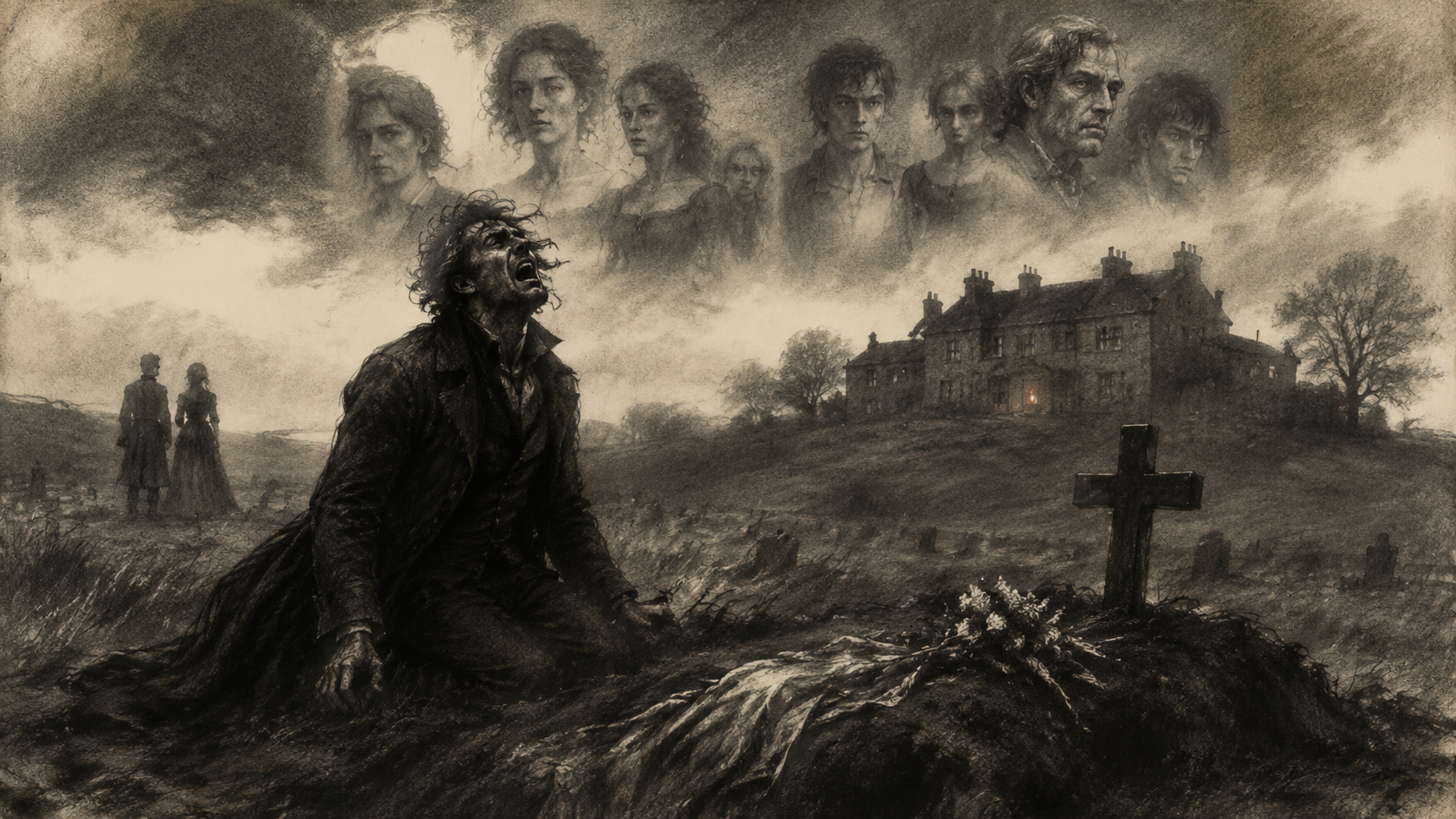
On her seventeenth birthday, he did not visit the churchyard: it was raining, and I observed- "You'll surely not go out to-night, sir?"
在她十七岁生日那天,他没有去墓地;天下着雨,我试探着问——‘您今晚肯定不会出门了吧,先生?’
原文金句 · 第29章 · 未赴墓地
One aside worth making: people often confuse this book with Jane Eyre, but the two were written by different sisters. Jane Eyre is by Emily's older sister Charlotte Brontë, with an entirely different cast and story—do not mix them up.
This is a book about how extreme love can get—and its extremity is that when that love is cut off, it is not an ending. It is the beginning of something far more frightening.
You know the plot. Why read the original at all
Because the real power of Wuthering Heights is not in the plot, but in the wind off the moor that blows through the prose itself. Reading a summary, you learn that Catherine dies, Heathcliff spends thirty years on revenge, and the children finally come together—but no summary can give you the density of language with which Emily Brontë backs a reader into a corner. Her sentences are short, violent, like sprigs of heather torn loose and blown by the wind; when she writes the moor at night, when she writes Heathcliff throwing open a window at midnight to speak to Catherine's ghost, those passages are among the most hair-raising in English prose. And the dialogue—when Catherine tells Heathcliff, in effect, I am Heathcliff as I live, the logic behind that line, her self-absorption, her cruelty, you can only feel that almost physical pull by reading the original. The plot is the map; the wind off the moor only reaches your face once you open the book.
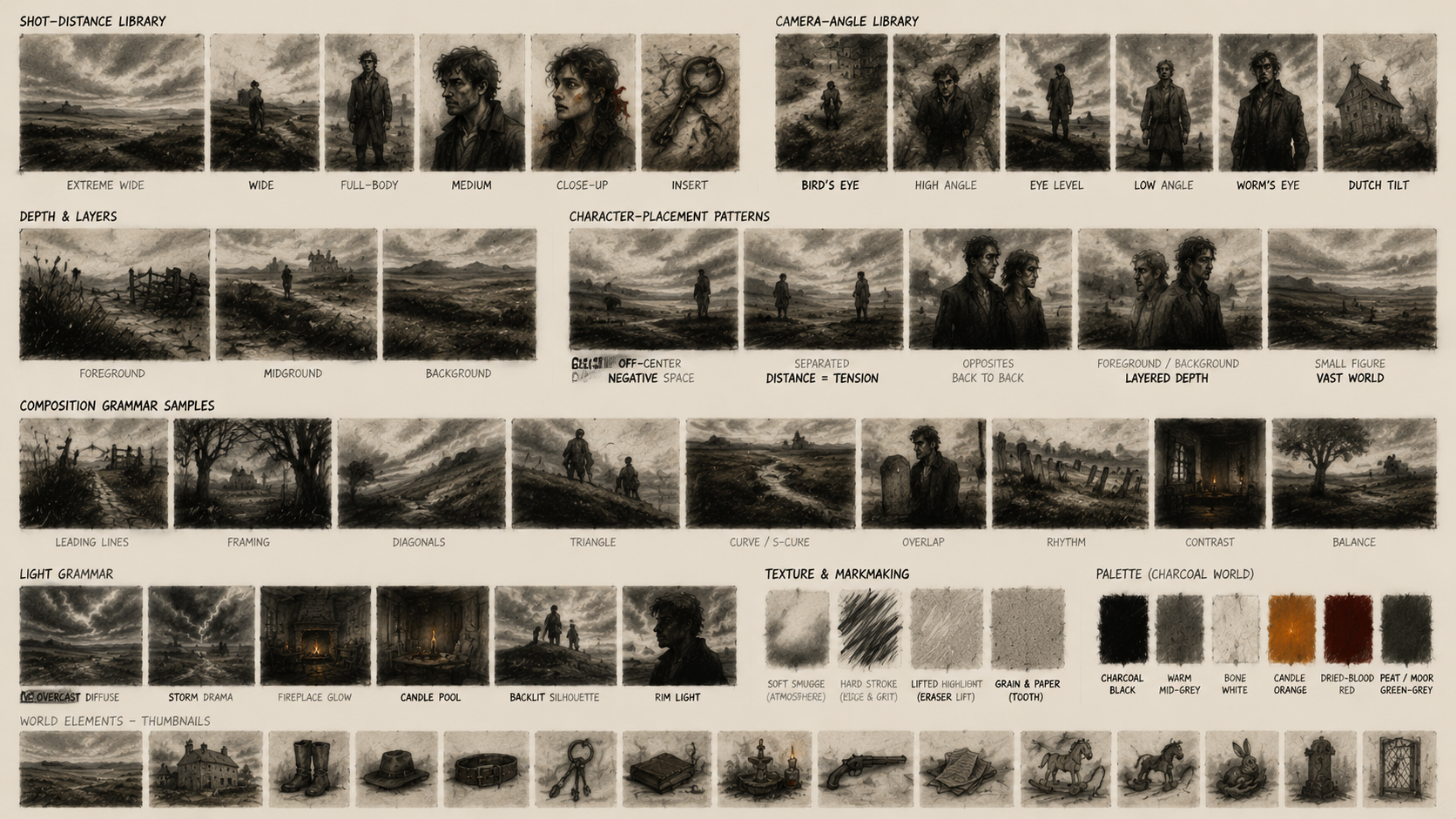
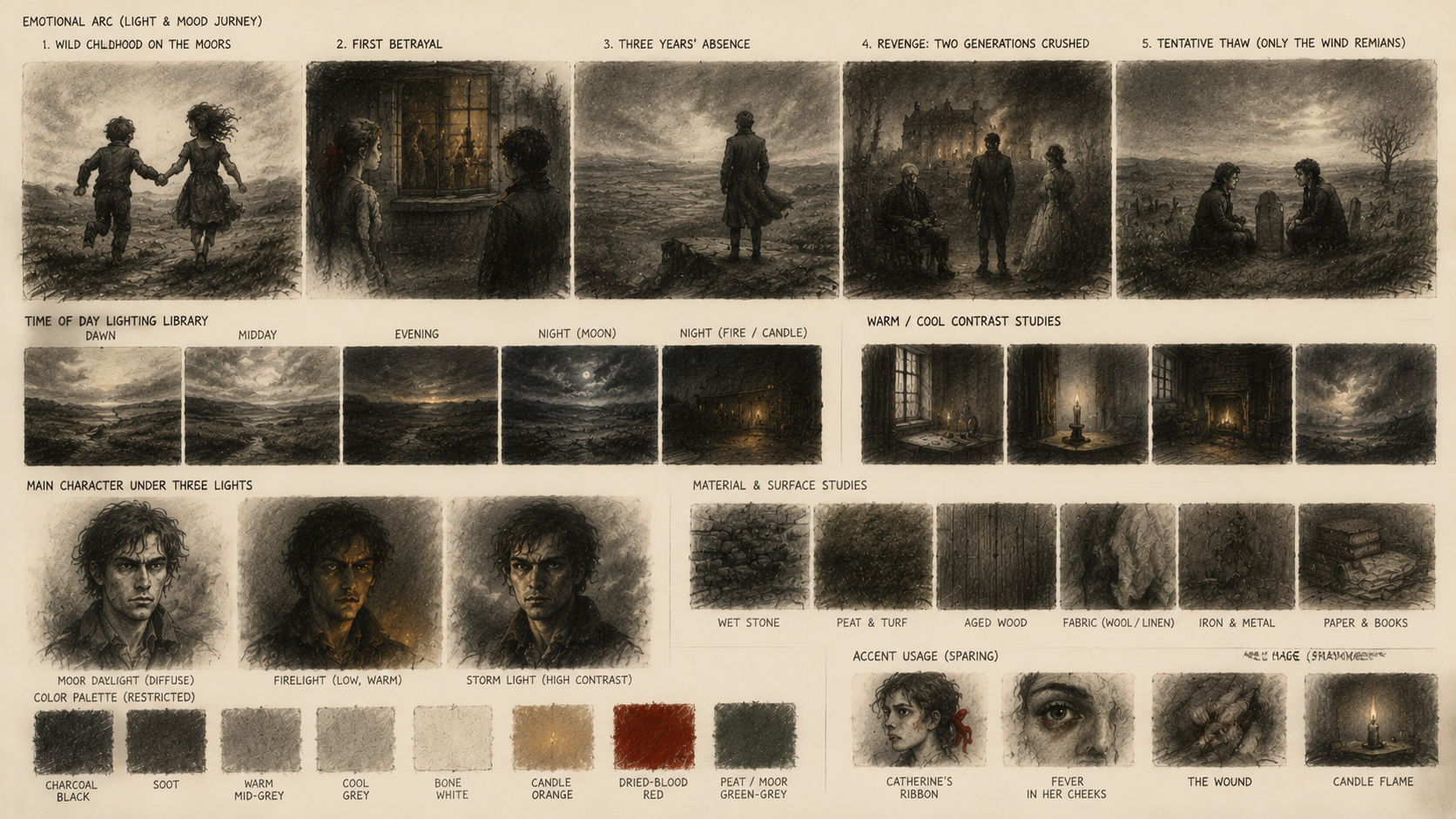
Art Direction4 plates
Before the guide was written, this book got a visual foundation — every illustration you just read grew out of it.