John Irving's 1989 novel is one long letter to a boy who died too young.
Text and illustrations produced by the pipeline
A fictional town in New Hampshire, in the middle of a Little League game. An oddly small boy with a voice like a mouse's squeak swings and sends a foul ball through a gap in the backstop — it strikes and kills his best friend's mother, watching from the stands. This heavy novel starts with that one ball gone wrong.
A Prayer for Owen Meany is John Irving's 1989 novel, and the story opens with that foul ball in 1953. Irving was born in 1942, and by his own account the seed of this book was planted during his years at a New England boarding school — even the air of the fictional town of Gravesend is lifted straight from that adolescence. It is a tragicomic coming-of-age novel, and critics generally rank it as his best. Chinese readers tend to think of The World According to Garp first when Irving's name comes up, but on America's own home turf, this is the book that nailed him to the wall of literary history.
Two boys are the pillars of this book. Owen Meany — small, with a strange, high-pitched voice, from a family that runs a granite quarry — is a straight-A student and editor of the school paper, and he believes, without wavering, that he is an instrument chosen by God. John Wheelwright is the first-person narrator, Tabby's illegitimate son, raised after his mother's death by his stepfather Dan Needham, a gentle drama teacher. The two boys become inseparable from the moment of that foul ball, and death never quite pulls them apart. Around them: a New England town coming loose under the shadow of the Vietnam draft, a Christmas pageant the church stages without fail every year, the old Victorian house kept by grandmother Harriet — and a father John spends the whole book searching for, whose name isn't revealed until the second half.
A guide like this can give you a map, not the ground itself. What's most remarkable in Irving's book is that particular New England small-town air — winter snow, the wooden pews of the church, granite blocks freshly cut from the quarry, the laughter two boys swallow in the middle of a prank — none of that reaches you except through the actual sentences. The airport scene runs barely two thousand words and ends the moment it's told, but when you finish it you'll find yourself closing the book and staring out the window for a long time.
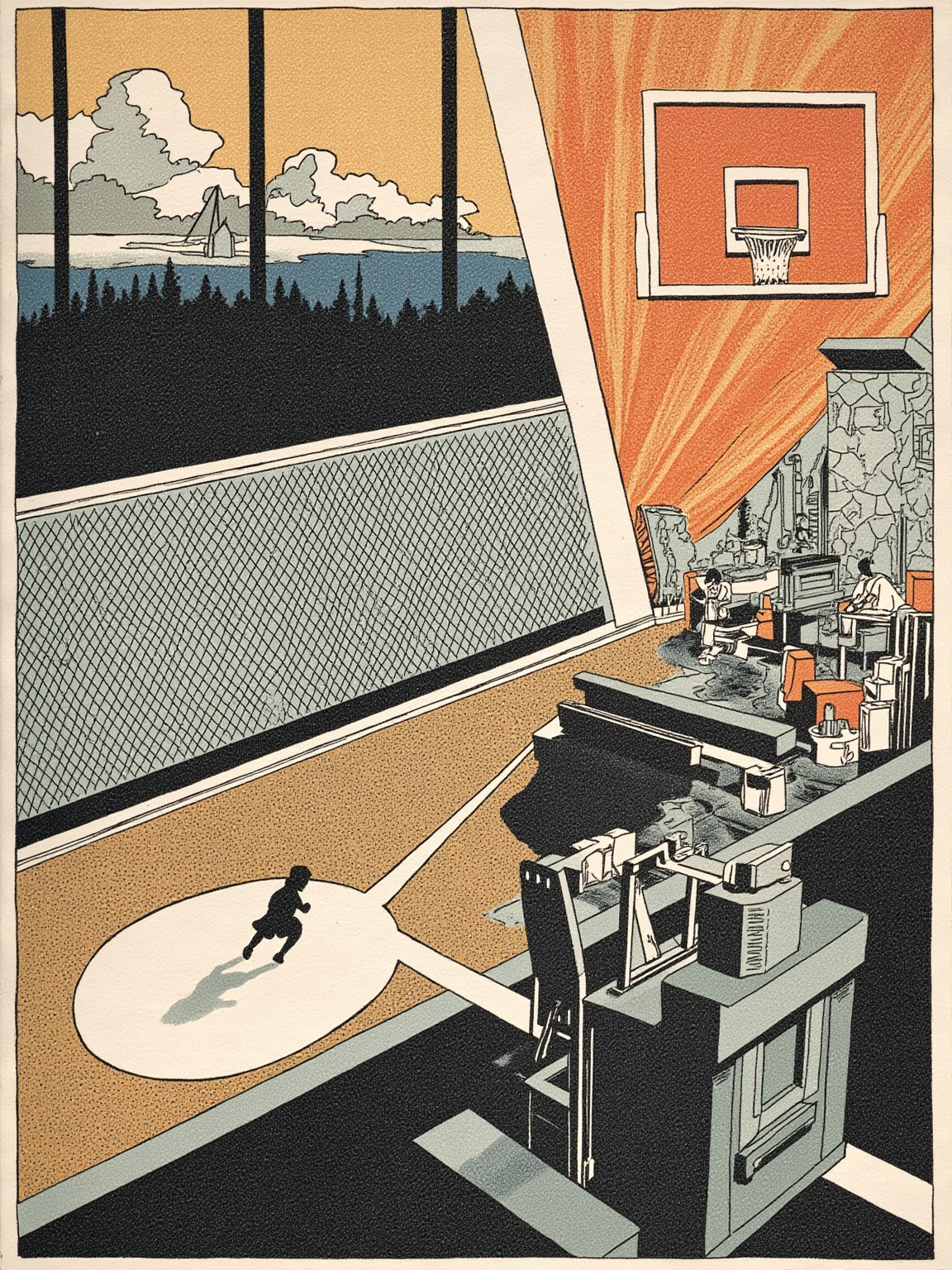
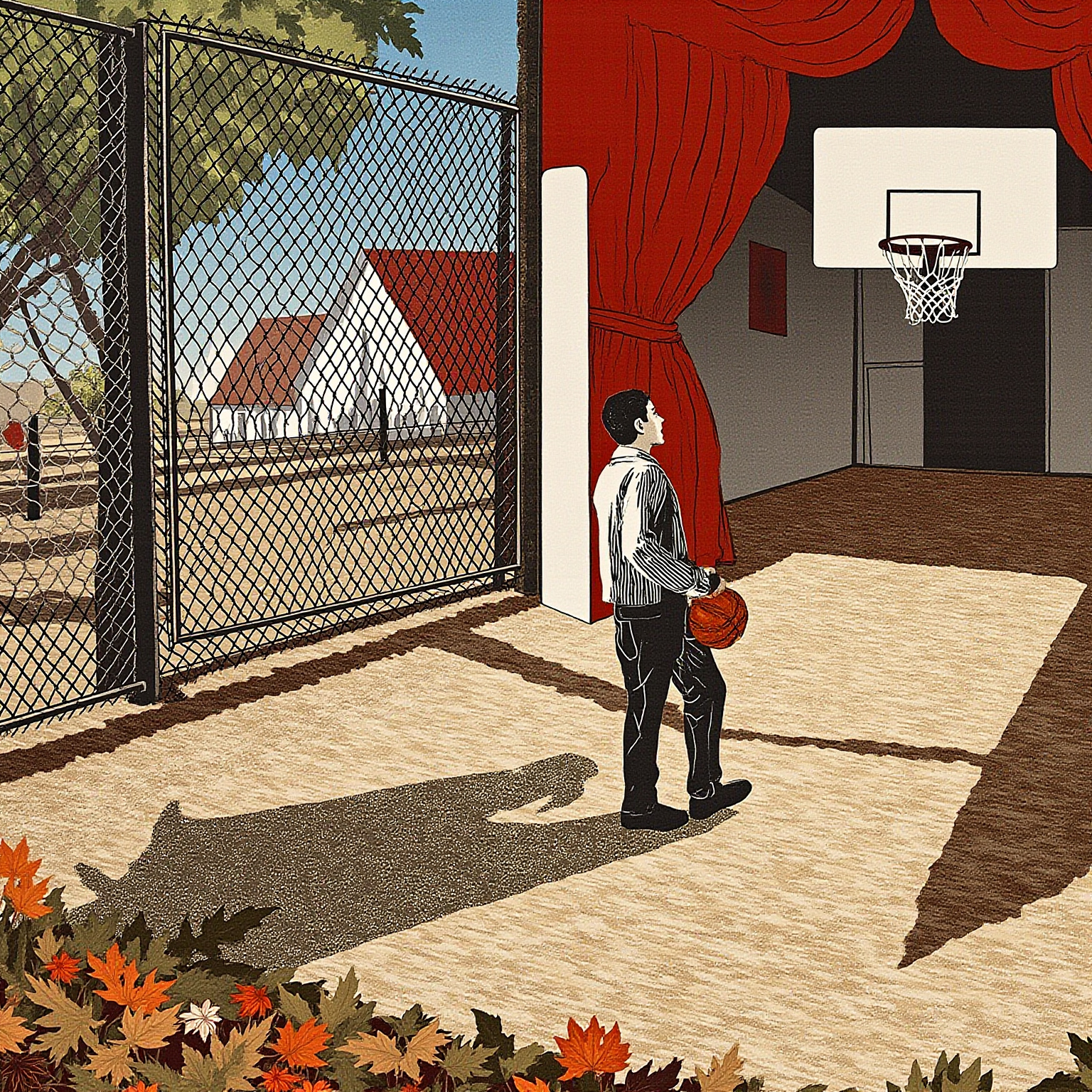
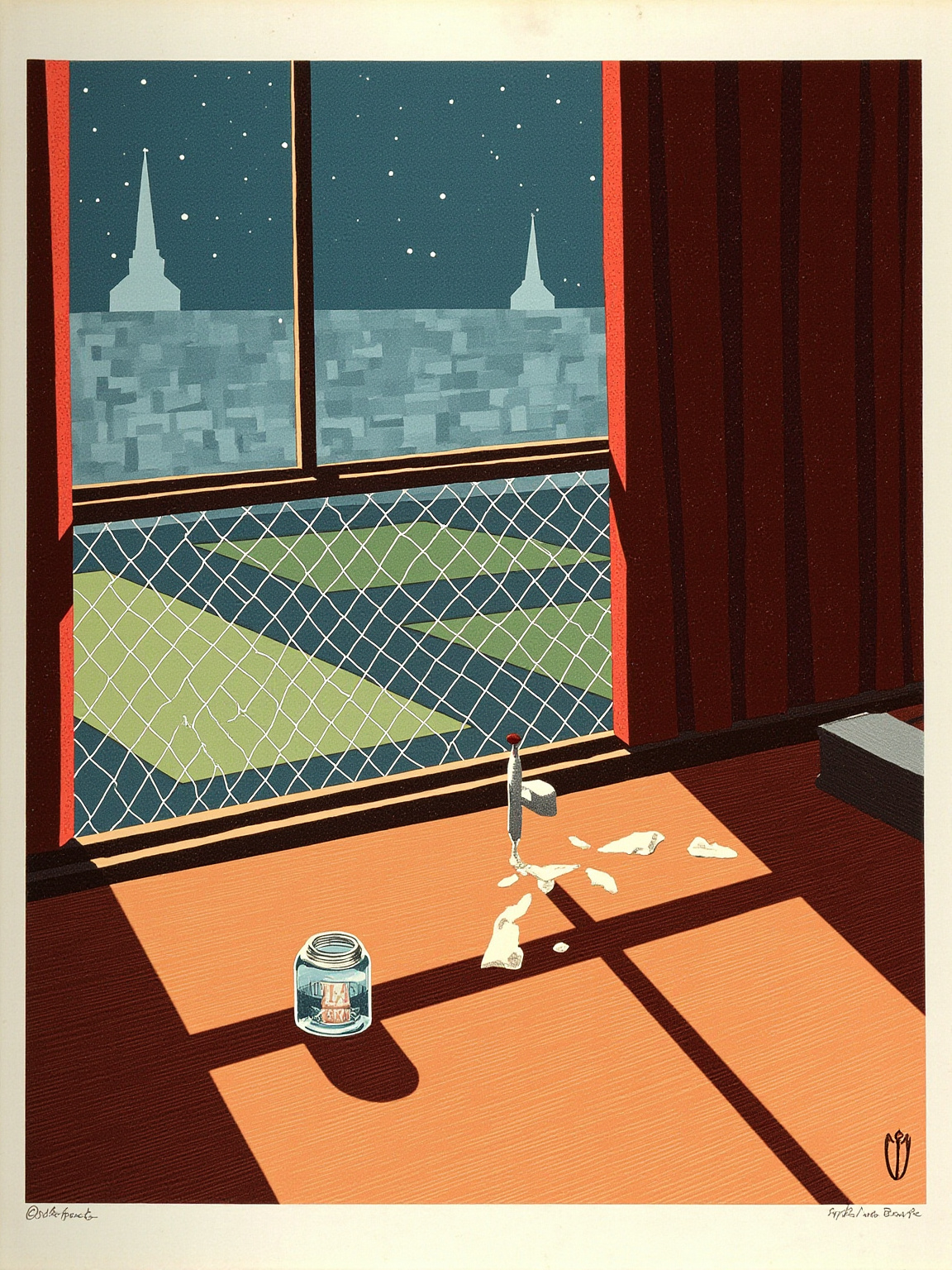
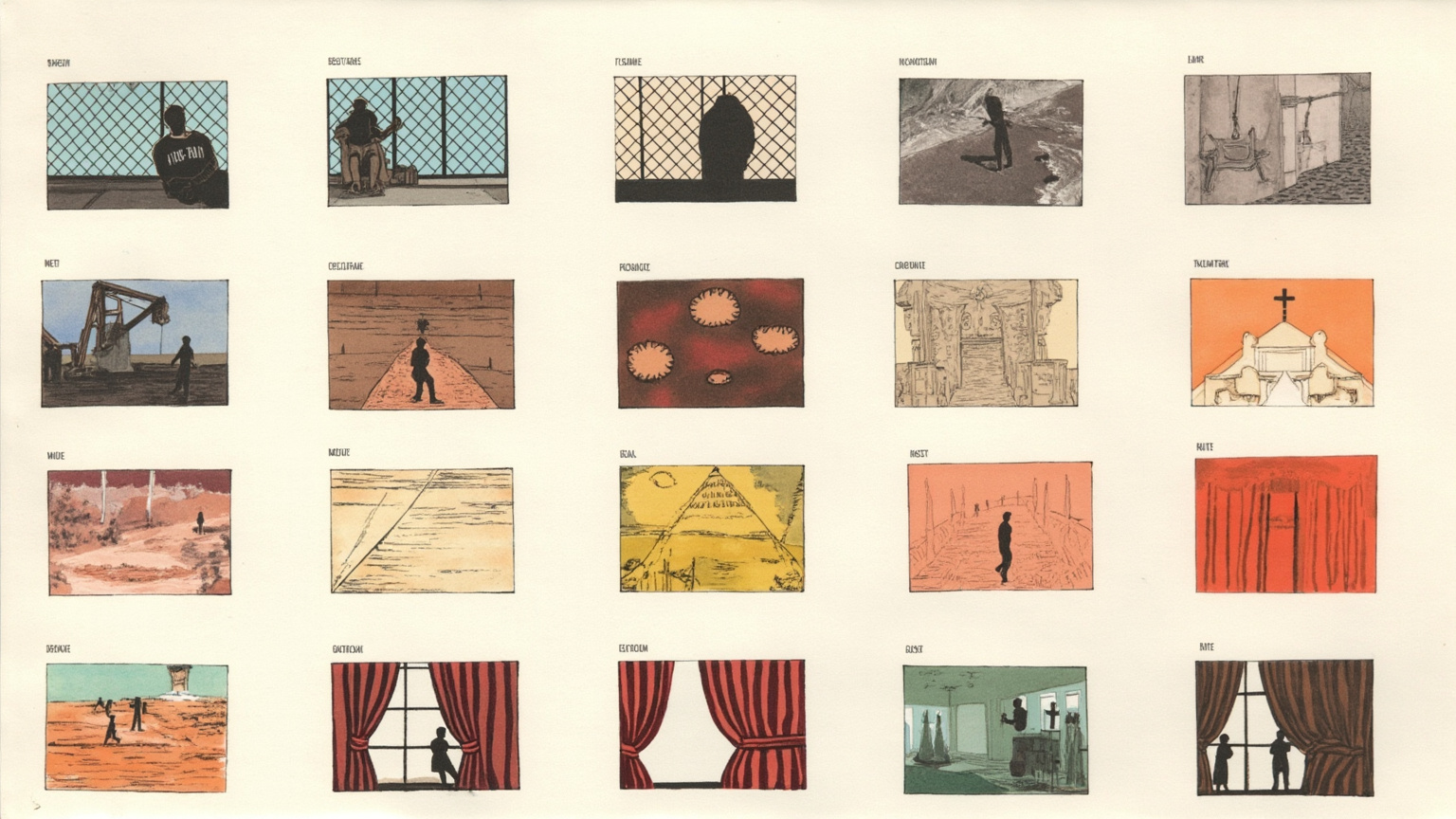
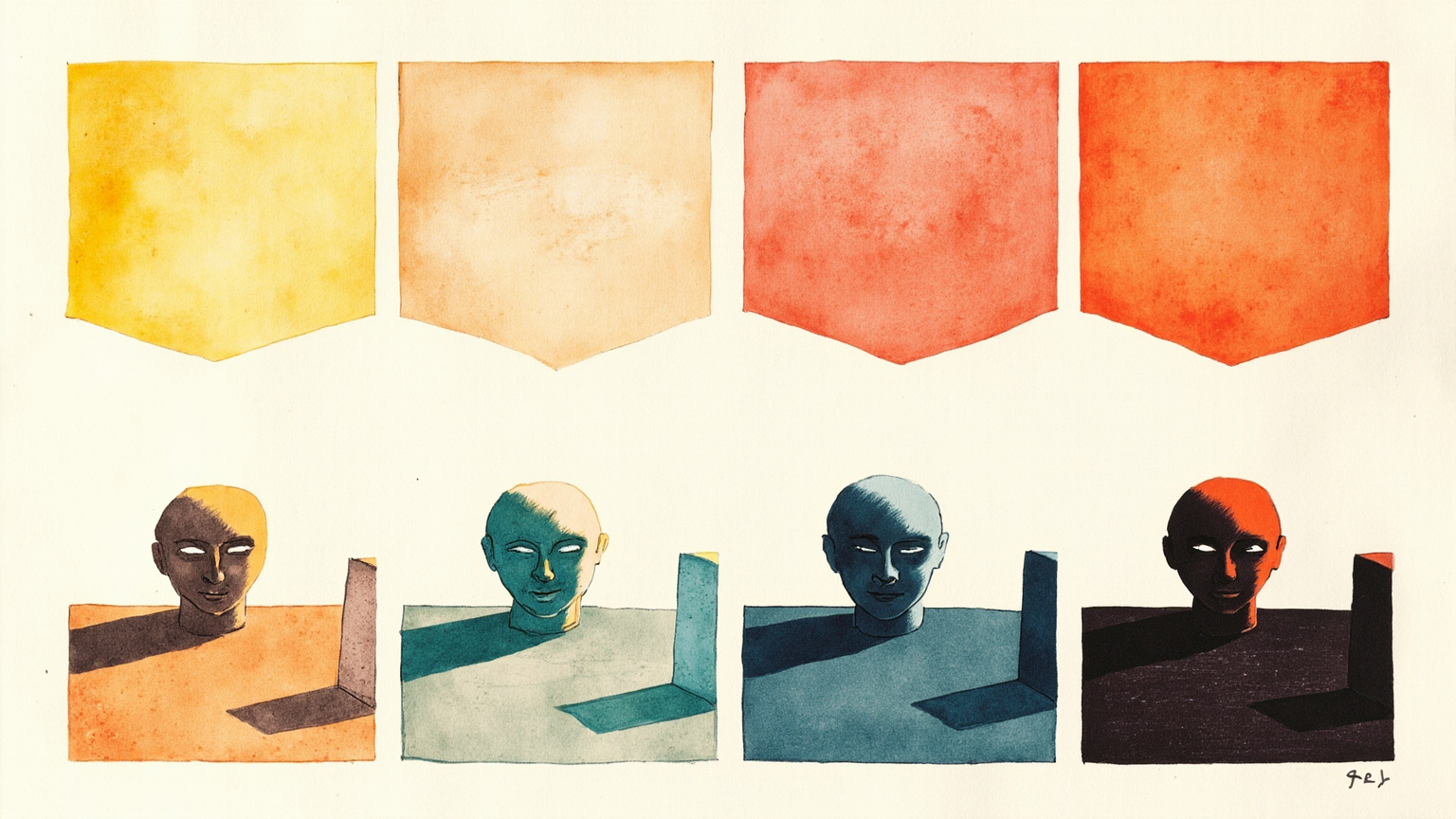
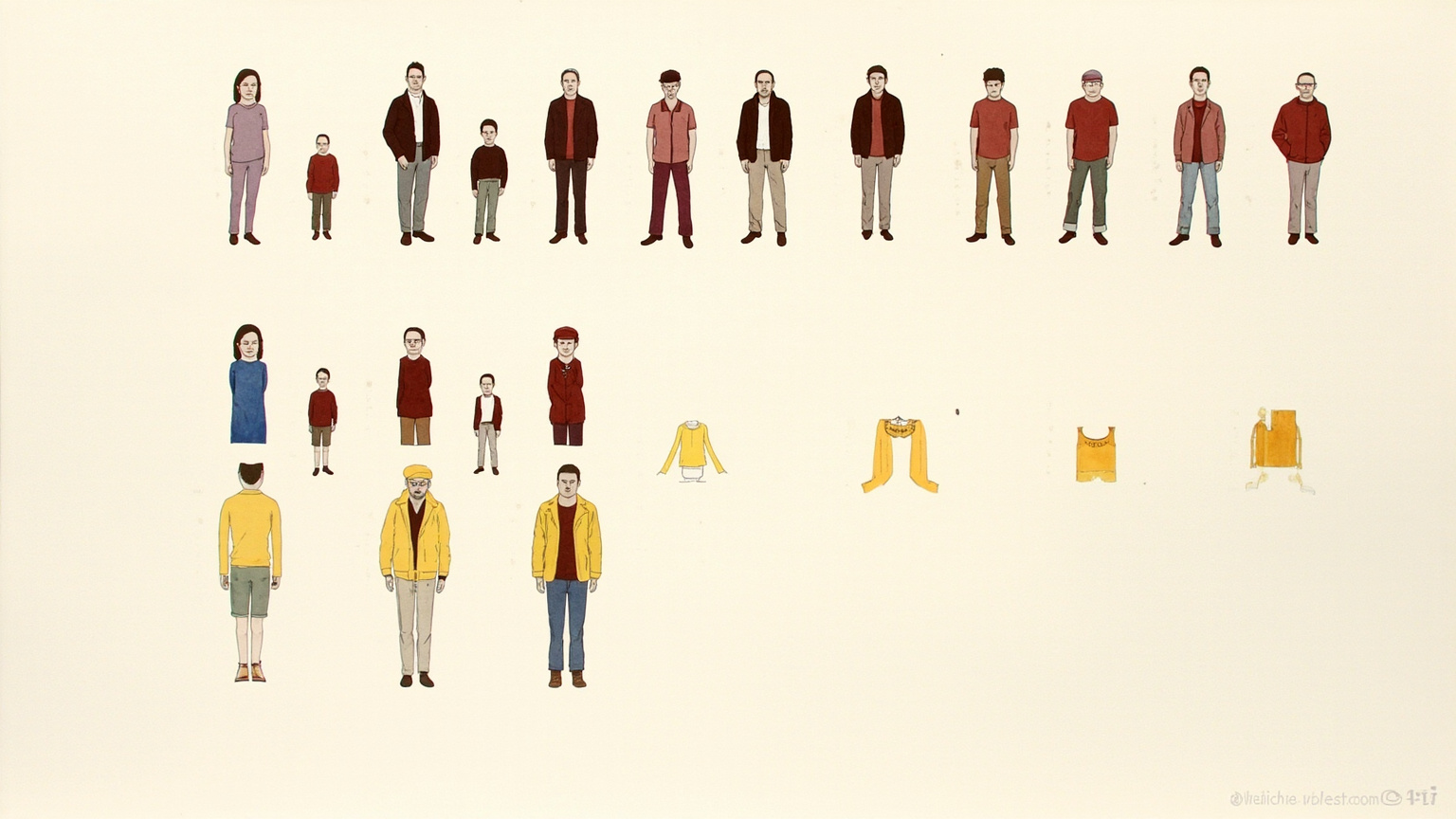
Before the guide was written, this book got a visual foundation — every illustration you just read grew out of it.
The 1953 Little League game. Owen Meany takes the bat the coach hands him and swings a light, careless foul ball; it clears a gap behind the backstop and strikes Tabby Wheelwright in the stands. She goes down and never gets up. Eleven-year-old John loses his mother; eleven-year-old Owen never again treats it as an ordinary accident — inside himself he receives it as a signal: I have just done something. The craft here is that Irving doesn't let either boy collapse on the spot. Instead he stretches this moment into a bass line running under the whole novel, thirty-odd years long, sounding again every time a memory circles back to it.
The Christmas pageant is the hinge of Owen's fate. Every year the church stages its own version, and Owen is put into it from early childhood — he plays the infant Christ swaddled in the manger one year, and in another he takes the near-silent part of the Ghost of Christmas Yet to Come. During a late rehearsal, he has a vision of his own gravestone — his name and the date of his death carved into it, plain to read. He writes it down and hands it to John, and from then on the two of them live inside a strange countdown: Owen knows the day he will die, but not how. It's a brutal move on Irving's part — he turns faith from a feeling into a set of hard numbers.
Around the same time, the two boys invent a basketball move they call the shot: John lifts the featherlight Owen into the air, and Owen sinks the dunk in under four seconds. They practice it day after day, year after year. For the first five hundred pages, it reads as nothing more than a private quirk between two teenagers — Irving mentions it and moves on, mentions it again and moves on, and the reader takes it for some throwaway bit of boyhood code, not worth a second thought.
By the mid-sixties, draft notices for Vietnam are arriving one by one in Gravesend mailboxes. Owen calculates that John will pass his physical and be classified fit for service, so he makes a decision that will keep him in moral shadow for the rest of his life: he gets John drunk and uses a surgical scalpel to cut off the top joint of his right index finger. The missing fingertip is enough, from then on, to fail John on every draft physical. Before John wakes, Owen seals the severed piece in a small jar and mails it to John's mother — who has been dead for years, so it goes to her grave. This is the hardest passage in the book to read, because it forces a question on the reader: can a man maim his best friend with his own hands, to keep him from dying in Vietnam?
Having pulled John out of the war, Owen enlists himself. But he is never sent to Vietnam — his unit stays stateside, assigned to escort the coffins of the dead home to their families. A man convinced he is God's instrument, certain his own martyrdom is only a matter of time, spends the whole war shuttling between airports and funeral homes. This is where the craft of the novel starts to show its hand: Owen's martyrdom isn't granted by enemy fire at the front. It is withheld from the battlefield by paperwork and fate working together in the rear.
1968, the airport in Phoenix, Arizona. Owen's convoy of coffins passes through, and he crosses paths there with John, whom he hasn't seen in years. The terminal is crowded with orphans evacuated from Vietnam, waiting to be claimed by new families. While the two are talking, a soldier in the middle of a breakdown runs into the restroom and pulls the pin on a grenade — as the blast tears the partition open, Owen shouts at John the same call the two of them have shouted at each other a thousand times before. John hoists him up without thinking, and Owen stretches his arms overhead and stuffs the grenade through a vent near the ceiling. It goes off between his own hands. He doesn't die in a rice paddy in Vietnam — he dies under the ceiling of an American airport terminal, both arms blown off, bleeding out beside the Vietnamese orphans he has just saved with his life.
The book's true ending is set in 1987. John, who moved to Canada back then to protest the draft, now teaches at a school in Toronto and serves, in his spare time, as a lay reader at an Episcopal church. The whole seven-hundred-page novel is him sitting by the lectern, telling his life story to a friend who has been dead for almost twenty years. He writes that it was Owen's death that pushed him back into faith — leaving America had been a political choice; returning to the church was because a small boy had once proved, with his own life, that the prophecy was true.
On the surface, this is a tug-of-war between fate and free will — Owen believes without doubt that he is God's instrument, that every event in his life bends toward a death date already written down; the people around him, John most of all, keep pulling back against him with their own free will. Underneath, what the book is really about is how faith gets lost and how it gets found again: a boy in a New England town watches his smartest friend do everything in the name of God, while he himself only sneaks back in through the side door of the altar, decades later. Vietnam is the backdrop for all of it — draft notices, draft dodgers, exile, protest — this is late-eighties America settling a long account with the sixties.
Irving's sharpest move is the shot. In the first half of the book it reads as nothing but a bit of idle code between two boys, forgotten as soon as the page turns; but when the airport scene at the end needs it, Irving pulls it out like a knife that has sat in a drawer for forty years. That gives the whole martyrdom a double meaning — a sacrifice arranged by providence, and also a piece of muscle memory the two boys built over half a lifetime of practice. In one stroke, Irving turns coincidence into destiny, and sends the reader back to reread the book. The first time I finished the airport scene, I went back and reread every passage in the first five hundred pages that so much as mentioned the shot.
The cruelty of this book isn't the death — it tells you on the first page that Owen will die. The cruelty is in making you watch a man maim his friend first, rather than let him die for nothing.