Frankenstein; or, The Modern Prometheus · Companion Guide
Frankenstein
A young man stitches life together from corpses, then flees the instant it opens its eyes — and the creature he abandons will chase him to the ice at the end of the world.
The opening: he assembles that face with his own hands, then is horrified by what he has made
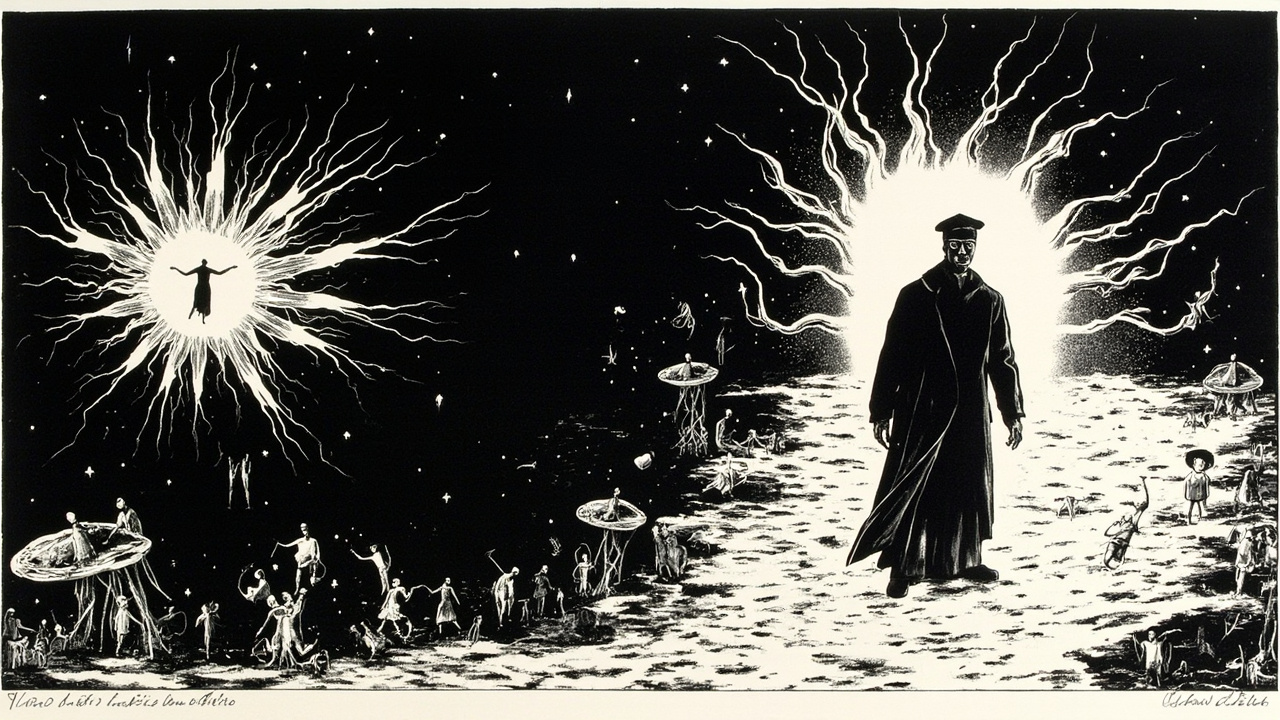
The eye opens. In a basement, a young man has been up all night, a huge assembled body laid out in front of him, two heads taller than he is. He reaches out trembling and finishes the last step. The pupil is watery, a dull yellow, and it is looking at him. A second later he is out the door and never comes back. It is the quietest moment in the whole book, and the most lethal. A young man from Geneva named Victor Frankenstein has just turned dead matter into a living thing, and he is undone by one of the oldest fears there is: seeing what you have made.
This is not just a horror story. It is a novel written over two hundred years ago by a teenage girl, and the question it asks is sharper than anything a modern horror film would dare: if you bring a life into being with your own hands, how much of it is your responsibility? And if you run, what does it become? The reason we are still talking about this book is that anyone with a child, anyone who writes code, anyone who has built something new and then lost control of it, ends up facing the same question.
What kind of book this is: the first science fiction novel, and a Gothic classic
The book appeared in England in 1818, published anonymously. Its author, Mary Shelley, was still very young that year. How it came to be written is itself one of the great oddities of literary history: at eighteen or nineteen, at a ghost-story evening on the shore of Lake Geneva, she made a wager with a circle of the most dazzling poets of the age, including Percy Shelley, who would become her husband, and Lord Byron, over who could write the most frightening tale. She won that wager, and what she won was an entire genre: science fiction.
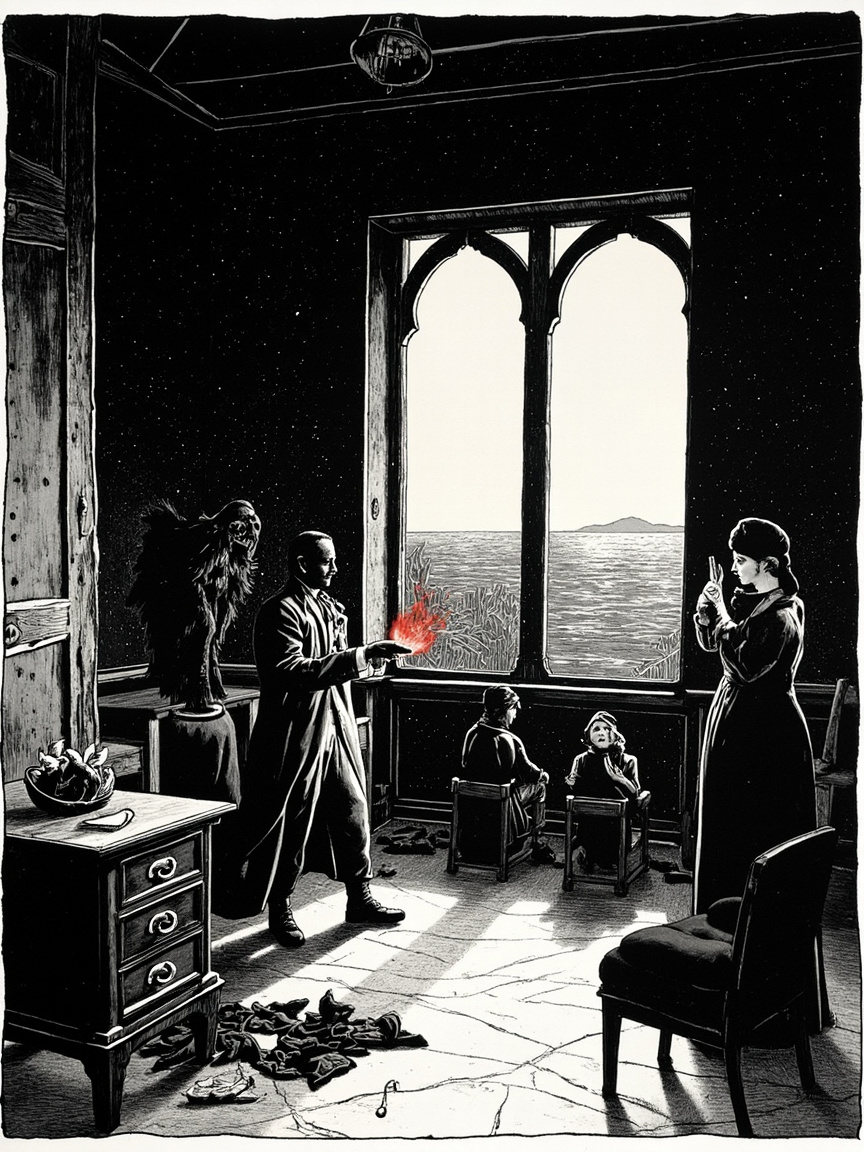
It is not the green-skinned, lightning-crackling mad-scientist picture the movies later made of it. It is a serious Gothic and Romantic novel, one that moves through atmosphere, through letters, through glaciers and endless polar night, through a dread in the human heart that never quite explains itself. Literary history remembers it for two things: it is the acknowledged ancestor of science fiction, and it lodged one question in every generation's mind for two hundred years since — once technology outruns conscience, who is left to clean up? The subtitle, The Modern Prometheus, the fire-thief, nails it down.
The characters and the world: a story told in three nested layers
The book's cleverest piece of design is its nesting. The outermost layer belongs to an English Arctic explorer named Robert Walton, whose ship is working its way through the polar ice; his first letter home is written to his sister. Out on the frozen sea he rescues a dying stranger racing north, Victor Frankenstein, who then spends several days dictating the story of his life to him. What the reader takes to be the main story is really Victor's account, told to Walton, and folded inside it is a further account, the creature's own memory of his origins, told directly to Victor. Three layers, each one holding the next.
The cast is small. Victor: a young man from Geneva, a brilliant student obsessed with old natural philosophy and alchemy. The creature: the nameless, tragic giant Victor makes, a self-taught soul, eloquent, a reader of Paradise Lost, starving for affection. Henry Clerval: Victor's closest friend, warmer and gentler, in love with literature and adventure rather than science. Elizabeth Lavenza: a foundling taken in by the Frankenstein family, Victor's childhood companion and betrothed. The rest of the names, William the little brother, Justine the family's servant, and the blind old De Lacey and his household, are better met inside the story, because each of them ends up an entry on the ledger between Victor and his creature.
How the plot runs: a scientist's flight, a creature's revenge, and the ice that finally traps them both
1. Opening on the Arctic ice: Walton rescues a man chasing something
The ship has been trapped in the Arctic pack ice for months, provisions are running low, and the crew is growing restless. In one of his letters Walton describes seeing a dog-sledge race across the ice with a figure of huge size riding it standing up; he writes it down as "the shape of a man." Soon after, near a floe run aground beside the ship, they find a man half-frozen and barely alive, who identifies himself as a native of Geneva and says he is pursuing a creature fleeing north. This is what is left of Victor Frankenstein at the far end of a year that has worn him down to nothing. Notice that Walton sees the creature before he ever meets Victor; that is the first nail Mary Shelley drives in for her reader.
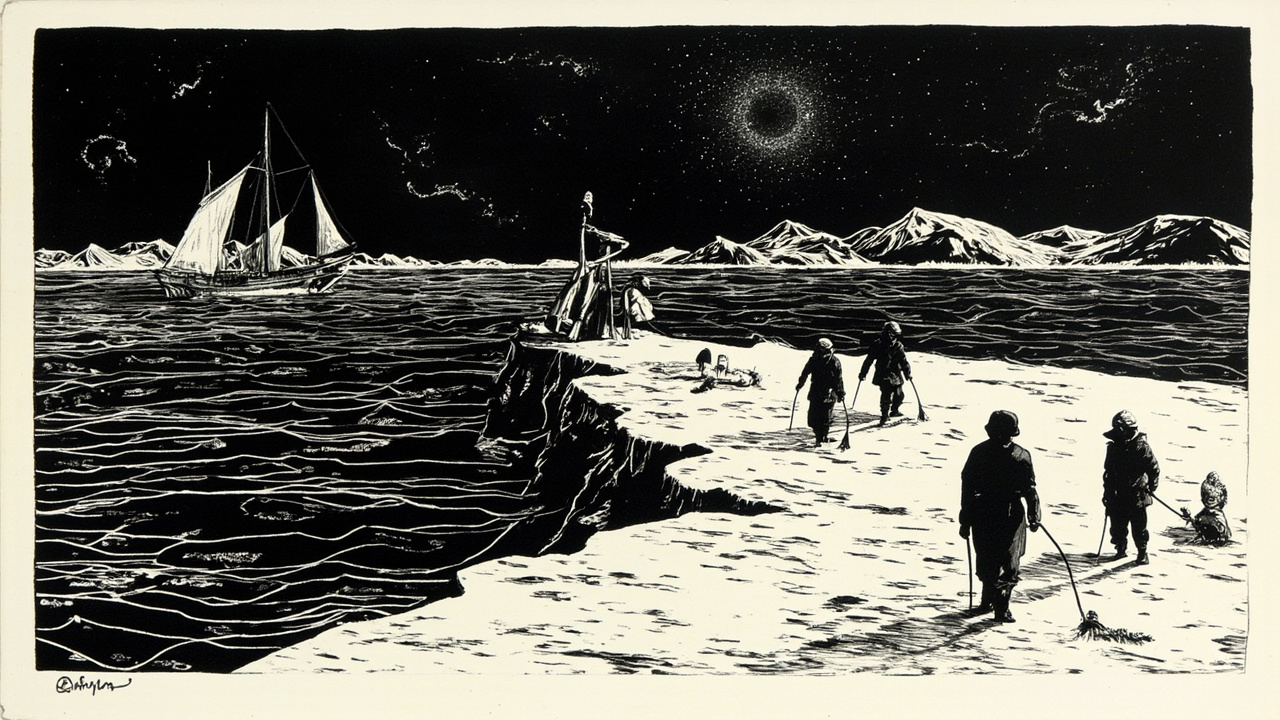
Beware, for I am fearless and therefore powerful.
当心——我一无所惧,所以强大。
Original line · The creature's strength, and the pursuit that follows him to the ends of the earth
2. The boy from Geneva, the boy who found alchemy, and the secret of life
Victor tells Walton his own story. Growing up in Geneva, he first fell under the spell of a battered old book of alchemy, then came under a professor of modern natural philosophy, and the two fused in him into a single, fatal appetite to steal fire from heaven. He leaves his father, his beloved Elizabeth, and his friend Clerval behind and goes alone to study at Ingolstadt, on the edge of Germany. There he uncovers a secret. What the secret actually is, Mary Shelley almost never says, only that it is a science of pouring life into dead matter. The vagueness is the point: she is not interested in the mechanics of it, but in a truth about people who glimpse forbidden ground and almost never stop themselves at the edge of it. A man barely twenty who has started to believe he is God, that is what matters here.
3. The second the eye opens: he flees in terror, and it is left alone to face itself
In a damp workshop lit by candlelight, jars and instruments and stolen remains scattered around him, Victor has assembled a huge human shape out of bones taken from graves. On a rainy night the creature comes to life. Victor watches the eye open, watery and yellow, staring back at him, for a few seconds, then turns and runs from the room and collapses in the hallway. When he works up the nerve to go back the next day, the thing is gone. You can see exactly how good Mary Shelley is here: she spends almost no time on the making of the creature; every ounce of horror is packed into that one turn away.
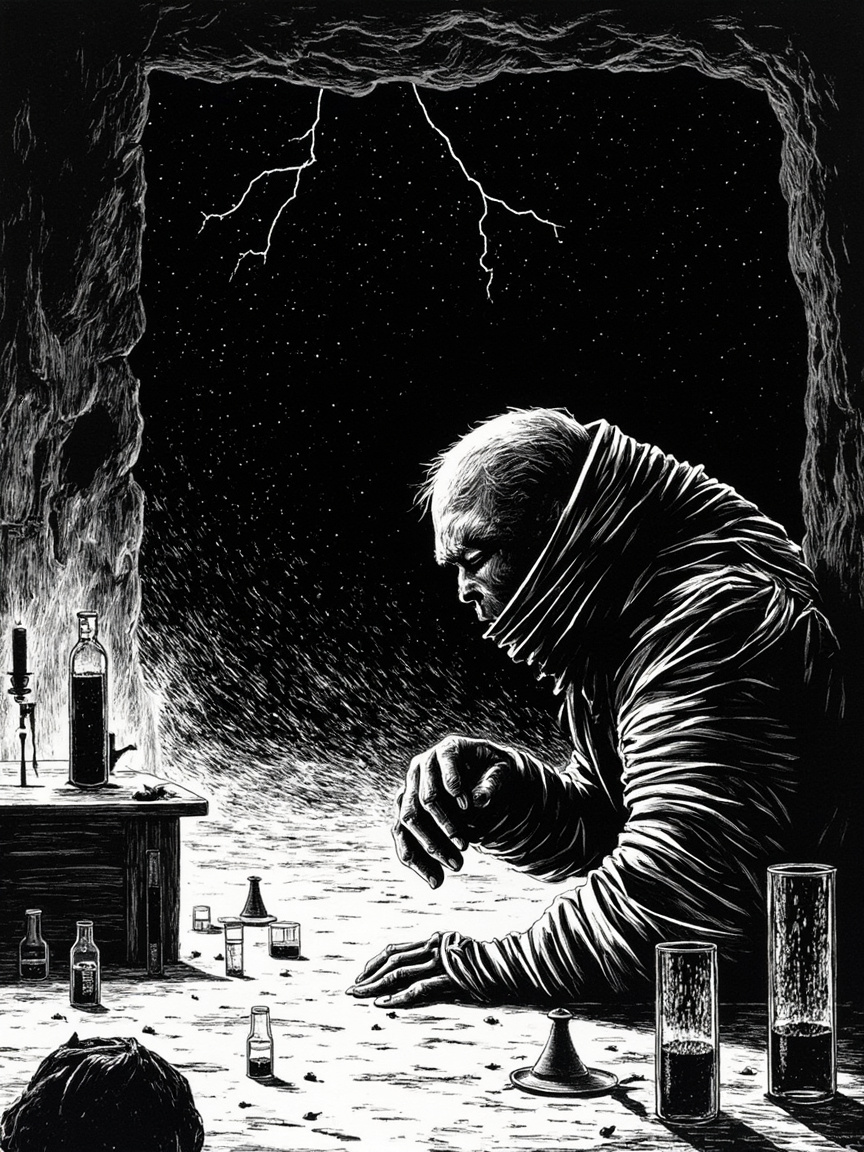
It was on a dreary night of November that I beheld the accomplishment of my toils.
就在十一月一个阴郁的夜晚,我亲眼看见自己两年的心血终于成真。
Original line · Chapter 5 · The night the creature is given life
4. Who is the real monster: behind the De Lacey family's window, the most heartbreaking pages in the book
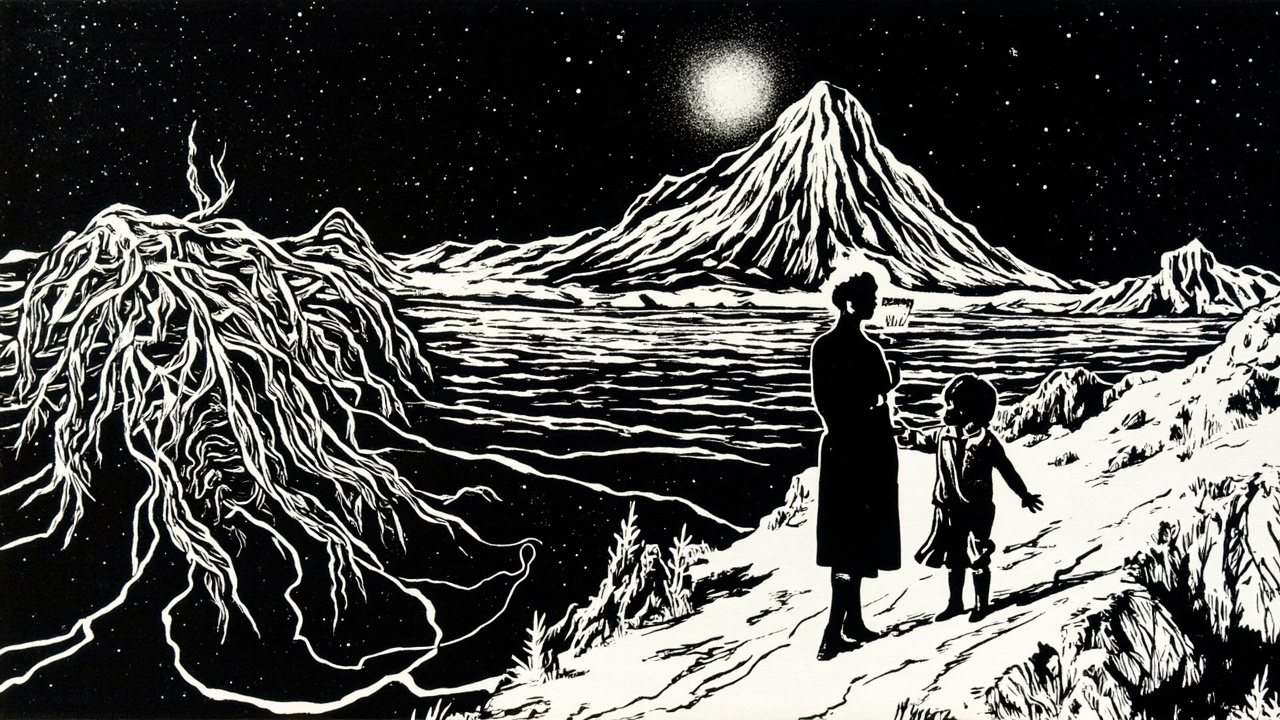
The creature later recalls his own first encounter with what it means to be human: cast out into the wilderness, he hides in the shed of a small cottage sheltering a group of exiles, an old man named De Lacey, his son and daughter, and an old Russian friend of the family. He harms no one; he simply watches through a crack in the wall as the household goes about its days. All winter he listens to them speak French, read aloud, and love one another, and by spring he has taught himself to read from three books they left behind: Paradise Lost, The Sorrows of Young Werther, and Plutarch's Lives. One day, with the old man alone and the young people out, he knocks and begs to be let in, only to be beaten and driven off the moment the rest of the family sees his face. This is where the novel's moral center quietly turns: the violence that actually turns the stomach is not the creature's, but the reaction of ordinary people to an ugly stranger who only wanted to be held.
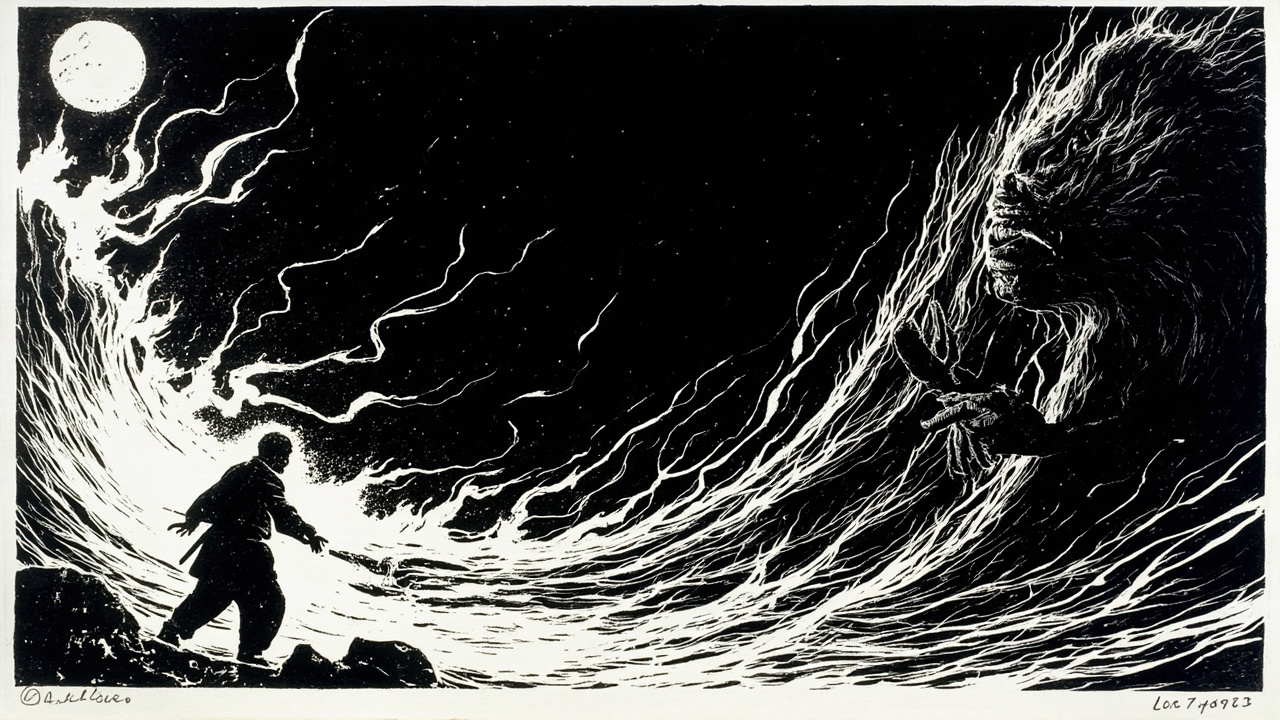
When the creature corners Victor on the Mont Blanc glacier, he delivers the most central confession in the whole book: that he too once longed for happiness, that watching the De Laceys taught him love and admiration, and that he was kicked straight back into despair for it, and that if he cannot be permitted to be human, he will be a devil instead. This is the passage that tips the novel's moral weight unmistakably onto the creature's side.
5. First blood: William, Justine, and the confrontation on the glacier
Unable to hold back his hatred any longer, the creature strangles Victor's little brother William. He also takes a small portrait from the boy's body, a likeness of someone dear to Victor, and hides it in his own clothes. Justine, the family's servant, who had always been gentle with the child, is accused of the murder and hanged for it; Victor, standing outside the courtroom as the verdict comes down, knows exactly who the real killer is and says nothing. He will not expose the secret of his creature, and his silence is paid for with someone else's life. Two months later, a trip into the mountains brings Victor and the creature face to face again, amid snow and ice, on the glacier at the Mer de Glace, and turns their second meeting into a piece of theater in which the two of them stare each other down with no possibility of reconciliation.
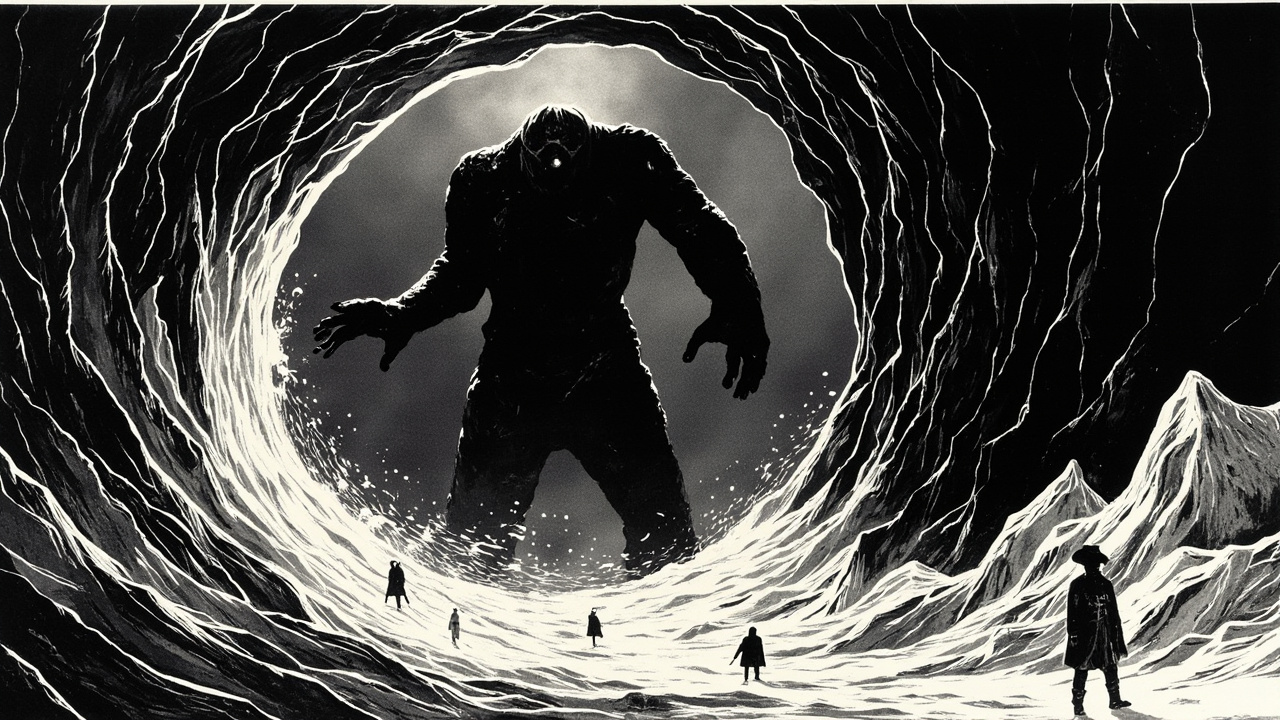
I ought to be thy Adam, but I am rather the fallen angel, whom thou drivest from joy for no misdeed.
我本该是你的亚当,你却把我当成堕落的天使——我并未作恶,你就把我逐出欢乐。
Original line · Chapter 10 · The Mont Blanc glacier, the creature confronts his creator
6. A bargain struck: the creator's great betrayal, and the wedding night that was always coming
On the glacier the creature names his price: make him a female companion, and the two of them will vanish into the wilds of South America and never trouble anyone again. Victor agrees, and sets to work in a cottage on a remote island in Scotland's Orkneys. Halfway through, with the thing on the table still sexless, still without feeling, a misshapen half-finished female, he is struck by a sudden thought: giving the male creature what he wants would only mean bringing a second outcast species into the world. He tears the female apart with his own hands. The creature, watching from outside, sees it happen and leaves him with a single threat: he will be there on Victor's wedding night. He keeps that promise in full. First Clerval, Victor's closest friend, is murdered and left on the English coast, and Victor is nearly hanged for the crime himself. Then, on Victor's own wedding night, Elizabeth is strangled by the creature's hands. Victor's father, having lost his youngest son and now his adored daughter-in-law, dies of grief soon after. Two generations, gone within a few months.
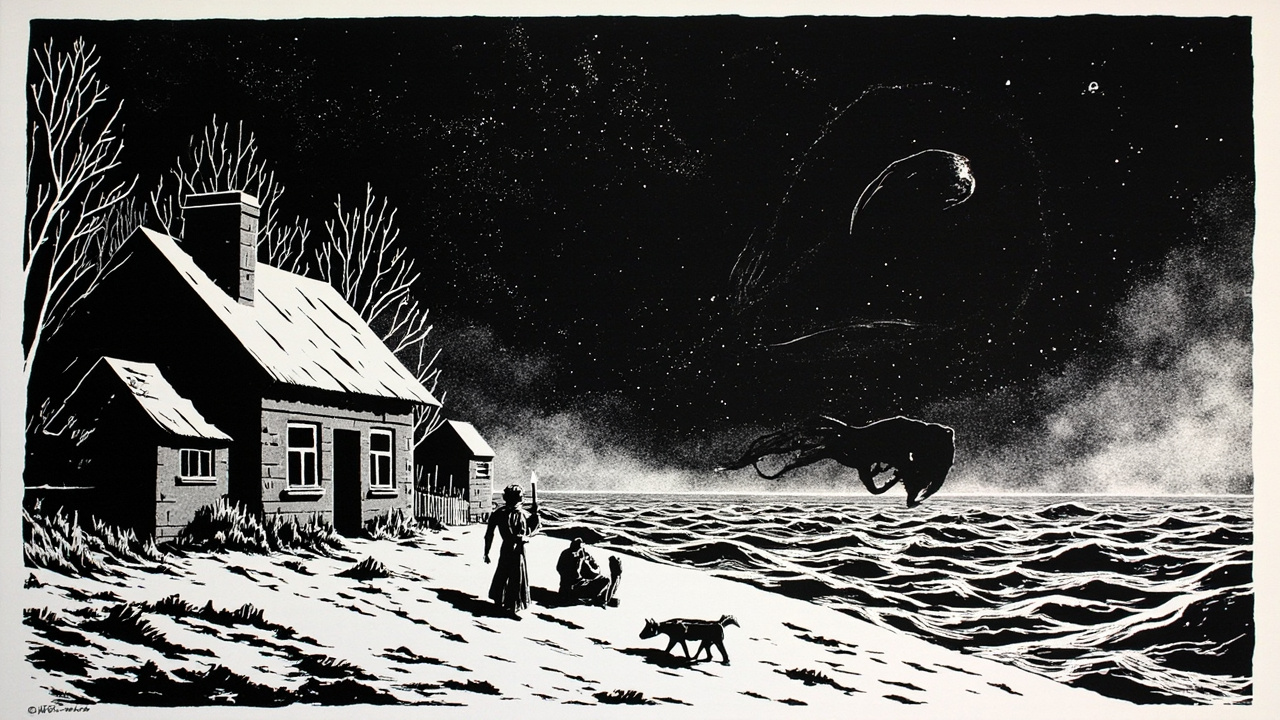
I will be with you on your wedding-night.
你新婚之夜,我必与你同在。
Original line · After Victor destroys the half-made female creature, the creature's curse
7. The end: on the Arctic ice, aboard Walton's ship, the creature delivers his eulogy
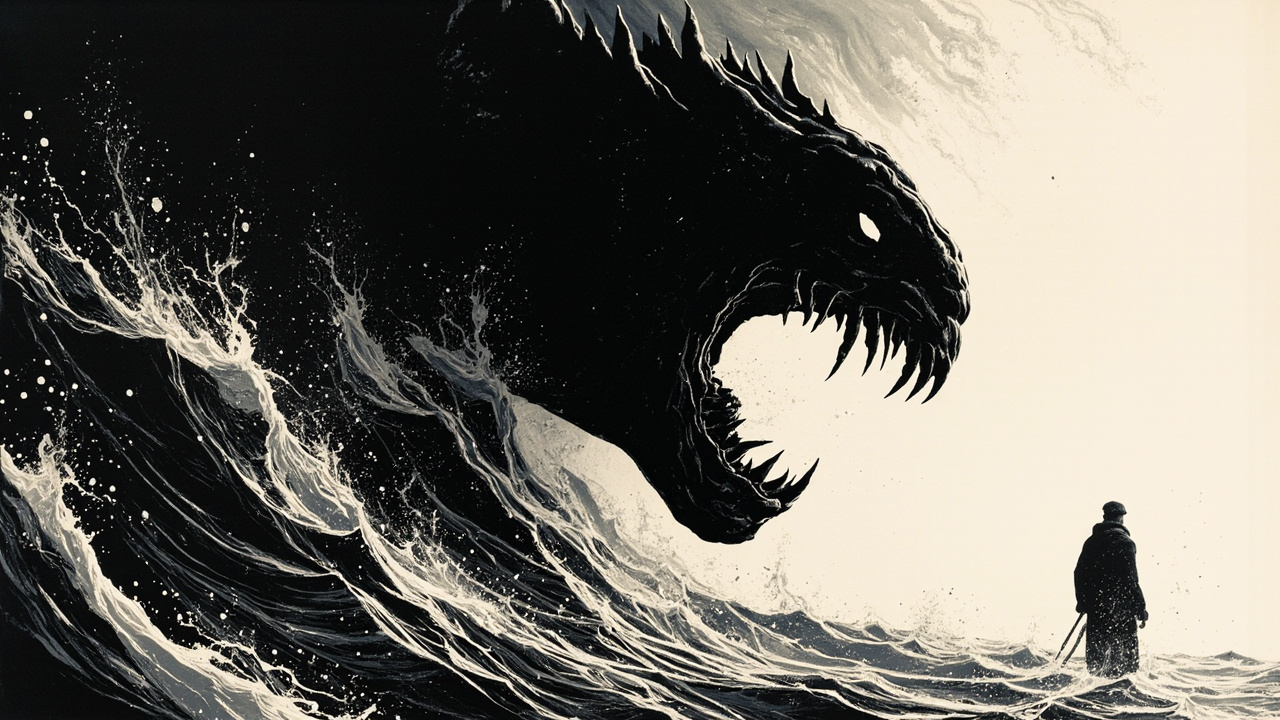
Victor has lost everything now: home, intimacy, reputation. He swears to hunt the creature to the end of the earth. He sets out from Geneva, follows the Rhine, crosses snowfields, pushes through the cold of northern Europe, and finally boards a whaling ship heading north, which happens to cross paths with Walton's. Aboard ship he fails fast, fever, coughing blood, and finally pours out what is left of his story to Walton. The book's last pages run like this: Victor dies; the creature is found bent over his body, mourning, swearing he will kill no more, asking only to burn himself on his own funeral pyre and have his ashes scattered on the sea, so the world need never again be frightened by his face. Then he steps out onto the ice, into the dark, and is gone.
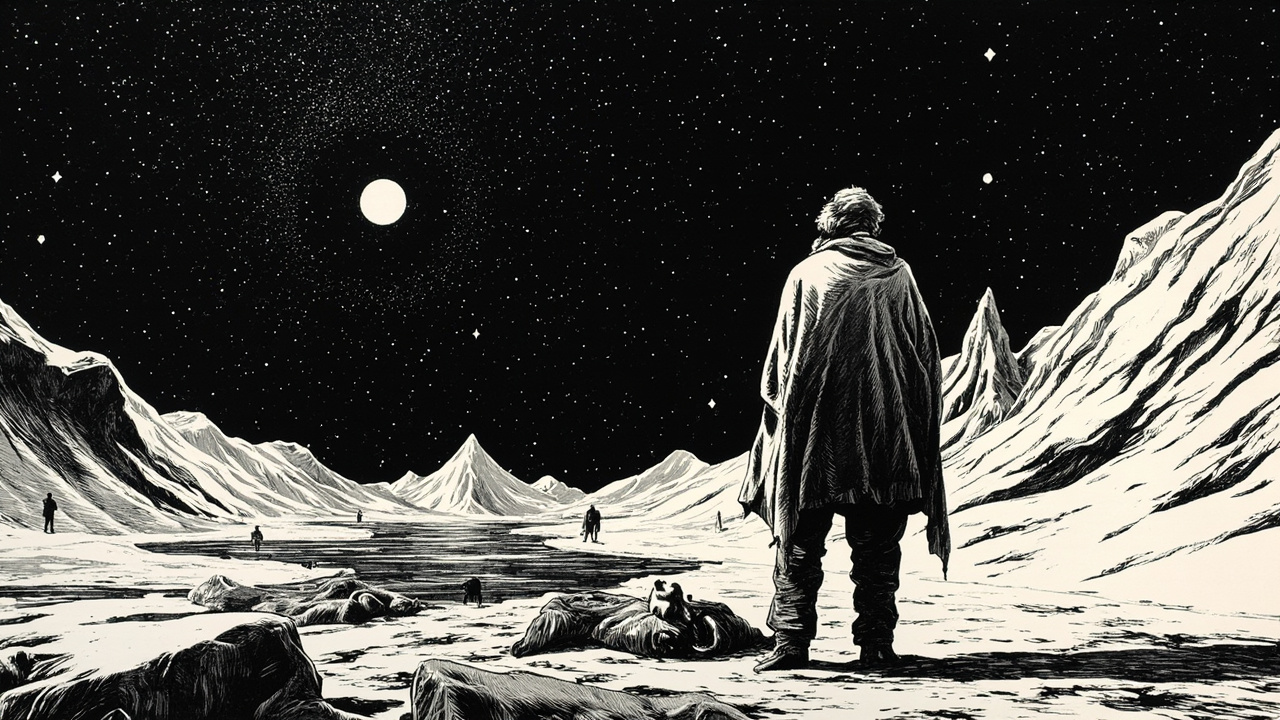
He was soon borne away by the waves and lost in darkness and distance.
转瞬间,他便被波涛卷走,消失在黑暗与远方。
Original line · The novel's final line · The creature vanishes into the ice
What it is really saying: technology and the creature with no name
This is why the book has been read and reread for two hundred years: its central question has never expired. Mary Shelley told a story that countless other genres would go on retelling: once science has managed to make a thing happen, who answers for what it has made happen? What the creature says to Walton at the very end is a summary of exactly that question: he refuses to make another of himself, refuses to let anyone else walk the same road. It is the plea of a solitary being, and it is also a memo the author left for every creator still to come.
There is a second theme running through the creature's side of the story: otherness, the violence of prejudice, and what happens when someone who only wants to belong is refused that belonging. The creature is not born evil, he is made that way by the world around him; and Victor is no world-ending fiend either, just a young man who thought he had the hand of God, whose act of abandonment turns out to do more damage than anything he actually built. Mary Shelley gives each of her two creators one protest to make: one asks, what right do you have to despise me for how I look? The other asks, what right do you have to leave me to carry this alone? Two centuries on, both protests still cut.
Why this book is remembered
First, it is the acknowledged founding work of science fiction, written by a girl who had not yet even had her wedding. Second, it takes what looks like a simple story and knots it into three frames of narration: Victor tells his version, the creature tells its version, Walton tells his own, and the three of them keep undercutting one another, leaving the reader to assemble what actually happened out of three overlapping biases. Third, Mary Shelley is a novelist who knows the power of leaving things unsaid: she says almost nothing about the science, and almost nothing about the details of the night the creature comes to life, so that those unspeakable few seconds become the deepest place in the whole book.
This is not a story where the scientist dies and the monster wins. It is an accident caused by a parent shirking responsibility for his child, and by the end, that creature is the one gathering wood for his own funeral pyre.
Why you should still go back to the original after reading this guide
Because a guide can tell you who killed whom, but it cannot give you the faint light on the glacier, the twitching fingers in the cabin, the seriousness with which the creature holds Paradise Lost open while teaching himself to speak. The four hundred pages of the actual novel hold the standoffs on the ice, the warmth of friendship, the terror of that one night after life has been made, and none of it breathes anywhere except inside the original sentences. Mary Shelley's whole view of the world can only be reached through the original text. Make yourself a cup of tea, give yourself a quiet evening, and read it start to finish; by the time you reach the glacier confrontation in section five, you will understand why this story has never once gone stale in two hundred years.
Art Direction4 plates
Before the guide was written, this book got a visual foundation — every illustration you just read grew out of it.